FORHP Policy Updates August 9, 2017 FY18 Inpatient PPS Rule - - PowerPoint PPT Presentation

forhp policy updates august 9 2017
SMART_READER_LITE
LIVE PREVIEW

FORHP Policy Updates August 9, 2017 FY18 Inpatient PPS Rule - - PowerPoint PPT Presentation

FORHP Policy Updates August 9, 2017 FY18 Inpatient PPS Rule Finalized (Effective 10/1/17) Deemphasizes review of CAH 96-hour certification requirement Establishes approx. $7 billion disproportionate share hospital (DSH)


slide-1
SLIDE 1

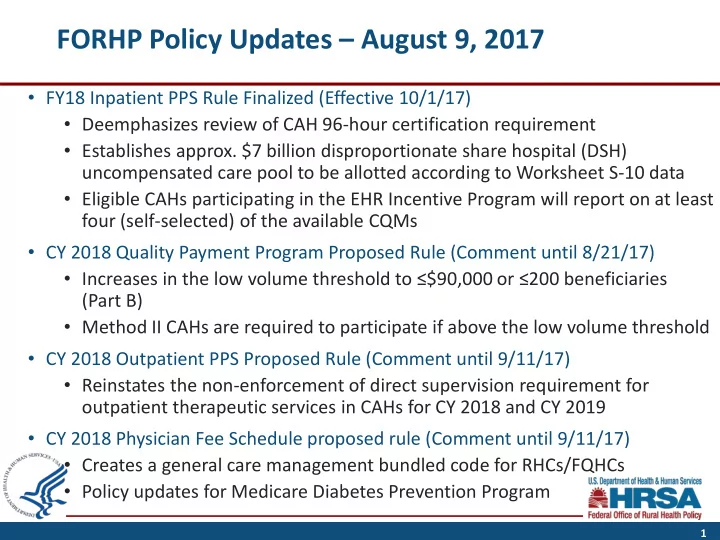
FORHP Policy Updates – August 9, 2017

  • FY18 Inpatient PPS Rule Finalized (Effective 10/1/17)
  • Deemphasizes review of CAH 96-hour certification requirement
  • Establishes approx. $7 billion disproportionate share hospital (DSH)

uncompensated care pool to be allotted according to Worksheet S-10 data

  • Eligible CAHs participating in the EHR Incentive Program will report on at least

four (self-selected) of the available CQMs

  • CY 2018 Quality Payment Program Proposed Rule (Comment until 8/21/17)
  • Increases in the low volume threshold to ≤$90,000 or ≤200 beneficiaries

(Part B)

  • Method II CAHs are required to participate if above the low volume threshold
  • CY 2018 Outpatient PPS Proposed Rule (Comment until 9/11/17)
  • Reinstates the non-enforcement of direct supervision requirement for
  • utpatient therapeutic services in CAHs for CY 2018 and CY 2019
  • CY 2018 Physician Fee Schedule proposed rule (Comment until 9/11/17)
  • Creates a general care management bundled code for RHCs/FQHCs
  • Policy updates for Medicare Diabetes Prevention Program

1

slide-2
SLIDE 2

RQITA Updates

TASC 90 Call August 9, 2017

slide-3
SLIDE 3

Stratis Health

  • Independent, nonprofit, Minnesota-based
  • rganization founded in 1971

– Lead collaboration and innovation in health care quality and safety, and serve as a trusted expert in facilitating improvement for people and communities

  • Work at intersection of research, policy,

and practice

1

slide-4
SLIDE 4

Rural Quality Improvement Technical Assistance Center (RQITA)

  • Three-year cooperative agreement awarded to Stratis

Health from Health Services and Resources Administration (HRSA) Federal Office of Rural Policy (FORHP), 2015 – 2018

  • Improve quality and health outcomes in rural

communities through technical assistance to beneficiaries of FORHP quality initiatives

– Flex/MBQIP – Small Health Care Provider Quality Improvement Grantees (SHCPQI)

2

slide-5
SLIDE 5

MBQIP Technical Assistance

  • Over 800 TA Requests logged (Since September 2015)

– Approximately 50 per month – Most common topics:

  • EDTC (342)
  • CMS Outpatient Measures (323)
  • CMS Inpatient Measures (196)

– Median days to resolution: 0 (zero), Mean 1.09

  • Flex Consultations: 21 (since September 2016)
  • MBQIP Orientation Calls: 11 (since September 2016)
  • 40 presentations (in-person, webinar/phone)

3

Request a Consultation, Presentation, or Orientation: Jodi Winters, jwinters@stratishealth.org

slide-6
SLIDE 6

MBQIP Tools and Resources

  • General: MBQIP Monthly, Measure Fact Sheets
  • Reporting: MBQIP Reporting Guide, Abstraction Training Videos,

EDTC Tools

  • Improvement: Using MBQIP Data Reports, CAH Improvement Guide

& Toolkit, HCAHPS Best Practices

  • Flex Focused:

– EDTC Comparison Template – Flex Program Guide: Developing MBQIP Peer Mentoring Programs – Flex Program Guide: Using MBQIP Excel Files – MBQIP Talking Points – Monthly Reporting Reminders

4

slide-7
SLIDE 7

Upcoming MBQIP Tools and Resources

  • Updates to MBQIP Reporting Guide, Additions to

CAH QI Improvement Guide and Toolkit, and resources to support new MBQIP measures.

  • Patient and Family Engagement Resource
  • Technical Expert Panel Review – EDTC Measure

(with U of MN Rural Research Center)

  • Inter-rater reliability pilot project
  • Share findings/information from eCQM Pilot

5

slide-8
SLIDE 8

MBQIP Support Assessment

  • RQITA Flex/MBQIP Assessment

distributed in August.

  • Please share with us your thoughts on:

– What is useful (or not)? – What is needed? – What could be done differently/better?

  • One assessment per state

6

slide-9
SLIDE 9

7

Rural Health Value Updates

slide-10
SLIDE 10

8

Rural Health Value

8

Vision: To build a knowledge base through research, practice, and collaboration that helps create high performance rural health systems

  • 3-year HRSA FORHP Cooperative agreement
  • Partners
  • RUPRI Center for Rural Health Policy Analysis and Stratis

Health

  • Support from Stroudwater Associates, WIPFLI, and Premier
  • Activities
  • Resource development and compilation, technical

assistance, research

slide-11
SLIDE 11

9

www.RuralHealthValue.org

9

slide-12
SLIDE 12

10

www.RuralHealthValue.org

  • Updated! Catalog of Value-Based Initiatives for Rural Providers
  • Critical Access Hospital Financial Pro Forma
  • Critical Access Hospital Financial Pro Forma for Shared Savings
  • Demonstrating Critical Access Hospital Value: A Guide to

Potential Partnerships

  • Engaging Your Board and Community in Value-Based Care

Conversations

  • New! Guide to Selecting Population Health Management

Technologies for Rural Care Delivery

  • Physician Engagement - A Primer for Healthcare Leaders
  • Rural Innovation Profiles
  • Understanding the Social Determinants of Health: A Self-

Guided Learning Module for Rural Health Care Teams

  • Value-Based Care Assessment Tool

10

slide-13
SLIDE 13

Questions?

Laura Grangaard Johnson, Research Analyst

952-853-8544 or 877-787-2847 lgrangaard@stratishealth.org www.stratishealth.org

11

slide-14
SLIDE 14

Updates from the Flex Monitoring Team

Kristin L Reiter, PhD Flex Monitoring Team University of North Carolina – Chapel Hill August 9, 2017 | TASC 90 Webinar

slide-15
SLIDE 15

University of Southern Maine

Evaluating State Flex Program Impact and Performance: Innovative Projects and PIMS Data This project has two components: the continuation of our evaluation of innovative projects by State Flex Programs, and the continuation of

  • ur Flex Program evaluation using PIMS data. This project will result

in semi-annual monitoring analysis reports, a final report, and a policy brief summarizing our findings.

slide-16
SLIDE 16

University of Southern Maine

Evaluation of State Flex Programs' Projects Targeting EMS Implementation of Standards and Best Practices Related to Time Critical Diagnoses The purpose of this project is to analyze the efforts of state Flex program initiatives to support the development of time-critical diagnoses (TCD) systems of care and provide models that can be used by other state Flex programs to support TCD systems of care in CAH communities. The project will result in a policy brief summarizing the results of the study.

slide-17
SLIDE 17

University of Southern Maine

Population Health Evaluation: The Role of CAHs in Providing Core Health Care Services in Rural Communities: The purpose of this project is to analyze the efforts of CAHs to develop systems of care that support the provision of these core health care services and identify opportunities for CAHs to develop core health care services in their own communities. It will explore

  • pportunities for FORHP and state Flex grantees to support CAHs

in achieving the Flex Program goal of developing rural systems of care that meet the population health needs of their communities. The project will culminate in two policy briefs: the first will summarize the development of select core health care services by CAHs and rural systems of care, while the second will discuss the ways in which state Flex programs can support the development of these core health services and rural systems of care with CAHs as the hubs.

slide-18
SLIDE 18

University of Minnesota

Evidence-Based Stroke Quality Improvement Programs for CAHs The purposes of this project are to identify successful evidence- based programs to improve stroke care that could be replicated in CAHs and disseminate information about these programs to State Flex Programs. This project will result in a policy brief including information on successful stroke QI programs applicable to CAHs.

slide-19
SLIDE 19

Ongoing Projects

  • Analyzing Quality Reporting and Improvement of CAHs –

University of Minnesota

  • Analyzing Financial and Operational Performance of CAHs –

University of North Carolina at Chapel Hill

  • National CAH Database Management and Maintenance –

University of North Carolina at Chapel Hill

  • CAHMPAS Query System Maintenance and Development –

University of North Carolina at Chapel Hill

slide-20
SLIDE 20

Developing a Hospital “Dashboard”

By domain, visualize a hospital’s performance on all indicators at

  • ne time.

Performance displayed as “percentile” in which hospital’s indicator value falls relative to a comparison

  • group. Click on

the indicator name to view actual value compared to benchmark and median values.

slide-21
SLIDE 21

Developing a Systematic Way to Draw SFC Attention to Performance by Hospital and by Indicator (example)

HOSPITALS:

  • For a given state / year, list each hospital

in order of # of benchmarks met

  • Click on an individual hospital’s name to

see that hospital’s dashboard INDICATORS:

  • For a given state / year, list indicators that

have benchmarks in order of the percent of hospitals in the state meeting benchmark

  • Click on indicator name to be taken to bar graph

display of values for all hospitals in the state

slide-22
SLIDE 22

Questions / Comments:

monitoring@flexmonitoring.org

THANK YOU!

This work was supported by the Federal Office of Rural Health Policy (FORHP), Health Resources and Services Administration (HRSA), U.S. Department of Health and Human Services (HHS) under cooperative agreement # U27RH01080. The information, conclusions and opinions expressed in this presentation are those of the authors and no endorsement by FORHP , HRSA, or HHS is intended or should be inferred.

slide-23
SLIDE 23

Stratis Health is a nonprofit organization that leads collaboration and innovation in health care quality and safety, and serves as a trusted expert in facilitating improvement for people and communities.

This project is supported by the Health Resources and Services Administration (HRSA) of the U.S. Department of Health and Human Services (HHS) under grant number U1RRH29052, Rural Quality Improvement Technical Assistance Cooperative Agreement, $500,000 (0% financed with nongovernmental sources). This information or content and conclusions are those of the author and should not be construed as the official position or policy of, nor should any endorsements be inferred by HRSA, HHS, or the U.S. Government.

slide-24
SLIDE 24

Preparing for the New State Flex Program Year

August 9, 2017

Caleb Siem

Program Specialist, National Rural Health Resource Center

Mike McNeely

Deputy Director, Federal Office of Rural Health Policy

1

Tracy Morton

Senior Program Manager , National Rural Health Resource Center

Sarah Young

Flex Program Coordinator , Federal Office of Rural Health Policy

slide-25
SLIDE 25

The National Rural Health Resource Center (The Center) is a nonprofit organization dedicated to sustaining and improving health care in rural

  • communities. As the nation’s leading technical

assistance and knowledge center in rural health, The Center focuses on five core areas:

  • Transition to Value and Population Health
  • Collaboration and Partnership
  • Performance Improvement
  • Health Information Technology
  • Workforce

The Center’s Purpose

2

slide-26
SLIDE 26

End of School/Back to School

3

slide-27
SLIDE 27

Wrapping Up the Current Year

  • Use up the rest of your supplies
  • Identify outstanding projects
  • Submit your final reports and presentations
  • Tally your grades
  • Share your report card
  • Clean out your locker

4

slide-28
SLIDE 28

Use Up the Rest of Your Supplies

  • Identify any incomplete projects or unspent

funds

  • Identify any cost savings
  • Note any needed changes in scope
  • Appropriately allocate the remainder of your

budget

5

slide-29
SLIDE 29

Identify Outstanding Projects

  • Check your work plan and subcontracts
  • Will you meet your project

goals and deliverables?

  • Evaluate if something needs to change or a

course correction is needed

  • If not, start a discussion with your Federal

Office of Rural Health Policy (FORHP) Project Officer (PO) so they are aware

6

slide-30
SLIDE 30

Submit Your Final Reports and Presentations

  • Receive your final deliverables from

subcontractors and remit final payments for deliverables

  • Submit your quarterly reports to FORHP
  • Submit any year-end reports to your partners,

stakeholders or Advisory groups

7

slide-31
SLIDE 31

Tally Your Grades

  • Update your PIMS Data Collection Tool and

Flex Work Plan Data Table to document

  • utputs and outcomes
  • Provide any feedback on the grant

measures to FORHP to aid in identify what is working and demonstrating impact

  • Prepare to submit the PIMS report in the fall
  • Determine if you are on track
  • Determine areas for improvement or need for

next year

8

slide-32
SLIDE 32

Share Your Report Card

  • Share your successes
  • Reports
  • Presentations
  • Acknowledgements from

partners and hospitals

  • Collect testimonials of your great

work and its impact

  • Share with your communities, hospitals,

partners, subcontractors, stakeholders, legislature, peers and FORHP

9

slide-33
SLIDE 33

Clean Out Your Locker

  • Save copies of important files in a place you

can easily access them next year

  • Close out any remaining contracts
  • Balance your budget and anticipate any

unobligated balance (UOB), then have a discussion with your FORHP PO

  • Be prepared to share your ideas and plan

for any UOB

10

slide-34
SLIDE 34

Preparing for the New Year

  • Find your advisor and the resource room
  • Fill your backpack
  • Find what grades need improvement
  • Review your syllabus
  • Pay for your resources
  • Know your due dates
  • Make friends
  • Monitor your grades

11

slide-35
SLIDE 35

Find Your Advisor

  • Build a relationship with your FORHP Project

Officer and Health Resources and Services Administration (HRSA) partners

  • Identify your FORHP PO and their contact

information on this map

  • Identify your HRSA Grants Management

Specialist (GMS) and their contact information at the end of your Notice of Award

12

slide-36
SLIDE 36

Find the Resource Room

  • Technical Assistance and Services Center

(TASC)

  • Flex Monitoring Team (FMT)
  • Rural Quality Improvement Technical

Assistance (RQITA)

  • Resources on the Medicare Beneficiary

Quality Improvement Project (MBQIP)

  • Technical assistance requests triaged by

TASC by emailing tasc@ruralcenter.org

13

slide-37
SLIDE 37

More Key Resources

  • Other Key Flex Partners
  • American Hospital Association (AHA)
  • National Rural Health Association (NRHA)
  • National Organization of State Offices of Rural Health

(NOSORH)

  • Rural Health Value (RHV)
  • Rural Health Information Hub (RHIhub)
  • Small Rural Hospital Transition (SRHT) Project
  • Small Rural Hospital Improvement Grant Program (SHIP)
  • FORHP Network Grantees Technical Assistance

Development grantees Allied health grantees Planning grantees Small health care provider quality improvement grantees

14

slide-38
SLIDE 38

Build Your Backpack

  • Stock up and bookmark key supplies
  • PIMS Data Collection Tool
  • Flex Work Plan Data Table
  • Critical Access Hospital Measurement &

Performance Assessment System (CAHMPAS)

  • Other state-level data
  • Flex Program Fundamentals
  • Core Competencies for State

Flex Program Excellence

  • Flex Logic Model

15

slide-39
SLIDE 39

Find What Grades Need to be Improved

  • Know where your program stands
  • Do you have grant conditions?
  • What is the guidance from your FORHP PO?
  • Take the Core Competencies for State Flex Program

Excellence: Self-Assessment at least annually

  • Know where your hospitals stand
  • MBQIP data reporting
  • CAHMPAS data
  • Engagement in state Flex Program activities
  • Hospitals can take the Population Health Readiness

Assessment and/or the Self-Assessment for Transition Planning to Value-based Systems

16

slide-40
SLIDE 40

Review Your Syllabus

  • Review your work plan – what are your
  • bjectives and activities
  • Develop tasks to meet the activities
  • Set up your tasks into a timeline (Gantt)
  • Use project management techniques to

manage the work

17

slide-41
SLIDE 41

Pay for Your Resources

  • Be ready to pay for the expertise
  • Have your subcontracts set and ready to be

administered as close to September 1 as possible

  • Maximize times and efficiency
  • Prevents incomplete work and unspent funds
  • Review the Grant Project Life Cycle Guide: A

Grant Subcontract Management Guide, webinar and Virtual Knowledge Group discussion

18

slide-42
SLIDE 42

Know Your Due Dates

  • Be aware of due dates for FORHP quarterly

reporting, deliverables from subcontractors, major work plan milestones

  • Set reminders for yourself
  • Break big pieces of work or long time frames

down into smaller amounts

19

slide-43
SLIDE 43

Monitor Your Grades

  • Don’t wait for mid-year or year end to know

your progress – use continuous evaluation

  • Update your PIMS Data Collection Tool and

Flex Program Work Plan Data Table throughout the year

  • Become familiar with CAHMPAS and other FMT

tools and resources

  • Become familiar with MBQIP data
  • Use the Plan-Do-Study-Act (PDSA) Cycle

20

slide-44
SLIDE 44

Make Friends

  • Network with your state Flex Program peers
  • Flex Program Forum
  • Flex Program Workshop
  • Flex Program Reverse Site Visit
  • Other national or regional conferences
  • Reach out to programs doing similar work or

in areas you’d like to explore

  • State Flex Profiles
  • Network with partners (existing or potential)

in your state with similar health care interests (rural or not)

21

slide-45
SLIDE 45

Get to know us better: http://www.ruralcenter.org

TASC

(218) 727-9390 tasc@ruralcenter.org

22