
SLIDE 1
Development of Timber Legality Standard in PNG
Cosmas Apelis, Senior Program Officer
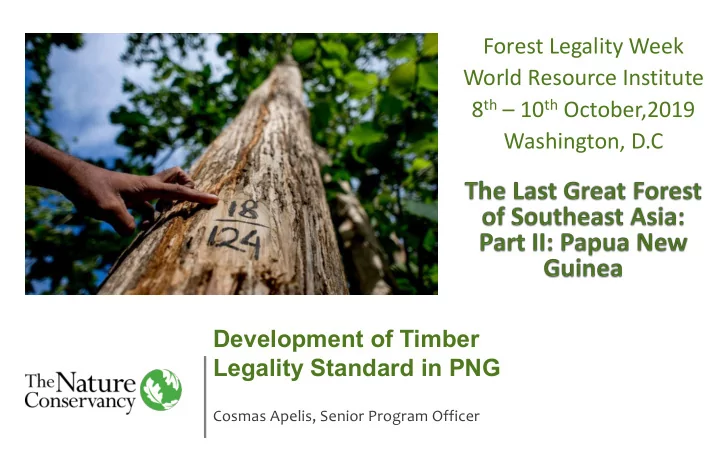
Forest Legality Week World Resource Institute 8 th 10 th - - PowerPoint PPT Presentation
Forest Legality Week World Resource Institute 8 th 10 th October,2019 Washington, D.C Development of Timber Legality Standard in PNG Cosmas Apelis, Senior Program Officer Our mission is to conserve the lands and waters on which all life
Cosmas Apelis, Senior Program Officer
U.S. state chapters active members
countries
acres of land protected
4,000/
employees/ scientists
preserves managed
Marine conservation projects
in 21 countries & all U.S. coastal states
river km protected
Year Action ITTO FAO/EU and TNC 2006 International workshop on EU-FLEG: workshop outcomes developed into a project proposal. 2007 Project approved by ITTO 2008-2009 Preparatory work on project implementation 2010- 2013 Project Implemented. A TLS developed with other outputs of the project (consisting of 2x documents-National and Local Standard- essentially Checklists) 2014 Testing of the PNG TLS- Stettin Bay Lumber Company (West New Britain Province) 2016 International stakeholder workshop on EU FLEGT and the PNG TLS presented 2017 April 2nd Testing Madang Timbers (Madang Province) 2017 June 3rd Testing Kamula Dosa (Western Province) 2017 Multi-stakeholder Technical Meeting Nov 2017 National Stakeholder workshop of the PNG TLS Mar 2018 Multi-stakeholder Technical Meeting May 2018 PNG NFB Submission for endorsement June 2018 Withdrawn from the NFB to due to issues raised by Civil Society Organizations (1st Dialogue) and to develop the supporting Timber Legality Verification System (TLVS). Nov 2018 2nd PNGFA-CSO Dialogue June 2019 3rd PNGFA-CSO Dialogue
Goal: PNG Forest Industry Participants are making an effective contribution towards legal and sustainable forest management Objective: PNG Forest Industry Participants are complying with all relevant social, environmental and economic laws & regulations. Principles: 1. Compliance with rights to harvest within forest areas that are legally acquired. 2. Compliance with requirements regarding forest management including compliance with relevant environmental, labour and community welfare laws. 3. Compliance with requirements concerning business operations, taxes, import & export duties, royalties and fees, directly relating to timber harvesting & trade. 4. Compliance concerning tenure rights or use rights to land & resources that may be affected by timber harvest rights, where such rights exist. 5. Compliance with requirements for processing, transport, trade and export procedures 6. Maintenance of the necessary registers. Criteria
Indicators
Criteria. Verifiers
with an Indicator.
Issue of SABLs and FCAs
Minimize issue of Transfer pricing
Issue of FPIC and SABLs
Govt agency coordination.
1. Pre-preparation: Application of the PNG TLS will require significant pre-preparation to determine what is required to be checked. 2. Log and product tracking: Log and product tracking is a foundation requirement of a PNG TLVS, and mechanisms are required for all FIPs and operations. Where multiple logs supplies into a supply chain exist, there is a need to identify logs of different origins. 3. Human resources: The operation of a PNG TLVS requires a range of parties and parties must display:
4. Outcomes: The complete mechanisms of a PNG TLVS through to an outcome or conclusion of a test of compliance are yet to be developed. 5. Monitoring and oversight: The robustness of the overall system will be underpinned by monitoring and
sourced off-the-shelf.