PNGs Forest Sector Land grabbing, illegal logging and biodiversity - - PowerPoint PPT Presentation

png s forest sector land grabbing illegal logging and
SMART_READER_LITE
LIVE PREVIEW

PNGs Forest Sector Land grabbing, illegal logging and biodiversity - - PowerPoint PPT Presentation

PNGs Forest Sector Land grabbing, illegal logging and biodiversity destruction WRI Forest Legality Week 30 October 2019 Reiner Tegtmeyer, Senior Forest Investigator About Global Witness International NGO founded in 1993 ~100


slide-1
SLIDE 1

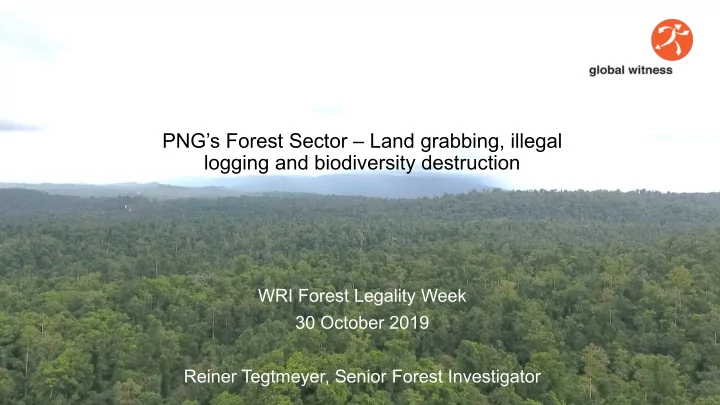
PNG’s Forest Sector – Land grabbing, illegal logging and biodiversity destruction

WRI Forest Legality Week 30 October 2019 Reiner Tegtmeyer, Senior Forest Investigator

slide-2
SLIDE 2
  • International NGO founded in 1993
  • ~100 staff; offices in London, DC, Brussels, and Beijing
  • Investigates and campaigns to prevent natural resource-

related conflicts and corruption, and associated environmental and human rights abuses

  • Work on forests and/or land rights issues carried out in

PNG, Solomon Islands, DRC, Liberia, Peru, Myanmar, Cambodia, Cameroon, Madagascar, Malaysia (Sarawak), Laos, Honduras, Nicaragua and others. New focus on role of agribusiness (cattle, palm oil, rubber, soy) and financial backers on destruction of climate-critical forests, in addition to logging industry

About Global Witness

FIND THE FACTS | EXPOSE THE STORY | CHANGE THE SYSTEM

slide-3
SLIDE 3
  • Investigating land grabs and environmental destruction
  • Working with local organisations and activists, and

cooperating with international organisations

  • Raising public and political awareness in producer and

consumer countries

  • Advocating for getting national and international laws in

place

  • Advocating for law enforcement
  • Calling for legality verification systems, independent

third-party verification, and buyers’ meaningful due diligence mechanisms

We strive to help protect forests and the rights of forest- dependent people by

slide-4
SLIDE 4
  • Majority of land and forests are legally controlled by rural

communities but massive land grabs through SABLs have resulted in loss for communities of over 5 million ha, more than 12% of land legally owned by them

  • Well-documented problems with illegalities in forestry sector

going back decades. Chatham House estimate: ~70% harvest

  • illegal. NEPCon illegality risk rating: 3/100 (very high risk)
  • No Freedom of Information Act equivalent; poor or non-existent

access to official forestry data (permits, evaluations, production) and environmental impact documentation

  • Forest Authority itself states it does not keep all necessary

records or perform required oversight

  • The forest sector should follow Extractive Industries sector:

Mining concession maps and corporate registry are freely available online; PNG is EITI member since 2014

Long-term illegalities in PNG’s forestry sector

slide-5
SLIDE 5
  • We investigated SABLs in ESP and WSP, ENB and NIP

(New Hanover) and traced a supply chain of SABL timber from forests to China and retail shelves in the U.S.

  • We assessed types of permits representing as a class 85%
  • f PNG’s log exports in 2017
  • We conducted document reviews (online/in person),

analysis of officially published export data and of satellite imageries, fieldwork in 4 provinces, interviews with

  • fficials, civil society representatives and landowners
  • In 2019 we researched the financing of six huge

agribusiness companies, one operating in PNG (“Money to Burn”, https://bit.ly/2my9t6O); discovering a total of $44 billion financing by over 300 investment firms, banks, and pension funds over last 6 years

Global Witness investigations in PNG (2014-2019)

slide-6
SLIDE 6
  • High- and medium-resolution satellite imagery analysis revealed

hundreds of apparent violations of the Forestry Act in 8 operations responsible for 32% of PNG’s 2017 log exports: logging in prohibited areas and within buffer zones, in protected areas and on high-relief slopes, repeated logging, etc.

  • Some operations violating the Forestry Act for decades
  • Other serious questions identified around the allocation and
  • versight of all types of logging and clearance permits
  • Warning to timber buyers, assessors: permits ≠ legality
  • Request for Forest Authority: Many apparent violations going unchallenged;

urgency in providing officials with funds and equipment to conduct rigorous control of operations; need for departmental cooperation, data transparency and compliance with allocation regulations

Global Witness investigations in PNG (2014-2019), ctd.

Landsat medium-resolution imagery (top) and WorldView 3 high-resolution imagery

slide-7
SLIDE 7
  • Multiple Timber Rights Purchases (TRP) recently

“extended” for PGK 250,000/permit despite no provision in Forestry Act allowing this – TRPs replaced in 1991 Forestry Act by Forest Management Agreements (FMA)

  • New agricultural clearance permits (FCA) being issued

in violation of due process and/or landowner rights – under the disguise of Voluntary Customary Land Registration Act (VCLR) scheme

  • Once issued, clearance permits are often abused to

log instead of establishing agricultural projects

  • Forest Authority does not maintain records or

perform checks on Timber Authority (TA) logging permits - no oversight of this class of operation (3%

  • f 2017 log exports)
  • Multiple examples of TA operations exporting more

than legally allowed in 2017 alone

Global Witness investigations in PNG (2017-2019), ctd.

slide-8
SLIDE 8

Global Witness investigations in PNG – Use of new technologies

Over the last years we increasingly used new technologies

  • Real-time ship tracking services, such as

MarineTraffic, in particular for vessels taking shipments from off-shore anchorages

  • Drones are allowing us to scan a wider area in the

field for illegal logging and obtaining high resolution aerial photos of those areas

  • Analyses of satellite imageries allows us to
  • remotely scan areas for illegal activities, such as

forest degradation (large-scale logging) and deforestation (forest conversion, e.g. into agricultural plantations)

  • detect violation of regulations protecting the

environment

  • Conducting interviews using iPhones for good

quality videos

slide-9
SLIDE 9

Global Witness investigations in PNG – Analysis of Satellite imageries

Figure 3. The upper image is an infra-red enhanced Landsat 7 image recorded 18 February 2000 in the Wawoi Guavi

  • concession. Recently cleared logging roads, and canopy gaps/skid trails denoting active harvesting appear in

pink/purple. Older logging roads appear yellow. Forests east of the river remain unlogged. The lower image shows an infra-red enhanced Landsat 8 image of the same area recorded 24 February 2017. Active harvesting can be seen in pink/purple, in areas that were already logged in 2000. The boundary of the repeat harvesting was mapped in

  • red. The interval between the first and second harvest for this area was 17 years (2017-2000).

Figure 4. Active harvesting inside a swamp in the Wawoi Guavi concession. Infra-red enhanced Landsat 8 image recorded 9 March

  • 2016. Swamp forest

appears in lighter lime green, rainforest appears in darker browner green, logging roads appear in

  • pink. Active harvesting

inside swamp forest appears in red/purple, the boundaries are marked in

  • range.

Figure 8. The extent of re-entry logging in less than 35 years detected between 2009 and January 2018. The number of years between the first and second harvest (the actual cutting cycle) is shown for each area of re- entry logging. Figure 11. Logging within 50 m of a Class 1 stream in Turama concession. Infra-red enhanced Landsat 8 image recorded 25/2/2017. Logging roads can be seen in pink/purple. Canopy gaps and cleared areas caused by active harvesting (tree-felling and skid tracks) appear in pink/purple surrounding the logging roads. Tree-felling can be seen right up to the stream

  • bank. The boundary of logging

within 50 m of the stream is marked in blue. Before and after arrival of logging companies, without consent of landowners

slide-10
SLIDE 10
  • Exposed land grabs and the role Chinese industry is

playing

  • Secured commitments from major companies in the US

and China

  • Increased engagement from Chinese government to

produce guidelines for timber importers, as a first step

  • Increased awareness of impacts of illicit tropical timber

in China and on international level

  • Stopping of (illegal) logging by a company in East Sepik

Province, reportedly partly as reaction to CSO activities supported by GW

What have we achieved so far?

slide-11
SLIDE 11
  • Improve transparency and access to information
  • Policy changes – FoI laws
  • Digitalisation of maps, permits, consultations and allocation processes, other official documents
  • Free and reliable online and in-person access to all relevant land and forest allocation and operations

documents

  • Protect law enforcement, anti-corruption teams, and forestry investigators from

political or personal reprisal

  • Prohibit forestry officials and law enforcement officers from receiving benefits

from logging companies

  • Hold government officials, companies and individuals accountable for violating the

law; penalties must be dissuasive

Recommendations for best practices and improving governance in the Forest Sector cooperation

slide-12
SLIDE 12
  • The PNG Government to immediately place a

moratorium on all new logging and forest clearance permits, and on all existing operations

  • The PNG Forest Authority to rigorously and regularly
  • versee operations of all forestry and land use
  • perations; permits found to have been issued illegally

to be cancelled

  • PNG’s new Timber Legality Standard to include clear

verifiers for the Free, Prior and Informed Consent of landowners for any logging or forest conversion taking place on their land – Final draft follows recommendation

Recommendations for best practices and improving governance in the Forest Sector cooperation, ctd.

slide-13
SLIDE 13

rtegtmeyer@globalwitness org lstanley@globalwitness.org www.globalwitness.org

Thank you for your attention