Forensic evaluation of nine miniSTR loci to aid analysis of - - PDF document

forensic evaluation of nine ministr loci to aid analysis
SMART_READER_LITE
LIVE PREVIEW

Forensic evaluation of nine miniSTR loci to aid analysis of - - PDF document

Forensic evaluation of nine miniSTR loci to aid analysis of degraded DNA in Koreans Ukhee Chung, Hwan Young Lee, Myung Jin Park, Sang-Ho Cho, Kyoung-Jin Shin and Woo Ick Yang Department of Forensic Medicine, Yonsei University College of


slide-1
SLIDE 1

1

Forensic evaluation of nine miniSTR loci to aid analysis of degraded DNA in Koreans

2006 대한법의학회

Ukhee Chung, Hwan Young Lee, Myung Jin Park, Sang-Ho Cho, Kyoung-Jin Shin and Woo Ick Yang

Department of Forensic Medicine, Yonsei University College of Medicine, Seoul, Korea Human Identification Research Center, Yonsei University, Seoul, Korea

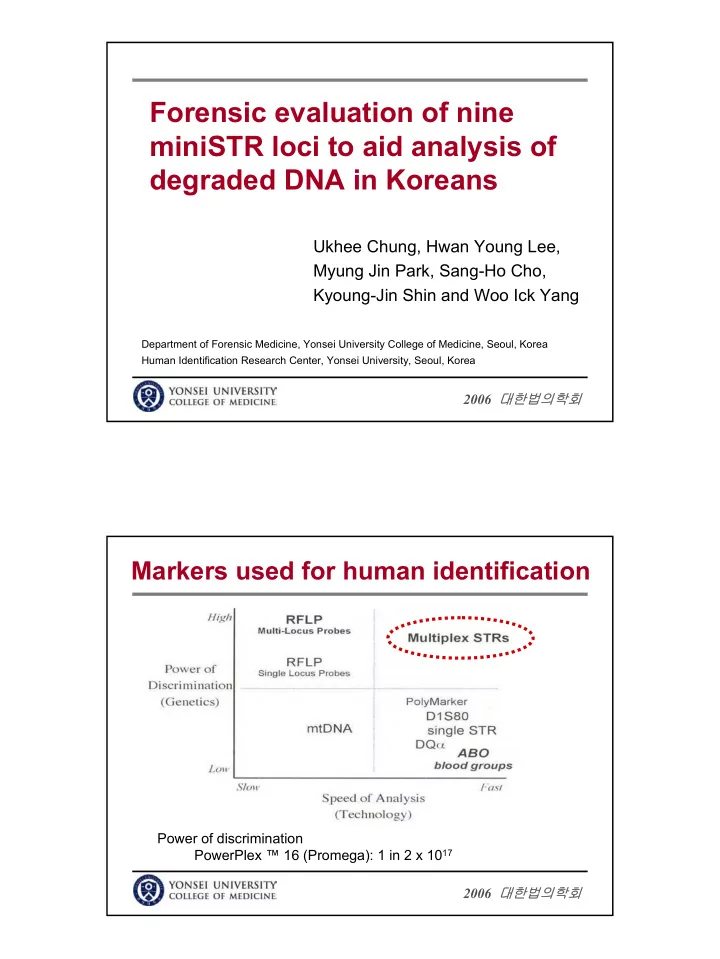
Markers used for human identification

Power of discrimination PowerPlex ™ 16 (Promega): 1 in 2 x 10¹⁷ 2006 대한법의학회

slide-2
SLIDE 2

2

PCR pattern of degraded DNA

Loss of Signal for Lager PCR Products

Data from a study done at NIST in May 2001

2006 대한법의학회

Size reduction of STR amplicon

Through Moving Primer Positions Closer to Repeat

Forward flanking region Reverse flanking region

Primer positions define PCR product size Repeat information is independent of amplicon size

Advantages of Approach: Size reduction enhances success rate with degraded DNA Retains same marker information (database compatibility) 2006 대한법의학회

slide-3
SLIDE 3

3

Needs for new miniSTRs

  • A few of CODIS loci cannot be made into

smaller amplicons.

  • Additional miniSTR markers can improve the

power of discrimination. New PCR primers were designed and tested for the NC01 (non-CODIS miniSTR 01) and NC02

2006 대한법의학회

STRs with reduced size amplicon

2006 대한법의학회

slide-4
SLIDE 4

4

Characterization of new miniSTRs

  • Evaluation of usefulness in degraded DNA

analysis

  • Population analysis for forensic application

2006 대한법의학회

Selection of new miniSTR loci

[GGAA]n 15 G09926 160,747,193 1q23.3 D1S1677 [TCTA]n 12 G08184 68,213,613 2p14 D2S441 [GAAT][GGAT][GAAT]n 9 G08326 93,975,767 4q22.3 D4S2364 NC03 [TAA]n 13 G08085 35,779,369 22q12.3 D22S1045 [GATA]m[GACA]n 13 G27275 93,298,432 14q32.3 D14S1434 [GGAA]n 13 G08820 130,566,908 10q26.3 D10S1248 NC02 NC01 [GATA]n 14 G08052 4,454,338 20p11.2 D20S482 [AGTA]m[GATA]n 16 G08540 112,985,899 6q16 D6S474 [GATA]n 9 G08294 173,233,666 3q26 D3S3053 Repeat Motif GenBank Allele GenBank Accession Chromosome bp Position Chromosome Location Locus

Primers of NC03 were designed by web-based Primer3

slide-5
SLIDE 5

5

PCR conditions

Total volume 10 µl 1.0 µl 10X Gold STR Buffer (Promega) 10X Primer Mix 1.0 U AmpliTaq Gold DNA Polymerase (Applied Biosystems) Template DNA 1 ng

Reaction mix Thermal cycling

72 °C for 1min Extension 60 °C for 45min Final extension 55 °C for 1min Annealing 94 °C for 1min Denaturation 95 °C for 11min Initial denaturation 30 cycles

Electrophoresis and Genotyping

  • The PCR products were separated by capillary

electrophoresis using an ABI PRISM 310 genetic analyzer (Applied Biosystems).

  • Allelic ladder was constructed by combining all
  • bserved alleles at each locus.
  • Genotyping at each locus was performed using

Genotyper 2.5 software (Applied Biosystems).

2006 대한법의학회

slide-6
SLIDE 6

6

Sensitivity test

29 cycles : 1000 pg, 500 pg 31 cycles : 300 pg, 100 pg 34 cycles : 50 pg, 30 pg 36 cycles : 10 pg, 5 pg

NC01: D10S1248, D14S1434, D22S1045 NC02: D4S2364, D2S441, D1S1677 NC03: D3S3053, D6S474, D20S482 BigMini: TH01, FGA, CSF1PO, D21S11, TPOX, D7S620

Template : Standard 9948 DNA (Promega) Primer sets

2006 대한법의학회

BigMini: TH01, FGA, CSF1PO, D21S11, TPOX, D7S620

Efficiency test

Artificially degraded DNA

Degradation of 3.0 µg blood DNA using 0.02 U DNase I (NEB) for several time periods: 0(control), 5, 10, 20, 30 and 40 min

DNA from old skeletal remains

DNA extracted from 30 old skeletal remains Total of 20 µl PCR reaction volume 35 thermal cycling

Primer sets

2006 대한법의학회 NC01, NC02, NC03 and BigMini

slide-7
SLIDE 7

7

DNA samples for population study

  • 300 unrelated Koreans
  • Mucosal epithelium of oral cavity
  • DNA was extracted using QIAamp DNA

Mini Kit (Qiagen)

2006 대한법의학회

Statistical analysis

PowerStat Excel Template

Allele Frequency Polymorphism Information Content (PIC) Power of Discrimination (PD)

Arlequin Statistical Analysis Package Version 2.000

Observed Heterozygosity Expected Heterozygosity Hardy-Weinberg Equilibrium (HWE) test

Mean Exclusion Chance (MEC)

2006 대한법의학회

slide-8
SLIDE 8

8

Primer sequences and concentrations

0.25 0.25 1 6

F- GGTTTTCCAAGAGATAGACCAAT R- GCCTCTCATAAATCCCTACTCATATCT

NED D6S474 1.30 1.30 22

  • 6

F- TGATAATGAACCCACTCAGATAGA R- GTGAGGTCTTTGCTCTCATGAAT

HEX D3S3053 0.23 0.23

  • 2

4

F- GAGACACCGAACCAATAAGAGA R- GCCACATGAATCAATTCCTATAATAAA

FAM D20S482 NC03 1.30 1.30

F- TTCTGTTGGTATAGAGCAGTGTTT R- GTGACAGGAAGGACGGAATG

NED D1S1677 1.00 1.00

F- CTGTGGCTCATCTATGAAAACTT R- GAAGTGGCTGTGGTGTTATGAT

HEX D2S441 1.30 1.30 2

  • 7

F- CTAGGAGATCATGTGGGTATGATT R- GCAGTGAATAAATGAACGAATGGA

FAM D4S2364 NC02 1.15 1.15 3 6

F- ATTTTCCCCGATGATAGTAGTCT R- GCGAATGTATGATTGGCAATATTTTT

NED D22S1045 1.30 1.30

  • 11

F- TGTAATAACTCTACGACTGTCTGTCTG R- GAATAGGAGGTGGATGGATGG

HEX D14S1434 1.20 1.20 1

F- TTAATGAATTGAACAAATGAGTGAG R- GCAACTCTGGTTGTATTGTCTTCAT

FAM D10S1248 NC01 Final Conc.(µM) From Repeat(bp) Primer Sequence (5' to 3') Label Dye Locus

Multiplex PCR of new miniSTRs

NC01 NC02 NC03

9948 Ladder 9948 Ladder 9948 Ladder
slide-9
SLIDE 9

9

Correct Partial Incorrect Failure

Sensitivity comparison between NCs and BigMini

NC01 NC02 NC03 BigMini

0% 20% 40% 60% 80% 100% 100pg 50pg 30pg 10pg 5pg 0% 20% 40% 60% 80% 100% 100pg 50pg 30pg 10pg 5pg 0% 20% 40% 60% 80% 100% 100pg 50pg 30pg 10pg 5pg 0% 20% 40% 60% 80% 100% 100pg 50pg 30pg 10pg 5pg

Locus-specific sensitivity comparison

0% 20% 40% 60% 80% 100% 100pg 50pg 30pg 10pg 5pg D6S474 0% 20% 40% 60% 80% 100% 100pg 50pg 30pg 10pg 5pg D14S1434 0% 20% 40% 60% 80% 100% 100pg 50pg 30pg 10pg 5pg D22S1045 0% 20% 40% 60% 80% 100% 100pg 50pg 30pg 10pg 5pg D10S1248 0% 20% 40% 60% 80% 100% 100pg 50pg 30pg 10pg 5pg D2S441 0% 20% 40% 60% 80% 100% 100pg 50pg 30pg 10pg 5pg D1S1677 0% 20% 40% 60% 80% 100% 100pg 50pg 30pg 10pg 5pg D20S482 0% 20% 40% 60% 80% 100% 100pg 50pg 30pg 10pg 5pg D3S3053

NC01 NC02 NC03 BigMini

0% 20% 40% 60% 80% 100% 100pg 50pg 30pg 10pg 5pg TH01 0% 20% 40% 60% 80% 100% 100pg 50pg 30pg 10pg 5pg CSF1PO 0% 20% 40% 60% 80% 100% 100pg 50pg 30pg 10pg 5pg TPOX 0% 20% 40% 60% 80% 100% 100pg 50pg 30pg 10pg 5pg FGA 0% 20% 40% 60% 80% 100% 100pg 50pg 30pg 10pg 5pg D21S11 0% 20% 40% 60% 80% 100% 100pg 50pg 30pg 10pg 5pg D7S820 0% 20% 40% 60% 80% 100% 100pg 50pg 30pg 10pg 5pg D4S2364

slide-10
SLIDE 10

10

Gel electrophoresis pattern of enzymatically degraded DNA

0.1 0.2 0.3 0.4 0.5 0.6 1.0 0.8 1.5 2.0 3.0 kb

Ladder Control 5 min 10 min 20 min 30 min 40 min

PCR amplifications of NCs and BigMini with artificially degraded DNA

NC01 NC02 NC03 BigMini

slide-11
SLIDE 11

11

PCR success rates of NCs and BigMini with DNA from 30 old skeletal remains

30 (100.0%) 0 (0.0%) 0 (0.0%) BigMini Set 2 FGA 30 (100.0%) 0 (0.0%) 0 (0.0%) BigMini Set 2 D21S11 30 (100.0%) 0 (0.0%) 0 (0.0%) BigMini Set 2 D7S820 27 (90.0%) 0 (0.0%) 3 (10.0%) NC01 D22S1045 21 (70.0%) 0 (0.0%) 9 (30.0%) BigMini Set 1 CSF1PO 18 (60.0%) 0 (0.0%) 12 (40.0%) BigMini Set 1 TH01 15 (50.0%) 0 (0.0%) 15 (50.0%) NC03 D6S474 12 (40.0%) 1 (3.3%) 17 (56.7%) NC03 D20S482 13 (43.3%) 0 (0.0%) 17 (56.7%) NC01 D10S1248 10 (33.3%) 2 (6.7%) 18 (60.0%) NC02 D2S441 6 (20.0%) 6 (20.0%) 18 (60.0%) BigMini Set 1 TPOX 10 (33.3%) 0 (0.0%) 20 (66.7%) NC02 D1S1677 9 (30.0%) 0 (0.0%) 21 (70.0%) NC01 D14S1434 4 (13.3%) 2 (6.7%) 24 (80.0%) NC03 D3S3053 4 (13.3%) 0 (0.0%) 26 (86.7%) NC02 D4S2364 Failure Profile with drop in Consensus profile Multiplex Set Marker

Allele frequency distributions of

NC01, NC02 and NC03 STRs in Koreans

0.027 0.002 19 0.370 0.025 0.063 18 0.003 0.262 0.088 0.100 17 0.002 0.045 0.045 0.210 0.127 0.010 16 0.025 0.153 0.168 0.245 0.347 0.015 0.050 15 0.205 0.453 0.127 0.345 0.357 0.122 0.318 14 0.263 0.270 0.002 0.082 0.005 0.010 0.038 0.472 13 0.308 0.048 0.005 0.002 0.153 0.185 0.125 12 0.028 11.3 0.005 0.010 0.315 0.367 0.375 0.013 11 0.003 0.017 0.445 0.090 0.235 0.003 10 0.003 0.208 0.368

  • 0.008

9 0.185 0.030 0.008 0.002 8 0.003 7

D22S1045 D20S482 D14S1434 D10S1248 D6S474 D4S2364 D3S3053 D2S441 D1S1677

Allele

slide-12
SLIDE 12

12

Statistical parameters

0.526 0.456 0.525 0.545 0.486 0.383 0.444 0.535 0.402

MECf

0.720 0.650 0.710 0.720 0.680 0.590 0.640 0.720 0.600

PICe

0.901 0862 0.888 0.900 0.879 0.825 0.842 0.902 0.824

PDd

0.761 0.695 0.745 0.763 0.725 0.660 0.702 0.754 0.659

Exp-Hc

0.760 0.660 0.770 0.783 0.737 0.607 0.737 0.620 0.657

Obs-Hb

0.985 0.252 0.161 0.599 0.883 0.053 0.508 0.000 0.124

p-valuea

D22S1045 D20S482 D14S1434 D10S1248 D6S474 D4S2364 D3S3053 D2S441 D1S1677

a HWE p-values b observed heterozygosity c expected heterozygosity d power of discrimination e polymorphism information content f mean exclusion chance

PD and MEC of CODIS and new miniSTRs

NC02 D4S2364 0.383 TPOX 0.811 TPOX 0.386 NC02 D1S1677 0.824 NC02 D1S1677 0.402 NC02 D4S2364 0.825 TH01 0.415 TH01 0.837 NC03 D3S3054 0.444 NC03 D3S3054 0.842 D3S1358 0.452 NC03 D20S482 0.862 NC03 D20S482 0.456 CSF1PO 0.864 CSF1PO 0.477 D3S1358 0.865 NC03 D6S474 0.486 NC03 D6S474 0.879 NC01 D14S1434 0.525 NC01 D14S1434 0.888 NC01 D22S1045 0.526 NC01 D10S1248 0.900 NC02 D2S441 0.535 NC01 D22S1045 0.901 NC01 D10S1248 0.545 NC02 D2S441 0.902 D7S820 0.562 D7S820 0.915 D16S539 0.576 D5S818 0.920 D5S818 0.75 D16S539 0.921 VWA 0.758 VWA 0.924 D21S11 0.761 D21S11 0.929 D13S317 0.774 D13S317 0.932 D8S1179 0.816 D8S1179 0.954 D18S51 0.829 D18S51 0.959 FGA 0.846 FGA 0.996 Multiplex Set Locus Mean Exclusion Chance Multiplex Set Locus Power of Discrimination

slide-13
SLIDE 13

13

Conclusions

  • We constructed three new miniplex sets of NC01 (D10S1248,

D14S1434, D22S1045), NC02 (D1S1677, D2S441, D4S2364) and NC03 (D3S3053, D6S474, D20S482).

  • Most of 9 miniSTRs showed reliable genotyping results with

50 pg DNA and some had good sensitivity even with 30 pg DNA.

  • D4S2364, D3S3053, D14S1434 and D1S1677 produced

more useful STR profiles for degraded samples.

  • Population study demonstrated that D10S1248, D2S441,

D22S1045, D14S1434 and D6S474 are as highly informative as CODIS STRs.