Forensic Body Fluid Identification Using Epigenetic Markers Hwan - - PDF document

forensic body fluid identification using epigenetic
SMART_READER_LITE
LIVE PREVIEW

Forensic Body Fluid Identification Using Epigenetic Markers Hwan - - PDF document

Forensic Body Fluid Identification Using Epigenetic Markers Hwan Young Lee Department of Forensic Medicine Yonsei University College of Medicine Forensic Sciences o Application of science to solve a legal problem 1 The Hierarchy and DNA


slide-1
SLIDE 1

1

Forensic Body Fluid Identification Using Epigenetic Markers

Hwan Young Lee Department of Forensic Medicine Yonsei University College of Medicine

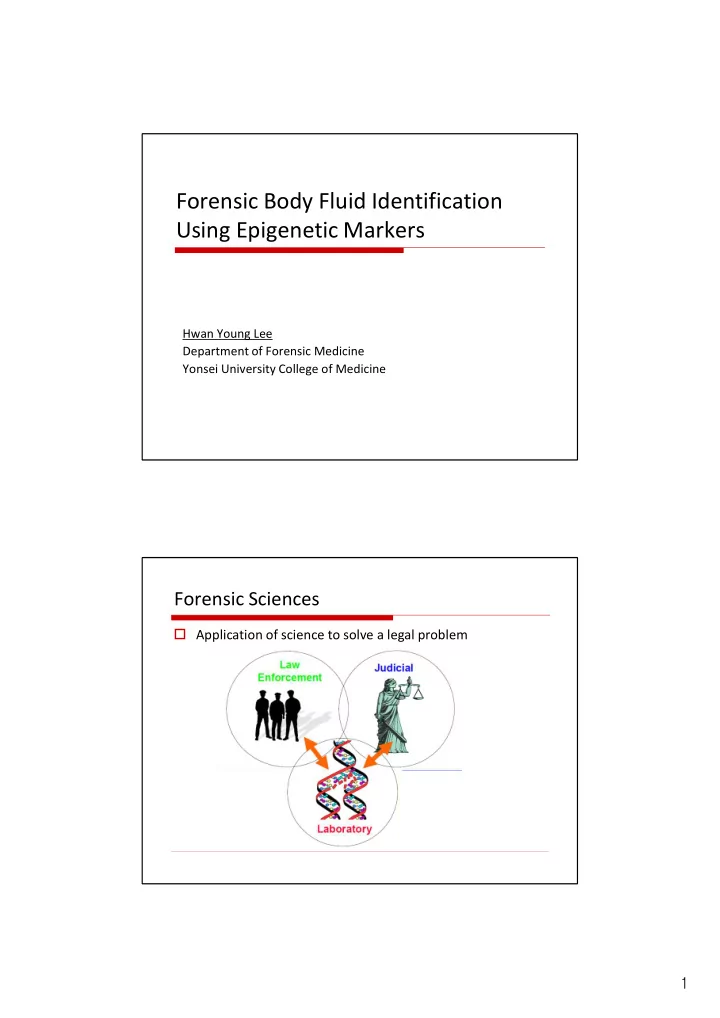
Forensic Sciences

  • Application of science to solve a legal problem
slide-2
SLIDE 2

2

  • Case issues are classified as belonging to one of four levels

§ Sub-source level “From whom has the DNA originated” § Source level “Could the blood present in the evidentiary stain have originated from the defendant?” § Activity level “What actions resulted in the observed blood stain patterns?” § Offence level “Is the defendant guilty of the crime?”

  • The activity that led to the deposition of the cellular

material is more and more assessed

The Hierarchy and DNA Evidence

  • Knowledge

regarding the cell types residing in an evidentiary trace can facilitate inference of activities

  • Chemical or catalytic tests
  • Assays for RNA, DNA methylation and microbial markers

Forensic Body Fluid Identification

slide-3
SLIDE 3

3

DNA Methylation across Tissues

Unsupervised clustering of average beta values in normal human tissues. Christensen et al. PLoS Genet (2009) Blood (Adult) Blood (Infant)

Methylation Profiling of Body Fluids

Sample Age Sample Age Sample Age Samples Age BL-01 24 SA-01 20 SE-01 20 VF-01 21 BL-02 27 SA-02 24 SE-02 27 VF-02 21 BL-03 28 SA-03 27 SE-03 28 VF-03 23 BL-04 33 SA-04 29 SE-04 31 MB-01 21 BL-05 37 SA-05 32 SE-05 37 MB-02 23 BL-06 38 SA-06 37 SE-06 38 MB-03 27 BL-07 41 SA-07 38 SE-07 41 BL-08 43 SA-08 43 SE-08 43 BL-09 48 SA-09 48 SE-09 48 BL-10 50 SA-10 50 SE-10 57 BL-11 57 SA-11 55 SE-11 59 BL-12 59 SA-12 59 SE-12 59

  • DNA methylation profiles were produced in 42 body fluid

samples including 12 blood, 12 saliva, 12 semen, 3 vaginal fluid and 3 menstrual blood using Human Methylaion450 BeadChip array (GSE59505)

Lee HY et al. Forensic Sci Int Genet (2015)

slide-4
SLIDE 4

4

Human Methylation450 BeadChip

Infinium I (Allele-specific) Infinium II (SBE: Single Base Extension)

aBL, SA, SE, MB and VF represent blood, saliva, semen, menstrual blood and vaginal fluid, respectively bAbs (delta_mean) represents the discrepancy in the mean values of average β-scores between a certain type of body fluid

and the other type of body fluids

Significant Probes from 450K Array

Comparisona Cut-offb

  • No. of CpGs

1 SE vs. BL Abs (delta_mean) ≥ 0.3, fdr. P < 0.05 64,079 SE vs. SA Abs (delta_mean) ≥ 0.3, fdr. P < 0.05 64,305 SE vs. VF Abs (delta_mean) ≥ 0.3, fdr. P < 0.05 54,062 SE vs. MB Abs (delta_mean) ≥ 0.3, fdr. P < 0.05 45,310 BL vs. SA Abs (delta_mean) ≥ 0.3, raw P < 0.05 9,100 BL vs. VF Abs (delta_mean) ≥ 0.3, raw P < 0.05 442 BL vs. MB Abs (delta_mean) ≥ 0.3, raw P < 0.05 556 SA vs. VF Abs (delta_mean) ≥ 0.3, raw P < 0.05 620 SA vs. MB Abs (delta_mean) ≥ 0.3, raw P < 0.05 371 VF vs. MB Abs (delta_mean) ≥ 0.2, raw P < 0.05 2 SE vs. (BL, SA, VF, MB) Abs (delta_mean) ≥ 0.5, fdr. P < 0.05 20,542 BL vs. (SA, VF, MB) Abs (delta_mean) ≥ 0.3, raw P < 0.05 4,252 SA vs. (BL, VF, MB) Abs (delta_mean) ≥ 0.3, raw P < 0.05 2,771 (VF, MB) vs. (BL, SA) Abs (delta_mean) ≥ 0.2, raw P < 0.05 604
slide-5
SLIDE 5

5

Body Fluid-Specific CpG Candidates

  • Body fluid-specific hyper
  • r hypo-methylation with

a low standard deviation in the same type of body fluid

  • Complete methylation or

unmethylation in

  • ther

types of body fluids

Selection of Body Fluid-Specific CpGs

SE1 SE2 SE3 BL1 BL2 VF1 VF2 SA1

slide-6
SLIDE 6

6

Semen Blood

Validation of Body Fluid-Specific CpGs

  • Body fluid-specificity was further investigated using direct

sequencing and a SBE reaction of bisulfite-converted DNA

Validation of Body Fluid-Specific CpGs

  • Body fluid-specificity was further investigated using direct

sequencing and a SBE reaction of bisulfite-converted DNA

Saliva

Y Y Y Y Y Y

Vaginal fluid

Y Y Y Y Y Y

slide-7
SLIDE 7

7

Multiplex SBE for Body Fluid Identification Multiplex SBE for Body Fluid Identification

  • A total of 151 samples were analyzed with the multiplex SBE
slide-8
SLIDE 8

8

Body Fluid Specificity of Selected CpGs

SE1 SE2 SE3 BL1 BL2 VF1 VF2 SA1

Menstrual Blood and Semen Profiles

Menstrual blood (n = 7) Menstrual blood (n = 9) Semen (n = 20) Semen (n = 20) Semen vasectomy (n = 9)

slide-9
SLIDE 9

9

  • Successful methylation profiling results could be obtained

with approximately 0.5 ng of bisulfite converted DNA

Sensitivity of the Developed Multiplex Aged Sample Test

  • Samples exposed to the environment for 75 days produced

successful DNA methylation profiling results and correct identification results

slide-10
SLIDE 10

10

Artificial Casework Sample Test

A post-coital vaginal swab A post-coital vaginal sample

  • btained with clean tissue paper

A post-coital penile sample

  • btained with clean tissue paper

A skin swab from a kissing site

Lee HY et al. Forensic Sci Int Genet (2015)

A swab from clean skin surface

  • Successful methylation profiling results could be obtained

with mixed body fluid samples

Modification of Multiplex SBE

  • The multiplex SBE was modified by replacing SE3 and BL2

with BL3 (cg08792630), and was registered as a standard

  • perating procedure of NFS

Semen Blood Vaginal fluid Menstrual blood Saliva

slide-11
SLIDE 11

11

Summary

  • Multiplex

methylation SNaPshot reactions were constructed to differentiate between blood, saliva, semen and vaginal fluid

  • The

multiplex could produce successful methylation profiles in aged or mixed samples

  • It appears favorable to have multiple markers per body

fluid type

  • DNA methylation-based tools have the potential to not only

body fluid identification but also gender and age estimation, discrimination of monozygotic twins, etc.

Acknowledgement

§ Ja Hyun An § Sang-Eun Jung § Eun Young Lee § Ajin Choi § Yu Na Oh § Woo Ick Yang § Kyoung-Jin Shin § Basic Science Research Program § National Forensic Service

slide-12
SLIDE 12

12

Thank you for your attention!

http://forensic.yonsei.ac.kr hylee192@yuhs.ac