Foreign Assets Control Facilitation: g Preparing for Heightened - - PowerPoint PPT Presentation

foreign assets control facilitation g preparing for
SMART_READER_LITE
LIVE PREVIEW

Foreign Assets Control Facilitation: g Preparing for Heightened - - PowerPoint PPT Presentation

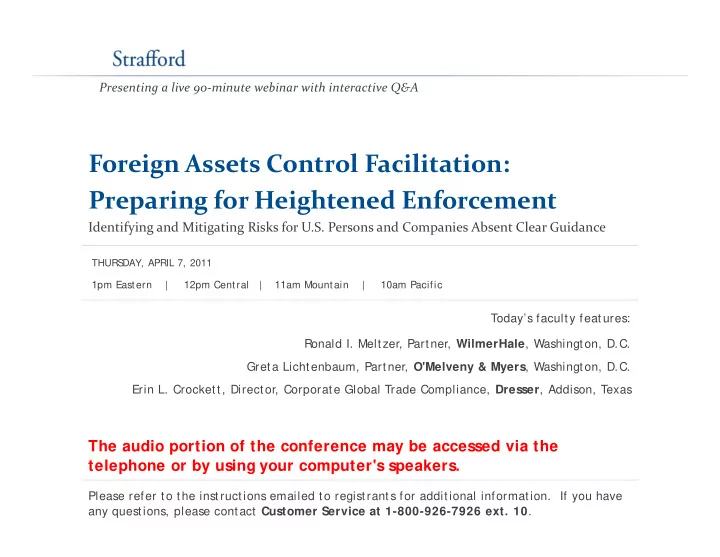
Presenting a live 90 minute webinar with interactive Q&A Foreign Assets Control Facilitation: g Preparing for Heightened Enforcement Identifying and Mitigating Risks for U.S. Persons and Companies Absent Clear Guidance THURS DAY, APRIL 7,


slide-1
SLIDE 1

Presenting a live 90‐minute webinar with interactive Q&A

Foreign Assets Control Facilitation: g Preparing for Heightened Enforcement

Identifying and Mitigating Risks for U.S. Persons and Companies Absent Clear Guidance

T d ’ f l f

1pm Eastern | 12pm Central | 11am Mountain | 10am Pacific THURS DAY, APRIL 7, 2011

Today’s faculty features: Ronald I. Meltzer, Partner, WilmerHale, Washington, D.C. Greta Lichtenbaum, Partner, O'Melveny & Myers, Washington, D.C.

The audio portion of the conference may be accessed via the

Erin L. Crockett, Director, Corporate Global Trade Compliance, Dresser, Addison, Texas

p y telephone or by using your computer's speakers.

Please refer to the instructions emailed to regist rants for additional information. If you have any questions, please contact Customer Service at 1-800-926-7926 ext. 10.

slide-2
SLIDE 2

Continuing Education Credits

FOR LIVE EVENT ONLY

For CLE purposes, please let us know how many people are listening at your location by completing each of the following steps:

  • In the chat box, type (1) your name, (2) your company name and (3) the

number of attendees at your location number of attendees at your location

  • Click the arrow to send
slide-3
SLIDE 3

Tips for Optimal Quality

S d Q lit S

  • und Quality

If you are listening via your computer speakers, please note that the quality of your sound will vary depending on the speed and quality of your internet connection. If the sound quality is not satisfactory and you are listening via your computer speakers, you may listen via the phone: dial 1-866-443-5798 and enter your PIN when prompted Otherwise please send us a chat or e mail when prompted. Otherwise, please send us a chat or e-mail sound@ straffordpub.com immediately so we can address the problem. If you dialed in and have any difficulties during the call, press *0 for assistance.

Viewing Qualit y

To maximize your screen, press the F11 key on your keyboard. To exit full screen, press the F11 key again press the F11 key again.

slide-4
SLIDE 4

Prohibited Facilitation Under OFAC Regulations OFAC Regulations

Ronald I. Meltzer Wil C tl Pi k i H l d D LLP Wilmer Cutler Pickering Hale and Dorr, LLP April 7, 2011

slide-5
SLIDE 5

OVERVIEW

1. What is facilitation? 2. Exceptions 3. Recent enforcement cases

WilmerHale

5

slide-6
SLIDE 6

Part One: What is facilitation? Part One: What is facilitation?

 Circumvention of OFAC requirements by

routing or supporting otherwise prohibited routing or supporting otherwise prohibited transactions through foreign persons

 Aiding or permitting non-US persons to  Aiding or permitting non US persons to

perform activity that would be prohibited if undertaken by US persons

 Explicit and imputed prohibition across all

OFAC sanctions programs

 Broad and elastic: even minor or indirect

actions that support or approve another person’s transaction with OFAC targets can constitute

WilmerHale

transaction with OFAC targets can constitute prohibited facilitation

6

slide-7
SLIDE 7

Definitions of facilitation: Iran, Sudan and Burma regulations g

 Iran: approving, financing, facilitating, or

guaranteeing any transaction by a foreign guaranteeing any transaction by a foreign person, where the transaction would be prohibited if performed by US person or within the United States (31 CFR §560.208)

 Sudan: action by a US person that assists or

S supports transactions with Sudan by any other person (31 CFR §538.407)

WilmerHale

7

slide-8
SLIDE 8

Definitions of facilitation: Iran, Sudan and Burma regulations g (continued)

 Burma: approving, financing, facilitating, or

guaranteeing a transaction by a foreign person, if such transaction would be prohibited when performed such transaction would be prohibited when performed by US person or within the United States (31 CFR §537.205(a))

 Exception for certain types of new investment in

Burma (31 CFR §537.205(b)), such as certain contracts to sell/purchase goods

WilmerHale

contracts to sell/purchase goods

8

slide-9
SLIDE 9

Cuba: evasion/avoidance

 CACR prohibits “[a]ny transaction for the

purpose or which has the effect of evading or avoiding any part of the [CACR] prohibitions” (31 avoiding any part of the [CACR] prohibitions (31 CFR §515.201(c))

 Interpreted to prohibit facilitation

p p

WilmerHale

9

slide-10
SLIDE 10

Other examples of facilitation from OFAC regulations g

 Altering policies or operating procedures to

enable a foreign affiliate/subsidiary to perform enable a foreign affiliate/subsidiary to perform OFAC-prohibited transactions

 Altering a foreign affiliate’s/subsidiary’s  Altering a foreign affiliate s/subsidiary s

  • perating policies and procedures to facilitate

OFAC-prohibited transactions

 Referring purchase orders, requests for bids,

  • r other business opportunities involving OFAC

t t t f i

WilmerHale

targets to a foreign person

10

slide-11
SLIDE 11

Penalties

For Iran, Sudan and Burma (under IEEPA):

 Civil: $250,000 per violation or twice

transactional value

 Criminal: $1 million per violation and 20 years

For Cuba (under TWEA): Civil: $65 000 per violation

 Civil: $65,000 per violation  Criminal: $1 million per violation and 10 years

WilmerHale

11

slide-12
SLIDE 12

Part Two: Exceptions

  • 1. Authorized transactions
  • 2. General inventory rule

WilmerHale

12

slide-13
SLIDE 13

Authorized transactions u o ed s c o s

Prohibited facilitation requires that the underlying transaction be unauthorized transaction be unauthorized If the transaction is permitted (either by general authorization or a specific license) then taking authorization or a specific license), then taking action to approve, facilitate or support that transaction is not prohibited Examples:

 Information and informational materials  Transactions covered by OFAC licenses

WilmerHale

13

slide-14
SLIDE 14

General Inventory Rule

 What if a US person sells goods to a foreign  What if a US person sells goods to a foreign

person in a third country that does business in Iran? Does that activity constitute prohibited facilitation?

 General inventory rule: US persons may

ll/t f d t thi d t t sell/transfer goods to a third-country party, even if a small/unidentifiable portion of such goods is destined for or ends up in OFAC targets p g

 Not in the OFAC regulations—established by

longstanding agency practice

WilmerHale

g g g y p

14

slide-15
SLIDE 15

General Inventory Rule (continued)

Two key limitations:

 Items when shipped from the United States or

b US t th thi d t t t by a US person to the third-country party must not be specifically intended for eventual sale to

  • r use in OFAC targets

g

 Third-country party’s inventory must not be

predominantly used for selling/sourcing such p y g g items to OFAC targets

WilmerHale

15

slide-16
SLIDE 16

Part Three: Recent Enforcement Cases

 Trans Pacific National Bank (Jan. 2011)  Aon Energy (Jan. 2011)

gy ( ) Stena Bulk LLC (Jan 2009)

 Stena Bulk LLC (Jan. 2009)

WilmerHale

16

slide-17
SLIDE 17

Trans Pacific National Bank Trans Pacific National Bank (Jan. 2011)

 Trans Pacific (a San Francisco bank)

processed two wire transactions to transfer $35,600 to a foreign person in September 2007 $35,600 to a foreign person in September 2007

 The two wire transfer requests referenced

“Iranian material” and “Iran material”

 No voluntary disclosure

Trans Pacific settled the case for $12 500

 Trans Pacific settled the case for $12,500

WilmerHale

17

slide-18
SLIDE 18

Aon Energy (Jan. 2011)

 Aon Energy (a Houston-based subsidiary of  Aon Energy (a Houston-based subsidiary of

Aon Corporation) brokered reinsurance retrocession deals (i.e., reinsurance for reinsurers) on behalf of European reinsurer and retrocessionaires (policy sellers) in October 2005 Th i $62 883 d d

 The premium was $62,883 and covered

construction risks associated with petroleum project in Iran p j

 No voluntary disclosure

Aon settled the case for $36 000

WilmerHale

 Aon settled the case for $36,000

18

slide-19
SLIDE 19

Stena Bulk LLC (Jan. 2009)

 Stena Bulk LLC is a US subsidiary of a

Swedish shipping company I 2003 d 2007 2008 i d St B lk

 In 2003 and 2007-2008 period, Stena Bulk

provided “transportation related services” for shipment of oil to/from Sudan p

 Stena Bulk voluntarily disclosed the violations

Settled for $426 486

 Settled for $426,486

WilmerHale

19

slide-20
SLIDE 20

Ronald I. Meltzer

WilmerHale WilmerHale (202) 663-6389 ronald.meltzer@wilmerhale.com

WilmerHale

20

slide-21
SLIDE 21

Greta L.H. Lichtenbaum

U S Economic Sanctions Laws: U.S. Economic Sanctions Laws: How Risks of Facilitation Violations Typically Arise

slide-22
SLIDE 22

Facilitation – General

  • Basic principle: A U.S. person may not facilitate

activities of a non-U.S. person that the U.S. person could not engage in directly

  • A risk for ALL sanctions programs
  • This provision refers to facilitating the activities of any

This provision refers to facilitating the activities of any foreign person (including an affiliate), and can create many challenges

  • It can prevent U S companies and persons from

It can prevent U.S. companies and persons from supporting transactions with sanctioned countries initiated

  • utside the United States, even where the U.S. company’s

role is limited

22

slide-23
SLIDE 23

Facilitation – Foreign Affiliate Risks

  • Risks arise with foreign subsidiaries that are not independent
  • Divergence of functional structure from legal structure
  • Interlocking officers directors or employees

Interlocking officers, directors or employees

  • Lack of maintenance of separate corporate formalities
  • Transaction-specific facilitation of non-U.S. affiliates’ activities in sanctioned countries can

arise in many ways, including:

P idi i t f fi i l i t

  • Providing various types of financial assistance
  • Exercising mandatory approval for contracts
  • Changing a subsidiary’s processes and procedures to permit a transaction to occur without U.S.

participation is facilitation

  • Brokering, financing, guaranteeing a contract
  • Assisting on exportation or re-exportation of goods and services
  • Insuring a subsidiary’s trading activities with Iran
  • Referral of purchase orders, requests for bids, or similar business opportunities to which the U.S.

person would not directly respond

  • Transporting or warranting the quality of goods sold by a subsidiary to Iran
  • Business or legal planning relating to the trade in goods, technology, or services between Iran and

any other location 23

slide-24
SLIDE 24

Facilitation – Foreign Affiliate Risks

  • Shared Support Services – Human

Resources/Personnel Resources/Personnel

  • U.S. involvement in hiring process or requirements

for personnel responsible for sanctioned country p p y business

  • Multiple employment contracts for individuals
  • Secondment of staff to foreign subsidiaries of U.S.

company with sanctioned activities

  • Employment of foreign nationals resident in Sudan
  • Employment of foreign nationals resident in Sudan
  • r Iran

24

slide-25
SLIDE 25

Facilitation – Foreign Affiliate Risks

  • U.S.-based Enterprise Resource Planning (“ERP”)

systems

  • ERP systems are designed to integrate all data and

processes of multinational companies into a unified system, using various components of computer software and hardware to achieve the integration. g

  • Can A U.S. parent be deemed to facilitate a foreign

subsidiary’s transactions with sanctioned countries if those transactions are effected through an ERP system based in the United States? the United States?

  • OFAC precedent is limited on questions of U.S.-based,

automated support. Cuba travel service provider precedent from 2002 (020416-FACRL-EU-10) is somewhat on point, suggesting that there is some risk of facilitation from U S suggesting that there is some risk of facilitation from U.S.- based ERP systems that provide operational support.

25

slide-26
SLIDE 26

Facilitation Risk: Unrelated Parties

  • Facilitation risk exists with relationships with

unrelated non-U.S. parties (e.g., joint development p ( g , j p projects, joint ventures, agents, clients and customers)

  • Includes the referral of business to non-U S persons

Includes the referral of business to non U.S. persons

  • Level of risk depends on how much business there is in

sanctioned countries, and what U.S. company’s role is in the shared activities shared activities

  • Risk should be assessed on a case-by-case basis
  • Expectations vis-à-vis sanctioned countries should be set at

the beginning of the relationship the beginning of the relationship

  • Due diligence and advance planning are critical

26

slide-27
SLIDE 27

Facilitation: Mergers & Acquisitions

  • If there is a revenue stream from a sanctioned

country, can change terms of the deal y, g

  • Significant revenue from sanctioned countries can be

problematic

  • If business is Cuba-related may need an OFAC license prior

If business is Cuba related, may need an OFAC license prior to closing, and business may need to cease if interest of U.S. person is controlling

  • If asset purchase, may need license prior to closing

p , y p g

  • If stock purchase of non-U.S. entity, may have to choose

between: (1) retaining revenue stream and allowing new sub to operate independently; and (2) foregoing revenue stream

  • consider post-closing compliance audit

27

slide-28
SLIDE 28

Facilitation: Mergers & Acquisitions

  • If there is a revenue stream from an

embargoed country planning about the embargoed country, planning about the following issues is essential:

  • Placement of U S persons in management
  • Placement of U.S. persons in management

positions of foreign subsidiary, including the Board

  • Modifications to operating procedures
  • d cat o s to ope at g p ocedu es
  • Delegations of authority from new parent
  • Integration, especially IT, business support

Integration, especially IT, business support functionality and finance/treasury

28

slide-29
SLIDE 29

Greta Lichtenbaum O'Melveny & Myers 202-383-5249 202-383-5249 glichtenbaum@omm.com

29

slide-30
SLIDE 30

Strategies For Overcoming Facilitation Challenges g

Mitigating Risks Mitigating Risks

slide-31
SLIDE 31

Understanding Your Company’s Risk! Understanding Your Company’s Risk!

  • Company’s Risk Profile impacts facilitation concerns

– Higher OFAC standards for Banks and Financial Institutions Products or technology desired in sanctioned countries – Products or technology desired in sanctioned countries – Mix of US and Non-US origin products and/or technologies – Expats population – Reliance on US Parent

  • Policies and procedures, i.e. Grants of Authority
  • US Persons board members

– Heavy Letter of Credit financing – Large global operation – Strong focus on “collaborative” centers of excellence Strong focus on collaborative centers of excellence – Wide distributor or third-party network

31

slide-32
SLIDE 32

Policy Versus Law . . . Policy Versus Law . . .

  • Some companies

have withdrawn from conducting from conducting business with one

  • r more of the
  • r more of the

U.S. economic sanctioned countries

Companies should make an honest self Companies should make an honest self-

  • appraisal of how

appraisal of how aggressive or conservative it is willing to be in regards to aggressive or conservative it is willing to be in regards to sanctioned countries opportunities sanctioned countries opportunities

32

slide-33
SLIDE 33

Internal Compliance Program p g

  • An effective ICP – a complete OFAC program

– Formalized policies and procedures – Controls and testing – Due Diligence path

P id d Provides road map Detects and prevents violations Mitigates penalties Mitigates penalties

Benefits Benefits

33

slide-34
SLIDE 34

A Strong ICP Foundation A Strong ICP Foundation

  • Upper management support

– Cannot succeed without management’s support Tone at the top middle bottom – Tone at the top – middle – bottom

  • Custom-fit to your company

– One size does not fit all – tailored to company’s risk profile p y p – Thoughtful application to businesses, products, customers, geographies

  • Flexible and evolving
  • Flexible and evolving

– Be alert to OFAC changes – dynamic program – Increased programs or existing programs strengthened

  • Manageable

– Reduce complex regulations to workable steps

34

slide-35
SLIDE 35

Due Diligence Due Diligence – – Essential Companies Know Essential Companies Know

  • Which employees are U.S. Persons or Persons Subject to

the Jurisdiction of the United States . . . And the employees know they are subject to the sanction regulations y j g

  • The members of their Supply Chain

– Customers and other third parties are properly screened and vetted before entering into a business relationship – not a listed SDN or

  • wned/controlled by a listed SDN

– Extension of the member’s supply chain – do they have business, directly or indirectly, in a sanction country? – Educate and raise awareness – ensure they are inadvertently referring – Educate and raise awareness – ensure they are inadvertently referring business or causing your company to refer business – Is an audit or monitoring program needed – what triggers one?

  • Companies with a global customer base or extensive

Co pa es a g oba cus o e base o e e s e network of agents or traders should consider implementing formal or structured due diligence procedures

35

slide-36
SLIDE 36

Due Diligence Due Diligence OFAC March 31, 2011 Notice OFAC March 31, 2011 Notice

Practices used by the Practices used by the Practices used by the Practices used by the Islamic Republic of Islamic Republic of Iran Shipping Lines Iran Shipping Lines (IRISL) d (IRISL) d (IRISL) and (IRISL) and companies acting on companies acting on its behalf to evade its behalf to evade U.S. and international U.S. and international economic sanctions economic sanctions

36

slide-37
SLIDE 37

Due Diligence Due Diligence – – Continued

Continued

OFAC March 31, 2011 Notice OFAC March 31, 2011 Notice

  • 1. Using container prefixes registered to another carrier;
  • 2. omitting or listing invalid, incomplete or false container

fi i hi i t i b d/ prefixes in shipping container numbers; and/or

  • 3. naming non-existent ocean vessels in shipping

documents documents

  • Do not unwittingly process fraudulent shipping documents or

f ilit t hibit d ti iti facilitate prohibited activities

  • Be alert to the presentation of fabricated vessel names in trade

documents and check the bona fides of unfamiliar entities issuing hi i d t shipping documents

  • Verify the accuracy of container numbers, particularly when

unfamiliar with the issuer of the shipping documents

37

slide-38
SLIDE 38

Parent Versus Subsidiaries Parent Versus Subsidiaries

  • Important to understand company structure including any

subsidiaries structure . . .

  • Despite the fact that a wholly owned and incorporated European company
  • Despite the fact that a wholly-owned and incorporated European company

may, under U.S. law, legally conduct business with sanctioned countries, the following factors can result in the company being subject to jurisdiction in the U.S.: – The company’s senior management is comprised of U.S. Persons – The company’s senior management is based in the United States and essentially runs the company from there – tight control over subs – There are U.S. Persons working within the business that have dealings with sanctioned countries and have not properly recused themselves – Foreign persons use the mail or wires to communicate with a U.S. P di d li t ti ith ti d t Person regarding a dealing or transaction with a sanctioned country

CISADA CISADA -

  • Understand transactions in which subs participate!

Understand transactions in which subs participate!

38

slide-39
SLIDE 39

Recusal Policy

  • Do we need one?

– Example: Placement of U.S. employees within or U.S.

  • fficers/directors on boards of foreign subsidiaries
  • fficers/directors on boards of foreign subsidiaries
  • Procedures for U.S. Persons and Persons subject to the

economic sanctions to formally recuse themselves

  • Receiving,

initiating

  • r

forwarding any correspondence, documents or other materials related to business with a sanctioned country

  • Attending meetings where there are discussions related to

Attending meetings where there are discussions related to business in sanctioned countries

  • Participating in any conversations or telephone calls where

business with sanctioned countries is discussed

M k R l F dil il bl

  • Make Recusal Forms readily available

39

slide-40
SLIDE 40

Education and Training Education and Training

  • Scope – should receive training on how to properly

respond to inquiries

  • May not refer any

sanction matters or business opportunities

U.S. U.S. Persons Persons

pp

Persons Persons

  • Should not

Non Non-

  • Should not

inadvertently include a U.S. Person

Non Non U.S. U.S. Persons Persons

  • Ongoing – education and outreach efforts

Persons Persons

40

slide-41
SLIDE 41

Education and Training continued Education and Training continued

  • Non-U.S. Persons should not inadvertently include a U.S.

Person

Provide or forward any correspondence documents or other

  • Provide or forward any correspondence, documents or other

materials related to business with a sanctioned country to a U.S. Person Refer any matters or opportunities related to a sanctioned

  • Refer any matters or opportunities related to a sanctioned

country to a U.S. Person

  • Discuss any matters or opportunities with a U.S. Person, in

meetings telephone calls or private conversations meetings, telephone calls or private conversations

  • Request any assistance from a U.S. Person

Example: Non-US engineer calling an engineer in the U.S. with a p g g g technical question and believing it is okay as long as he does mention the question involves an Iranian project

41

slide-42
SLIDE 42

Understand Exemptions . . . p

  • “Activity of a purely clerical or reporting nature that

does not further trade or financial transactions with [sanctioned parties] is not considered prohibited [sanctioned parties] is not considered prohibited facilitation.”

  • For example

For example

– reporting on the results of a subsidiary's trade with Sudan is not prohibited, hil fi i i i th t t d ti th – while financing or insuring that trade or warranting the quality of goods sold by a subsidiary to the Government of Sudan constitutes prohibited facilitation.”

42

slide-43
SLIDE 43

Third Party Risks Third Party Risks

  • Channel Members – distributors, agents and reps, Trading Houses,

Customs Brokers and Freight Forwarders, Financial Institutions, Joint Ventures, etc. 3rd Party Agreements and Contracts:

  • Consider contract wording:

– Minimally, include wording that all parties to the contract are in compliance with applicable law – Ideally, include more specific wording addressing compliance with TWEA IEEPA and OFAC Regulations TWEA, IEEPA and OFAC Regulations

  • Potential benefits of contract wording

– Mitigation factor in event of violation Di l i h b i di OFAC C li – Dialogue with business persons regarding OFAC Compliance – Due diligence

43

slide-44
SLIDE 44

Third Party Risks Third Party Risks – – Joint Ventures Joint Ventures

– Annual Reviews – Who has majority ownership? Is there an agreement regarding export control compliance? – Is there an agreement regarding export control compliance? – What is the structure of the JV board? – Do any board members need to sign a Recusal to ensure no facilitation actions? – Agreement Clauses

  • Compliance with U.S. laws and local laws

p

  • Right to Audit
  • Terms and Conditions

– Education

Often includes Anti Often includes Anti-

  • Corruption

Corruption – – B ib (FCPA) Dili ll! B ib (FCPA) Dili ll! Often includes Anti Often includes Anti-

  • Corruption

Corruption – – B ib (FCPA) Dili ll! B ib (FCPA) Dili ll!

Education

  • Not Legal advice
  • Not acting as their Compliance group

Bribery (FCPA) Diligence as well! Bribery (FCPA) Diligence as well! Bribery (FCPA) Diligence as well! Bribery (FCPA) Diligence as well!

44

slide-45
SLIDE 45

Monitoring Monitoring

  • Review and audit routinely – program and transactions
  • Test samples based on risks and supply chain complexities
  • Incorporate monitoring activities into Internal Audit program and other
  • Incorporate monitoring activities into Internal Audit program and other

risk-base approaches

  • Ensure a process for open communication and then for reporting

inquiries from sanction countries inquiries from sanction countries

  • Use sanctions-compliance clauses
  • Build within 3rd party agreements “Triggers” permitting reviews and

audits as needed audits as needed

  • Develop policies and procedures oversight – to ensure not changing to

evade the regulations P f i di h k f h OFAC i b ib h OFAC

  • Perform periodic checks of the OFAC site or subscribe to the OFAC

alerts

45

slide-46
SLIDE 46

Questions? Q

  • Thank you!

Erin Crockett Director, Corporate Global Trade Compliance Dresser, Inc. 972-361-4752 972 361 4752 erin.crockett@dresser.com

– Comments are those of the presenter and do not necessarily – Comments are those of the presenter and do not necessarily reflect those of any one company.

46