Forces Shaping Integrated Care Forces Shaping Integrated Care - - PDF document

forces shaping integrated care forces shaping integrated
SMART_READER_LITE
LIVE PREVIEW

Forces Shaping Integrated Care Forces Shaping Integrated Care - - PDF document

APNA 29th Annual Conference Session 3022: October 30, 2015 Presenters Care Coordination in Integrated Care: Development of a Role for Joyce Shea, DNSc, PMHCNS BC Psychiatric RNs Fairfield University, CT B. Jamie Stevens, MSN, APRN, PMHNP


slide-1
SLIDE 1

APNA 29th Annual Conference Session 3022: October 30, 2015 Shea 1 Care Coordination in Integrated Care: Development of a Role for Psychiatric RNs

APNA 29th Annual Conference Lake Buena Vista, Florida Session #3022 October 30, 2015

Presenters

Joyce Shea, DNSc, PMHCNS‐BC Fairfield University, CT

  • B. Jamie Stevens, MSN, APRN, PMHNP‐BC

Community Health Center, Inc., CT Amanda Schuh, MS, RN, PMHNP‐BC Mayo Clinic Health System, MN Carol Radovich, RN, MSN VA Medical Center, West Haven, CT

Speakers have no conflicts of interest or commercial support to disclose for this presentation.

Unless indicated otherwise, all graphics used in the following slides were accessed free of charge through the ClipArt program (Microsoft, 2014).

OBJECTIVES

1) Describe the historical development of Integrated Care (IC) and the role of Care Coordinator. 2) Identify the skills that psychiatric RNs bring to the role of Care Coordinator. 3) Discuss competencies needed by the Care Coordinator in IC and methods for evaluating skills and outcomes.

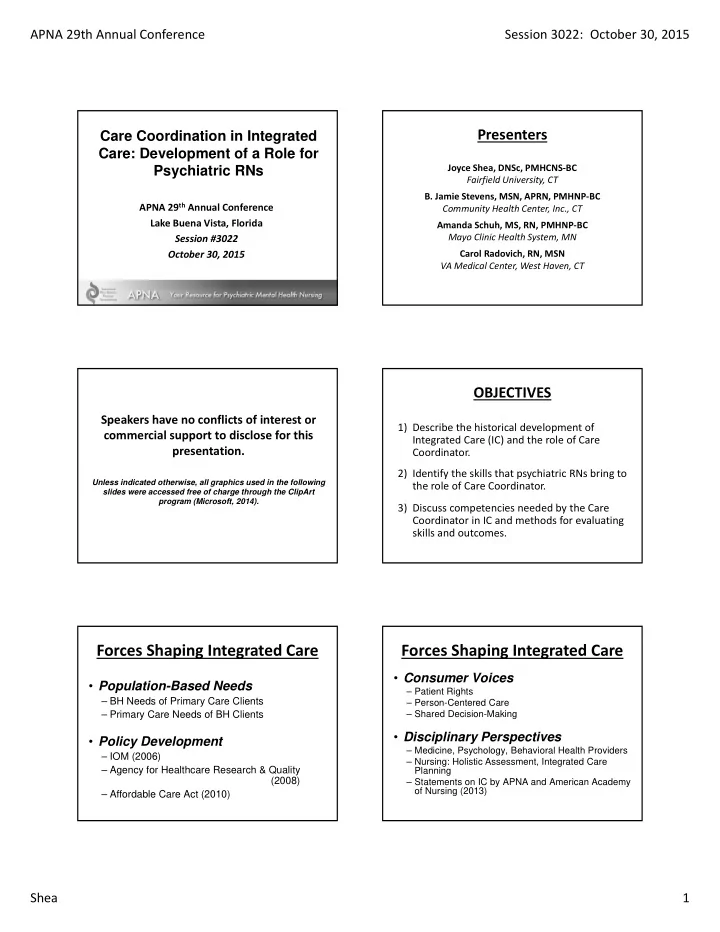
Forces Shaping Integrated Care

  • Population-Based Needs

– BH Needs of Primary Care Clients – Primary Care Needs of BH Clients

  • Policy Development

– IOM (2006) – Agency for Healthcare Research & Quality (2008) – Affordable Care Act (2010)

Forces Shaping Integrated Care

  • Consumer Voices

– Patient Rights – Person-Centered Care – Shared Decision-Making

  • Disciplinary Perspectives

– Medicine, Psychology, Behavioral Health Providers – Nursing: Holistic Assessment, Integrated Care Planning – Statements on IC by APNA and American Academy

  • f Nursing (2013)
slide-2
SLIDE 2

APNA 29th Annual Conference Session 3022: October 30, 2015 Shea 2

Models of Integrated Care

  • Four-Quadrant Clinical Integration

Model

– National Council for Community Behavioral Healthcare (2009)

  • Vertical and Horizontal Models

– Curry & Ham (2010)

  • Levels of Collaboration Model

– Center for Integrated Health Solutions (2013)

Definition of Integrated Care (IC)

“The care that results from a practice team of primary care and behavioral health clinicians, working together with patients and families, using a systematic and cost‐effective approach to provide patient‐centered care for a defined population.”

(AHRQ, 2013, p. 2)

Care Coordinator: Emerging Role in IC

  • Shares some features of Case Management

services from the 1980’s and 90’s

  • That role may be more ancillary than central as a

member of the IC team, with varying degrees of autonomy and authority

(Lombard et al., 2009)

  • The more active role of Care Coordinator is

required to navigate multiple systems of care and maintain the client’s engagement in care

  • Calls for a much more highly personalized and

relationship dependent process

Psychiatric RNs and the CC Role

  • Nurses have been suggested as the logical

professional to coordinate physical care for people with severe mental illness (Happell, et al., 2011)

  • The educational and clinical preparation of

psychiatric‐mental health (PMH) nurses has been described as “inherently integrated” and focused on an “understanding of mind‐body connections” (Delaney, 2015, p. 321)

Skill Sets of the PMH RN

  • Center for Integrated Health Solutions (2014)

have identified 9 core competencies needed by members of IC teams

  • These competencies align well with the

Standards of Practice for PMH RNs described in the Psychiatric‐Mental Health Nursing: Scope and Standards of Practice, 2nd Edition (2014)

– Includes discussion of specific roles for PMH RNs in Integrated Care

Integrated Care in a Federally Qualified Health Center (FQHC)

  • B. Jamie Stevens, MSN, APRN, PMHNP‐BC

Community Health Center, Inc. Waterbury, CT

slide-3
SLIDE 3

APNA 29th Annual Conference Session 3022: October 30, 2015 Shea 3 What is fueling the drive toward care coordination?

  • 1. Fragmentation in health care delivery
  • 2. Health care costs concentrated in small shares of

the population with chronic conditions

  • 3. New chronic care needs are emerging (ie.
  • besity)
  • 4. The chronically ill are most affected by weak

care coordination.

www.oecd.org/els/health‐systems/39791610.pdf, (12‐Dec‐2007), accessed 8/30/15

Definitions

FQHC (Federally Qualified Health Center) –

1. Receive grants under Section 330 of PHSA 2. Receive enhanced reimbursements from Medicare/ Medicaid 3. Must serve underserved area or population 4. Provide comprehensive services 5. Ongoing quality assurance program 6. Governing board of directors

Definitions

PCMH (Patient Centered Medical Home)

1. Comprehensive care 2. Patient Centered 3. Coordinated Care 4. Accessible Services 5. Quality and Safety (https://pcmh.ahrq.gov/page/defining‐pcmh, accessed 8/26/2015)

Safety Net Provider

A mission driven health care agency dedicated to providing care and services to the most vulnerable populations, poor, marginalized, un/der‐insured, within a defined service area (www.ncbi.nlm.nih.gov/books/NBK224521/, accessed 8/26/2015)

Patients served: >120,000

Comprehensive Care (~Integrated Care) in PCMH

Function #1:

–The primary care medical home is accountable for meeting the large majority of each patient’s physical and mental health care needs, including prevention and wellness, acute care, and chronic care. –Providing comprehensive care requires a team of care providers. This team might include physicians, advanced practice nurses, physician assistants, nurses, pharmacists, nutritionists, social workers, educators, and care coordinators. –Although some medical home practices may bring together large and diverse teams of care providers to meet the needs of their patients, many others, including smaller practices, will build virtual teams linking themselves and their patients to providers and services in their communities.

slide-4
SLIDE 4

APNA 29th Annual Conference Session 3022: October 30, 2015 Shea 4

Coordinated Care in PCMH

Function #2:

–The primary care medical home coordinates care across all elements of the broader health care system, including specialty care, hospitals, home health care, and community services and supports. –Such coordination is particularly critical during transitions between sites of care, such as when patients are being discharged from the hospital. –Medical home practices also excel at building clear and open communication among patients and families, the medical home, and members of the broader care team.

PMH‐RN Standards of Practice

Standard 1. Assessment Standard 2. Diagnosis Standard 3. Outcomes Identification Standard 4. Planning Standard 5. Implementation

  • a. Coordination of Care
  • b. Health Teaching and

Promotion

  • c. Consultation
  • d. Prescriptive Authority and Tx
  • e. Pharm/Biological, and Int. Tx
  • f. Milieu Therapy
  • g. Therapeutic Relationship and

Counseling

  • h. Psychotherapy

Standard 6. Evaluation Standard 7. Ethics Standard 8. Education Standard 9. EBP and Research Standard 10. Quality of Practice Standard 11. Communication Standard 12. Leadership Standard 13. Collaboration Standard 14. Prof. Practice Eval. Standard 15. Resource Utilization Standard 16. Environmental Health

Psychiatric Mental Health Nursing Scope and Standards of Practice. 2014. pp iv‐v.

What is needed to do care coordination?

“Care coordination represents a distinct contribution that requires education and dedicated nursing time, separate from the day to day tasks in a busy practice.”

(Anderson, D, OJIN, 2012)

“Coordination is a deliberate cross‐cutting action that involves high‐quality, caring, and well‐informed staff, patients and unpaid caregivers who must work in partnership together across health and social care

  • settings. For coordination to occur, it must be adequately

resourced with efficient systems and services that communicate.”

(www.ncbi.nlm.nih.gov/pcm/articles/PMC4008426/…accessed 8/26/2015)

Comparison of Care Coordinator Job Descriptions

Items matched to job function and responsibility: 9 items matched Items matched to job requirements: 6 items matched

(see handout for complete details)

How will we know it works?

AHRQ Care Coordination Measures Atlas: Appendix IV: Care Coordination Measure Instruments Measure #5: Care Coordination Measurement Tool Measure #6: Client Perception of Care Coordination

http://www.ahrq.gov/sites/default/files/wysiwyg/professionals/prevention‐chronic‐ care/improve/coordination/atlas2014/careap4.pdf (accessed 8/31/15)

Integrated Care in an Ambulatory Clinic Setting

Amanda L. Schuh, MS, RN, PMHNP‐BC Mayo Clinic Health System Mankato, Minnesota

slide-5
SLIDE 5

APNA 29th Annual Conference Session 3022: October 30, 2015 Shea 5

Care Coordination

  • Mayo Clinic Health System

– Primary Care Clinics

  • Triple AIM Goals

– Population Health – Experience of Care – Per Capita Cost

  • Team Based Care

– Registered Nurse – Primary Care Physician – Psychiatrist – Social Worker

Outcomes

  • Provider:

– Satisfaction – Health Maintenance Goals

  • Patient:

– PHQ‐9 and GAD‐7 scores – Blood Pressure, HgbA1c, Cholesterol – Satisfaction

  • Organization:

– Emergency Department and Urgent Care Visits – Financial Savings

Lessons Learned & Future Steps

  • Team Based Care
  • Expanding Access
  • Further Assessment of Outcomes
  • Importance of Psychiatric Nursing

VETERAN HEALTH CARE SYSTEM ‐CONNECTICUT

“WHEN YOU HAVE SEEN 1 VA; YOU HAVE SEEN 1 VA” What do we look like: Complex hospital with full range of inpatient services Acute Psych: 1 inpatient unit and a Psychiatric Emergency Room (PER) 2 major campuses ‐ inner city and suburban Multiple satellite clinics (CBOCs) Blind Rehab/ Educational Center Service not only Connecticut but the entire nation Psych services offered in all venues October 2015

VETERANS HEALTH ADMINISTRATION

VACT’s Coordination of Veteran Care

Coordination in terms of Nursing Care Units : Care Coordinators Primary Care Coordinators (PCCs) Case Managers Integrated Care RNs Tele‐mental Health Care RNs HPACT teams

VETERANS HEALTH ADMINISTRATION

Care Coordinators- The MICM Team

Mental health Intensive Care Management (Team) RN driven team who works with the multi‐disciplinary treatment teams and VA Psych day programs

  • Organization of OP/Community treatment plan
  • Compliance with health care appointments ; procedures, attendance at treatment

modalities, etc.

  • Assistance with housing
  • Liaison with legal team
  • Medication management – med pours; depo injections, etc.

(2 teams: MICM and MICM Range)

slide-6
SLIDE 6

APNA 29th Annual Conference Session 3022: October 30, 2015 Shea 6

VETERANS HEALTH ADMINISTRATION

INTEGRATED PSYHIATRIC RNs

Psychiatric RNs assigned to Primacy Care Teams and embedded in the Medical Clinics

  • Identify Veterans with potential psychiatric issues/ concerns
  • Work with the Veteran on a limited basis until they have an appointment in the

proper Psych Clinic

  • Coordinate groups to assist Veteran’s compliance; understanding of current

symptoms

  • Trouble shoot for the medical side of the clinic‐ (patient de‐escalation, managing

behavioral disturbances ; work with the PER and VAPD)

  • Educating medical staff to psychiatric diagnosis and participate in treatment

planning to set appropriate patient/ provider expectations

(Invaluable asset)

VETERANS HEALTH ADMINISTRATION

CASE MANAGMENT

TELEMENTAL HEALTH NURSING UNIT RNs with daily face to face contact electronically Electronic equipment set up in the Veteran’s home Allows for intensive monitoring of general psychiatric status, symptom emergence, medication side effects, etc. CASE MANAGERS RNs that follow the Veteran through hospital stays in community hospitals Coordinate return to VA Outpatient or Inpatient care (Mill Bill) PRIMARY CARE COORDINATOR (psychiatric) RNs who assist with inpatient discharge plans and execution of such

VETERANS HEALTH ADMINISTRATION

HPACT TEAMS

MEDICALLY and PSYCHIATRICALLY FOCUSED TREATMENT TEAMS Professional teams consisting of a medical RN, psychiatric RN, and a medical provider that are embedded in the Outpatient Psych Day Programs

  • Focused on giving medical care in real time.
  • See patients for ongoing chronic illness as well as an immediate urgent issue
  • Wellness visits: vaccinations, BP monitoring, etc.
  • Psychiatric RN establishes trust, engages the Veteran and monitors not only

psychiatric issues but assists with wellness needs

  • Assist with the procurement of housing through the VA’s homeless program

VETERANS HEALTH ADMINISTRATION

A SUCCESS STORY

Hx: Mr. C – a 100 % service connected, 57 yo, 6 foot, 4 inch homeless, male with near genius intelligence. Dually diagnosed with schizophrenia and multi‐substance abuse ( ETOH and cocaine). Eventually diagnosed with Lymphoma.

  • MANY admissions and Psych Emergency Room Visits!
  • Very violent and frequently in 4 point locked restraints
  • Ongoing legal issues
  • Primitive behaviors‐ clog shower, defecate in the corner of the room

Assigned to a MICHM RN: lead to positive outcomes Did have episodes of taking prescribed medications Conserved for finance Obtained housing and furniture Less inpatient admissions

VETERANS HEALTH ADMINISTRATION

SUCCESS CONTINUES

Frequent contact (visits) to the PER: no restraints and less violence No jail time Now connected to PER staff A ‘GOOD DEATH’

  • Mr. C knew he was dying

Increased visits to PER but no primitive behaviors MICHM nurse visits Mr. C’s mother and sister with patient’s invitation Medical hospitalizations with only psych consultation; not intervention Admitted to VA Hospice: family visits, PER /MICHM staff visits Comfortable death Did not die alone

Outcome Evaluation of the CC Role

  • Individual Patient Outcomes
  • Organizational Outcomes
  • Provider Outcomes
slide-7
SLIDE 7

APNA 29th Annual Conference Session 3022: October 30, 2015 Shea 7

Ques Questions?? tions?? Thank y Thank you!! u!!

Contact Information

  • Joyce Shea: jshea@fairfield.edu
  • Jamie Stevens: stevenb@chc1.com
  • Amanda Schuh: schuh.amanda@mayo.edu
  • Carol Radovich: Carol.Radovich@va.gov