For Wednesday Read chapter 3, sections 1-4 Homework: Chapter 2, - - PowerPoint PPT Presentation

for wednesday
SMART_READER_LITE
LIVE PREVIEW

For Wednesday Read chapter 3, sections 1-4 Homework: Chapter 2, - - PowerPoint PPT Presentation

For Wednesday Read chapter 3, sections 1-4 Homework: Chapter 2, exercise 4 Explain your answers (Identify any assumptions you make. Where you think theres a question, explain your thinking.) Views of AI Weak vs. strong


slide-1
SLIDE 1

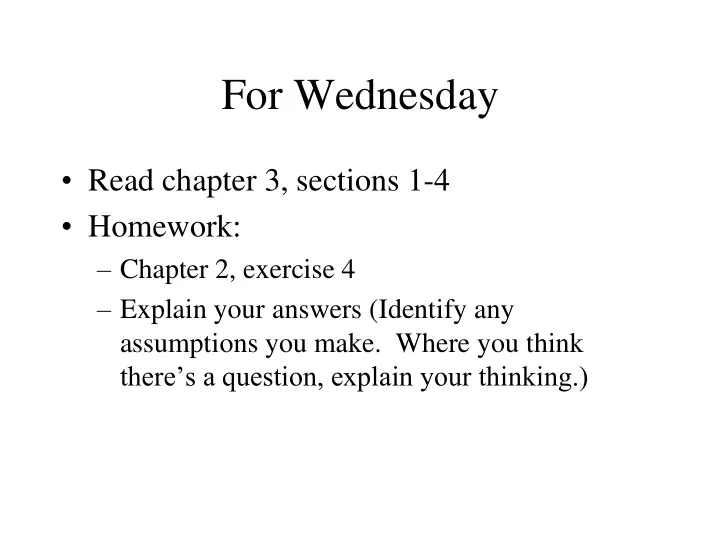
For Wednesday

  • Read chapter 3, sections 1-4
  • Homework:

– Chapter 2, exercise 4 – Explain your answers (Identify any assumptions you make. Where you think there’s a question, explain your thinking.)

slide-2
SLIDE 2

Views of AI

  • Weak vs. strong
  • Scruffy vs. neat
  • Engineering vs. cognitive
slide-3
SLIDE 3

What Is an Agent?

  • In this course (and your textbook):

– An agent can be viewed as perceiving its environment

  • Note that perception and environment may be very

limited

– An agent can be viewed as acting upon it environment (presumably in response to its perceptions)

  • Agent is a popular term with nebulous

meaning--so don’t expect it to mean the same thing all of the time in the literature

slide-4
SLIDE 4

Rational Agents

  • Organizing principle of textbook
  • A rational agent is one that chooses the best

action based on its perceptions

  • This does not have to be the best action that

could have been taken--perception may be limited

slide-5
SLIDE 5

Determining Rationality

  • Must have a performance measure.
  • Rationality depends on

– The performance measure. – Agent’s prior knowledge. – Agent’s possible actions. – Agent’s percept sequence to date.

slide-6
SLIDE 6

Issues in Determining Rationality

  • Omniscience
  • Autonomy
slide-7
SLIDE 7

Task Environment Specification

  • Performance measure
  • Environment
  • Actuators
  • Sensors
slide-8
SLIDE 8

Environment Issues

  • Observability
  • Single or multi-agent

– Cooperative or competitive

  • Deterministic or stochastic
  • Episodic or sequential
  • Static or dynamic
  • Discrete or continuous
  • Known or unknown
slide-9
SLIDE 9

Types of Agents

  • Simple Reflex
  • Model-based Reflex
  • Goal-based
  • Utility-based
  • Learning