for Walkable Communities Alabama State Collaborative Workshop - - PowerPoint PPT Presentation

for walkable communities
SMART_READER_LITE
LIVE PREVIEW

for Walkable Communities Alabama State Collaborative Workshop - - PowerPoint PPT Presentation

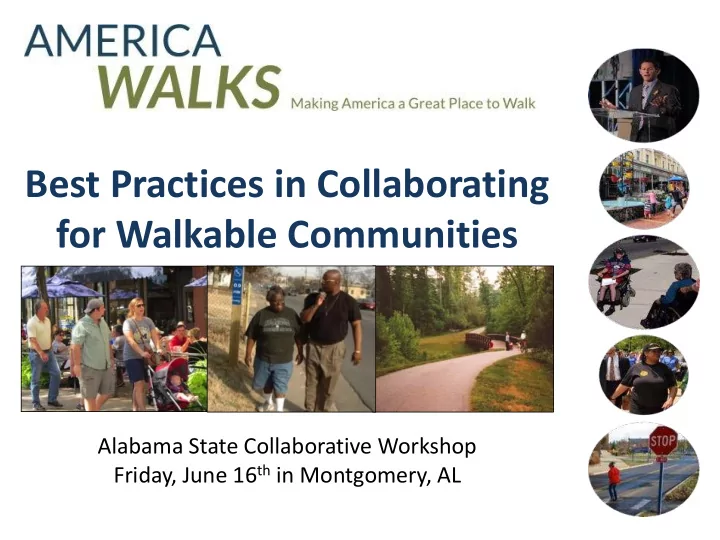
Best Practices in Collaborating for Walkable Communities Alabama State Collaborative Workshop Friday, June 16 th in Montgomery, AL Local Planning Team Workshop Goals 1. Strengthen collaboration between ALDOT, ADPH, ADECA, and other partners


slide-1
SLIDE 1

Best Practices in Collaborating for Walkable Communities

Alabama State Collaborative Workshop Friday, June 16th in Montgomery, AL

slide-2
SLIDE 2

Local Planning Team

slide-3
SLIDE 3

Workshop Goals

  • 1. Strengthen collaboration between ALDOT, ADPH,

ADECA, and other partners

  • 1. Develop a shared understanding of the benefits of

walkable communities, especially for disadvantaged populations and people with disabilities

  • 1. Learn about the funding process and hear from local

mayors about their walkability initiatives

  • 1. Provide feedback on the draft State Bicycle and

Pedestrian Plan

  • 1. Commit to a collaborative action plan, moving

forward

slide-4
SLIDE 4

Workshop Agenda

9:00 am: Welcome and introductions 9:30 am: Presentation: Best Practices in Collaborating for Walkable Communities 10:00 am: Panel discussion with ALDOT, ADPH, and ADECA senior administrators 10:30 am: Break 10:45 am: Small discussion groups: Asset-Mapping Exercise 12:00 pm: Lunch (courtesy of AARP) 12:15 pm: Lunch session: Alabama Local Leaders Panel 1:00 pm: Walkability audits 2:00 pm: ALDOT presentation: Draft State Bicycle and Pedestrian Plan 2:15 pm: Small discussion groups: Strategic Planning Activity 3:30 pm: Commitments for next steps 4:00 pm: Close

slide-5
SLIDE 5

Problem #1: Sedentary Lifestyles

slide-6
SLIDE 6

Problem #1: Sedentary Lifestyles

Adult Obesity

slide-7
SLIDE 7

Problem #2: Generational Car Culture

In 1969, 50% of American children walked to school In 2006, just 15% walked to school

slide-8
SLIDE 8

Problem #2: Generational Car Culture

In 1969, 50% of American children walked to school In 2006, just 15% walked to school

slide-9
SLIDE 9

Problem #3: Health Care Costs

slide-10
SLIDE 10

Problem #3: Health Care Costs

$3 trillion

slide-11
SLIDE 11

Problem #4: Unsafe Streets

slide-12
SLIDE 12

Problem #4: Unsafe Streets

Pedestrian fatality risk at different collision speeds

slide-13
SLIDE 13

Surgeon General’s Call to Action on Walking and Walkable Communities

8th September, 2015

Goal 1. Make Walking a National Priority Goal 2. Design Communities that Make It Safe and Easy to Walk for People of All Ages and Abilities Goal 3. Promote Programs and Policies to Support Walking Where People Live, Learn, Work, and Play Goal 4. Provide Information to Encourage Walking and Improve Walkability Goal 5. Fill Surveillance, Research, and Evaluation Gaps Related to Walking and Walkability

slide-14
SLIDE 14

Surgeon General’s Call to Action on Walking and Walkable Communities

8th September, 2015

Goal 1. Make Walking a National Priority Goal 2. Design Communities that Make It Safe and Easy to Walk for People of All Ages and Abilities Goal 3. Promote Programs and Policies to Support Walking Where People Live, Learn, Work, and Play Goal 4. Provide Information to Encourage Walking and Improve Walkability Goal 5. Fill Surveillance, Research, and Evaluation Gaps Related to Walking and Walkability

slide-15
SLIDE 15

National Health Care Expenditures

slide-16
SLIDE 16

Behavior and Environment “It is unreasonable to expect people to change their behavior … when so many forces in the

environment conspire against

such change” Institute of Medicine

slide-17
SLIDE 17

A Problem for Public Health “How can we change the

built environment …

so the healthy choice is the easy choice?”

slide-18
SLIDE 18

How are Health and Transportation Collaborating in Other States?

Oregon: Memorandum of Understanding Massachusetts: Healthy Transportation Compact and Healthy Transportation Policy Directive North Carolina: Statewide Bicycle and Pedestrian Plan Arkansas: Communities Leading the Way Kentucky: Pedestrian Planning Assistance to Communities Montana: Framework of Aligning Principles Minnesota: Interagency Agreement and Statewide Pedestrian Plan

slide-19
SLIDE 19

Montana: Collaborative Framework Of Aligning Principles

  • 1. Safety
  • 2. Mobility and Access
  • 3. Economic Vitality
  • 4. Quality of Life
  • 5. Health and Environment
  • 6. Equity

Partners: Montana Dept. of Public Health and Human Services Montana Department of Transportation Montana Department of Commerce Bike Walk Montana

slide-20
SLIDE 20

Minnesota: Interagency Agreement

slide-21
SLIDE 21

Panel Discussion

  • Don Arkle, Chief Engineer (representing John Cooper,

Director), Alabama Department of Transportation

  • Dr. Thomas Miller, State Health Officer, Alabama

Department of Public Health

  • Kenneth Boswell, Director, Alabama Department of

Economic and Community Affairs

slide-22
SLIDE 22

Small Discussion Groups: Asset-Mapping Exercise

  • 1. Why is walkability important to my
  • rganization?
  • 1. What desired outcomes or organizational

goals do we have in this area?

  • 1. What assets, strengths, and expertise does my
  • rganization bring to a partnership focused on

walkable communities?

  • 1. What existing programs, partnerships, and

data can we contribute to this partnership?

  • 1. What barriers and challenges do we face, with

which other partners can help us?

slide-23
SLIDE 23

AARP Lunch Session: Alabama Local Leaders Panel

  • AAA
  • BBB
  • CCC
slide-24
SLIDE 24

Walkability Audits

TABLE 1: Nick Sims Molly Killman Cheyenne West William Robbins Phoenix Robinson Mitch Carter Scott Parker TABLE 4: Amy Rauworth Laurie Eldridge-Auffant Randy Stroup Jim Plott Howard Johnson Alicia Powers Wynell Bell Lisa Thrift TABLE 3: Allison Tubbs Waymon Benifield Sonya Baker Michael Kaczorowski Rachael Leonard Lita Waggoner Alison Frazier TABLE 6: Ian Thomas Ray Pugh Crystal Davis Lindsay Puckett Dorothy Dorton Kathe Briggs Jonathan Smith TABLE 2: Candi Williams Anne Hails Samille Jackson LaTara Burton April Delchamps Ruth Brock Beth Kenward TABLE 5: Tom Schmid Rebecca Fulks Scott Tillman Ryan Parker Hannah Craft Carolyn Buck Vickie Moore