For many, is an ideal place - - PDF document

for many is an ideal place
SMART_READER_LITE
LIVE PREVIEW

For many, is an ideal place - - PDF document

13/12/2016 Regional Perspective: chemotherapy systems and challenges Acknowledgements: Kong DCM*, Fitzpatrick A, Hill L, Robertson K Jason Wisemen Ballarat Health Services Steve Medwell Declaration: Research funding and consultancy


slide-1
SLIDE 1

13/12/2016 1

Regional Perspective: chemotherapy systems and challenges

Kong DCM*, Fitzpatrick A, Hill L, Robertson K Ballarat Health Services

Acknowledgements:

  • Jason Wisemen
  • Steve Medwell

Declaration: Research funding and consultancy

  • NHMRC
  • Roche
  • MSD
  • Pfizer
  • 1. Healthcare & Cancer in Rural-Regional Setting.
  • 2. Ballarat Health Services → BRICC satellite pharmacy
  • 3. Chemotherapy systems (electronic) → ARIA
  • 4. Facilitators & Challenges

Rural-Regional Australia

  • ~7 million Australians (30% of population) live in

inner/outer regional, remote or very remote [ABS, Regional population growth 2014-2015 (2016)]

  • Individuals residing in regional and rural Australia

experience health inequalities [AIHW, 2016; ACSQHC’s A TLAS variation (2015)]

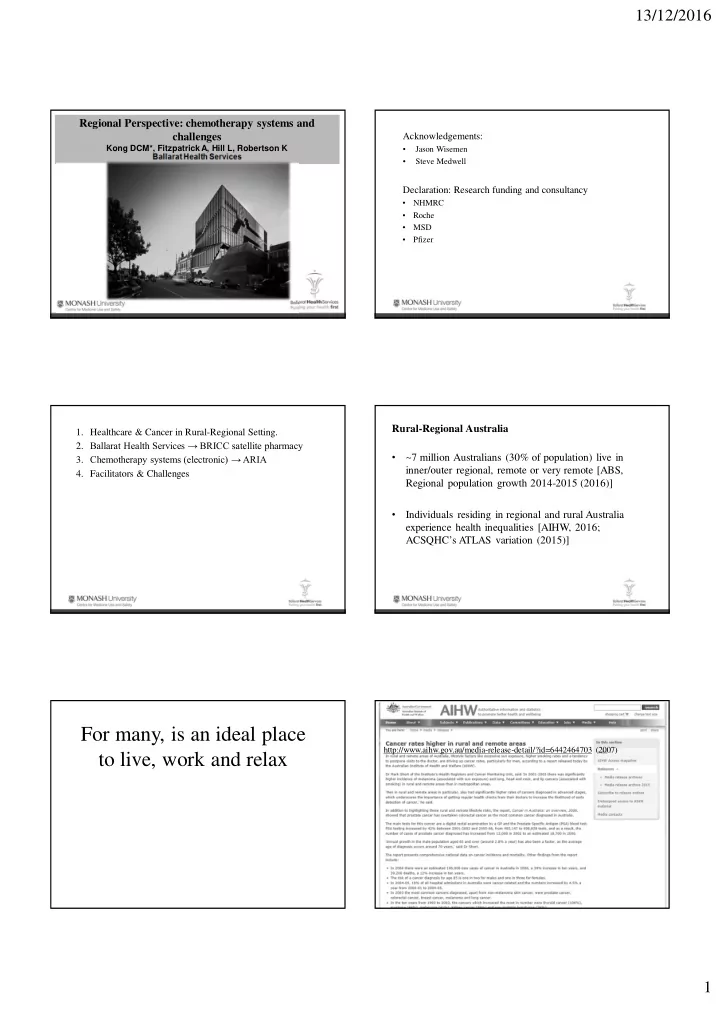
For many, is an ideal place to live, work and relax

http://www.aihw.gov.au/media-release-detail/?id=6442464703 (2007)

slide-2
SLIDE 2

13/12/2016 2

Cancer in Rural-Regional

  • 108, 000 new cases (2007)
  • 39,000 deaths (2007)
  • ~33% live in regional & rural areas

MJA(2014); 201(8): 445-446 MJA(2013); 199 (9): 605-609 MJA(2013); 199 (9): 605-609 Cancer in Rural-Regional Factors contributing to lower survival rates cancer patients in rural areas: 1. Less availability of diagnostic and treatment services 2. Later diagnosis 3. Lower socioeconomic status 4. Reduced rates of physical activity 5. Increased rates of high risk alcohol consumption 6. Higher proportion of Aboriginal and Torres Strait Islanders 7. Increased sun exposure

Fact Sheet 8: Cancer in rural Australia (National Rural Health Alliance & Clinical Oncological Society of Australia, 2012).

Rural-Regional Australia Targeting Zero. Supporting the Victorian hospital system to eliminate avoidable harm and strengthen quality of care (Duckett S., Victorian Government 2016): 1. Weaker legislative requirements for oversight of safety and quality in small hospitals 2. Gaps in capacity are greatest for rural hospital Boards 3. Full- and part-time doctors are resistant to attempts to influence their practice 4. Small hospitals remain unlikely to have sufficient useful information on relative performance

  • 1. Healthcare & Cancer in Rural-Regional Setting.
  • 2. Ballarat Health Services → BRICC satellite pharmacy
  • 3. Chemotherapy systems (electronic) → ARIA
  • 4. Facilitators & Challenges
slide-3
SLIDE 3

13/12/2016 3

BHS Ballarat Regional Integrated Cancer Centre (BRICC) Satellite Pharmacy

  • Staffing profile
  • 3 pharmacists
  • 1.5 technicians
  • Manufacturing mostly outsourced
  • Oncology Day Ward (~16 chairs)
  • Scripts from Outpatient Clinics and Clinical Trials

BHS BRICC Satellite Pharmacy

  • Workload summary

BHS BRICC Satellite Pharmacy

  • Workload summary
  • 1. Healthcare & Cancer in Rural-Regional Setting.
  • 2. Ballarat Health Services → BRICC satellite pharmacy
  • 3. Chemotherapy systems (electronic) → ARIA
  • 4. Facilitators & Challenges

Chemotherapy systems (electronic)

  • CHARM (http://www.charmhealth.com.au/)
  • ARIA (https://www.varian.com/oncology/products/software/information-

systems/aria-ois-radiation-oncology) Ballarat Regional Integrated Cancer Centre Curr Oncol (2014); 21:224-233

slide-4
SLIDE 4

13/12/2016 4

  • ARIA = Oncology Information System by Varian Medical Systems
  • ARIA at BRICC: sharing information between Medical and

Radiation Oncology

ARIA Interface

Process Diagram

Build your chemo regimen → cross checking & sign-off

Safety benefits (Aria):

  • Enables protocols to be standardised, and authorised (entered by

pharmacist, checked by oncologist)

  • Approx. 250 treatment protocols have been set up
  • Electronic recording of chemotherapy administration by nursing
  • Route management
  • Cr/ Cl (ml/min) – drug calculation for ordering
  • BSA calculation and dosing
  • Dose Capping and rounding
  • Cumulative Dosing Tracking ( e.g. Anthracycline life time dosing limits)
  • Allergy Recording and Checking
  • Adverse Reaction Recording
  • Drug Interaction Checking
  • Specific diagnosis specific treatment paths (Treatment regimens)
slide-5
SLIDE 5

13/12/2016 5

Safety benefits (Aria):

  • Visibility of medications between MO & RO (one way at this time)
  • Centralisation of all medication data & pathology
  • No transcription errors (Legibility)
  • Ordering errors eliminated
  • Pharmacy assistance in tracking and rectification of orders prior to

dispensing and administration

  • Restriction of prescribing
  • Outreach support
  • 1. Healthcare & Cancer in Rural-Regional Setting.
  • 2. Ballarat Health Services → BRICC satellite pharmacy
  • 3. Chemotherapy systems (electronic) → ARIA
  • 4. Facilitators & Challenges

Facilitators:

  • Growing demand – 36% increase in patients (FY 14-15 to 15-16)
  • Supporting Horsham, Hamilton, Stallwell
  • One ‘stop shop’ with safety elements

Challenges: ARIA-related:

  • Outages (unavailability of drug charts)
  • Limited bedside access / at point of care
  • Interaction with other systems (i.e. iPharm)
  • PBS Scripting not enabled
  • User Access and Rights
  • Maintenance of ARIA: E.g. updating/reviewing protocols (i.e. new /
  • ld) → ~280 protocols at BHS
  • Training required for end users → VMOs
  • No integration with iPharmacy

Challenges:

Human factors:

  • Training opportunities for staff
  • Qualified staff / expertise to accommodate increasing demand

Challenges:

  • Supply → outsource vs in-house
  • No integration with external manufacturing contractor(s) as yet
  • Managing growing number & complexities of clinical trials
  • Communication & access to visiting VMOs
  • Complacency → medical staff approving of orders without

appropriate checking first

slide-6
SLIDE 6

13/12/2016 6

In conclusion:

1. Demand for cancer services in rural & regional setting continues to increase 2. Ensuring allocated staffing resources are aligned with increasing workload is a challenge in maintaining quality of service 3. Oncology information systems are available to support operations 4. Challenges remains but……………….