for Higher Efficiencies Steve Bistak sbistak@novatorque.com Agenda - - PowerPoint PPT Presentation

for higher efficiencies
SMART_READER_LITE
LIVE PREVIEW

for Higher Efficiencies Steve Bistak sbistak@novatorque.com Agenda - - PowerPoint PPT Presentation

Permanent Magnet Motors for Higher Efficiencies Steve Bistak sbistak@novatorque.com Agenda What are the efficiency regulations in place for motors? What are the options for better efficiency? PMAC Motor Performance Advantages


slide-1
SLIDE 1

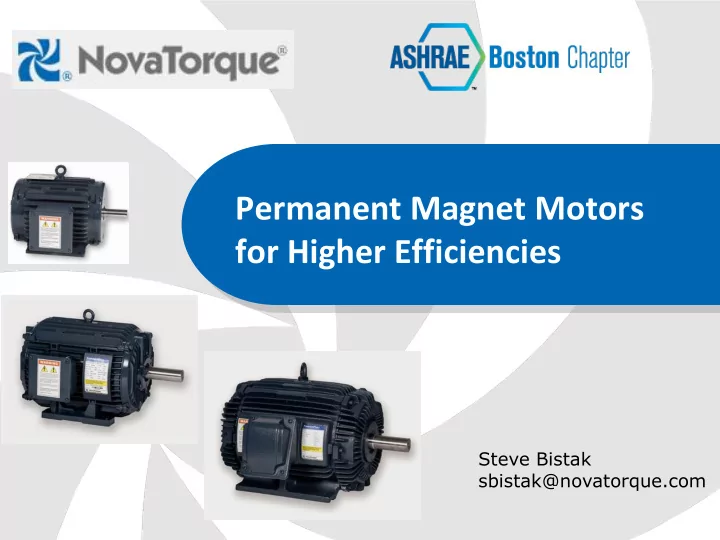
Permanent Magnet Motors for Higher Efficiencies

Steve Bistak sbistak@novatorque.com
slide-2
SLIDE 2

Agenda

  • What are the efficiency regulations in place for motors?
  • What are the options for better efficiency?
  • PMAC Motor Performance Advantages
  • Real World Savings
  • Motor Models, Labeling, VFD Compatibility
slide-3
SLIDE 3

Energy Standards

United States

EPAct

The Energy Policy Act of 1992, Starting in October 1997, required most general-purpose polyphase squirrel cage induction motors manufactured for sale in the United States in sizes between1 and 200 horsepower to meet minimum efficiency standards.

EISA

The Energy Independence and Security Act (“EISA”), which was signed into law in 2007, became effective

  • n December 19, 2010. This law expands the mandated energy efficiency standards from the Energy

Policy Act of 1992 (EPAct) for a wider range industrial motors 1-500 HP which are manufactured for sale in the United States.

EISA Enhancements June 2016

8 pole motors covered Not covered by US efficiency regulations Air Over motors Motors that can only be used on VFD’s

slide-4
SLIDE 4

Energy Standards Europe

European Standards IE2 and IE3 are basically equivalent to EPAct and EISA. IE2 by June 16, 2011 IE3 by January 1, 2015 (for motors >=7.5 to 375 kW) and IE2 only in combination with an adjustable speed drive IE3 for all motors by January 1, 2017, (for motors from 0.75 to 375 kW) and IE2 only in combination with an adjustable speed drive. IE4 Standards established but not yet required (2020?), (for motors from 0.75 to 375 kW) IE5 Standards in discussion stage. Each of the EU Regulatory changes was / is on average a 2 Band improvement of efficiencies over the previous regulation, based on NEMA efficiency bands

slide-5
SLIDE 5

What are the options for increased efficiency?

Some US manufacturers have introduced “Super Premium” product. ACIM with longer core length higher grade of electrical steel more copper in the windings redesigned fans and fan shrouds These typically have design “A” starting characteristics and may not be suitable for retrofit applications without using a soft start or VFD (0 – 60 % higher than Design “B”) Copper Die Cast Rotor (in place of Aluminum Die Cast) Have been discussed for a number of years but have not yet overcome manufacturing issues due to higher temperatures and pressures required. Articles read suggest 4% more efficient than ACIM. Typically design “A” starting characteristics. Hybrid Induction motors with permanent magnets imbedded in cast aluminum rotor. Some manufacturers have introduced Permanent magnet motors Require a VFD with PM capability for operation NO sine wave bypass capability frame sizes may be smaller than NEMA ACIM standards

slide-6
SLIDE 6

Further Efficiency Gains Will Require New Motor Technology

  • Permanent magnet motors the most likely candidates.

Available today and offer an immediate efficiency boost due to the use

  • f permanent magnets.

PM motors require a VFD for operation. Most new HVAC applications incorporate a VFD for speed control for energy savings to meet coming Federal regulations. As Induction motors are designed for higher efficiencies they tend to become “design A” electrical types with very high amp draw on start

  • up. This usually necessitates the use of a softstart or VFD to manage

this excessive electrical draw. PM Motors provide the highest levels of efficiency since no electrical energy is required to “induce” a magnetic field in the rotor. Note: There is NO sine wave bypass possible with PM motors. The relationship between frequency and motor speed is usually different than an induction motor.

slide-7
SLIDE 7

Confidential & Proprietary

Perman anen ent t Magnet t Motors s – En Environm

  • nmen

ental tal Motivat vation ion

Annual Reduction 2,822 kWh (1) 10hp 4,633 50.9 2,090 219 4.5

slide-8
SLIDE 8

Perman anen ent t Magnet t Motors s – Key Benefits fits

  • Higher full & variable speed efficiency
  • Flatter efficiency curve
  • Cooler operating temperatures
  • Full torque at low speeds
  • Increased power density
  • Some ratings available in smaller frames, providing lighter weight
slide-9
SLIDE 9

Perman anen ent t Magnet t Motors s – Issues ues to consid sider er

  • PM motors require an individual VFD per motor, NO sine wave

bypass is available.

  • Points to ponder
  • In a fan array there is usually built in redundancy eliminating the need for

bypass

  • VFD’s are much more reliable today than they were in the ‘80s when bypass

began to be implemented.

  • PM motors are much more efficient that ACIMs
  • This may allow the use of a smaller VFD than the ACIM would require
  • Always size VFD by motor FLA (not HP)
  • In facilities with a large number of motors this may allow smaller

conductors and a smaller power feed and associated control.

  • With a single VFD and multiple motors each “branch” should have
  • Short circuit protection
  • Motor Overload protection
  • A disconnecting means
  • If bypass is required it is generally provided by a parallel large VFD
  • When all the above is considered the cost generally runs from about the same to

lower for an individual VFD solution.

slide-10
SLIDE 10

Efficiency Comparison ACIM vs. PM

PM motor efficiencies on VFD power. ACIM on Sine wave. ACIM motors lose .5 – 1.5 points of efficiency when run on VFD.

HP @ 1800 RPM

NEMA Efficiency Band

2 3 5 7.5 10 15 20 96.2 95.8 95.4 95 IE 5 94.5 IE 5 94.1

  • Sup. Prem
  • Sup. Prem

93.6 IE 5 IE 5

Sup Prem

  • Sup. Prem

93

NEMA Prem

92.4

IE 5 IE 5

Sup Prem Sup Prem NEMA Prem

  • Sup. Prem
  • Sup. Prem

91.7

NEMA Prem NEMA Prem

91

Sup Prem Sup Prem

EPAct EPAct

  • Sup. Prem
  • Sup. Prem

90.2 IE 5 89.5

NEMA Prem NEMA Prem

EPAct EPAct 88.5

Sup Prem

  • Sup. Prem

87.5 EPAct EPAct 86.5

NEMA Prem

85.5

General range of efficiencies for Permanent Magnet Motors

84

EPAct

General range of efficiencies for AC Induction Motors

82.5

slide-11
SLIDE 11

50% 55% 60% 65% 70% 75% 80% 85% 90% 95% 100% 400 500 600 700 800 900 1000 1100 1200 1500 1800

Motor Efficiency Speed (rpm)

PM Motor vs. Induction at Multiple Speeds

Confidential & Proprietary

Perman anen ent t Magnet t Motors s – Prima mary ry Advanta tage ge

1800 rpm 1200 rpm 900 rpm

slide-12
SLIDE 12

#1 #1 - Higher er Full & Variab able le Speed d Ef Effi ficiency ency

slide-13
SLIDE 13

NovaTorque Annual Saving vs. Induction Motor

Confidential & Proprietary

$0 $25 $50 $75 $100 $125 $150 $175 $200 $225 0.05 0.06 0.07 0.08 0.09 0.1 0.11 0.12 0.13 0.14 0.15

Total Annual Savings Electricity Cost (¢/kWh)

Annual Savings

  • PM

Motor vs. Premium Induc on

  • Mul ple

HP

  • 1800

RPM

  • 80%

Duty Cycle

  • 5

HP

  • 3

HP

Note: Duty Cycle = 80% at full speed

slide-14
SLIDE 14

Confidential & Proprietary

Note: Duty Cycle = 100% at full speed

Perman anen ent t Magnet t Motors s – Finan ancial cial Motivat vation ion

$0 $50 $100 $150 $200 $250 $300 $350 $400 $450 0.02 0.03 0.04 0.05 0.06 0.07 0.08 0.09 0.1 0.11 0.12 0.13 0.14 0.15

Total Annual Savings Electricity Cost (¢/kWh)

Annual Savings

  • PM

Motor vs. Premium Induc on

  • Mul ple

HP

  • 1800

RPM

  • 100%

Duty Cycle

  • 10

HP

  • 7.5

HP

slide-15
SLIDE 15

EC Fan Systems – 3 Choices

Electronically Commutated Motors

slide-16
SLIDE 16

All in One System - Unitary

All in one solution

VFD / EC motor / Fan all in one unit Pros All in one reduced wiring reduced assembly Cons One piece breaks and it all goes out for repair More limited in what you can get Fan selection Motor ratings VFD features

slide-17
SLIDE 17

EC Motor with integral VFD + Fan Two Components

EC motor / VFD , Fan Pros More Fan Choices Reduced Installation Reliable and the default choice Easy maintenance and replacements Cons Limited Motor HP range and speeds available Motor or VFD failure and both go for repair More limited in what you can get Motor ratings VFD features

slide-18
SLIDE 18

VFD, EC Motor, FAN – Individual Components Individual components

EC motor, VFD, Fan Pros More Fan Choices More Motor Choices More VFD Choices Pick the best product for your application from each category Pick the highest efficiency product in each category. easier / faster repair / replacement. Only replace the failed item. Cons More thought required to match the proper items More assembly time

slide-19
SLIDE 19

Perman anen ent t Magnet t Motors s - Confi figurat uration ions s

External rnal Rotor Used prima marily rily with th VFD/E /EC C motor/fan fan - unitary tary product uct

slide-20
SLIDE 20

Perman anen ent t Magnet t Motors s - Confi figurat uration ions s

EC Motor

  • r/VFD

VFD

slide-21
SLIDE 21

Perman anen ent t Magnet t Motors s - Confi figurat uration ions s

Singl ngle e Stato tor & Rotor Traditional ditional configura iguration tion

slide-22
SLIDE 22

Perman anen ent t Magnet t Motors s - Confi figurat uration ions s

Singl ngle e Stato tor & Dual Rotor

slide-23
SLIDE 23

PMAC vs. . NEMA MA Premiu ium m Motor

PMAC NEMA Premium

Typical Efficiency Comparison on Variable Torque load.

slide-24
SLIDE 24

Motor Base Speed on ECPM motors not tied to number of poles!

60 65 70 75 80 85 90 95 900 1400 1900 2400 2900 Motor Efficiency (%) Motor Speed (RPM)

Comparison of Motor Efficiency on Typical 10HP, 2700RPM Fan Application

PMAC 10HP @ 2400 Base Speed NEMA Premium 10HP ACIM 1800 RPM Base Speed NEMA Premium 15HP ACIM 3600 RPM Base Speed

slide-25
SLIDE 25

Installation & Maintenance Requirements

25

Same as an AC Induction Motor

  • Follow the VFD manufacturer’s wiring instructions.
  • Mount and align as you would an ACIM
  • Consider protection against shaft currents.
slide-26
SLIDE 26

When comparing PMAC to ACIM Remember

26

  • ALL published data on AC Induction Motors is based on operation on

sine wave power. Efficiency – per NEMA Standards Service Factor - Typically 1.15 – 1.25 Temperature Rise - B

  • When an ACIM is operated on VFD power

Efficiency – drops by approximately .5 – 1 ½ points or more Service Factor - 1.0 Temperature Rise - F Since PMAC motors can only be run on a VFD, their published information is generally based on performance while on the VFD.

slide-27
SLIDE 27

#3 #3 – Generally ally Cooler er Op Operat ation ion

Electri tricity city / Power in Heat to atmosphere sphere - loss sses Rotatio tion n / w work out

PM Motors s Op Operat ate e at Lower r Temperat rature ures Higher er Ef Effi ficiency ncy = Lower r Heat Losses ses

slide-28
SLIDE 28

Improved efficiency positive effect on costs to cool

28

IF you are mounting your AHU motors in the airstream a more efficient

motor with have a positive effect in reducing your cooling costs because the put less heat, due to reduced losses, into the airstream.

Watt/ HP HP Watts % Eff % Loss Watts Lost Time Propor tion Watt Loss x Time Induction Motor 745.7 5.00 3,728.50 89.14% 10.86% 404.92 0.1 40.49 745.7 1.48 1,105.87 86.77% 13.23% 146.31 0.8 117.05 745.7 0.63 466.06 80.44% 19.56% 91.16 0.1 9.12 166.65 Heat Into Air Stream in Watts PM Motor 745.7 5.00 3,728.50 94.40% 5.60% 208.80 0.1 20.88 745.7 1.48 1,105.87 92.33% 7.67% 84.82 0.8 67.86 745.7 0.63 466.06 88.71% 11.29% 52.62 0.1 5.26 94.00 Heat Into Air Stream in Watts Heat introduced into the airstream has been reduced by 44%

slide-29
SLIDE 29

29

Test conducted from Oct 2013 through Feb 2014 Comparison of a 5 HP (Premium Efficiency, IE3) induction motor with a 5 HP PMAC

  • Both equipped with variable frequency drive (VFD)
  • Parallel operation in an air handling exhaust application with

power monitoring through the Building Management System

  • Test conducted for 1 month, then motor positions swapped

and the test continued another month

PMAC motor consumed 8.5% less power for the same air flow! SMUD (Sacramento Municipal Utility District) field test

slide-30
SLIDE 30

30

Replaced 40 HP motor & fan with 4x2 array of 4.5 HP PMAC motors & fans 7 of 8 motors running with variable

  • speed. 8th motor for redundancy

25% energy saving predicted; 35% energy savings measured

  • Estimate 8 to 12% of savings from PMAC

compared to NEMA Premium motor efficiency

Line current reduced

  • Before retrofit: 47.5 amps
  • After retrofit: 30.2 amps

Barclay’s Bank Air Handler Retrofit

slide-31
SLIDE 31

31

Major HVAC OEM – Data Center Case Study

  • PMAC 900rpm rated motors were

comparatively tested against AC Induction 6- pole motors for use in an Oregon data center application.

  • Test results showed a 16%-18% energy

reduction over 6-pole AC Induction motors for the application operating points.

Blower Speed 350 rpm 500 rpm CFM 16,400 23,720 AC Induction (kW) 0.980 2.792 NovaTorque (kW) 0.817 2.286 Power Reduction 16.6% 18.1%

slide-32
SLIDE 32

Perman anen ent t Magnet t Motors s - Ex Example e

Retrofit fit on Existi sting g Air Handler dlers

  • 2 motors per floor (17 floors)
  • Added VFDs for controls
  • Units run 12-14 daily 5 days a

week Initial itial Find ndin ings gs

  • 43.7% reduction in power

usage

  • Expected project payback < 2

years (motors + VFDs + labor)

slide-33
SLIDE 33

VFD’s – Mfg’s with ECPM compatible product

33

ALL ECPM motors require a VFD for operation. Not all VFDs are capable of running ECPM motors. The VFD must have the proper algorithm as part of it’s firmware. Most major VFD manufacturers have at least one product capable of running ECPM motors.

slide-34
SLIDE 34

Savings Calculator – Most motor manufacturers have a savings calculator

Typical data input requirements

34

slide-35
SLIDE 35

Savings Calculator – Data output

35

slide-36
SLIDE 36

Savings Calculator - Graph

36 Efficiencies generally provided at the data points and Along any point on graph.

slide-37
SLIDE 37

Thank You !!!!

37

Steve Bistak sbistak@novatorque.com