Footprint Characterization A Focus for Landscape Photo - Credit Tim - - PowerPoint PPT Presentation

footprint characterization a focus for landscape
SMART_READER_LITE
LIVE PREVIEW

Footprint Characterization A Focus for Landscape Photo - Credit Tim - - PowerPoint PPT Presentation

Footprint Characterization A Focus for Landscape Photo - Credit Tim Vinge Management Tim Vinge (GOA Lead) Photo - Credit Tim Vinge Landscape Restoration Ecologist Resource Integration Planning Branch Government of Alberta Photo - Credit Tim


slide-1
SLIDE 1

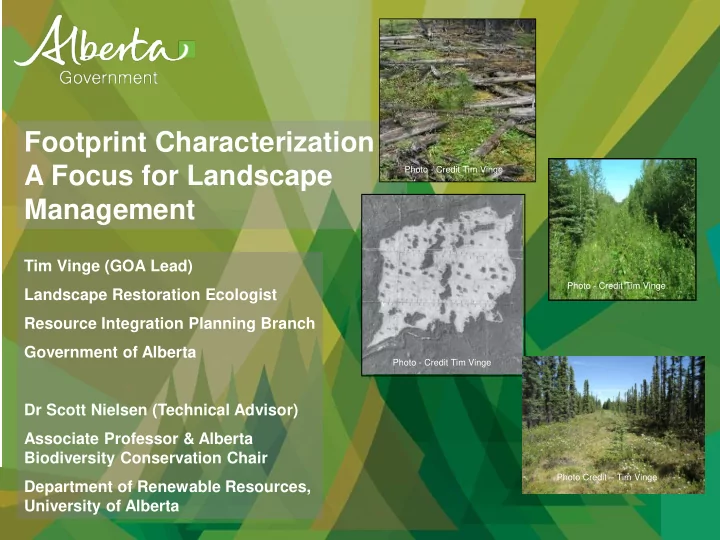
Footprint Characterization A Focus for Landscape Management

Tim Vinge (GOA Lead) Landscape Restoration Ecologist Resource Integration Planning Branch Government of Alberta Dr Scott Nielsen (Technical Advisor) Associate Professor & Alberta Biodiversity Conservation Chair Department of Renewable Resources, University of Alberta

Photo Credit – Tim Vinge Photo - Credit Tim Vinge Photo - Credit Tim Vinge Photo - Credit Tim Vinge

slide-2
SLIDE 2

Outline for Discussion on Footprint Characterization and Planning Focus

1. Alignment With the Biodiversity Management Framework (BMF) 2. The Management Approach 3. The Toolkit 4. Making Good Decisions for Management (Decision Support Tools) 5. Current Provincial Initiatives (ALGAR, CEMA Stony Mountain 800 Access

Pilot, ALPAC Dillon Wildlands Restoration and DART)

6. Pulling it all together (The management system) 5. Next steps (Our Commitment)

slide-3
SLIDE 3

Alignment With the Biodiversity Management Framework (BMF)

The Biodiversity Areas have been identified under the BMF. The Landscape Management Plan will use the Biodiversity Areas in the BMF to help focus management actions. The goal is to create a strong network of areas across the landscape in support of biodiversity.

1. Areas Containing Biodiversity Values

The BMF will inform the landscape evaluation in two important areas

slide-4
SLIDE 4

Alignment With the Biodiversity Management Framework (BMF)

The BMF has identified indicators that represent a broad range of biodiversity in the region. The BMF indicators will be used as evaluation criteria to determine management focus areas. Additional values can be identified through the stakeholder engagement process and the BMF for use as evaluation criteria. 2. Biodiversity Management Framework Indicators

slide-5
SLIDE 5

Managing Complex Landscapes

What is a good approach?

We must develop a strategy to manage the landscape in the face of it’s complexity and diversity. Solutions for landscape management are

  • complex. Managers

must be able to see through this complexity to define effective management solutions Ecosystems have form and function. We need to build a management system around this understanding

Photo Credit - EMEND Research Study

Disturbances are important drivers

  • n the landscape

We must manage risk

  • n the landscape.
slide-6
SLIDE 6

The Game of Landscape Musical Chairs

Disturbances Provide the Music

The music rarely stops and when it does there is never enough chairs

  • Disturbances cause changes

to the landscape over time. There is an adaptation to these changes.

  • Changes in the landscape can

affect values in a + or – fashion.

  • Important to ensure that

management maintains these values over time (i.e. wildlife habitat)

Photo - Credit Tim Vinge Photo - Credit Tim Vinge Photo - Credit Tim Vinge Photo - Credit Tim Vinge

Wildlife Example

slide-7
SLIDE 7

So What Should We Do?

Where ? What tools?

1. Avoid and minimize new footprint 2. Restoration of legacy linear footprint

How?

Decision Support Capability

Build More Chairs

Photo - Credit Tim Vinge Photo - Credit Tim Vinge

slide-8
SLIDE 8

Two Approaches to Building the Chairs

Minimize New Disturbances Integrated Land Management Tools

  • Innovative pipeline strategies
  • Multi use corridors
  • Coordinated access management

Integrated Land Management Tools Compendium Both are Important

Place Based Management Actions

Fix Legacy Linear Disturbances Restoration Tools

Seismic Line Treatments

  • Site preparation (mounding)
  • Planting seeding
  • Wood applications
  • Winter planting

Linear restoration tools have been developed over the last 5 years.

slide-9
SLIDE 9

Building the Restoration Toolkit

Using good disturbances to fix legacy disturbances Positive responses of ecosystems to management interventions

Use approaches that are inspired by nature

  • Dr. John Spence University of Alberta

Old Legacy 2D Seismic

Mounding site Preparation 2.4 Million Dollars in research in the last 5 years.

Photo - Credit Tim Vinge Photo - Credit Tim Vinge Photo - Credit Tim Vinge

slide-10
SLIDE 10

Linear Restoration Example

Road before treatment Road after treatment Targeted Linear restoration and access management

3 years after treatment

Photo - Credit Tim Vinge Photo - Credit Tim Vinge

Mounding site Preparation

slide-11
SLIDE 11

Building the ILM Toolkit

The ILM tools already exist

Depends on

  • Species involved
  • Habitat availability
  • Disturbance level
  • Site sensitivity
  • Type of development
  • Management objectives

Goal of ILM is to minimize the impact of development.

Access Management

Photo Credit - Tim Vinge

Application of ILM is place-based

slide-12
SLIDE 12

Some Important Questions about the Tools

How do we make the best decisions? Lots of Land Uses

Landscape Complexity

What should I do? Where should I do it? How much should I do? Where should I start? What tools do I have available?

?

We need a comprehensive approach to deal with complexity

Photo Credit - Brian Coupal

Courtesy of the BC Ministry of Forests

Photo Credit – Natural Resources Canada

Photo Credit – Tim Vinge

slide-13
SLIDE 13

Preliminary Phase I Results

Seeing Through the Complexity

The Partners

  • University of Alberta
  • Alberta Biodiversity

Monitoring Institute

  • Government of Alberta

Decision Support Tool The tools selected will help to focus management options including ILM and restoration in the best locations.

Planning Units Values Targets Costs

Potential Options

slide-14
SLIDE 14

Planning Units for Evaluating Management Options

¼ section is ~800 x 800 m (~66 ha)

Study area = 72,554 km2 Planning units = 101,101 (¼ sections) Summarize information within ¼ sections Target areas for biodiversity & restoration

Photo credit: Tim Vinge

slide-15
SLIDE 15

Traditional (2D) seismic line footprint

Total = 53,496 km

Areas predicted to have failed natural regeneration

Forest regen. ≥3m

Restoration targets within woodland caribou range

Determining Locations for Management Priorities

slide-16
SLIDE 16
  • Other sources of biodiversity & values (Aboriginal Communities and Stakeholders)
  • Constraints to restoration
  • Prioritization & coordination of restoration projects
  • Identification of ILM priorities

Need to also Consider…

Photo credit: Scott Nielsen Photo credit: Scott Nielsen Photo credit: Scott Nielsen

slide-17
SLIDE 17

Biodiversity Values

Rare plants

  • Rare plants

List available

Fruiting shrubs

  • 16 species

List available

Forest birds Habitats

  • 19 species
  • 7 Old growth
  • 5 Cavity nesters
  • Fens

Mammals

  • Caribou
  • Lynx
  • Fisher
  • Marten
  • Moose

BMF Indicators-

slide-18
SLIDE 18

Anthropogenic footprint

Bitumen thickness

ABMI footprint

Disturbance Considerations

Identifying Potential Options

Considerations for Management Locations

slide-19
SLIDE 19

Ranking Sites for Management

in Consideration of Limitations

Restoration targets Biodiversity values Disturbance Considerations

Use software to identify & rank sites for restoration & biodiversity value, given the fewest constraints to restoration & conservation (“best bang for your buck”)

slide-20
SLIDE 20

Prioritizing Sites for Management

Several approaches can be used

2D lines 2D lines & caribou caribou & biodiversity

slide-21
SLIDE 21

Comparison of BMF Biodiversity Areas to Preliminary Management Focus Areas in the LMP

Restoration and ILM Focus Areas BMF Biodiversity Areas Map

slide-22
SLIDE 22

Current Landscape Restoration Initiatives in Alberta

  • CEMA Cumulative Environmental Management Association Stony Mountain 800

Access management Pilot. Looks at managing access and reclamation of linear features in the RMWB.

  • ALGAR Linear Restoration Program. Completed under the Oil Sands Leadership

Initiative (OSLI), now COSIA. The ALGAR program is using linear restoration techniques to restore caribou habitat in wetlands.

  • DART (Disturbance and Recovery Trajectories) Research conducted at the University
  • f Alberta by Cassidy Van Rensen looking at seismic line recovery over time. The

research will help to set priorities for seismic line restoration.

  • ALPAC Trans Canada Pipelines - Dillon Wildlands Caribou Habitat Restoration Project

to offset new pipeline construction in the Dillon Wildlands area in north eastern Alberta.

All of these initiatives will contribute to the Landscape Management Plan.
slide-23
SLIDE 23

Footprint Characterization and Plan

Phase 1 and 2

  • Phase 1 will provide an evaluation of the footprint and associated biodiversity

to determine the best locations for management actions. Phase I will use the BMF Biodiversity Values Areas and Indicators along with other biodiversity values to determine management focus areas.

  • Phase 2 of the FC will focus on the site level application of the management
  • tools. (i.e. Which seismic lines, Which treatments). Phase II will incorporate

additional stakeholder values and BMF Indicators to refine ILM and restoration applications.

– Phase II will inform the Resource Management Plans (i.e. Moose Lake Access Management Plan and Birch River Conservation Area Ecosystem Forestry Plan, and the SAOS Plan) on site based application of restoration and ILM strategies.

slide-24
SLIDE 24

Landscape Restoration Focus Process Bringing it all together