Fluoroscopy Evaluation Guidelines for Detector Input Dose Settings - - PDF document

fluoroscopy evaluation
SMART_READER_LITE
LIVE PREVIEW

Fluoroscopy Evaluation Guidelines for Detector Input Dose Settings - - PDF document

Fluoroscopic Imaging Equipment Fluoroscopy Evaluation Guidelines for Detector Input Dose Settings and Image Optimization Patient Dose Image Quality RELATIVE EERD vs kVp 210% 200% Shimadzu Bransist - 22 cm FOV Direct Flat Panel


slide-1
SLIDE 1

1

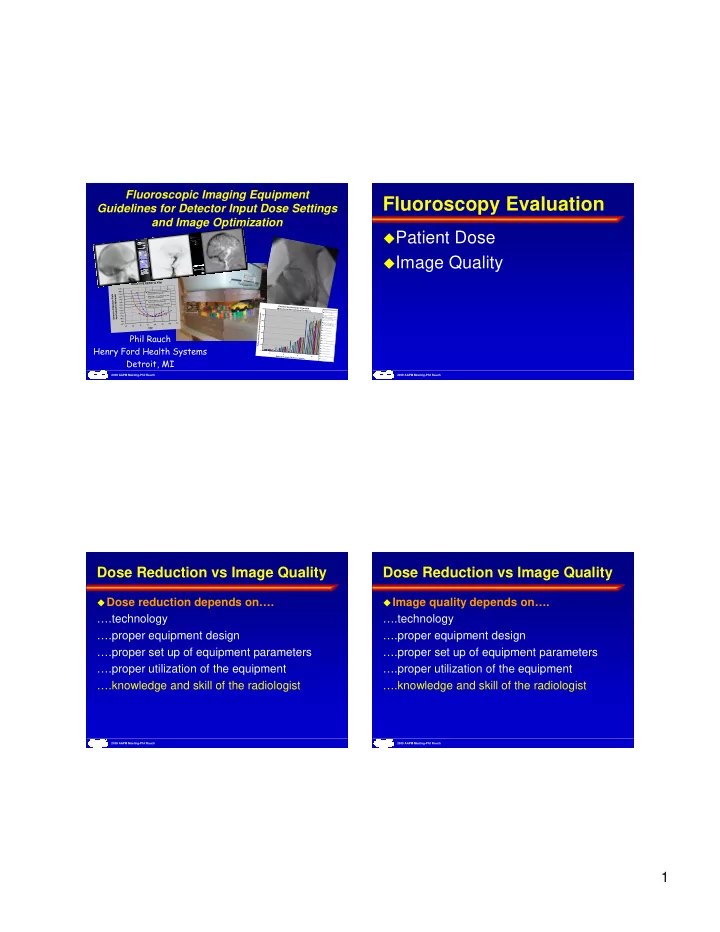
Fluoroscopic Imaging Equipment Guidelines for Detector Input Dose Settings and Image Optimization

Phil Rauch Henry Ford Health Systems Detroit, MI

2009 AAPM Meeting-Phil Rauch

E n t r a n c e A i r K e r m a f
  • r
2 2 c m F O V ( M e a s u r e d a t I n t e r v e n t i
  • n
a l R e f P
  • i
n t ) 2 4 6 8 1 1 2 1 4 4 6 8 1 N
  • m
i n a l P h a n t
  • m
T h i c k n e s s ( i n c h e s ) P a t i e n t E n t r a n c e A i r K e r m a R a t e ( m G y / m i n ) No Grid-70 kV 10R AF 2kW 4ms/7 ms micro focus Note: Th i s one at 4 0 n Gy/pulse and 10 pps 100kV 10 R AF 2kW smallfo cus No Grid-70kV 10 R AF 2kW 4 ms/7ms micro focus Note: Th i s one at 2 3 n Gy/pulse and 30 pps 80kV 10R 0302 3kW smallfocu s Note: Th i s one at 3 6 n Gy/pulse and 15 pps so mea
  • s. Dose
was mu l tiplied by 2 In terven tion al IQ 2 80kV 10R 0302 2kW smallfocu s Note: Th i s one at 3 6 n Gy/pulse and 15 pps so mea
  • s. Dose
was mu l tiplied by 2 70kV 10R AF 2kW 5ms/8ms microfocu s 80kV 10R AF 2kW smallfocus 80kV 10R 02 3kW small focus In terven tion al IQ 1 (no DHHS) 70kV 10R AF 2kW microfocus 70kV Service 02 70kV 10R AF 3kW 6ms/9ms small focus 70kV 10R AF 3kW 8ms/12ms smallfo cus 70kV 10R 02 3kW small focus 70kV 10R 02 2kW small focus 70kV 20R AF 3kW smallfocus 70kV 10R AF 3kW smallfocus 70kV 20R AF 3kW 8ms/12ms smallfo cus 70kV Service 00

RELATIVE EERD vs kVp

80% 90% 100% 110% 120% 130% 140% 150% 160% 170% 180% 190% 200% 210% 40 50 60 70 80 90 100 110

kVp Detector Exposure Rate Normalized to Minimum

Shimadzu Bransist - 22 cm FOV Direct Flat Panel Detector (Se/TFT) Philips Xper - 22 cm FOV Indirect Flat Panel Detector (CsI(Tl)/TFT) Siemens Artis Zee - 42 cm FOV Indirect Flat Panel Detector (CsI(Tl)/TFT) Siemens Siregraph - 22 cm FOV X-ray Image Intensifier Detector

2009 AAPM Meeting-Phil Rauch

Fluoroscopy Evaluation

Patient Dose Image Quality

2009 AAPM Meeting-Phil Rauch

Dose Reduction vs Image Quality

Dose reduction depends on….

….technology ….proper equipment design ….proper set up of equipment parameters ….proper utilization of the equipment ….knowledge and skill of the radiologist

2009 AAPM Meeting-Phil Rauch

Image quality depends on….

….technology ….proper equipment design ….proper set up of equipment parameters ….proper utilization of the equipment ….knowledge and skill of the radiologist

Dose Reduction vs Image Quality

slide-2
SLIDE 2

2

2009 AAPM Meeting-Phil Rauch

What is the exam protocol?

What is the Patient Dose?

2009 AAPM Meeting-Phil Rauch

What is the Exam Protocol?

2009 AAPM Meeting-Phil Rauch

Entrance Air Kerma for 22 cm FOV (Measured at Interventional Ref Point)

20 40 60 80 100 120 140 4 6 8 10

Nominal Phantom Thickness (inches) Patient Entrance Air Kerma Rate (mGy/min)

No Grid-70 kV 10R AF 2kW 4ms/7ms microfocus Note: This one at 40 nGy/pulse and 10 pps 100kV 10R AF 2kW smallfocus No Grid-70kV 10R AF 2kW 4ms/7ms microfocus Note: This one at 23 nGy/pulse and 30 pps 80kV 10R 0302 3kW smallfocus Note: This one at 36 nGy/pulse and 15 pps so meas. Dose was multiplied by 2 Interventional IQ 2 80kV 10R 0302 2kW smallfocus Note: This one at 36 nGy/pulse and 15 pps so meas. Dose was multiplied by 2 70kV 10R AF 2kW 5ms/8ms microfocus 80kV 10R AF 2kW smallfocus 80kV 10R 02 3kW smallfocus Interventional IQ 1 (no DHHS) 70kV 10R AF 2kW microfocus 70kV Service 02 70kV 10R AF 3kW 6ms/9ms smallfocus 70kV 10R AF 3kW 8ms/12ms smallfocus 70kV 10R 02 3kW smallfocus 70kV 10R 02 2kW smallfocus 70kV 20R AF 3kW smallfocus 70kV 10R AF 3kW smallfocus 70kV 20R AF 3kW 8ms/12ms smallfocus 70kV Service 00

FDA Limit

Patient dose (and image quality) are highly dependent on the exam protocol setting

2009 AAPM Meeting-Phil Rauch

Entrance Air Kerma for 22 cm FOV (Measured at Interventional Ref Point)

20 40 60 80 100 120 140 4 6 8 10

Nominal Phantom Thickness (inches) Patient Entrance Air Kerma Rate (mGy/min)

No Grid-70 kV 10R AF 2kW 4ms/7ms microfocus Note: This one at 40 nGy/pulse and 10 pps 100kV 10R AF 2kW smallfocus No Grid-70kV 10R AF 2kW 4ms/7ms microfocus Note: This one at 23 nGy/pulse and 30 pps 80kV 10R 0302 3kW smallfocus Note: This one at 36 nGy/pulse and 15 pps so meas. Dose was multiplied by 2 Interventional IQ 2 80kV 10R 0302 2kW smallfocus Note: This one at 36 nGy/pulse and 15 pps so meas. Dose was multiplied by 2 70kV 10R AF 2kW 5ms/8ms microfocus 80kV 10R AF 2kW smallfocus 80kV 10R 02 3kW smallfocus Interventional IQ 1 (no DHHS) 70kV 10R AF 2kW microfocus 70kV Service 02 70kV 10R AF 3kW 6ms/9ms smallfocus 70kV 10R AF 3kW 8ms/12ms smallfocus 70kV 10R 02 3kW smallfocus 70kV 10R 02 2kW smallfocus 70kV 20R AF 3kW smallfocus 70kV 10R AF 3kW smallfocus 70kV 20R AF 3kW 8ms/12ms smallfocus 70kV Service 00

Low doses for this protocol may be appropriate for pediatric imaging FDA Limit

slide-3
SLIDE 3

3

2009 AAPM Meeting-Phil Rauch

Entrance Air Kerma for 22 cm FOV (Measured at Interventional Ref Point)

20 40 60 80 100 120 140 4 6 8 10

Nominal Phantom Thickness (inches) Patient Entrance Air Kerma Rate (mGy/min)

No Grid-70 kV 10R AF 2kW 4ms/7ms microfocus Note: This one at 40 nGy/pulse and 10 pps 100kV 10R AF 2kW smallfocus No Grid-70kV 10R AF 2kW 4ms/7ms microfocus Note: This one at 23 nGy/pulse and 30 pps 80kV 10R 0302 3kW smallfocus Note: This one at 36 nGy/pulse and 15 pps so meas. Dose was multiplied by 2 Interventional IQ 2 80kV 10R 0302 2kW smallfocus Note: This one at 36 nGy/pulse and 15 pps so meas. Dose was multiplied by 2 70kV 10R AF 2kW 5ms/8ms microfocus 80kV 10R AF 2kW smallfocus 80kV 10R 02 3kW smallfocus Interventional IQ 1 (no DHHS) 70kV 10R AF 2kW microfocus 70kV Service 02 70kV 10R AF 3kW 6ms/9ms smallfocus 70kV 10R AF 3kW 8ms/12ms smallfocus 70kV 10R 02 3kW smallfocus 70kV 10R 02 2kW smallfocus 70kV 20R AF 3kW smallfocus 70kV 10R AF 3kW smallfocus 70kV 20R AF 3kW 8ms/12ms smallfocus 70kV Service 00

Settings optimized for low dose pediatric imaging may not be appropriate for adults

FDA Limit

2009 AAPM Meeting-Phil Rauch

Image Quality Assessment

2009 AAPM Meeting-Phil Rauch

Image Quality Assessment

Contrast Noise Sharpness Saturation Artifacts Descriptors

2009 AAPM Meeting-Phil Rauch

Image Quality Assessment

Edge Detection Pattern Recognition Comparison Assessment Relevance Conclusion

Evaluation

(HVS)

slide-4
SLIDE 4

4

2009 AAPM Meeting-Phil Rauch

Is Pulse Width Important?

2009 AAPM Meeting-Phil Rauch

Is Pulse Width Important?

2009 AAPM Meeting-Phil Rauch

Fluoroscopic Image Quality

Blur (Frame integration Time)

Image Intensifier Flat Panel

2009 AAPM Meeting-Phil Rauch

Exposure ON-time – Pulsed vs Cont

Pulsed Fluoro* (30 pulses per sec) *Displayed at 7.5 fps Continuous Fluoro* (30 video frames per sec) *Displayed at 7.5 fps

slide-5
SLIDE 5

5

2009 AAPM Meeting-Phil Rauch

Fluoroscopic Image Quality

Frame integration time L A G ( S i g n a l r e t e n t i

  • n

)

Image Intensifier Flat Panel

2009 AAPM Meeting-Phil Rauch

Fluoroscopic Image Quality

Frame integration time L A G ( S i g n a l r e t e n t i

  • n

) R e c u r s i v e f i l t e r s e t t i n g

Image Intensifier Flat Panel

2009 AAPM Meeting-Phil Rauch

Blur versus Recursive Filtering

Continuous Fluoroscopy Pulsed Fluoroscopy

Without Recursive Filtering With Recursive Filtering

2009 AAPM Meeting-Phil Rauch

Blur versus Recursive Filtering

Continuous Fluoroscopy Pulsed Fluoroscopy

Without Recursive Filtering With Recursive Filtering

slide-6
SLIDE 6

6

2009 AAPM Meeting-Phil Rauch

Fluoroscopic Image Quality

Frame integration time L A G ( S i g n a l r e t e n t i

  • n

) R e c u r s i v e f i l t e r s e t t i n g P e r c e p t u a l i n t e g r a t i

  • n

Image Intensifier Flat Panel

2009 AAPM Meeting-Phil Rauch

Where are the 3’s

Perceptual Integration

2009 AAPM Meeting-Phil Rauch

Perceptual Integration

30 Frames/sec Where are the 3’s

2009 AAPM Meeting-Phil Rauch

Perceptual Integration

8 Frames/sec Where are the 3’s

slide-7
SLIDE 7

7

†EERD = Entrance Exposure Rate to Detector Beam Alignment Geometry SID SSD FDA Max FDA 21CFR Normal Level Minimum Filtration Spatial Beam Shaping FOV Electronic Zoom Measurement Iris (Optical) Slow Scan Normal Scan Video Camera Detector Characteristics Display Characteristics Spatial Resolution Anti-scatter Grid Contrast Resolution Temporal Resolution Noise MTF X-ray Tube kV-mA Power Curves X-ray Generator Continuous Fluoroscopy Pulsed Fluoroscopy Fluoroscopy Waveform Fluoroscopy ON-Time Last Image Hold High Level Pulse Width Collimation without Radiation Pulse Rate Acquisition Type Image Size Wedge Filter Scatter to Primary Ratio Dynamic Range DQE Luminance Contrast Gamma Iris (Lead) Spectral Beam Shaping Grid Control Dose Mode SNR Patient Size

Spectral Filtration Patient Exposure Image Quality EERD† kV

2009 AAPM Meeting-Phil Rauch

Generator Fluoroscopy Technique

Generator Fluoroscopy Power Curves

60 70 80 90 100 110 120 130 0.0 0.5 1.0 1.5 2.0 2.5 3.0 3.5 4.0

mA kVp

  • Cont. Low - 30 (video) fps

2009 AAPM Meeting-Phil Rauch

Generator Fluoroscopy Technique

Generator Fluoroscopy Power Curves

60 70 80 90 100 110 120 130 0.0 0.5 1.0 1.5 2.0 2.5 3.0 3.5 4.0

mA kVp

  • Cont. Norm - 30 (video) fps
  • Cont. Low - 30 (video) fps

2009 AAPM Meeting-Phil Rauch

Generator Fluoroscopy Technique

Generator Fluoroscopy Power Curves

60 70 80 90 100 110 120 130 0.0 0.5 1.0 1.5 2.0 2.5 3.0 3.5 4.0

mA kVp

Pulsed - 30 pps

  • Cont. Norm - 30 (video) fps
  • Cont. Low - 30 (video) fps
slide-8
SLIDE 8

8

2009 AAPM Meeting-Phil Rauch

Generator Fluoroscopy Technique

Generator Fluoroscopy Power Curves

50 60 70 80 90 100 5 10 15 20 25 30 35 40 45

mA kVp

N o rm a l D o s e P uls e d - 3 .7 5 pp s / 0 .2 m m C u S pe c tra l F ilte r 2009 AAPM Meeting-Phil Rauch

Generator Fluoroscopy Technique

Generator Fluoroscopy Power Curves

50 60 70 80 90 100 5 10 15 20 25 30 35 40 45

mA kVp

Hig h D o s e P u ls e d - 3 .7 5 p ps / 0 .2 m m C u S p e c tra l F ilte r N o rm a l D o s e P uls e d - 3 .7 5 pp s / 0.2 m m C u S pe c tra l F ilte r 2009 AAPM Meeting-Phil Rauch

Generator Fluoroscopy Technique

Generator Fluoroscopy Power Curves

50 60 70 80 90 100 5 10 15 20 25 30 35 40 45

mA kVp

N o rm a l D o s e P u ls e d - 15 p ps / 0 .2 m m C u S p e c tra l F ilte r 2009 AAPM Meeting-Phil Rauch

Generator Fluoroscopy Technique

Generator Fluoroscopy Power Curves

50 60 70 80 90 100 5 10 15 20 25 30 35 40 45

mA kVp

H ig h P uls e d - 15 pp s / 0 .2 m m C u S pe c tra l F ilte r N o rm a l D o s e P u ls e d - 15 p ps / 0 .2 m m C u S p e c tra l F ilte r

slide-9
SLIDE 9

9

2009 AAPM Meeting-Phil Rauch

Generator Fluoroscopy Technique

Generator Fluoroscopy Power Curves

50 60 70 80 90 100 5 10 15 20 25 30 35 40 45

mA kVp

Normal Dose Continuous / 0.2mm Cu Spectral Filter

2009 AAPM Meeting-Phil Rauch

Generator Fluoroscopy Technique

Generator Fluoroscopy Power Curves

50 60 70 80 90 100 5 10 15 20 25 30 35 40 45

mA kVp

High Dose Continuous / 0.2mm Cu Spectral Filter) Normal Dose Continuous / 0.2mm Cu Spectral Filter

2009 AAPM Meeting-Phil Rauch

Entrance Exposure Rate to Detector

Solid state detectors must be positioned outside the automatic dose rate measurement field

2009 AAPM Meeting-Phil Rauch

EERD Test Conditions

RELATIVE EERD vs kVp

80% 90% 100% 110% 120% 130% 140% 150% 160% 170% 180% 190% 200% 210% 40 50 60 70 80 90 100 110

kVp Detector Exposure Rate Normalized to Minimum

Siemens Siregraph - 22 cm FOV X-ray Image Intensifier Detector

slide-10
SLIDE 10

10

2009 AAPM Meeting-Phil Rauch

EERD Test Conditions

RELATIVE EERD vs kVp

80% 90% 100% 110% 120% 130% 140% 150% 160% 170% 180% 190% 200% 210% 40 50 60 70 80 90 100 110

kVp Detector Exposure Rate Normalized to Minimum

Siemens Artis Zee - 42 cm FOV Indirect Flat Panel Detector (CsI(Tl)/TFT) Siemens Siregraph - 22 cm FOV X-ray Image Intensifier Detector 2009 AAPM Meeting-Phil Rauch

EERD Test Conditions

RELATIVE EERD vs kVp

80% 90% 100% 110% 120% 130% 140% 150% 160% 170% 180% 190% 200% 210% 40 50 60 70 80 90 100 110

kVp Detector Exposure Rate Normalized to Minimum

Philips Xper - 22 cm FOV Indirect Flat Panel Detector (CsI(Tl)/TFT) Siemens Artis Zee - 42 cm FOV Indirect Flat Panel Detector (CsI(Tl)/TFT) Siemens Siregraph - 22 cm FOV X-ray Image Intensifier Detector 2009 AAPM Meeting-Phil Rauch

EERD Test Conditions

RELATIVE EERD vs kVp

80% 90% 100% 110% 120% 130% 140% 150% 160% 170% 180% 190% 200% 210% 40 50 60 70 80 90 100 110

kVp Detector Exposure Rate Normalized to Minimum

Shimadzu Bransist - 22 cm FOV Direct Flat Panel Detector (Se/TFT) Philips Xper - 22 cm FOV Indirect Flat Panel Detector (CsI(Tl)/TFT) Siemens Artis Zee - 42 cm FOV Indirect Flat Panel Detector (CsI(Tl)/TFT) Siemens Siregraph - 22 cm FOV X-ray Image Intensifier Detector 2009 AAPM Meeting-Phil Rauch

EERD Test Conditions

EERD for Different Attenuators

50 100 150 200 250

0.0 1.0 2.0 3.0 4.0 5.0 6.0 7.0 8.0 9.0 10.0 11.0 12.0 13.0

Attenuator Thickness EERD (micro-R per sec)

Acrylic (inches) Aluminum (inches) Copper (mm)

slide-11
SLIDE 11

11

2009 AAPM Meeting-Phil Rauch

Image Quality: What is it?

“Image quality depends only on intrinsic, objective

physical characteristics of an imaging system, and can be measured independently of an observer”

Definitions courtesy Ralph Schaetzing, Agfa Corp.

2009 AAPM Meeting-Phil Rauch

Detector Metrics Image Intensifier Flat Panel

Detector Input Dose Rates (FP)

2009 AAPM Meeting-Phil Rauch

Indirect Conversion FPD Indirect Conversion FPD Indirect Conversion FPD Indirect Conversion FPD

Image Detector

2009 AAPM Meeting-Phil Rauch

Pixel Pitch – Estimated Resolution

Pixel Pitch

Detector Mfg. Pixel Pitch Nyquist (lp/mm) Nyquist x 2^(.5) (lp/mm) Mesh Lines per Inch at 45-degrees Safire (a-Se, a-Si TFT) Shimadzu 0.150 3.33 4.71 120 Philips, Siemens (CsI(Tl), a-Si TFT) - Angio Trixell 0.154 3.25 4.59 117 Philips, Siemens (CsI(Tl), a-Si TFT) - Cardiac Trixell 0.184 2.72 3.84 98 GE, Revolution (CsI(Tl), a-Si TFT) GE 0.200 2.50 3.54 90

slide-12
SLIDE 12

12

2009 AAPM Meeting-Phil Rauch

Actual Resolution

Archived 512 x 512 Archived 1024 x 1024

2009 AAPM Meeting-Phil Rauch

Image Quality Assessment

Detroit Phantom

2009 AAPM Meeting-Phil Rauch

Image Quality Assessment

2009 AAPM Meeting-Phil Rauch

Image Quality Assessment

FOV Coverage Motion blur Resolution Contrast to noise Comparison with other

fluoroscopy equipment

Rotational Angiography 3D Reconstruction Recursive Filter effects Image processing effects Pixel matrix effects

slide-13
SLIDE 13

13

2009 AAPM Meeting-Phil Rauch

Image Quality Assessment

FOV Coverage Motion blur Resolution Contrast to noise Comparison with other

fluoroscopy equipment

Rotational Angiography 3D Reconstruction Recursive Filter effects Image processing effects Pixel matrix effects

2009 AAPM Meeting-Phil Rauch

Image Quality Assessment

Rotational Angiography Digital Radiograph

2009 AAPM Meeting-Phil Rauch

Image Quality Assessment

Rotational Angiography Digital Radiograph

2009 AAPM Meeting-Phil Rauch

3-D Reconstruction

Image Quality Assessment

Digital Radiograph

slide-14
SLIDE 14

14

2009 AAPM Meeting-Phil Rauch

Image Detector (Fluoro LIH)

  • Can you match the fluoroscopy LIH

image to the detector?

  • A. Image Intensifier
  • B. Indirect Flat Panel
  • C. Direct Flat Panel

2009 AAPM Meeting-Phil Rauch

Image Detector (Fluoro LIH)

Indirect Conversion FPD Indirect Conversion FPD Indirect Conversion FPD Indirect Conversion FPD

?

2009 AAPM Meeting-Phil Rauch

Image Detector (Fluoro LIH)

Car Moving

2009 AAPM Meeting-Phil Rauch

Image Detector (Fluoro LIH)

Car Stationary

slide-15
SLIDE 15

15

2009 AAPM Meeting-Phil Rauch

Resolution

Can you see a 50µ moving wire using a flat panel detector with a pixel pitch of 150µ? With a pixel pitch of 200µ?

2009 AAPM Meeting-Phil Rauch

Resolution

Direct Capture, 150µ pixel pitch Indirect Capture, 200µ pixel pitch Wire size numbers are located below the corresponding wire

2009 AAPM Meeting-Phil Rauch

Image Detector (Fluoro LIH)

Indirect Conversion FPD Indirect Conversion FPD Indirect Conversion FPD Indirect Conversion FPD

Cannot rely on reported detector metrics

  • alone. Must understand and appropriately

utilize optimum technical settings and image processing

2009 AAPM Meeting-Phil Rauch

Detector Input Dose Rates (XRII)

Dose Rate Selection Field of View Selection

slide-16
SLIDE 16

16

2009 AAPM Meeting-Phil Rauch

Detector Input Dose Rates (XRII)

40 cm 30 cm 22 cm 17 cm Low

Dose Rate Selection Field of View Selection

Norm High

2009 AAPM Meeting-Phil Rauch

Detector Input Dose Rates (XRII)

30 cm Low

Dose Rate Selection Field of View Selection Continuous Fluoroscopy: Input dose per frame of fluoroscopy?

2009 AAPM Meeting-Phil Rauch

Detector Input Dose Rates (XRII)

30 cm

  • Low Dose Mode
  • Cont. Fluoroscopy
  • 30 cm FOV

Detector Input Dose/Fr?

  • A. 0.37 µR (3.2 nGy)
  • B. 0.75 µR (6.6 nGy)
  • C. 1.5 µR (13.1 nGy)
  • D. 3.0 µR (26.3 nGy)
  • E. 6.0 µR (52.6 nGy)
  • F. No Clue

Low

……values assume FDA minimum beam filtration

2009 AAPM Meeting-Phil Rauch

Detector Input Dose Rates (XRII)

30 cm

  • Low Dose Mode
  • Cont. Fluoroscopy
  • 30 cm FOV

Detector Input Dose/Fr?

  • A. 0.37 µR (3.2 nGy)
  • B. 0.75 µR (6.6 nGy)
  • C. 1.5 µR (13.1 nGy)
  • D. 3.0 µR (26.3 nGy)
  • E. 6.0 µR (52.6 nGy)
  • F. No Clue

Low

……values assume FDA minimum beam filtration

slide-17
SLIDE 17

17

2009 AAPM Meeting-Phil Rauch

Detector Input Dose Rates (XRII)

  • Low Dose Mode
  • Cont. Fluoroscopy
  • 30 cm FOV

Detector Input Dose/Fr?

  • A. 0.37 µR (3.2 nGy)
  • B. 0.75 µR (6.6 nGy)
  • C. 1.5 µR (13.1 nGy)
  • D. 3.0 µR (26.3 nGy)
  • E. 6.0 µR (52.6 nGy)
  • F. No Clue

……values assume FDA minimum beam filtration ……can use 2x these values if minimum 0.2 mm Cu beam filtration is utilized

2009 AAPM Meeting-Phil Rauch

Detector Input Dose Rates (XRII)

  • Low Dose Mode
  • Cont. Fluoroscopy
  • 30 cm FOV

Detector Input Dose/Fr?

1x 1.5x 3.0x

2009 AAPM Meeting-Phil Rauch

Detector Input Dose Rates (XRII)

  • Low Dose Mode
  • Cont. Fluoroscopy
  • 30 cm FOV

Detector Input Dose/Fr?

1x 1.5x 3.0x Detector dose scales inversely as either the ratio of the FOV, or as the ratio squared

40 cm 30 cm 22 cm 17 cm

2009 AAPM Meeting-Phil Rauch

Video Frame Rate

What is the video frame rate in the U.S.A.? Ans: 30 video frames per second

slide-18
SLIDE 18

18

2009 AAPM Meeting-Phil Rauch

Rauch's 30-30-30 Rule:

For a nominal 30 cm image intensifier field of view (FOV),

Pulse rate of 30 pps, Set the EERD to 30 µR/sec

For other FOV's, scale by either the ratio of the FOV (auto

  • ptical lens aperture) or the square of the ratio

For spectral beam filtration…

0.1 mm Cu equivalent, multiply by 1.41 0.2 mm Cu equivalent, multiply by 2

Detector Input Dose Rates (XRII)

For flat panel, special consideration is required!!

2009 AAPM Meeting-Phil Rauch

Image Intensifier Flat Panel

Detector Input Dose Rates (FP)

Detector Metrics (Fluoroscopy Doses)

Adapted from Koch, A., Macherel, J.M., Wirth, T., de Groot, P., Ducourant, T., Couder, D., Moy, J.P., & Calais, E. (2001). Detective quantum efficiency of an X-ray image intensifier chain as a benchmark for amorphous silicon flat panel detectors, Proc. SPIE, 4320, 115-20 2009 AAPM Meeting-Phil Rauch

Image Intensifier Flat Panel

Detector Input Dose Rates (FP)

Detector Metrics (Fluoroscopy Doses)

“The minimum operating dose level is defined by the magnitude of the noise arising in the AM array and readout electronics. This typically sets the lower

  • perating limit for detector dose at 20-50 nGy.”

Cowen AR et al., Solid-state, flat-panel, digital radiography detectors and their physical imaging characteristics, Clin Radiol (2008) 2009 AAPM Meeting-Phil Rauch

Pixel Pitch – Air Kerma per Pixel

Pixel Pitch

For the transition from XRII to Flat Panel, the required EERD can be estimated by determining the air kerma required for the XRII when it is operating at the same pixel pitch at that for the flat panel.

Detector Mfg. Pixel Pitch Safire (a-Se, a-Si TFT) Shimadzu 0.150 Philips, Siemens (CsI(Tl), a-Si TFT) - Angio Trixell 0.154 Philips, Siemens (CsI(Tl), a-Si TFT) - Cardiac Trixell 0.184 GE, Revolution (CsI(Tl), a-Si TFT) GE 0.200

slide-19
SLIDE 19

19

2009 AAPM Meeting-Phil Rauch

Pixel Pitch vs Input Dose

*Per Rauch’s 30-30-30 rule

Pixel Pitch (mm) Equivalent XRII Diam (cm) for 1024 Pixels Diam^2 Ratio wrt 30 cm FOV EERD (µR) EERD (nGy)

XRII

0.293 30.00 900.00 1.00 1.00 8.76

Flat Panel

0.150 15.36 235.93 3.81 3.81 33.42 0.154 15.77 248.68 3.62 3.62 31.70 0.184 18.84 355.01 2.54 2.54 22.21 0.200 20.48 419.43 2.15 2.15 18.80

*

2009 AAPM Meeting-Phil Rauch

Pixel Pitch vs Input Dose

*Per Rauch’s 30-30-30 rule

Pixel Pitch (mm) Equivalent XRII Diam (cm) for 1024 Pixels Diam^2 Ratio wrt 30 cm FOV EERD (µR) EERD (nGy)

XRII

0.293 30.00 900.00 1.00 1.00 8.76

Flat Panel

0.150 15.36 235.93 3.81 3.81 33.42 0.154 15.77 248.68 3.62 3.62 31.70 0.184 18.84 355.01 2.54 2.54 22.21 0.200 20.48 419.43 2.15 2.15 18.80

*

2009 AAPM Meeting-Phil Rauch

Pixel Pitch vs Input Dose

*Per Rauch’s 30-30-30 rule

Pixel Pitch (mm) Equivalent XRII Diam (cm) for 1024 Pixels Diam^2 Ratio wrt 30 cm FOV EERD (µR) EERD (nGy)

XRII

0.293 30.00 900.00 1.00 1.00 8.76

Flat Panel

0.150 15.36 235.93 3.81 3.81 33.42 0.154 15.77 248.68 3.62 3.62 31.70 0.184 18.84 355.01 2.54 2.54 22.21 0.200 20.48 419.43 2.15 2.15 18.80

*

2009 AAPM Meeting-Phil Rauch

Pixel Pitch vs Input Dose

*Per Rauch’s 30-30-30 rule

Pixel Pitch (mm) Equivalent XRII Diam (cm) for 1024 Pixels Diam^2 Ratio wrt 30 cm FOV EERD (µR) EERD (nGy)

XRII

0.293 30.00 900.00 1.00 1.00 8.76

Flat Panel

0.150 15.36 235.93 3.81 3.81 33.42 0.154 15.77 248.68 3.62 3.62 31.70 0.184 18.84 355.01 2.54 2.54 22.21 0.200 20.48 419.43 2.15 2.15 18.80

*

slide-20
SLIDE 20

20

2009 AAPM Meeting-Phil Rauch

Pixel Pitch vs Input Dose

*Per Rauch’s 30-30-30 rule

Pixel Pitch (mm) Equivalent XRII Diam (cm) for 1024 Pixels Diam^2 Ratio wrt 30 cm FOV EERD (µR) EERD (nGy)

XRII

0.293 30.00 900.00 1.00 1.00 8.76

Flat Panel

0.150 15.36 235.93 3.81 3.81 33.42 0.154 15.77 248.68 3.62 3.62 31.70 0.184 18.84 355.01 2.54 2.54 22.21 0.200 20.48 419.43 2.15 2.15 18.80

*

2009 AAPM Meeting-Phil Rauch

Pixel Pitch vs Input Dose

*Per Rauch’s 30-30-30 rule

Pixel Pitch (mm) Equivalent XRII Diam (cm) for 1024 Pixels Diam^2 Ratio wrt 30 cm FOV EERD (µR) EERD (nGy)

XRII

0.293 30.00 900.00 1.00 1.00 8.76

Flat Panel

0.150 15.36 235.93 3.81 3.81 33.42 0.154 15.77 248.68 3.62 3.62 31.70 0.184 18.84 355.01 2.54 2.54 22.21 0.200 20.48 419.43 2.15 2.15 18.80

*

2009 AAPM Meeting-Phil Rauch

Detector Input Dose Rates

1x 1.5x 3.0x

What about pulsed fluoroscopy?

2009 AAPM Meeting-Phil Rauch

  • For pulse rates lower than 30 pps, use Aufrichtig*

perceptual pulsed fluoroscopy scale factor to adjust dose per frame for different frame rates

*Perceptual comparison of pulsed and continuous fluoroscopy, Richard Aufrichtig,

  • Med. Phys. 21 (2), February 1994

Dose Per Pulse (<30 pps)

(Dose/Pulse)2 = (Dose/Pulse)1*SQRT[(Pulse Rate)1/(Pulse Rate)2] Example: Change from 30pps to 7.5 pps (Dose/Pulse)2 = (Dose/Pulse)1*SQRT[30/7.5] = (Dose/Pulse)1*2

slide-21
SLIDE 21

21

2009 AAPM Meeting-Phil Rauch

  • For pulse rates lower than 30 pps, use Aufrichtig*

perceptual pulsed fluoroscopy scale factor to adjust dose per frame for different frame rates

*Perceptual comparison of pulsed and continuous fluoroscopy, Richard Aufrichtig,

  • Med. Phys. 21 (2), February 1994

Dose Per Pulse (<30 pps)

For pulse rate of 5 per second or lower, use the Aufrichtig calculated value for 5 pps

(The retina can only retain an image for 200 ms, so there is no integration of noise for pulse rates of 5 pps or lower)

C-arm Dose Rates

2009 AAPM Meeting-Phil Rauch

Mobile C-arm Operational Settings

  • XRII Imaging System (31cm FOV)
  • Filtration equiv to 0.1 mm Cu
  • Fluoro modes:

Cont., 8, 4, 2, 1 pps Ability to select “Low” dose Two foot pedals:

– Left: Normal Fluoro – Right: Boost Fluoro

Operator can store 0 to 30

frames/sec (maxed at selected pulse rate

  • Acquisition Modes

15, 30 pps Ability to select “Low dose” Ability to use the two foot pedals All frames recorded

C-arm Dose Rates

3143 74 Default dose Boost Pulsed 132 12 Default dose Non-boost Pulsed 2833 37 Low dose Boost Pulsed 82 6 Low dose Non-boost Pulsed 148 22 Default dose Boost Continuous 67 12 Default dose Non-boost Continuous 55 9 Low dose Boost Continuous 37 6 Low dose Non-boost Continuous Max Dose Rate (mGy/min) EERD 1 (nGy/pulse) Operational Mode

1 EERD per pulse is the same for all pulse rates 2 Data for 8pps & 4pps; scales with pulse rate below 4pps 3 Data for 30pps; scales with pulse rate, except 8pps and

4pps have the same max rate due to change in pulse width

2009 AAPM Meeting-Phil Rauch

Mobile C-arm Operational Settings

  • XRII Imaging System (31cm FOV)
  • Filtration equiv to 0.1 mm Cu
  • Fluoro modes:

Cont., 8, 4, 2, 1 pps Ability to select “Low” dose Two foot pedals:

– Left: Normal Fluoro – Right: Boost Fluoro

Operator can store 0 to 30

frames/sec (maxed at selected pulse rate

  • Acquisition Modes

15, 30 pps Ability to select “Low dose” Ability to use the two foot pedals All frames recorded

EERD and Max Dose Rate (FDA)

C-arm Dose Rates

3143 74 Default dose Boost Pulsed 132 12 Default dose Non-boost Pulsed 2833 37 Low dose Boost Pulsed 82 6 Low dose Non-boost Pulsed 148 22 Default dose Boost Continuous 67 12 Default dose Non-boost Continuous 55 9 Low dose Boost Continuous 37 6 Low dose Non-boost Continuous Max Dose Rate (mGy/min) EERD 1 (nGy/pulse) Operational Mode

1 EERD per pulse is the same for all pulse rates 2 Data for 8pps & 4pps; scales with pulse rate below 4pps 3 Data for 30pps; scales with pulse rate, except 8pps and

4pps have the same max rate due to change in pulse width

2009 AAPM Meeting-Phil Rauch

Dose Rate Analysis Are these values acceptable? Values exceed the FDA limits of 176

mGy/min for high dose fluoroscopy

EERD dose not change with pulse

rate, so the same detector dose is delivered at 1pps as at 30pps

Appears to be pulsed fluoroscopy…. ….but the 15pps and 30pps are

labeled “Cine”, and all frames are recorded.

The FDA limits do not apply EERD and Max Dose Rate (FDA)

slide-22
SLIDE 22

22 Entrance Exposure Rate to Detector

EERD and Max Dose Rate (FDA)

3143 74 Default dose Boost Pulsed 132 12 Default dose Non-boost Pulsed 2833 37 Low dose Boost Pulsed 82 6 Low dose Non-boost Pulsed 148 22 Default dose Boost Continuous 67 12 Default dose Non-boost Continuous 55 9 Low dose Boost Continuous 37 6 Low dose Non-boost Continuous Max Dose Rate (mGy/min) EERD 1 (nGy/pulse) Operational Mode

1 EERD per pulse is the same for all pulse rates 2 Data for 8pps & 4pps; scales with pulse rate below 4pps 3 Data for 30pps; scales with pulse rate, except 8pps and

4pps have the same max rate due to change in pulse width

2009 AAPM Meeting-Phil Rauch

EERD Analysis

  • Using Rauch 30-30-30 rule,

adjustment for filtration, and Aufrichtig scale, expect 11.6 nGy per pulse for 30 pps†

  • Measured default non-boost values

are in agreement for 30pps

  • However, for pulsed mode the

dose does not change as the pulse rate is reduced (Does not follow the Aufrichtig scale)

  • Result is too low a dose for the

lower pulse rates, which may discourage operators from using the lower rates

†8.76nGy*(30/31)2*SQRT(30/30)*1.41

Entrance Exposure Rate to Detector

EERD and Max Dose Rate (FDA)

3143 74 Default dose Boost Pulsed 132 12 Default dose Non-boost Pulsed 2833 37 Low dose Boost Pulsed 82 6 Low dose Non-boost Pulsed 148 22 Default dose Boost Continuous 67 12 Default dose Non-boost Continuous 55 9 Low dose Boost Continuous 37 6 Low dose Non-boost Continuous Max Dose Rate (mGy/min) EERD 1 (nGy/pulse) Operational Mode

1 EERD per pulse is the same for all pulse rates 2 Data for 8pps & 4pps; scales with pulse rate below 4pps 3 Data for 30pps; scales with pulse rate, except 8pps and

4pps have the same max rate due to change in pulse width

2009 AAPM Meeting-Phil Rauch

Analysis

  • Expect low dose mode to be about

1/2 to 2/3 of the default dose

  • Measured non-boost values are in

agreement

Entrance Exposure Rate to Detector

EERD and Max Dose Rate (FDA)

3143 74 Default dose Boost Pulsed 132 12 Default dose Non-boost Pulsed 2833 37 Low dose Boost Pulsed 82 6 Low dose Non-boost Pulsed 148 22 Default dose Boost Continuous 67 12 Default dose Non-boost Continuous 55 9 Low dose Boost Continuous 37 6 Low dose Non-boost Continuous Max Dose Rate (mGy/min) EERD 1 (nGy/pulse) Operational Mode

1 EERD per pulse is the same for all pulse rates 2 Data for 8pps & 4pps; scales with pulse rate below 4pps 3 Data for 30pps; scales with pulse rate, except 8pps and

4pps have the same max rate due to change in pulse width

2009 AAPM Meeting-Phil Rauch

Analysis

  • Expected values for default boost

pulsed would be 2x to 3x the non- boost values

  • Measured default boost pulsed

values are 6x larger than non- boost

Entrance Exposure Rate to Detector

EERD and Max Dose Rate (FDA)

3143 74 Default dose Boost Pulsed 132 12 Default dose Non-boost Pulsed 2833 37 Low dose Boost Pulsed 82 6 Low dose Non-boost Pulsed 148 22 Default dose Boost Continuous 67 12 Default dose Non-boost Continuous 55 9 Low dose Boost Continuous 37 6 Low dose Non-boost Continuous Max Dose Rate (mGy/min) EERD 1 (nGy/pulse) Operational Mode

1 EERD per pulse is the same for all pulse rates 2 Data for 8pps & 4pps; scales with pulse rate below 4pps 3 Data for 30pps; scales with pulse rate, except 8pps and

4pps have the same max rate due to change in pulse width

2009 AAPM Meeting-Phil Rauch

Analysis

  • Using Rauch 30-30-30 rule,

adjustment for filtration, and Aufrichtig scale, expect 28.4 to 56.8 nGy per pulse for boost at 5 pps or lower†

  • Measured default boost value is

much larger than this estimate

  • Furthermore, the dose does not

change as the pulse rate is increased (Does not follow the Aufrichtig scale)

  • Result is much larger than

necessary doses for the higher frame rates

†8.76nGy*(30/31)2*SQRT(30/5)*2

slide-23
SLIDE 23

23

2009 AAPM Meeting-Phil Rauch

Rauch’s 30-30-30 Rule

Use the previous type analysis to determine how

the vendor specified or measured EERD compares with the expected values

Use the rule to compare measured values with the

expected change in EERD whenever there are variations in the field of view, filtration, or pulse rate

2009 AAPM Meeting-Phil Rauch

Image Quality: What is it?

“Image quality depends only on intrinsic, objective

physical characteristics of an imaging system, and can be measured independently of an observer”

“Image quality is whatever the observer says it is (i.e.,

it is a subjective perception of the image, ‘in the eye of the beholder’)”

Definitions courtesy Ralph Schaetzing, Agfa Corp.

2009 AAPM Meeting-Phil Rauch

Human Visual Perception

Fluoroscopic Image Quality

Biliary endoscopic catheterization Mobile C-arm Gastroenterology clinic (No X-ray techs) 1024 x 1280 x 12 bit image Secondary capture of fluoro frame

slide-24
SLIDE 24

24

Observations Mottled Blurred, probably due to long pulse width Low dynamic range Lack of detail Inappropriate anatomical setting No x-ray technique or image processing information available in the DICOM metadata Fluoro Frame Fluoro Frame 8-Bit Grayscale 8-Bit Grayscale Flat Detector XRII 512 x 512 Matrix 768 x 576 Matrix Modality Image downsized from 10242 Digital Video Screen Capture via DVR Fluoro Frame Fluoro Frame 12-Bit Grayscale 8-Bit Grayscale Flat Detector XRII 1024 x 1024 Matrix 768 x 576 Matrix Modality Store Monitor Image Digital Video Screen Capture via DVR Fluoro Frame Fluoro Frame 12-Bit Grayscale 8-Bit Grayscale 1024 x 1024 Matrix 884 x 884 Matrix Flat Detector XRII Modality Store Monitor Image Screen Capture via Paxport

slide-25
SLIDE 25

25

2009 AAPM Meeting-Phil Rauch

Dynamic Range

Fluoroscopy – Vascular Mode

Trixell Pixium 4700 (0.154 µ; 2480 x 1910 matrix

Digital Radiography

Trixell Pixium 4600 (0.143 µ; 3001 x 3001 matrix

Fluoroscopy – Vascular Mode

Trixell Pixium 4700 (0.154 µ; 2480 x 1910 matrix

Fluoroscopy – Cardiac Mode

Trixell Pixium 4700 (0.154 µ; 2480 x 1910 matrix

2009 AAPM Meeting-Phil Rauch

Video Bandwidth

  • Three display monitors provide with installation

(Live fluoroscopy, Roadmap, Reference)

  • A single video graphics display card is used to simultaneously paint all

three images and graphics

  • Result is a loss of resolution when compared with the display of single

images on a modality workstation or on PACS

slide-26
SLIDE 26

26

2009 AAPM Meeting-Phil Rauch

Test Your Knowledge

2009 AAPM Meeting-Phil Rauch

Test Your Knowledge

Question: Name two ways the vessel contrast can appear as in this image Answer:

  • 1. Start injection of

contrast well before starting the run

  • 2. Change the mask to a

frame after the contrast has filled some vessels

2009 AAPM Meeting-Phil Rauch

Test Your Knowledge

Why are these image so different?

2009 AAPM Meeting-Phil Rauch

Test Your Knowledge

Why are these image so different?

72 kVp, 250 mA, 8 ms 1024 x 1024 x 8 bits 65 kVp, 15 mA, 13 ms 512 x 512 x 8 bits

slide-27
SLIDE 27

27

2009 AAPM Meeting-Phil Rauch

Image Quality Analysis

Spectral filtration Bolus filters Generator power curves Pulse width Grid vs Non-grid Collimation Detector dose per

image

Anatomical program

selection

Recursive filter setting Edge enhancement Harmonization (Dynamic

Range(

Pixel matrix and bit depth

for acquisition

Pixel matrix and bit depth

stored

Pixel matrix and bit depth

archived

2009 AAPM Meeting-Phil Rauch

Image Quality: What is it?

“Image quality depends only on intrinsic, objective

physical characteristics of an imaging system, and can be measured independently of an observer”

“Image quality is whatever the observer says it is (i.e.,

it is a subjective perception of the image, ‘in the eye of the beholder’)”

“Image quality is defined by an observer's ability to

achieve an acceptable level of performance for a specified task”

Definitions courtesy Ralph Schaetzing, Agfa Corp.

2009 AAPM Meeting-Phil Rauch

Image Interpretation

Successful interpretation depends on…

Image Attributes Human Observer (education, experience) Human Visual Perception Pattern Recognition Clarity of the imaging task Minimal external distractions Level of confidence

2009 AAPM Meeting-Phil Rauch

Conclusions

Image quality is not just detector metrics Image quality is not just a subjective impression Image quality for fluoroscopy must be assessed

with moving objects in order to get a complete understanding of performance

Use pulsed fluoroscopy and the Aufrichtig scale to

produce better images, not solely to reduce dose

slide-28
SLIDE 28

28

2009 AAPM Meeting-Phil Rauch

Final Imaging Task

Why is there an extra square?

How can this be true?

Below the four parts are re-

  • rdered

The four parts are exactly the same as those used above

Thank you

Phil Rauch philr@rad.hfh.edu