Florida Transportation Plan Goals Safety Transportation solutions - - PowerPoint PPT Presentation

florida transportation plan goals
SMART_READER_LITE
LIVE PREVIEW

Florida Transportation Plan Goals Safety Transportation solutions - - PowerPoint PPT Presentation

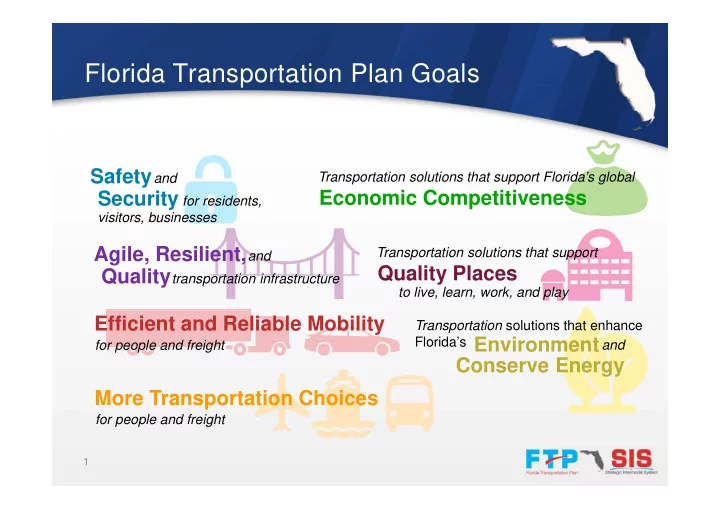
Florida Transportation Plan Goals Safety Transportation solutions that support Floridas global and Economic Competitiveness Security for residents, visitors, businesses Agile, Resilient, Transportation solutions that support and


slide-1
SLIDE 1

Florida Transportation Plan Goals

1

Safety Security

and for residents, visitors, businesses

Efficient and Reliable Mobility

for people and freight

More Transportation Choices

for people and freight Transportation solutions that support Florida’s global

Economic Competitiveness

Transportation solutions that enhance Florida’s Environment and

Conserve Energy

and transportation infrastructure

Agile, Resilient, Quality Quality Places

Transportation solutions that support to live, learn, work, and play

slide-2
SLIDE 2

2

Safety Security

and for residents, visitors, businesses

FTP Goal Imagine 2040 Goal

Enhance the Safety and Security

  • f the transportation system for both

motorized and non-motorized users. Support Economic Vitality to foster the global competitiveness, productivity, and efficiency of local and regional businesses. Transportation solutions that support Florida’s global

Economic Competitiveness Quality Places

Transportation solutions that support to live, learn, work, and play Improve the Quality of Life, promote

Energy Conservation, and Enhance the Environment,

while minimizing transportation related fuel consumption, air pollution, and greenhouse gas emissions. Transportation solutions that enhance Florida’s Environment and

Conserve Energy

slide-3
SLIDE 3

3

FTP Goal Imagine 2040 Goal

Promote Accessibility and

Mobility by increasing and

improving multi-modal

Transportation Choices, and

the connectivity across and between modes, for people and freight. Assure that Transportation

Improvements coordinate closely

with the comprehensive land use plans and support anticipated growth and development patterns. Consider cost effective solutions that

Preserve Existing Facilities and Optimize the Efficiency of

Transportation System Management and Operations. and transportation infrastructure

Agile, Resilient, Quality Efficient and Reliable Mobility

for people and freight

More Transportation Choices

for people and freight

Quality Places

Transportation solutions that support to live, learn, work, and play

slide-4
SLIDE 4

4

2040 Transportation Plan = Many Kinds of Investments …..

Preserve the System Reduce Crashes & Vulnerability Minimize Traffic for Drivers & Shippers Real Choices when Not Driving Grow Economic Activity Centers

How can performance measures help us target limited resources?

slide-5
SLIDE 5

5

Select the amount to invest, over 20 years, in each program: Low, Medium or High?

5

You have about $5,500 M to spend on four transportation programs: Save some money for Major Projects!

For simplicity, the cost estimates and budget are shown in millions of present-day dollars, for a 20-year period of spending. In each program, the low investment level is based on current spending in our county.

Preserve the System Reduce Crashes and Vulnerability Minimize Traffic for Drivers & Shippers Real Choices When Not Driving

slide-6
SLIDE 6

6

Performance Measures

Preserve the System

  • Road resurfacing schedule
  • Bridge repair schedule
  • Vehicle replacement schedule

Reduce Crashes & Vulnerability

  • Total crashes, fatal crashes, and walk/bike crashes
  • Economic impact of a major storm

Manage Traffic for Drivers & Shippers

  • Peak-hour travel time reliability
  • Affected truck trips

Real Choices for Non-Drivers

  • People & jobs served by the bus system and

trail/sidepath network

slide-7
SLIDE 7

7

0.5 1 1.5 2 2.5 3

2010 2013 Level 1 Level 3

Travel Time Reliability: How much longer could it take you at rush hour?

7 Largest Counties in FL Hillsborough - Arterials Hillsborough - Freeways

2.5x 2x 1.5x Level 1 Level 3 2013 2010

  • Peak-hour travel time is

how much less reliable than today?

  • Hours of truck delay

Level 1 – CURRENT SPENDING

  • Travel time % more reliable
  • n major roads
  • Reduced truck “hot spots”

by %

Level 2 – ATMS FULLY FUNDED

  • Level 2, plus increased

reliability on freeways

Level 3 – FWY ATMS FUNDED

What can we get if we invest in Minimizing Congestion for Drivers & Shippers?

EXAMPLE

slide-8
SLIDE 8

8

Reliability Prediction: SHRP 2 C11

  • Part of a larger FDOT effort to get SHRP 2

analytic products into practice

  • Methodology doesn’t require much data:

sketch planning level

– AADT, capacity, incident characteristics

  • Considers both recurring and incident delay
  • Predicts several reliability metrics

– Planning Time Index used: 95th %ile TT/Ideal TT

8

slide-9
SLIDE 9

9

Types of Improvements Considered

  • Operations

– Ramp metering – incident management – DMS – variable speed limits – HOV-to-HOT – hard shoulder running – Traffic signal coordination – Adaptive signal control – Integrated corridor management – Different levels of aggressiveness for some strategies (e.g., incident management) – Strategies can be bundled

9

slide-10
SLIDE 10

10

Imagine 2040.org

10

slide-11
SLIDE 11

11

Types of Improvements Considered (cont.)

  • Safety

– Red light enforcement – incident management – bike lanes – delineation – lighting – conversion to roundabout – parking prohibition – pedestrian crosswalks and beacons – add raised median – road diet – add lanes + median to 2-lane – add turn lanes – possibly connected/automated vehicles – can be bundled

11

slide-12
SLIDE 12

12

All spending levels are for 20 years, in present day million $.

Low . . . . . . . . . . . . . $1,321

  • Safety signs, guardrail, minor road fixes, & education

reduce crashes 10%

  • Highways in low lying areas unusable for 8 weeks after

Category 3 hurricane

Medium . . . . . . . . . $1,945

  • Low level, plus sidewalks and street lighting on all major

roads, and 900 high-crash intersections get fixes – reducing crashes 20%

  • Interstate highways in low-lying areas are protected from

storm surge

High . . . . . . . . . . . . . $3,385

  • Medium level, plus 900 miles of “Complete Streets”

projects (medians, streetscape, traffic calming) – reducing crashes 50%

  • Major roads and interstates in low-lying areas are

protected from storm surge

Q4: Select the amount to invest for

Reducing Crashes & Vulnerability

slide-13
SLIDE 13

13

What do we mean by Reducing Vulnerability?

slide-14
SLIDE 14

14

Risk Scenario

– Simulated Category 3 storm surge

  • Same category,

trajectory as 1921 Tarpon Springs storm

  • High tide
  • Addition of sea level

rise (2040)

slide-15
SLIDE 15

15

Simulated Cat 3 storm surge in 2040 and inundated roadway network Tampa St Pete Clearwater

slide-16
SLIDE 16

16

Stormwater Infrastructure Programs 2014

Annual Averages

  • Hillsborough County

$10.2 M ($3.6 from SW fees)

  • City of Tampa

$13.5 M ($6.1 from SW fees)

  • Temple Terrace

$ 0.8 M

  • Plant City

$ 6.9 M

  • FDOT District 7

$ 9.8 M

Total Cost $41.15 M

“Level 1 Funding”

slide-17
SLIDE 17

17

Potentially Cost-Feasible With New Funding

  • Harden 78 lane-miles of Interstates

$ 37 M

  • Harden 178 lane-miles of other arterials

$ 97 M “Harden” means improve stormwater drainage systems, strengthen road base, raise road profile, and protect shorelines from waves using vegetation or structures. Annualized over 20 years = $8 M per year +/- ($2014)

“Level 3 Funding”

slide-18
SLIDE 18

18

Weeks of Disruption in Network, Post-Event

1 2 3 4 5 6 7 8 9

Base/Low Medium High weeks disruption Investment Scenario D2 (weeks) D1 (weeks) D0 (weeks)

RECOVERY

“Base Case” Investment Scenario Narrative Coastal Interstates, particularly Bay crossings, suffer washouts at approaches and experience minor structural damage, yielding the equivalent of 2 weeks of capacity loss (includes debris removal and inspections). Washouts and erosion on coastal arterials are prevalent, a substantial portion of saturated roadway base requires replacement, and some bridges experience severe scouring and approach washouts, yielding the equivalent of 4 weeks of capacity loss. Local facilities experience similar, but more prevalent impacts and are generally designated for repair and clearance last, yielding the equivalent of 8 weeks of capacity loss.

slide-19
SLIDE 19

19

What can we get if we invest in Reduced Vulnerability?

Investment Level 1 – $823 M (current spending x 20 years) Routine drainage improvements Up to 8 weeks of road network disruption with sample Cat 3 storm Resulting economic loss: $477 M Investment Level 2 - $1,025 M Focus on interstates: drainage improvements, shoreline armoring, wave attenuation Up to 6 weeks of road network disruption with sample Cat 3 storm Resulting economic loss: $259 M or $218 M Savings Investment Level 3 – $1,159 M Interstates & arterials: drainage improvements, shoreline armoring, wave attenuation 3 weeks of road network disruption with sample Cat 3 storm Resulting economic loss: $225 M or $252 M Savings

slide-20
SLIDE 20

20

Interactive website

  • Live 8 weeks

On-the-spot polling

  • Civic groups vote

2400+ responses

Tell Us By Text or Web!

20

22333 [keyword]

slide-21
SLIDE 21

21

Your plan exceeds current budget. Click for info on revenue options.

Spending Level Preferences, On-line

Includes spending on both programs & projects over 20 years

< $5 B $5-7 B $7-9 B > $9 B

82% of respondents exceeded the current budget

slide-22
SLIDE 22

22

Financial Scenario 1 (Baseline) - Existing revenues & spending patterns

  • Most programs at

Level 1

  • US Hwys funded

with State Other Arterials Program - $465m

  • Major roads in

Tampa funded with Tampa CIT revenues thru 2026 - $40m

Existing Revenues New Revenues Level 1 Funding Level 2 Funding Level 3 Funding KES Hwy Projects KES Transit Projects Crash Reduct.

slide-23
SLIDE 23

23

Preserve the System

  • Roads repaved every 50 years on average
  • Aging bridges replaced on time, buses every 16 years

Reduce Crashes & Vulnerability

  • Continue today’s programs: crashes drop 10%
  • Low-lying major roads unusable up to 8 weeks after a Cat. 3 storm

Minimize Traffic for Drivers & Shippers

  • Intersections work 10% better
  • Continue today’s truck “quick fix” program

Real Choices when Not Driving

  • Add 140 miles of trails & sidepaths by 2040
  • Frequent bus service for 16% of people & jobs,

somewhat frequent service (every ½-hour) for 45%

Financial Scenario One (Baseline) Performance

Level 2 ½ Level 2 Level 1 Level 1 Level 1 Level 1 Level 1 Level 1

slide-24
SLIDE 24

24

Pavement Bridges Bus Maint.

  • Cong. Mgt.

Crash Reduct.

  • Vuln. Reduct.

Bus Services TD Svcs. Trails/ Sidepaths Hwy Capacity Fixed Transit State Maint. & Non-SIS Hwys

  • Metro. Grants

Transit Revenues Local Govt. Gas Tax Existing CIT

  • Imp. Fees,
  • Prop. Share

New Sales Tax $- $2,000 $4,000 $6,000 $8,000 $10,000 $12,000 $14,000 $16,000 $18,000

Expenditures Revenues

Existing Revenues New Revenues Level 1 Funding Level 2 Funding Level 3 Funding KES Hwy Projects KES Transit Projects

Financial Scenario 8a 1 Ct. Sales Tax

  • Can increase

most programs to Level 3 and afford some highway capacity and fixed transit projects

24

slide-25
SLIDE 25

25

Preserve the System

  • Roads repaved every 17 years on average, meeting standards
  • Aging bridges and buses replaced on time

Reduce Crashes & Vulnerability

  • Complete streets & intersection projects: crashes drop 21-50%
  • Low-lying major roads unusable up to 6 weeks after a Cat. 3 storm

Minimize Traffic for Drivers & Shippers

  • Intersections work 17% better, and freeways 10% better
  • Two new RR overpasses remove 10-hour daily road blockage

Real Choices when Not Driving

  • Add 240 miles of trails & sidepaths by 2040
  • Frequent bus service for almost half of people & jobs,

somewhat frequent service (every ½-hour) for almost two-thirds

Scenario 8a (One-Cent Sales Tax) Performance

Level 3 Level 2 ½ Level 2 Level 3 Level 3 Level 3 Level 3 Level 3

slide-26
SLIDE 26

“Adopt Vision Zero in Tampa!”

Because no loss of life is acceptable on our roadways “A completely different way of looking at transportation”

slide-27
SLIDE 27

Does Vision Zero Make Sense Here?

In America: 10.2 deaths per 100,000 people In Florida: 12.5 deaths per 100,000 people In Hillsborough County: 12.7 deaths per 100,000

  • n average over last five years.

That means, in 2014, 33 more people died in our county than if we had an “average” American safety record.

US DOT Fatality Analysis Reporting System, 2014 data

slide-28
SLIDE 28

Severe Crashes: Fatal Crashes:

Over Half of our “Severe Injury” and “Fatal” Crashes are occurring along Urban Major Roadways

What’s the Problem?

slide-29
SLIDE 29

Pedestrian Crash Problem Areas

Pedestrian Death Rates in High-Poverty Tracts

Governing magazine, 2008-2012 data

Larger circle = Higher rate

Crossing major roads, both at signals and away from signals, especially:

  • Along 6-lane roads
  • Along transit routes
  • In lower-income areas
  • At night
  • Hillsborough Pedestrian

Safety Action Plan, FDOT, 2015

slide-30
SLIDE 30

An example

Busch & 40th St

  • Tourists
  • USF students
  • Stores & employers
  • Popular bus route
  • Neighborhoods along both sides, connecting streets
  • Nine lanes to cross on Busch at this intersection
  • Posted speed limits: 45 mph
  • Distance to next signal-protected crosswalk: .6 mi

30

slide-31
SLIDE 31

Common theme throughout Vision Zero Plans: Speed

Speed affects left-turn & angle crash survival too!

slide-32
SLIDE 32

Top Severe Injury Crash Intersections & Corridors

Intersections with 20+ crashes Corridors with 35+ crashes

5% of our major roads account for 40% of our pedestrian crashes

Hey, wait– isn’t traffic slow enough already?

Reducing speeds in a handful of areas could make a life & death difference

Urban Major Roadways

slide-33
SLIDE 33

“Complete Street” Treatments

Octavia Blvd, San Francisco Source: dearestdistrict5.blogspot.com

  • Repurpose

existing ROW on major roads

  • Separate faster

through-traffic from local traffic

  • Calm speeding
  • Reduce exposure

for walkers and left-turns

Octavia Blvd

  • Four through-lanes
  • Two local lanes with on-street parking & “sharrows”
  • Three medians with trees; shorter crosswalks
slide-34
SLIDE 34

Busch Blvd Collaboration Example

FDOT Resurfacing + City of Tampa + MPO Enhancements Program

  • Fix major sidewalk gaps
  • Ped countdown signals
  • Hi-visibility crosswalks, local streets
  • Decorative crosswalks, major streets
  • ADA curb ramps at all crossings
  • Landscaping, including irrigation
slide-35
SLIDE 35

Fletcher Ave Collaboration Example

FDOT Safety Grant + Hillsborough Co. Resurfacing + MPO Surface Transp. Priority

  • New mid-block crossings with RRFB
  • Fix sidewalk gaps, ADA curb ramps
  • High-visibility crosswalks
  • Posted speed reduction, lane narrowing,

new bike lanes

  • Xeriscaping: median obstacle
slide-36
SLIDE 36

Intersection Spot- Treatment Collaboration

FDOT Safety Program + NHTSA Grant for Education & Enforcement

  • $2m Design/Build – Push Button contract
  • Intersections selected based on corridor

pedestrian crash history

  • Approximately 400 signalized intersections
  • Targeted enforcement at select intersections
  • Both Drivers and Pedestrians
  • Extend “Stop & Look” pedestrian education
slide-37
SLIDE 37

Tampa Walk-Bike Implementation

MPO Planning Program + Tampa traffic calming, sidewalk & 3R programs

  • Field reviews to identify

feasible low-cost treatments

  • All of the above

treatments on the table

slide-38
SLIDE 38

George Road Complete Street Feasibility Study

Hillsborough MPO, 2016

  • Install bike lanes between Memorial Highway and

Independence Parkway.

  • Crosswalks restriped with high emphasis markings
  • Sidewalks gap fill-in, meet ADA compliance standards.
  • Retrofit midblock crossing to a high emphasis crosswalk

with RRFB and landscaping

  • Retrofit painted medians to raised medians with

landscaping

  • Install 800 feet new sidewalk, south side of Independence

Parkway, east of George Road

  • Install paved shoulders and stripe for bike lanes south of

Independence Parkway

  • New path via Dana Shores Drive to connect with the U-
  • path. Existing park gates may need to be moved
  • Install bollards to internal pathway connecting

at the parking lot

  • Signal upgrades to allow detection of bicyclists. Signals

should have full pedestrian detection features and count down timers

  • Resurface roadway pavement
  • Install speed pillows
slide-39
SLIDE 39

George Road Complete Street

Health Impacts

  • The National Research Council defines Health

Impact Assessment (HIA) as “a systematic process that uses an array of data sources and analytic methods, and considers input from stakeholders to determine the potential effects of a proposed policy, plan, program, or project on the health of a population and the distribution of those effects within the population. HIA provides recommendations on monitoring and managing those effects.”

National Research Council, Improving Health in the United States, 2011

slide-40
SLIDE 40

Health Impact Determinant: Access to Regional Trail System

George Road

WR1

slide-41
SLIDE 41

Slide 40 WR1

Wade Reynolds, 2/29/2016

slide-42
SLIDE 42

Health Impact Assessment Steps……

slide-43
SLIDE 43

Outcome: Chronic Disease

(Adults, Hills. Cty.)

Health Indicator Florida (%) Hillsborough (%) White (Non-Hispanic) (%) Black (Non-Hispanic) (%) Hispanic (%) Diabetes 11.2 12.4 10.0 13.7 17.6 Overweight 13.5 15.1 12.3 17.1 21.2 Obese 36.4 38.2 38.1 45.4 35.8 Adults Ever Told Had Heart Disease, Heart Attack, Stroke 10.3 10.5 12.1 10.1 8.7 Adults Ever Told Had Arthritis 26.0 22.8 29.0 17.0 16.4

Source: Florida CHARTS, 2013 & Florida CHARTS, 2012-2014

  • 40,000 residents near George Rd
  • 45% Hispanic
slide-44
SLIDE 44