FL FLAN ANGE IN INSULATIO ION FOR FOR CA CATH THOD ODIC - - PowerPoint PPT Presentation

fl flan ange in insulatio ion for for ca cath thod odic
SMART_READER_LITE
LIVE PREVIEW

FL FLAN ANGE IN INSULATIO ION FOR FOR CA CATH THOD ODIC - - PowerPoint PPT Presentation

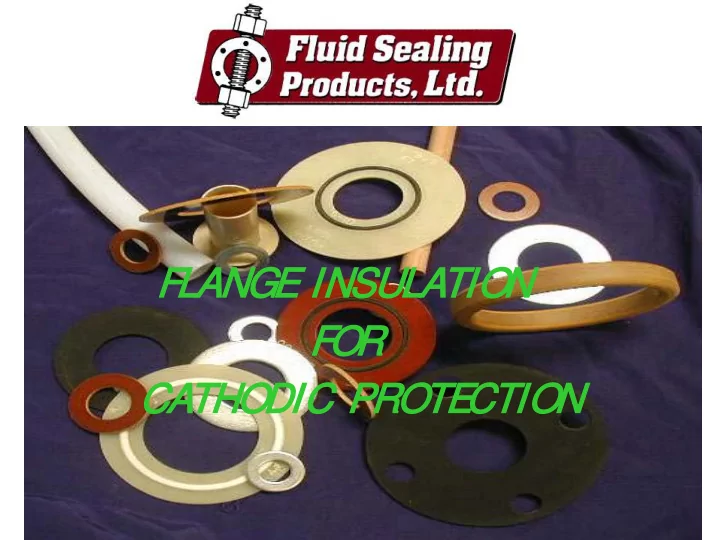
FL FLAN ANGE IN INSULATIO ION FOR FOR CA CATH THOD ODIC IC PROTE ROTE CT CTION ION Flange ange Insu Insulatio ation Flange insulation kits are the most widely used form of controlling losses due to corrosion. They can be


slide-1
SLIDE 1

FL FLAN ANGE IN INSULATIO ION FOR FOR CA CATH THOD ODIC IC PROTE ROTE CT CTION ION

slide-2
SLIDE 2

Flange ange Insu Insulatio ation

  • Flange insulation kits are the most widely used

form of controlling losses due to corrosion. They can be used to control stray electric currents in piping at oil, gas, water, refinery and chemical plants and increase the effectiveness of cathodic protection systems and confine or eliminate electrolytic corrosion.

  • Most common components are a gasket,

sleeves for bolt protection, and washers for nut

  • protection. The variety of component materials

is dependent upon application.

slide-3
SLIDE 3

Type “E ” Full Face

  • Type “E” gaskets have

the same outside diameter as the flange

  • ffering full protection.

This will prevent the collection of foreign matter between the flange faces and insures complete cathodic

  • isolation. A wide variety
  • f materials are available

to suit the requirements.

slide-4
SLIDE 4

Type “F” Raised Face

  • Type “F” gaskets are

made to fit inside the bolt circle and cover the raised face portion. It is recommended that a dirt guard be used to prevent foreign matter from shorting out the flanges. The flanges can also be

  • wrapped. A wide variety
  • f materials are available

to suit the requirements.

slide-5
SLIDE 5

Type “D” Ring Type Joint

  • Type “D” or RTJ gaskets

are made to fit the ring groove on ring type joint flanges.

  • Usually manufactured

from phenolic based materials, however customer requirements can be met.

  • It is recommended that

the flanges be wrapped

  • r a dirt guard be used to

prevent foreign material from shorting out the flanges.

slide-6
SLIDE 6

Insu Insul-Sea eal (O l (O-Rin ing T Typ ype) e)

  • Insul-Seal gaskets utilize

the resilience of an “O” ring to maintain constant contact with the flange

  • face. Both the gasket

and o-ring are available in a variety of materials as well as both “E” and “F” styles to suit the requirement.

slide-7
SLIDE 7

Gasket Specifications

  • Gaskets – Type E and F can be manufactured from:
  • Phenolic (plain and neoprene faced)
  • NEMA Grade GRE (glass reinforced epoxy)
  • Garlock Non-Asbestos sheet gasket materials
  • Garlock Gylon (reinforced PTFE)
  • INSUL-SEAL gaskets contain an O-ring (customer

specified)

  • Unique materials for special applications are

available at customers request

slide-8
SLIDE 8

Sl Sleeve ve & & Washe asher r Mate Materi rial als

  • Phenolic
  • Mylar
  • Minlon (one piece sleeve

& washer)

  • NEMA GRE (glass

reinforced epoxy)

  • Garlock non-asbestos
  • Garlock Gylon
  • Special applications at

customer request

slide-9
SLIDE 9

Recommended Installation Procedure

  • Verify the insulation kit contains the materials specified and the

contents are not damaged

  • Clean and inspect pipe flange faces.
  • Install gasket - insure proper flange alignment
  • Insert insulation sleeves into the bolt holes
  • Insert the bolt with insulating washers against the flange followed by

the steel washers and nuts

  • Tighten bolts in a cross (or star) pattern with 30% of recommended

torque followed by 60% followed by 100%

  • Retorque fasteners exposed to aggressive thermal cycling
  • Proper torque values are available upon request
slide-10
SLIDE 10

1-800-460-1028 Houston, Texas USA www.fluidsealingproducts.com