Sabbati ticals a s and t the e Scienti tifi fic M Meth thod - - PowerPoint PPT Presentation

sabbati ticals a s and t the e scienti tifi fic m meth
SMART_READER_LITE
LIVE PREVIEW

Sabbati ticals a s and t the e Scienti tifi fic M Meth thod - - PowerPoint PPT Presentation

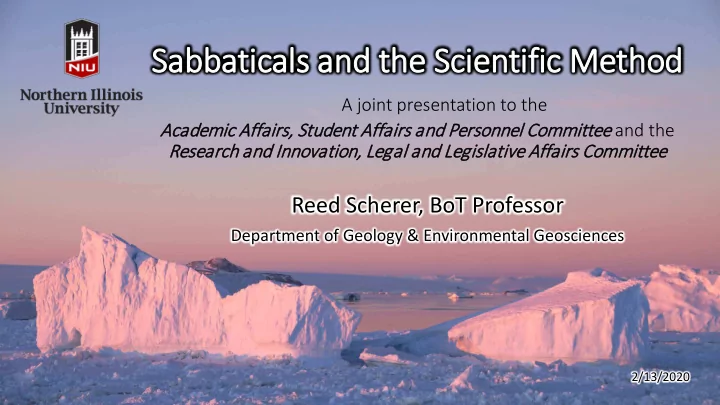
Sabbati ticals a s and t the e Scienti tifi fic M Meth thod A joint presentation to the Academic A Affairs, S Student A Affairs a and P Personnel C Commi mittee and the Research and I Innovatio ion, Le Legal a and Le Legis


slide-1
SLIDE 1

Sabbati ticals a s and t the e Scienti tifi fic M Meth thod

A joint presentation to the Academic A Affairs, S Student A Affairs a and P Personnel C Commi mittee and the Research and I Innovatio ion, Le Legal a and Le Legis isla lativ ive A Aff ffair irs C Commit ittee

Reed Scherer, BoT Professor

Department of Geology & Environmental Geosciences

2/13/2020

slide-2
SLIDE 2
  • NSF-funded WISSARD Project (2009-2015)
  • Drilling through the West Antarctic Ice Sheet to study ice sheet

stability and history

  • Relevant to society because knowing the history of ice sheet

changes provides key constraints for models that forecast future behavior in a rapidly warming, CO2-enhanced world

My Sabbatical, Fall 2016

*

slide-3
SLIDE 3
  • Among the many discoveries, our research showed a very

surprising and controversial finding based on analysis of subglacial sediment cores

  • We then broadened our analyses to include subglacial

sediments we’d recovered years ago

My Sabbatical, Fall 2016

*

slide-4
SLIDE 4
  • Our chief finding:
  • Following the end of the last Ice Age, ~9,000 years ago, the West

Antarctic Ice Sheet retreated much faster and much further than previously known

  • Retreat then halted and the ice sheet regrew to its current

configuration, suggesting some previously unknown resilience

My Sabbatical, Fall 2016

slide-5
SLIDE 5
  • We knew that publishing our findings in the peer-reviewed literature was

going to be difficult - the scientific community would be resistant

  • The peer-review process often requires convincing skeptical colleagues (often
  • ur competitors for research funding) to change their understanding
  • For maximum impact we strive to publish in the most competitive journals
  • Nature Magazine is the highest ranked scientific journal, accepting only 7.7% of

submitted research papers (following a very long vetting process).

My Sabbatical, Fall 2016

slide-6
SLIDE 6
  • A break from teaching was needed to allow me to focus
  • n the difficult process of writing the manuscript
  • (note that colleagues at most large research universities have lower teaching loads)
  • For my 2016 sabbatical I contacted a colleague at Lamont-Doherty Earth

Observatory (LDEO), Columbia University, NY and was offered a formal invitation to be Visiting Senior Scientist

  • A talk I gave at Columbia on WISSARD research turned into a game-changer!

My Sabbatical, Fall 2016

slide-7
SLIDE 7
  • Joining forces with my new colleagues resulted in a

paradigm-changing paper in Nature (published June, 2018)

  • NIU co-authors include Profs. Ross Powell & Nathan

Stansell, Ph.D. Candidate Jason Coenen, and NIU alumni Slawek Tulaczyk

  • This paper is ranked in the top 1% of scientific research

papers in terms of impact (Altimetric score of 263).

My Sabbatical, Fall 2016

slide-8
SLIDE 8
  • This is only one of a number of prominent WISSARD Project

papers, several led by graduate students

  • Most recently, Coenen et al., 2019 (just out in print this week)

Student Success

slide-9
SLIDE 9
  • Jason can certainly attest to the fact that publishing peer-reviewed research

papers is a painful, even gut-wrenching process

  • It requires extraordinary levels of patience, perseverance and the development
  • f a very thick skin! This is similarly the case with obtaining research grants.
  • The chief reward is the respect and esteem of colleagues around the world.
  • This extends to your institution!

Student Success

slide-10
SLIDE 10
  • Gave talks at 5 different universities
  • Attended and spoke at 2 research conferences
  • Submitted (and was awarded) a $10,000 research grant from the

Columbia University Climate Research Foundation

  • Used to support NIU undergraduate student research
  • Developed new lines of research and new collaborations
  • Held regular Skype meetings with my graduate and undergraduate

students

  • Had numerous media contacts

During the sabbatical, I also:

slide-11
SLIDE 11
  • During the 2016 sabbatical I was interviewed by numerous US and

international print and broadcast media regarding my research findings, including the Washington Post and Popular Science, with a potential reach of 60 million readers, not counting Twitter and Facebook hits

  • Media from the 2018 Nature paper was cited by 40 major news outlets

with a reach of 215 million readers, not including Twitter or Facebook

  • Advertising Value Equivalency (AVE) of $2M

Media contacts

slide-12
SLIDE 12

Typical al t timeline f for a a scientific r resear arch p project: 5 5-8 y years rs

  • Cultivate an idea & mature a hypothesis into a viable research proposal: 1-2+ years
  • Prepare and submit the research proposal:

3-4 months

  • Continue this or other research while waiting for proposal results:

1 year

  • If not funded on first go (likely), revise & resubmit, wait for result:

1 year

  • Once funded, perform research:

2-4+ years

  • Prepare manuscript for publication based on new results

1-2 years

  • Submit, wait for reviews, revise & resubmit (repeat as needed):

2± years

So Somewhat an analogous t to a a smal all s star art-up b bus usiness, f from i ide dea t a to profit itib ibilit ility

slide-13
SLIDE 13
  • They enhance the profile of the home institution
  • They offer important professional development opportunities for the

faculty

  • Increase likelihood of future grant funding
  • Inform and revitalize pedagogy
  • Can offer critical connections, networking and career opportunities for
  • ur students (e.g., graduate programs, research collaborations & jobs)
  • All of which pay dividends in enhancing NIU’s profile, grant dollars

and student career success!

  • THANK YOU

Sabbatical leaves are a critical component of all research universities