Fish Population Characterization Near the Drop Structure Goals and - - PowerPoint PPT Presentation

fish population characterization near the drop structure
SMART_READER_LITE
LIVE PREVIEW

Fish Population Characterization Near the Drop Structure Goals and - - PowerPoint PPT Presentation

Fish Population Characterization Near the Drop Structure Goals and Objectives Determine the location of the first fish passage barrier downstream of the drop structure Determine the amount of suitable spawning and rearing habitat for


slide-1
SLIDE 1

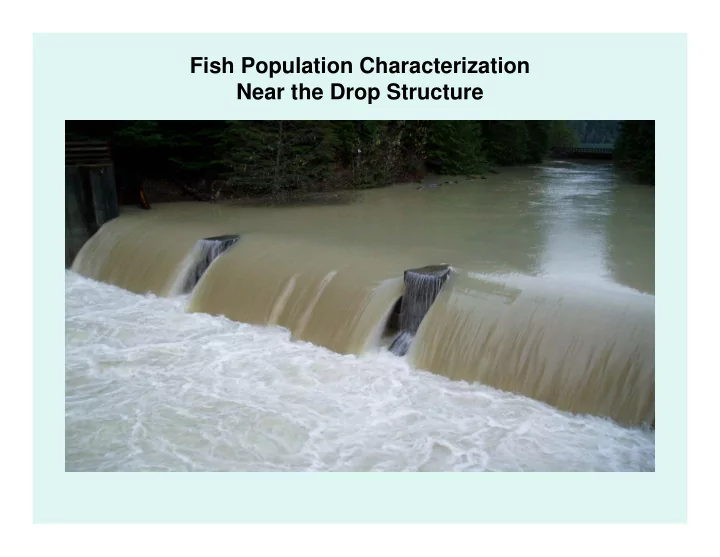
Fish Population Characterization Near the Drop Structure

slide-2
SLIDE 2

Goals and Objectives

  • Determine the location of the first fish passage

barrier downstream of the drop structure

  • Determine the amount of suitable spawning and

rearing habitat for rainbow and cutthroat in the isolated reach

  • Determine the fish species present in the

isolated reach

  • Determine the population size and age/size

structure of all fish species in the isolated reach

  • Determine upstream migration timing of any

species present

slide-3
SLIDE 3

Methods

  • Analysis of Upstream Barrier

– Surveying and Photos

  • Quantification of Spawning and Rearing Habitat

– Habitat Characterization (Habitat Typing, Stream widths, Gradients, Substrate Composition, etc.) – Fish Passage Priority Index Calculation

  • Fisheries Investigations

– Electrofishing – Length and Weight Measurements

  • Determination of Upstream Migration

– Netting below the drop structure

  • Literature Review

– Examined potential for injury of fish passing over drop structures during spill events (See Fish Population Characterization Report)

slide-4
SLIDE 4

Study Area

  • A 1464 ft section of Lake Creek from the

drop structure downstream to the first identified natural barrier.

  • This location is consistent with the

physical habitat assessment conducted in 2004.

slide-5
SLIDE 5

Analysis of Upstream Barrier

  • A definite barrier was located 1464 ft (RM 5.4)

below the drop structure

  • The barrier was surveyed in conjunction with

fisheries investigations on 8/23/06

  • The barrier possessed an 11.80 ft fall at a base

flow release of 3.5 cfs from the drop structure

  • The falls exceeds the leaping capabilities of

rainbow trout and other resident species potentially present in Lake Creek

slide-6
SLIDE 6

Barrier at RM 5.4

Barrier

slide-7
SLIDE 7

Quantification of Spawning and Rearing Habitat

  • Three 30 m study sites (SS) were evenly placed

and surveyed between the drop structure and the barrier at RM 5.4

  • A distinct habitat break existed near Study Site 2

downstream of which, gradients increased from approximately 1.40% to 6.20%

  • Spawning gravel at all three site comprised less

than 5% of the total substrate

slide-8
SLIDE 8

Lake Creek Habitat Characteristics Below the Drop Structure

slide-9
SLIDE 9

Calculation of Fish Passage Priority Index

  • After all data was collected, a Habitat Quality

Modifier (HQM) was applied to wetted and bankfull width numbers

  • Total wetted and bankfull width habitat for

rearing in the isolated reach was determined to be 395.0 m2 and 797.6 m2 respectively

  • Total wetted and bankfull width habitat for

spawning in the isolated reach was determined to be 9.1 m2 and 19.6 m2 respectively

slide-10
SLIDE 10

Calculation of Fish Passage Priority Index

slide-11
SLIDE 11

Calculation of Fish Passage Priority Index (Cont.)

slide-12
SLIDE 12

Calculated Priority Indices

slide-13
SLIDE 13

Fisheries Investigations

  • To assure consistency between this study

and the Fish Species Distribution and Composition Study, fish presence information was gathered at the 3 study sites concurrent with spawning and rearing habitat measurements in August, 2006

  • The entire 1464 ft reach was surveyed for

species information on October 17th and 18th, 2006.

slide-14
SLIDE 14

August 2006 Sampling Period

  • Two electrofishing passes were made at

each study site

  • A total of 5 rainbow were captured

– Three at SS#3 (furthest downstream, just above the barrier) – Two at SS#2

  • The fish ranged in length from 40 mm to

140 mm and in weight from 1.0 g to 28.0 g

  • No other species were observed
slide-15
SLIDE 15

August 2006 Fish Sampling Data

Fish Population Characterization Below Drop Structure Rainbow Trout Fork Length vs. Weight (August 2006)

0.0 5.0 10.0 15.0 20.0 25.0 30.0 40 110 120 125 140 Length (mm) W eight (g) Rainbow Trout

slide-16
SLIDE 16

October 2006 Sampling Period

  • The entire 1464 ft reach was electrofished
  • Reaches between 150-200 ft were blocked
  • ff with nets and two passes were made
  • A total of 12 rainbow were captured
  • The fish measured between 70 mm and

165 mm and weighed between 3.7 g and 39.5 g

  • No other species were observed
slide-17
SLIDE 17

October 2006 Fish Sampling Data

Fish Population Characterization Below Drop Structure Rainbow Trout Fork Length vs. Weight (October 2006)

5 10 15 20 25 30 35 40 45 70 75 75 80 82 115 123 123 125 127 135 165 Length (mm) Weight (g) Rainbow

slide-18
SLIDE 18

Length vs. Weight Correlation for Rainbow Trout Captured

Length vs. Weight Correlation for Rainbow Trout Captured Below the Drop Structure (2006)

y = 0.0019x2 - 0.0642x R2 = 0.9699 0.0 5.0 10.0 15.0 20.0 25.0 30.0 35.0 40.0 45.0 20 40 60 80 100 120 140 160 180 Length (mm) W eight (g) Rainbow

  • Poly. (Rainbow)
slide-19
SLIDE 19

Determination of Upstream Migration Timing

  • A fyke net was used to capture fish potentially attempting

an upstream migration near the drop structure

  • The net was in place from mid-July through late October,

2006 (Heavy snow and high flows creating overtopping events precluded netting from beginning any earlier)

  • Only 1 rainbow measuring 220 mm was captured in the

net

  • Multiple overtopping events occurred in May and June

2006

  • Many rainbow, (up to 20 at one time), measuring

between 200 mm to 300 mm were observed multiple times near the outflow of the fish flow pipe after

  • vertopping had stopped
slide-20
SLIDE 20

Fyke Net Location

slide-21
SLIDE 21

Work Left To Do

  • As conditions allow in 2007:

– Begin netting below the Drop Structure in February – June – Complete census of fish population in the affected reach in June