First-principles calculation of solution enthalpy of key gaseous - - PDF document

first principles calculation of solution enthalpy of key
SMART_READER_LITE
LIVE PREVIEW

First-principles calculation of solution enthalpy of key gaseous - - PDF document

Transactions of the Korean Nuclear Society Virtual Spring Meeting July 9-10, 2020 First-principles calculation of solution enthalpy of key gaseous impurities in liquid sodium: Correction methods Junhyoung Gil and Takuji Oda Department of


slide-1
SLIDE 1

First-principles calculation of solution enthalpy of key gaseous impurities in liquid sodium: Correction methods

Junhyoung Gil and Takuji Oda Department of Energy Systems Engineering, Seoul National University, Seoul, Republic of Korea 08826

*Corresponding author: oda@snu.ac.kr

  • 1. Introduction

A sodium fast reactor (SFR) is a Gen-IV advanced reactor that adopts liquid sodium as a coolant. To ensure the comprehensive safety of the SFR, transport properties of impurities in liquid sodium must be carefully studied. Experience and knowledge, however, have not been sufficiently accumulated for liquid sodium, compared to water that has been widely used as the coolant in existing reactors. This can be partly attributed to difficulties in performing experiments with liquid sodium, such as purity control of sodium and high chemical reactivity of sodium with water and air. Quantum mechanical (QM) calculations can be a useful alternative to experiments in studying liquid

  • sodium. In our ongoing research, we aim to establish a

calculation method for solution enthalpy, one of the fundamental transport properties, of impurities in liquid sodium by using first-principles calculations based on density functional theory (DFT). As a verification stage, we have been calculating the solution enthalpy of relatively simple but important gaseous impurities, namely O2, H2, and I2, in liquid Na [1], and comparing the results with experimental data. Meanwhile, it is known that the DFT often fails to reproduce accurately the formation enthalpy of insulating solid compounds because of incomplete error cancellation between the total energy of the compound and the total energies of its elemental constituents [2-3]. This is the case when the constituents are physically and chemically very different, such as metals (e.g. Na) and molecules (e.g. O2, H2, I2). Because the total energy of impurity- including Na is subtracted from the sum of the total energies of pure Na and an impurity molecule to obtain solution enthalpy, the DFT-calculated solution enthalpies

  • f O2, H2, and I2 in liquid Na are likely to have errors.

In this study, as a follow-up to the previous study [1], we consider several possible correction methods for the solution enthalpy calculation. Specifically, methods using (i) the experimental binding energy of an impurity molecule, (ii) the experimental formation enthalpy of an impurity-Na compound, (iii) the concept of fitted elemental-phase reference energies [2], and (iv) the concept of coordination corrected enthalpies [3] are introduced and discussed.

  • 2. Methods

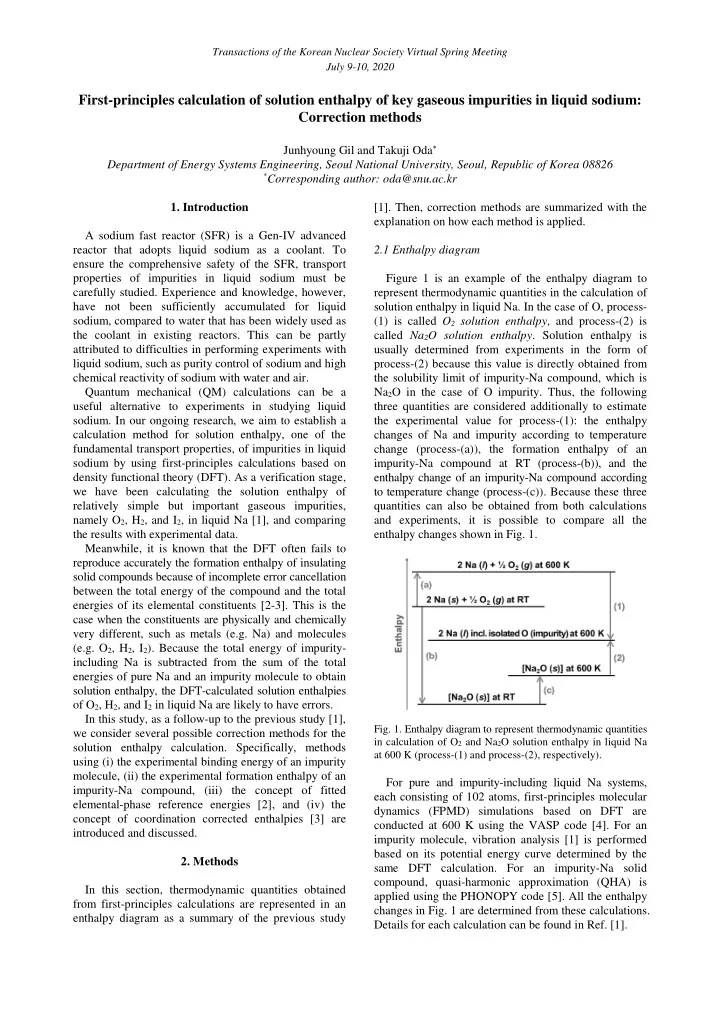
In this section, thermodynamic quantities obtained from first-principles calculations are represented in an enthalpy diagram as a summary of the previous study [1]. Then, correction methods are summarized with the explanation on how each method is applied. 2.1 Enthalpy diagram Figure 1 is an example of the enthalpy diagram to represent thermodynamic quantities in the calculation of solution enthalpy in liquid Na. In the case of O, process- (1) is called O2 solution enthalpy, and process-(2) is called Na2O solution enthalpy. Solution enthalpy is usually determined from experiments in the form of process-(2) because this value is directly obtained from the solubility limit of impurity-Na compound, which is Na2O in the case of O impurity. Thus, the following three quantities are considered additionally to estimate the experimental value for process-(1): the enthalpy changes of Na and impurity according to temperature change (process-(a)), the formation enthalpy of an impurity-Na compound at RT (process-(b)), and the enthalpy change of an impurity-Na compound according to temperature change (process-(c)). Because these three quantities can also be obtained from both calculations and experiments, it is possible to compare all the enthalpy changes shown in Fig. 1.

  • Fig. 1. Enthalpy diagram to represent thermodynamic quantities

in calculation of O2 and Na2O solution enthalpy in liquid Na at 600 K (process-(1) and process-(2), respectively).

For pure and impurity-including liquid Na systems, each consisting of 102 atoms, first-principles molecular dynamics (FPMD) simulations based on DFT are conducted at 600 K using the VASP code [4]. For an impurity molecule, vibration analysis [1] is performed based on its potential energy curve determined by the same DFT calculation. For an impurity-Na solid compound, quasi-harmonic approximation (QHA) is applied using the PHONOPY code [5]. All the enthalpy changes in Fig. 1 are determined from these calculations. Details for each calculation can be found in Ref. [1].

Transactions of the Korean Nuclear Society Virtual Spring Meeting July 9-10, 2020

slide-2
SLIDE 2

2.2 Experimental binding energy of impurity molecule This correction method focuses on the problem that the DFT calculation often does not accurately reproduce the binding energy of a gaseous molecule. In this method, the difference between the DFT-calculated and the experimental binding energies of an impurity molecule, ΔEb, is employed as a correction factor. For example, the Perdew-Burke-Ernzerhof (PBE) functional [6] used throughout the research calculates the binding energy of an O2 molecule as 6.007 eV/O2 while the corresponding experimental value is reported as 5.134 eV/O2 [7]. Accordingly, the correction factor to the total energy of an O2 molecule, ΔEb, is 0.873 eV/O2. This method assumes that the error comes only from the calculation of an impurity molecule while there

  • ccur negligible errors in the calculations of pure Na,

impurity-including Na, and an impurity-Na compound. Although the PBE functional exhibited a decent performance for pure Na in a previous study [8], there is no guarantee that the PBE well describes the interaction between impurity and Na. Thus, this correction method should not be perfect and need consideration while the method is still expected to correct much error and is relatively simple to be used. 2.3 Experimental formation enthalpy of compound This method uses both (i) the difference between the DFT-calculated and the experimental binding energies

  • f an impurity molecule, ΔEb, and (b) the difference

between the DFT-calculated and the experimental formation enthalpies of an impurity-Na compound, ΔEf. Because the formation enthalpy of an impurity-Na compound is considered, the method deals not only with the error in the calculation of an impurity molecule but also with some errors in the calculations of pure Na and an impurity-Na compound. For example, the PBE calculates the formation enthalpy of a Na2O crystal at RT to be -3.818 eV/Na2O while the corresponding experimental value is reported as -4.333 eV/Na2O [9]. This difference of 0.515 eV/Na2O (ΔEf) is related to the errors in (i) the dissociation of a Na crystal, (ii) the dissociation of an O2 molecule, and (iii) the binding to be a Na2O crystal. Meanwhile, if one considers a process where a Na2O crystal dissolves into liquid Na, of which the enthalpy change is the Na2O solution enthalpy, the process involves (i) the dissociation

  • f a Na2O crystal, (ii) the binding of the two Na atoms

with other Na atoms in liquid Na, and (iii) the binding

  • f the O impurity atom with neighboring Na atoms in

liquid Na. If (iii) is neglected here, this process is the

  • pposite of the formation process of a Na2O crystal with

the dissociation of an O2 molecule excluded. Thus, the correction factor to the Na2O solution enthalpy is determined by subtracting ΔEb from ΔEf, which is to be 0.079 eV/O. 2.4 Fitted elemental-phase reference energies Fitted elemental-phase reference energies (FERE) is the concept that the calculation error in the formation enthalpies of compounds is assumed to be allocated to each element [2]. In Ref. [2], the DFT-calculated and the experimental formation enthalpies of 252 binary compounds were used in the fitting to obtain the FERE shift, δμFERE, for each element. For example, δμFERE is reported as 0.17 eV for Na and 0.23 eV for O [2]. Using these values, the correction factor to the formation enthalpy of a Na2O crystal is determined as 0.17 eV/Na × 2 Na + 0.23 eV/O × 1 O = 0.57 eV/Na2O. The number of first-neighboring Na atoms for an O impurity atom in an O-including liquid Na system is calculated to be 5.6. However, the correction factor to the O2 solution enthalpy should not be calculated simply as 0.17 eV/Na × 5.6 Na + 0.23 eV/O × 1 O = 1.18 eV. Although the local structure of corresponding O-Na complex in O-including liquid Na may be described as “Na5.6O”, this local structure is not repeated as in a

  • crystal. Indeed, the number of first-neighboring O atoms

for a Na atom in the O-Na local complex is one because there is only one O atom. Because the number of first- neighboring atoms for a Na atom in a pure liquid Na system is calculated to be 12.9, it can be considered that

  • ne out of 12.9 first-neighboring atoms for Na is O.

Thus, the correction factor to the O2 solution enthalpy is calculated as 0.17 eV/Na × 5.6 Na × 1/13.1 + 0.23 eV/O × 1 O = 0.30 eV. 2.5 Coordination corrected enthalpies The concept of coordination corrected enthalpies (CCE) [3] is similar to that of FERE except for the following two points. First, CCE specifies oxidation state as well as the type of a cation and an anion. In

  • ther words, CCE utilizes a bond-wise correction factor

(e.g. Na-O, Na-H, etc.) while FERE utilizes an element- wise correction factor (e.g. Na, O, H, etc.). Secondly, CCE uses both the number of first-neighboring cation- anion bonds for a cation and the stoichiometric coefficients

  • f a compound while FERE uses only the stoichiometric

coefficients of a compound. For example, the correction factor for the Na-O bond with the oxidation state of Na being +1 is reported as 0.0826 eV/bond [3]. Considering that there are four first-neighboring O atoms for each Na atom in a Na2O crystal, the correction factor to the formation enthalpy of Na2O is calculated as 0.0826 eV/bond × 4 bonds × 2 = 0.661 eV/Na2O. To apply this concept to correct the calculation of O2 solution enthalpy, the following points are considered: (i) an O-Na local complex in an O-including liquid Na system consists of 5.6 Na atoms and one O impurity atom, and (ii) each Na atom in the O-Na local complex has one Na-O bond. Accordingly, the correction factor to O2 solution enthalpy is calculated as 0.0826 eV/bond × 1 bond × 5.6 = 0.463 eV.

Transactions of the Korean Nuclear Society Virtual Spring Meeting July 9-10, 2020

slide-3
SLIDE 3
  • 3. Results

Table I shows the calculation results for O2 and Na2O solution enthalpy in liquid Na at 600 K (i) before and (ii)-(v) after applying each correction. The errors from the experimental values [9,10] before the correction are +30.7 kJ/mol and -18.3 kJ/mol for O2 and Na2O solution enthalpy, respectively. The absolute errors decreased up to a few kJ/mol after applying the

  • correction. The FERE correction method works best in

the case of an O impurity while relatively simple binding energy correction and formation enthalpy correction can also decrease much error.

Table I: Calculation results for O2 and Na2O solution enthalpy in liquid Na at 600 K (i) before and (ii)-(v) after applying each correction. The experimental value for O2 solution enthalpy at 600 K, -375.7 kJ/mol, was estimated using Ref. [9,10], and the value for Na2O solution enthalpy, +46.9 kJ/mol, was directly brought from Ref. [10]. Whether and which correction is applied Solution enthalpy (kJ/mol) Error from experimental value (kJ/mol) O2 Na2O O2 Na2O (i) No correction

  • 345.0

+28.6 +30.7

  • 18.3

(ii) Binding energy correction

  • 387.1

+28.6

  • 11.4
  • 18.3

(iii) Formation enthalpy correction -387.1 +36.2

  • 11.4
  • 10.7

(iv) FERE correction

  • 373.9

+54.7 +1.8 +7.8 (v) CCE correction

  • 389.6

+47.7

  • 13.9

+0.8

According to Table I, the FERE correction results in the least absolute error for the O2 solution enthalpy while the CCE correction results in the least absolute error for the Na2O solution enthalpy. This is possibly related to the difference in the nature of the two correction methods. In the FERE correction, the error is attributed to each element. The dissolution of O2 in liquid Na, process-(1) in Fig. 1 with the enthalpy change

  • f the O2 solution enthalpy, involves the dissociation of

O2 and Na, which is about each element. Meanwhile, in the CCE correction, the error is attributed to each cation-anion bond. The dissolution of Na2O in liquid Na, process-(2) in Fig. 1 with the enthalpy change of the Na2O solution enthalpy, involves the dissociation of Na2O, which is about cation-anion bonds between elements. The comparison between calculation results and experimental data for all the thermodynamic quantities in Fig. 1 is to be shown in the presentation. Further, the most suitable correction method is to be chosen with the discussion on the correction methods after analyzing the results for H and I impurities.

  • 4. Conclusion

Correction methods for the calculation of solution enthalpy of impurity in liquid sodium have been introduced and applied for key gaseous impurities, namely O2, H2, and I2. In this paper, the results of applying each of the correction methods – binding energy correction, formation enthalpy correction, FERE correction, and CCE correction – to the O impurity in liquid Na have been shown. The FERE correction has resulted the least error in the O2 and Na2O solution enthalpy relative to the experimental values while the most appropriate correction method needs to be carefully selected after the comprehensive analysis including the results for H and I impurities. ACKNOWLEDGEMENTS This research was supported by the National Research Foundation (NRF) of Korea under the Nuclear Research and Development Program and by the BK21 PLUS project of Seoul National University. REFERENCES

[1] J. Gil and T. Oda, Solution enthalpy calculation for impurity in liquid metal by first-principles calculations: A benchmark test for oxygen impurity in liquid sodium, submitted to The Journal of Chemical Physics (under review). [2] V. Stevanović and Stephan Lany, Correcting density functional theory for accurate predictions of compound enthalpies of formation: Fitted elemental-phase reference energies, Physical Review B, Vol.85, p.115104, 2012. [3] R. Friedrich et al., Coordination corrected ab initio formation enthalpies, npj Computational Materials, Vol.5, p.59, 2019. [4] G. Kresse and J. Furthmüller, Efficient iterative schemes for ab initio total-energy calculations using a plane-wave basis set, Physical Review B, Vol.54, p.11169, 1996. [5] A. Togo and I. Tanaka, First principles phonon calculations in materials science, Scripta Materialia, Vol.108, p.1, 2015. [6] J. Perdew, K. Burke, and M. Ernzerhof, Generalized Gradient Approximation Made Simple, Physical Review Letters, Vol.77, p.3865, 1996. [7] Y. Luo and J. Kerr, CRC Handbook of Chemistry and Physics, 89th edition, CRC Press, Boca Raton, FL, 2012. [8] J. Han and T. Oda, Performance of exchange-correlation functionals in density functional theory calculations for liquid metal: A benchmark test for sodium, The Journal of Chemical Physics, Vol.148, p.144501, 2018. [9] P. Linstrom and W. Mallard, NIST Chemistry Webbook, NIST Standard Reference Database Number 69, National Institute of Standards and Technology, Gaithersburg, MD, 2019. [10] R. Eichelberger, The solubility of oxygen in liquid sodium: A recommended expression, AEC Research and Development Report, Atomics International, 1968. Transactions of the Korean Nuclear Society Virtual Spring Meeting July 9-10, 2020