First order arithmetic Axioms 1 ( x )(0 = Sx ) 2 ( x )( y )( Sx - - PowerPoint PPT Presentation

first order arithmetic
SMART_READER_LITE
LIVE PREVIEW

First order arithmetic Axioms 1 ( x )(0 = Sx ) 2 ( x )( y )( Sx - - PowerPoint PPT Presentation

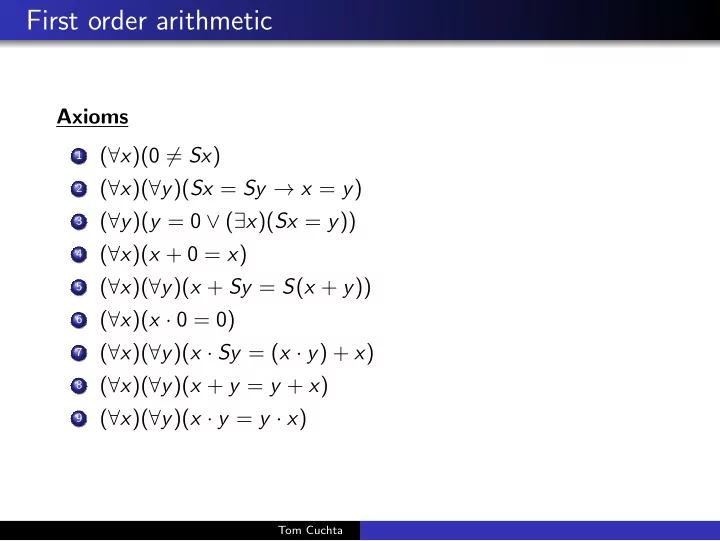
First order arithmetic Axioms 1 ( x )(0 = Sx ) 2 ( x )( y )( Sx = Sy x = y ) 3 ( y )( y = 0 ( x )( Sx = y )) 4 ( x )( x + 0 = x ) 5 ( x )( y )( x + Sy = S ( x + y )) 6 ( x )( x 0 = 0) 7 ( x )(


slide-1
SLIDE 1

First order arithmetic

Axioms

1 (∀x)(0 = Sx) 2 (∀x)(∀y)(Sx = Sy → x = y) 3 (∀y)(y = 0 ∨ (∃x)(Sx = y)) 4 (∀x)(x + 0 = x) 5 (∀x)(∀y)(x + Sy = S(x + y)) 6 (∀x)(x · 0 = 0) 7 (∀x)(∀y)(x · Sy = (x · y) + x) 8 (∀x)(∀y)(x + y = y + x) 9 (∀x)(∀y)(x · y = y · x) Tom Cuchta

slide-2
SLIDE 2

First order arithmetic

Prove in 1st order arithmetic: (x + S0) = SS0 ↔ x = S0. {Ax 5} (1) (∀y)(x + Sy = S(x + y)) Axiom 5 US {Ax 5} (2) x + S0 = S(x + 0) 1 US {Ax 4} (3) x + 0 = x Axiom 4 US {Ax 4, 5} (4) x + S0 = Sx 2 3 Identity Law {5} (5) (x + S0) = SS0 Premise {5, Ax 4, 5} (6) SS0 = Sx 4 5 Identity Law {Ax 2} (7) (∀y)(SS0 = Sy → S0 = y) Axiom 2 US {Ax 2} (8) SS0 = Sx → S0 = x 7 US {5, Ax 2, 4, 5} (9) S0 = x 6 8 Detachment {5, Ax 2, 4, 5} (10) x = S0 9 Identity {Ax 2, 4, 5} (11) (x + S0) = SS0 → x = S0 5 10 C.P. {12} (12) x = S0 Premise {12, Ax 5} (13) (x + S0) = S(S0 + 0) 2 12 Identity Law {Ax 4} (14) S0 + 0 = S0 Axiom 4 {12, Ax 4, 5} (15) x + S0 = SS0 13 14 Identity Law {Ax 4, 5} (16) x = S0 → (x + S0) = SS0 12 15 C.P. {Ax 2, 4, 5} (17) (x + S0) = SS0 ↔ x = S0 11 16 Law of Biconditionals

Tom Cuchta

slide-3
SLIDE 3

First order arithmetic

Sometimes it is useful to break a proof of a theorem down into constituent parts and then combine the parts. This can help “chunk” a longer proof into a sequence of simpler proofs. We could have proven (x + S0) = SS0 ↔ x = S0 in the following way: Theorem A: (x + S0) = SS0 → x = S0 Theorem B: x = S0 → (x + S0) = SS0 Notice in the previous slide, Theorem A was proven on line (11) and depends on Axioms 2, 4, and 5 and Theorem B was proven

  • n line (16) and depends on Axioms 4 and 5.

We allow ourselves to use theorems in a formal deduction by placing it on a new line (with proper documentation).

Tom Cuchta

slide-4
SLIDE 4

First order arithmetic

Prove (x + S0) = SS0 ↔ x = S0 from Theorem A and Theorem B: {Ax 2, 4, 5} (1) (x + S0) = SS0 → x = S0 Theorem A {Ax 4, 5} (2) x = S0 → (x + S0) = SS0 Theorem B {Ax 2, 4, 5} (3) (x + S0) = SS0 ↔ x = S0 1 2 Law of Biconditionals

Tom Cuchta

slide-5
SLIDE 5

First order arithmetic

Prove (∀x)(x · (x + S0) = x · x + x) in first order arithmetic. {Axiom 7} (1) (∀y)(x · Sy = (x · y) + x Axiom 7 US {Axiom 7} (2) x · Sx = (x · x) + x 1 US {Axiom 5} (3) (∀y)(x + Sy = S(x + y)) Axiom 5 US {Axiom 5} (4) x + S0 = S(x + 0) 3 US {Axiom 4} (5) x + 0 = x Axiom 4 {Axiom 4, 5} (6) x + S0 = Sx 4 5 Identity Law {Axiom 4, 5, 7} (7) x · (x + S0) = (x · x) + x 2 6 Identity Law {Axiom 4, 5, 7} (8) (∀x)(x · (x + S0) = (x · x) + x) 7 UG

Tom Cuchta