EQUALITY 12ai (1) T(p,q) T(q,p) (p,q are constants) AUTOMATED - - PowerPoint PPT Presentation

equality
SMART_READER_LITE
LIVE PREVIEW

EQUALITY 12ai (1) T(p,q) T(q,p) (p,q are constants) AUTOMATED - - PowerPoint PPT Presentation

EQUALITY 12ai (1) T(p,q) T(q,p) (p,q are constants) AUTOMATED REASONING (2) T(X,X) (3) p=q SLIDES 12: A "Natural" derivation of [] (1) T(p,q) T(q,p) (2) T(X,X) (3) p=q


slide-1
SLIDE 1

AUTOMATED REASONING SLIDES 12: PARAMODULATION Using Equality (=) in Data Equality Axioms Equality and Resolution: Paramodulation Controlling use of equality in Resolution: Hyper-paramodulation RUE-resolution Equality and Models

KB - AR - 09 EQAX2 and EQAX3 are substitutivity schema. There is one axiom for each argument position for each function/predicate. (1) T(p,q)∨T(q,p) (p,q are constants) (2) ¬T(X,X) (3) p=q 12ai

EQUALITY

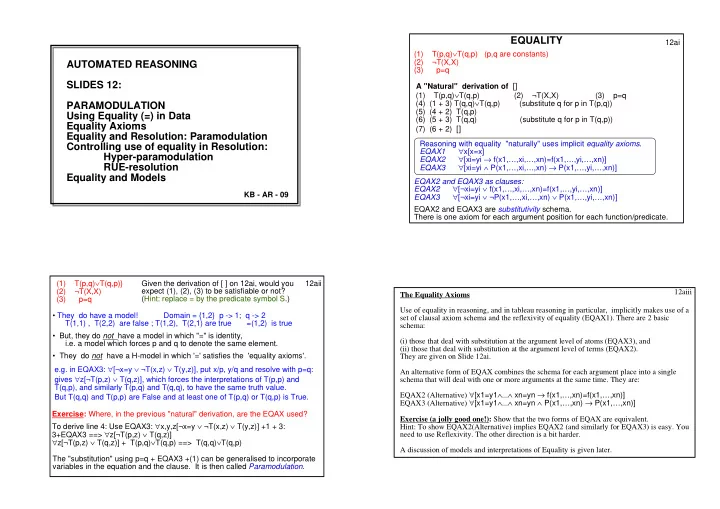
(1) T(p,q)∨T(q,p) (2) ¬T(X,X) (3) p=q (4) (1 + 3) T(q,q)∨T(q,p) (substitute q for p in T(p,q)) (5) (4 + 2) T(q,p) (6) (5 + 3) T(q,q) (substitute q for p in T(q,p)) (7) (6 + 2) [] A "Natural" derivation of [] EQAX2 and EQAX3 as clauses: EQAX2 ∀[¬xi=yi ∨ f(x1,…,xi,…,xn)=f(x1,…,yi,…,xn)] EQAX3 ∀[¬xi=yi ∨ ¬P(x1,…,xi,…,xn) ∨ P(x1,…,yi,…,xn)] Reasoning with equality "naturally" uses implicit equality axioms. EQAX1 ∀x[x=x] EQAX2 ∀[xi=yi → f(x1,…,xi,…,xn)=f(x1,…,yi,…,xn)] EQAX3 ∀[xi=yi ∧ P(x1,…,xi,…,xn) → P(x1,…,yi,…,xn)]

  • They do have a model! Domain = {1,2} p -> 1; q -> 2

T(1,1) , T(2,2) are false ; T(1,2), T(2,1) are true =(1,2) is true

  • But, they do not have a model in which "=" is identity,

i.e. a model which forces p and q to denote the same element.

  • They do not have a H-model in which '=' satisfies the 'equality axioms'.

12aii The "substitution" using p=q + EQAX3 +(1) can be generalised to incorporate variables in the equation and the clause. It is then called Paramodulation. Given the derivation of [ ] on 12ai, would you expect (1), (2), (3) to be satisfiable or not? (Hint: replace = by the predicate symbol S.) (1) T(p,q)∨T(q,p)} (2) ¬T(X,X) (3) p=q Exercise: Where, in the previous "natural" derivation, are the EQAX used? To derive line 4: Use EQAX3: ∀x,y,z[¬x=y ∨ ¬T(x,z) ∨ T(y,z)] +1 + 3: 3+EQAX3 ==> ∀z[¬T(p,z) ∨ T(q,z)] ∀z[¬T(p,z) ∨ T(q,z)] + T(p,q)∨T(q,p) ==> T(q,q)∨T(q,p) e.g. in EQAX3: ∀[¬x=y ∨ ¬T(x,z) ∨ T(y,z)], put x/p, y/q and resolve with p=q: gives ∀z[¬T(p,z) ∨ T(q,z)], which forces the interpretations of T(p,p) and T(q,p), and similarly T(p,q) and T(q,q), to have the same truth value. But T(q,q) and T(p,p) are False and at least one of T(p,q) or T(q,p) is True. 12aiii The Equality Axioms Use of equality in reasoning, and in tableau reasoning in particular, implicitly makes use of a set of clausal axiom schema and the reflexivity of equality (EQAX1). There are 2 basic schema: (i) those that deal with substitution at the argument level of atoms (EQAX3), and (ii) those that deal with substitution at the argument level of terms (EQAX2). They are given on Slide 12ai. An alternative form of EQAX combines the schema for each argument place into a single schema that will deal with one or more arguments at the same time. They are: EQAX2 (Alternative) ∀[x1=y1∧...∧ xn=yn → f(x1,…,xn)=f(x1,…,xn)] EQAX3 (Alternative) ∀[x1=y1∧...∧ xn=yn ∧ P(x1,…,xn) → P(x1,…,xn)] Exercise (a jolly good one!): Show that the two forms of EQAX are equivalent. Hint: To show EQAX2(Alternative) implies EQAX2 (and similarly for EQAX3) is easy. You need to use Reflexivity. The other direction is a bit harder. A discussion of models and interpretations of Equality is given later.

slide-2
SLIDE 2

12bi Given (1) T(p,q)∨T(q,p) (2) ¬T(X,X) (3) p=q (4). ¬S=Z ∨ ¬T(S,W) ∨ T(Z,W) (EQAX3) (5) (3+4) ¬T(p,W) ∨ T(q,W) + (1) => T(q,q) ∨ T(q,p) (6) (5+2) T(q,p) (7) ¬S=Z ∨ ¬T(W,S) ∨ T(W,Z) (EQAX3) (8) (3+7) ¬T(W,p) ∨ T(W,q) + (1) => T(q,q) (9) (8+2) []

Using the Equality Axioms in Resolution

Transitivity can be shown similarly. (Exercise: DIY!) EQAX1 and EQAX3 ⇒ symmetry of '='.

  • 1. X=X (EQAX1)
  • 2. ¬U=V ∨ ¬U=Z ∨ V=Z (EQAX3)

(¬U=V ∨ ¬P(U,Z) ∨ P(V,Z) put = for 'P' )

  • 3. a=b
  • 4. ¬(b=a) (3 and 4 from ¬∀x∀y [x=y → y=x]
  • 5. (2+4) ¬U=b ∨ ¬U=a
  • 6. (5+3) ¬a=a
  • 7. (6+1) []

Note: intermediate clauses like (5) or (8) formed from (4) + (3)

  • r from (7) + (3),

need not be retained. DEFN: (PARAMODULATION) (generalises simple substitution) if C1≡ L[t]∨ C1' (i.e. t occurs in L) , C2 ≡ r=s ∨ C2' (or s=r ∨ C2') and rθ=tθ, then the clause C1' ∨ C2' ∨ L[sθ]θ is called a paramodulant. 12bii a=b L(X) ∨ M(X) L(b) ∨ M(a) (P) match X with a replace a by b in L(a) (P) stands for paramodulation Symmetry is built in so can also match X with b and replace by a. Can match X either in L(X) or in M(X). Can also obtain: L(a)∨ M(b). Substitutions occur in 1 arg. position at a time. Example In general:

  • 1. Unify the "to" term – the one to be replaced in C1 (t)

and the "from" term – the one in the equality being replaced (r) (mgu is θ)

  • 2. Apply the unifier θ to both clauses C1 and C2 to give C1θ and C2θ
  • 3. Replace the "to" term in C1θ by the term on the other side of the "from"

equation – the one in the equality that is the replacement (sθ)

  • 4. The result is the disjunction of C1θ and C2θ after replacement and

without the equation. 12biii {f(X)=b ∨ C(X) R(f(a))∨ Q C(a) ∨ R(b) ∨ Q (P) match f(X) with f(a) and replace by b. f(X,g(X))=e ∨ T(X) S(Y,f(g(Y),Z)) ∨ W(Z) S(Y,e)∨W( g(g(Y)) )∨T(g(Y) ) (P) match f(X,g(X)) with f(g(Y),Z) (X/g(Y), Z/g(g(Y)) ) and replace f( g(Y),g(g(Y)) ) by e.

  • 1. T(p,q) ∨T(q,p) (Not everyone is trying equally hard.

¬∀x∀y[¬T(x,y) ∧ ¬T(y,x)] )

  • 2. ¬T(X,X) (No-one tries harder than himself)
  • 3. U=V (There is not more than one person.¬ ∃x∃y¬ [x = y] )

(4) (P. 3+1) T(V1,q) ∨T(q,p) (take instance U1=V1 of (3); match U1 with p and replace by V1) (5) (4+2) T(q,p) (6) (P. 5+3) T(V2,p) ( take instance U2=V2 of (3); match U2 with q and replace by V2) (7) (6+2) [] SOME MORE EXAMPLES 12biv Paramodulation Paramodulation is the method by which equality is included in resolution refutations. It is a generalisation of equality substitution: if s=t and s occurs in some sentence S, then t can replace s in any (or all) of the occurences. Similarly, if t occurs in S, then s can replace t. (See definition on 12bii.) The paramodulation rule implicitly makes use of the Equality Axiom schema and consists of several steps, given in 12bii. It is easiest to apply instantiation first, to both the clause containing the equality E as well as to the clause containing the term to which the equality will be applied, so that the term being substituted from is the same as the term being substituted

  • into. Then apply the equality substitution. The resulting clause, called a paramodulant, is the

disjunction of the instantiated and substituted clauses (apart from equality E, which is omitted). Paramodulation can be simulated by resolution, in which case there are two distinct phases: (a) use EQAX2 and E to obtain an equation E', between terms, that can be used to substitute at atom level; (b) use E' and EQAX3 to make the substitution at atom level. For (a) there may need to be (none, 1 or more) applications of using the appropriate EQAX2. For example, suppose the clause a=b ∨ C were to be used (E is a=b). In order to substitute into P(f(a)), an equality of the form f(..)=t is required. From a=b∨ C and the instance (of EQAX2) x=y→f(x)=f(y) we get f(a)=f(b)∨C (E' is f(a)=f(b)); then we can use the instance (of EQAX3) x=y∧P(x)→P(y) to obtain P(f(b))∨C. If, instead of P(f(a)), the atom was P(g(f(a))), then an additional instance of EQAX2, x=y→g(x)=g(y), is necessary to obtain g(f(a))=g(f(b))∨C from f(a)=f(b)∨C. Exercise: Show how paramodulation of X=b into P(f(Y),Y) to derive P(f(b),Y) is simulated by resolution and appropriate instances of EQAX2 and EQAX3.

slide-3
SLIDE 3

Can apply refinements (eg locking) to use of equality axioms to combine refinements with paramodulation to control use of equality axioms. eg Paramodulation can be combined with hyper-resolution: In Hyper-paramodulation, Hyper-resolution is used for the resolution steps and is forced on the use of EQAX. There are some restrictions:

  • Can only use X=Y if it is an atom in an electron.
  • Can only paramodulate into an electron.
  • May need specific instances of EQAX1 - e.g. f(x) = f(x), g(x,y) = g(x,y),
  • r must allow explicit use of EQAX2.

12ci Example: (1) a<b ∨ a=b (2) ¬ a<c (3) b<c (4) ¬x<y ∨ ¬y<z ∨ x<z (5) 1+3+4: a=b ∨ a<c} (6) P: 5+3: a<c ∨ a<c ==> a<c (factor) (7) 6+2: [] Example: (1) a=b (2) ¬P(f(a),f(b) ) (3) P(x,x) (4) x=x (Note: (5) P: 1+2: ¬P(f(b),f(b)) would violate restriction) (6) P: 1+3: P(a,b) also P(b,a) Then STUCK! Need (4a) f(x)=f(x) (or use of EQAX2 +1) (7) P:1+4a: f(b)=f(a) (8) P: 7+3: P(f(a),f(b)) (9) 8+2: [ ]

Paramodulation Strategies

  • Using EQAX3 (eg ¬x=y ∨ ¬ P(…,x,…) ∨ P(…,y…)) which is a nucleus:

it needs 2 electrons: One electron must be the one in which a=b occurs and the other must be the one in which P(…,a,…) occurs. This enforces the two restrictions (a) and (b)

  • Using EQAX2 (eg ¬x=y ∨ f(x) =f(y)), also a nucleus and needs 1 electron:

which must be the one in which a=b occurs; helps enforce (a)

  • (c) is caused by (b); eg cannot make ¬P(f(a),f(b)) into ¬P(f(a),f(a)) using a=b (in
  • rder to match P(x,x)), so must derive P(f(a),f(b)) instead;

this requires to derive f(a)=f(b) from a=b 12cii

How do the restrictions for Hyper-paramodulation arise?

a) Can only use X=Y if it is an atom in an electron. b) Can only paramodulate into an electron. c) May need specific instances of EQAX1 - e.g. f(x) = f(x), g(x,y) = g(x,y),

  • r must allow explicit use of EQAX2.

From a HR refutation using EQAX can obtain a Hyper-paramodulation refutation: Use of EQAX3 simulates a paramodulation step already Use of EQAX2 can also be turned into a paramodulation step using reflexive axioms such as f(x)=f(x). (Details an exercise.) Example: (1) a<b ∨ a=b (2) ¬a<c (3) b<c (4) {x<z ∨ ¬y<z ∨ ¬x<y (5) RUE: 2+3: ¬a=b (6) 5+1: a<b (7) 4+6+3: a<c (9) 7+2: [] 12ciii RUE-RESOLUTION (Digricoli,Raptis) Informal example: P(a)∨D, ¬P(b) and ¬x=y ∨ ¬P(x)∨P(y) (ie C1, C2 and EQAX3) ==> D∨¬a=b To match P(a) and ¬ P(b) (to resolve C1 and C2) must show a = b. The goal "show a=b" (represented by ¬a=b) is refuted after matching P(a),P(b) Can use some simplification steps to reduce ¬t1=t2 eg ¬f(a)=f(b) reduces to ¬a=b by EQAX2 implicitly ¬x=a reduces to x==a by EQAX1 implicitly RUE forces a kind of locking on use of EQAX Given C1≡L[t1]∨ D and C2≡¬L'[t2]∨ E, the RUE-resolvent is D ∨ E ∨¬t1=t2; Uses EQAX3 ¬x=y∨¬L[x]∨L[y]: L[t1] unifies with L[x] and L'[t2] unifies with L[y]. The locking gives x=y higher index than other literals. Notes on RUE-resolution RUE-resolution is an alternative to paramodulation as a way of including EQAX implicitly into the deduction. It can, informally, be interpreted as trying to impose locking onto the use of equality axioms. It is as though some kind of locking strategy is applied to EQAX3 such that the non-equality literals must be resolved (with other clauses) before any other useful resolvents can be made using these axioms. i.e. the equality literals are locked highest in EQAX3. If the RUE-resolvent includes an equality ¬t1=t2 such that t1 and t2 are not different constants, then further simplifications can be applied using either EQAX1 or EQAX2. For instance: If t1 and t2 are identical terms, then resolve with EQAX1. If t1 or t2 is a variable, then resolve with EQAX1 to instantiate the variable. If t1 and t2 are functional terms f(x1,...,xn) and f(y1,...,yn), then resolve with the (Alternative) EQAX2 (for f) to get ¬x1=y1∨... ∨¬xn=yn. Can possibly apply further simplifications to each of the inequalities so introduced. In all 3 cases the original inequality will be eliminated. Exercise (good one): Compare the use of RUE-resolution and Paramodulation for the 3 clauses (1) P(x,x,a), (2) ¬P(b,y,y), (3) b=a. 12civ

slide-4
SLIDE 4

12di

  • An E-interpretation is an H-interpretation HI , which satisfies:

t=t is true in HI for all t in the Herbrand Universe if s=t is true in HI then t=s is true in HI if s=t and t=r are true in HI then s=r is true in HI if s=t is true in HI then f(s)=f(t) is true in HI for every functor f (and similarly generalised to functors of arity > 1) if s=t and L[s] are true in HI then L[t] is true in HI

  • In other words, '=' satisfies EQAX at ground level.
  • S is E-unsatisfiable if S has no E-interpretations.
  • (Corollary) S is E-unsatisfiable iff S+EQAX is unsatisfiable.
  • (Theorem) A set of clauses S is E-unsatisfiable iff S has no models in

which '=' is interpreted as the identity relation (called normal models).

  • Completeness Result: (Peterson 1983) If S is E-unsatisfiable,

then [] can be derived from S ∪ {X=X} by paramodulation and resolution.

SOME PROPERTIES OF EQAX

  • Paramodulation allows the properties of '=' to be taken into account

implicitly and avoids using them explicitly. 12dii Models including the Equality Literal: Notes on Normal Models(1) Standard approaches to incorporating equality in tableau and first order logic introduce the notion of normal models, in which the equality predicate is interpreted as identity. I.e. if p=q is true, then p and q must be interpreted as the same domain element. However, such models are not Herbrand models (Why?) (Because Herbrand models satisfy the property that each term maps to itself in the Herbrand domain. So p and q map to unique elements of the domain.) Normal models do not sit well within a clausal framework. Instead, Herbrand models that satisfy the basic requirement of substitutivity are used. As far as satisfiability is concerned, the two approaches are equivalent: there is a normal model of some clauses S iff there is a Herbrand model of S that also satisfies the substitutivity schema. Justification of Corollary on Slide 12di: We show the contrapositive: S is E-satisfiable iff S+EQAX is satisfiable. Let M be (any) model of S+EQAX; then there is also a H- model of S+EQAX. But this is an E-interpretation by definition, so S is E-satisfiable. On the other hand, suppose S is E-satisfiable and let M be an E-interpretation that satisfies S; then M also satisfies the EQAX by definition. 12diii Notes on normal models (2): (Proof outline of Theorem) Suppose S+EQAX are unsatisfiable then S has no normal model, for such a model would violate the assumption. On the other hand, if S +EQAX are satisfied by some model M, then S+EQAX have a H-model H; this H is therefore an E-interpretation. From H can be constructed a normal model (see Chapter notes on paramodulation for construction). Example: Given: S is the set of facts p=q, T(p,q), ¬T(X,X). Suppose T(p,q), p=q, q=p, p=p, q=q are true and T(p,p), T(q,p), T(q,q) are false. This is not an E-interpretation as it doesn't satisfy the following instance of EQAX3: ¬p=q ∨ ¬T(p,q) ∨ T(q,q). Let S' be S without ¬T(X,X). Suppose all atoms are true, then both facts in S' are true in this E-interpretation. It is still not a normal model as it satisfies p=q, yet p and q are not mapped to the same domain element. A normal model M for S' could use the domain {d}, and the mapping p->d, q->d. M sets T(d,d) true and interprets "=" as the identity relation (i.e. d=d is true). M satisfies p=q (which is interpreted as d=d), and clearly satisfies the equality axioms. (In general, to obtain a normal model must ensure that all terms that are equal to one another, i.e. in the same equivalence class, are mapped to the same domain element. The domain of the normal model consists of the names of the equivalence classes (c.f. d in the example.)) 12ei

Summary of Slides 12

  • 1. The use of equality is ubiquitous in every day reasoning. It uses the natural rule
  • f substitution. Given an equality atom such as p=q, occurrences of p may be

repalced by q (or vice versa) in any context.

  • 2. Equality reasoning implicitly makes use of equality axiom schema. We called

these schema EQAX1 (Reflex), EQAX2 (for building up equations between terms) and EQAX3 (for substitution).

  • 3. In resolution theorem provers the natural rule of equality substitution is

generalised to paramodulation, in which the equality may be one disjunct of a clause, and may involve variables, both in the equality and/or the context. 4.Paramodulation leads to a large increase in the search space, especially when equalities have variables, since they will match many contexts. e.g. given f(x)=x, even if the equality is restricted so that only occurrences of the RHS may be substituted for occurrences of the LHS, there are four places in which the equality can be used in the context P(f(f(y)),y). (What are they?)

  • 5. The completeness of paramodulation and resolution states that E-

(un)satisfiability can be checked using paramodulation.

slide-5
SLIDE 5

12eii

  • 6. Models for equality in which = is interpreted as the identity predicate (x=x for all x

and no other relationships) are not usually Herbrand models. They are called normal

  • models. E-interpretations are the Herbrand/clausal analogue: a set of clauses that

have a model which is also a model of the equality axioms is called E-satisfiable. E- satisfiable clauses S have normal models as well, formed by considering the equivalence classes imposed by the given equalities as domain elements.

  • 7. In fact, a set of clauses S is E-unsatisfiable iff S has no normal models. Hence there

is only need to detect E-unsatisfiability.

  • 8. Ways to control paramodulation have been investigated. Hyper-paramodulation is
  • ne way, in which hyper-resolution restrictions are imposed on the use of equality

substitution axioms, as well as the ordinary clauses. These restrictions constrain both the equality used to provide the substitution and the literal being substituted into to belong to an electron. For completeness, functional instances of EQSUB1 (Reflex) may be needed.

  • 9. A second control method is RUE resolution, in which the equality in equality axioms

is always the last literal to be resolved upon. This enforces resolution on the two literals in such axioms, which results in ``matching'' the literals and generating negative equality literals that can be interpreted as goals to be derived. e.g. P(f(f(y)),y) can be RUE-resolved with ¬P(f(a),a): first match corresponding terms: f(f(y))=f(a) and y=f(a) and then set them as goals (i.e. negate them) yielding ¬f(f(y))=f(a) ∨ ¬y=f(a), which gives ¬f(y)=a ∨ ¬y=a. These have to be proved from the given data.