Fiona Carragher Deputy Chief Scientific Officer @DepCSOFiona 13 th - - PowerPoint PPT Presentation

fiona carragher deputy chief scientific officer
SMART_READER_LITE
LIVE PREVIEW

Fiona Carragher Deputy Chief Scientific Officer @DepCSOFiona 13 th - - PowerPoint PPT Presentation

Collaborate to Improve Care Fiona Carragher Deputy Chief Scientific Officer @DepCSOFiona 13 th July 2016 www.england.nhs.uk The triple aim for the future NHS Health & Care and wellbeing gap Quality Gap - Preventing morbidity -


slide-1
SLIDE 1

www.england.nhs.uk
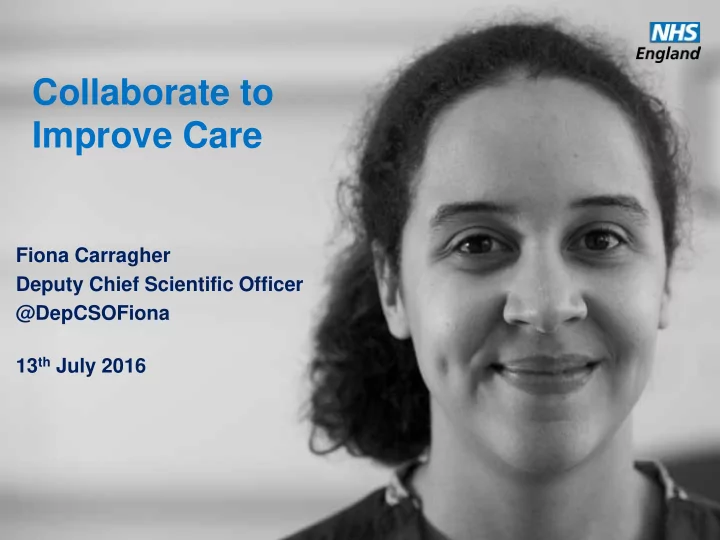
Collaborate to Improve Care

Fiona Carragher Deputy Chief Scientific Officer @DepCSOFiona 13th July 2016

slide-2
SLIDE 2

www.england.nhs.uk

The ‘triple aim’ for the future NHS

Health & wellbeing gap

  • Preventing morbidity
  • Reducing inequality

between various communities

Funding & efficiency gap

  • Ensuring effective sustainable

services given social and demographic change

Care and Quality Gap

  • Improving

identification and management of patient conditions, making the most

  • f the
  • pportunities

available

There is currently:

  • inequitable access to

diagnostics & scientific services

  • variable quality in delivery
  • commissioning fails to link to

the value proposition

slide-3
SLIDE 3

www.england.nhs.uk

Requirements for the future NHS

  • Improving integration of services –

breaking down barriers between services and developing new integrated structures

  • New structures for delivering care
  • Improving the NHS’s ability to undertake

research and innovation & raising the game on health technology

  • More investment in primary care
  • Patients have greater control of their
  • wn care
  • Radical upgrade in prevention and public

health

slide-4
SLIDE 4

Healthcare Scientists

Lab/Pathology Sciences

  • Analytical Toxicology
  • Anatomical pathology
  • Blood transfusion

science/transplantation

  • Clinical biochemistry including

paediatric metabolic biochemistry

  • Clinical genetics/Genetic

Science

  • Clinical embryology &

Reproductive Science

  • Clinical immunology
  • Cytopathology including

cervical cytology

  • Electron microscopy
  • External quality assurance
  • Haematology
  • Haemostasis and thrombosis
  • Clinical Immunology
  • Histocompatibility &

immunogenetics

  • Histopathology
  • Microbiology
  • Molecular pathology of

acquired disease

  • Phlebotomy
  • Tissue banking

Physiological Sciences

  • Audiology
  • Autonomic neurovascular function
  • Cardiac physiology
  • Clinical perfusion science
  • Critical care science
  • Gastrointestinal physiology
  • Neurophysiology
  • Ophthalmic and vision science
  • Respiratory physiology
  • Urodynamic science
  • Vascular science

Physical Sciences and Biomedical Engineering

  • Biomechanical engineering
  • Clinical measurement &

Development

  • Clinical Pharmaceutical Science
  • Diagnostic radiology & MR physics
  • Equipment management & clinical

engineering

  • Medical electronics &

instrumentation

  • Medical engineering design
  • Clinical photography
  • Nuclear medicine
  • Radiation protection & monitoring
  • Radiotherapy physics
  • Reconstructive Science
  • Rehabilitation engineering
  • Renal dialysis technology
  • Ultrasound & non-ionising

radiation

These specialisms are found across the health and social care system in the UK inclusive of the NHS, Public Health England and NHSBT and in the private & third sector delivering NHS services for patients

Bioinformatics including

  • Clinical Bioinformatics and Genomics
  • Computer science and modelling
  • Specialist Health Informatics & analysis

Many of these specialisms have important links with the other professional areas, with some staff having joint registration

slide-5
SLIDE 5

The NHS –a service built on science and technology

1950 1960 1970 1980 1990 2000 2010 1987: First digital hearing aid 2010: First bilateral cochlear implant 1995: introduction

  • f medical lasers

2002: first successful gene therapy 1985: PCR and automated DNA sequencing 1978: First IVF baby 1980: First full body MR scan 1971: First CT scan 1958: Vaccination programme for polio & diphtheria 1962: Successful total hip replacement 1958: First diagnostic ultrasound machine An indicative selection from the last 68 years

slide-6
SLIDE 6

Science and technology- crucial for the future

slide-7
SLIDE 7

…Be Innovative

  • Bring your ideas to the

table

  • Think creatively
  • Collaborate with

clinical colleagues, industry, academia

  • Who else can you

learn from ?

slide-8
SLIDE 8

…how you can make a difference to others?

slide-9
SLIDE 9

…Take your place in the team

slide-10
SLIDE 10

And be fearless !

  • Think about how you can

make a difference

  • Be confident so your

voice is heard

  • Say yes to opportunities
  • Others may come with

you

slide-11
SLIDE 11

Enthusiasm is contagious!

  • Break the stereotype
  • Have passion and

commitment

  • Think about how you can

play your part in this challenge

  • Bring your skill, expertise,

creative minds to the problems raised