Finite Mathematics MAT 141: Chapter 4 Notes Slack Variables and the - - PowerPoint PPT Presentation

finite mathematics mat 141 chapter 4 notes
SMART_READER_LITE
LIVE PREVIEW

Finite Mathematics MAT 141: Chapter 4 Notes Slack Variables and the - - PowerPoint PPT Presentation

MAT 141, Chapter 4 Finite Mathematics MAT 141: Chapter 4 Notes Slack Variables and the Pivot The Simplex Method David J. Gisch S implex Method and S lack Variables S lack Variables We use a slack variable to turn an inequality into an


slide-1
SLIDE 1

MAT 141, Chapter 4 1

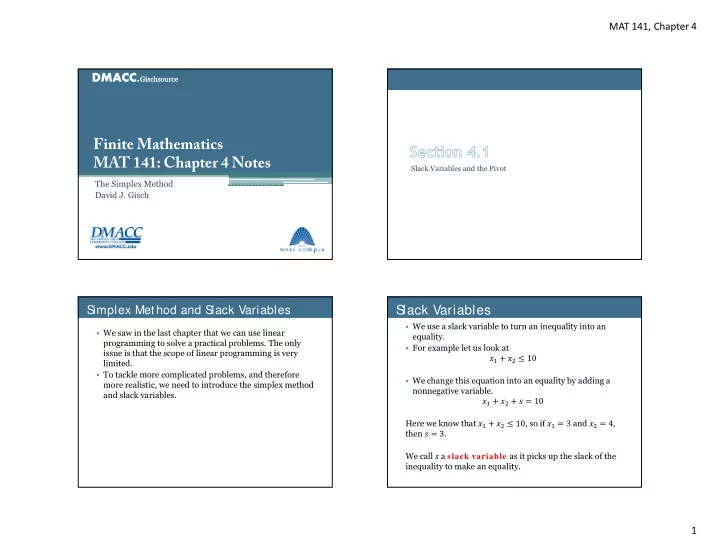
Finite Mathematics MAT 141: Chapter 4 Notes

The Simplex Method David J. Gisch

Slack Variables and the Pivot

S implex Method and S lack Variables

  • We saw in the last chapter that we can use linear

programming to solve a practical problems. The only issue is that the scope of linear programming is very limited.

  • To tackle more complicated problems, and therefore

more realistic, we need to introduce the simplex method and slack variables.

S lack Variables

  • We use a slack variable to turn an inequality into an

equality.

  • For example let us look at

10

  • We change this equation into an equality by adding a

nonnegative variable. 10 Here we know that 10, so if 3 and 4, then 3. We call a slack variable as it picks up the slack of the inequality to make an equality.

slide-2
SLIDE 2

MAT 141, Chapter 4 2

S implex Method

  • Because we are using several variables it is not

convenient to use x, y, z etc. Thus, we use , read “x sub

  • ne,” and so forth so we are not limited by the letters of

the alphabet.

The Farmer

Example: A farmer has 100 acres of land on which he wishes to plant a mixture of potatoes, corn, and cabbage. The amounts and constraints are given in the following table. (a) Write the objective function using subscripted variables. 120 40 60

The Farmer

a) Write the constraints as inequalities.

b) Write the constraints as inequalities. 100 400 160 180 20,000 10 4 7 500 c) Write each inequality as an equality using a different slack variable for each.

  • +

+ +

  • 100

10 +4 +7 +

  • 500

Simplified

The Farmer

(a) Write the constraints as inequalities. (b) Basdkashflka (c) asjflhaljf

(d) Now add the objective function with all variables moved to the left. (e) Turn this into an augmented matrix.

  • 100

10 4 7

  • 500

120 40 60

  • 1

1 1 1 100 10 4 7 1 500 120 40 60 1

This augmented matrix is called the Sim plex Tableau. The objective function always goes

  • n the

bottom.

slide-3
SLIDE 3

MAT 141, Chapter 4 3

Bicycles

Example: A manufacturer of bicycles builds racing, touring, and mountain models. The bicycles are made of both aluminum and steel. The company has available 91,800 units of steel and 42,000 units of

  • aluminum. The racing, touring, and mountain models need 17, 27,

and 34 units of steel, and 12, 21, and 15 units of aluminum,

  • respectively. How many of each type of bicycle should be made in
  • rder to maximize profit if the company makes $8 per racing bike,

$12 per touring bike, and $22 per mountain bike? What is the maximum possible profit? (a) Write the objective function using subscripted variables. (b) Write the constraints as inequalities and turn them into equalities by including slack variables. (c) Take these equalities and the objective function and include them in a simplex tableau.

Bicycles

`

The Pivot Method

  • How do we take the simplex tableau and find a solution?

▫ We use Gauss-Jordan to pivot about elements. ▫ Pivot about the highlighted variable.

  • 1

1 1 1 100 10 4 7 1 500 120 40 60 1

  • 1

1 1 1 100 1 2 5

  • 7 10

50 120 40 60 1

120

⁄ 1 1 10

  • 50

1 2 5

  • 7 10

50 8 24 12 1 6000

You have zeros above and

  • below. The pivot is

complete.

The Pivot Method

  • Read the solution from the result?
  • This tells us that with 50 and 50 we have a maximum

profit of $6000.

  • This means we should plant 50 acres of potatoes, no corn, and no

cabbage.

▫ Thus, we end up leaving 50 acres unplanted (represented by the slack variable). It seems weird but it is actually optimal. Check it out.

⁄ 1 1 10

  • 50

1 2 5

  • 7 10

50 8 24 12 1 6000

Acres Cost Profit 40 $16,000 $4,800 $4,000 Left 50 $20,000 $6,000 60 $24,000 $7,200 Out of Money 1 1 1

slide-4
SLIDE 4

MAT 141, Chapter 4 4

`

The Pivot Method

  • 2

2 1 1 12 1 2 3 1 45 3 1 1 1 20 2 1 3 1

Example: Pivot about the indicated number and state the resulting solution.

`

The Pivot Method

  • 2

2 3 1 500 4 1 1 1 300 7 2 4 1 700 3 4 2 1

Example: Pivot about the indicated number and state the resulting solution.

Maximization Problems

S teps to the S implex Method

slide-5
SLIDE 5

MAT 141, Chapter 4 5

Find the Pivot

  • 2

2 1 1 12 1 2 3 1 45 3 1 1 1 20 2 1 3 1

Example: Find the Pivot for the tableau.

Most negative indicator. 12 1 12 45 3 15 20 1 20 Smallest nonnegative number.

Find the Pivot

  • 4

2 3 1 22 2 2 5 1 28 1 3 2 1 45 3 2 4 1

Example: Find the Pivot for the tableau.

Most negative indicator. 22 3 7.33 28 5 5.6 45 2 22.5 Smallest nonnegative number.

Quick Review

4)

Find the Pivot

  • 2

1 2 1 25 4 3 2 1 40 3 1 6 1 60 4 2 3 1

Example: Find the Pivot for the tableau and perform the pivot.

slide-6
SLIDE 6

MAT 141, Chapter 4 6

Example Continued Example Continued Example Continued Put it all together.

Example: Use the simplex method to solve the linear programming problem.

Maximize: 8 3 Subject to: 6 8 118 5 10 220 0, 0, 0

slide-7
SLIDE 7

MAT 141, Chapter 4 7

Example Continued

  • 1

6 8 1 118 1 5 10 1 220 8 3 1 1

  • 1

6 8 1 118 1 2 1 1 2 45 63 8 1 994

→ 8 → Optimal solution is 118, 0 , and 0 which gives you a maximum of 994. Remember to check that all the indicators are positive!

Put it all together.

Example: Use the simplex method to solve the linear programming problem.

Maximize: 2 5 Subject to: 5 2 30 4 3 6 72 0, 0, 0

Example Continued Put it all together.

Example: Big Dave’s Fancy Widget Emporium makes three products. The distribution of labor and the profits are give in the table below. Create a simplex tableau and solve to maximize profit.

Departm ent Production Hours by Product Departm ent Capacity for Hours A B C Assembling 2 3 2 30,000 Painting 1 2 2 38,000 Finishing 2 3 1 28,000 (PROFIT) $2 $5 $4

slide-8
SLIDE 8

MAT 141, Chapter 4 8

Widgets Continued Toy Manufacturer

Example: A small toy manufacturing firm has 200 squares of felt, 600 oz of stuffing, and 90 ft of trim available to make two types of toys, a small bear and a monkey. The bear requires 1 square of felt and 4 oz of stuffing. The monkey requires 2 squares of felt, 3 oz of stuffing, and 1 ft of trim. The firm makes $1 profit on each bear and $1.50 profit on each monkey. (a) Set up the linear programming problem to maximize profit. (b) Solve the linear programming problem.

Toy Manufacturer

Minimization Problems

slide-9
SLIDE 9

MAT 141, Chapter 4 9

Transposition Of Matrices

  • Taking a matrix and interchanging its row for its

columns is known as the transposition of a matrix, denoted . 2 3 1 1 4 , 2 3 1 1 4

  • Note that if has size , then has size .

Example: Find the transposition of the given matrix. 3 2 1 4 6 3 5

Minimization Problems

  • To minimize a linear programming problem you

transpose its matrix of equations and treat it as a maximization problem.

Minimize: 7 5 8 Subject to: 3 2 10 4 5 25 0, 0, 0 Maximize: 10 25 Subject to: 3 4 7 2 5 5 8 0, 0, 0 3 2 1 10 4 5 25 7 5 8 3 4 7 2 5 5 1 8 10 25 This idea of transposing the matrices is also known as stating the dual problem. Transpose Duals

Minimization

Example: Use the simplex method to solve the linear programming problem.

Minimize: 4 Subject to: 2 3 115 2 8 200 50 0, 0, 0 Maximize: 115 200 50 Subject to: 2 1 2 2 3 8 4 0, 0, 0 1 2 3 115 2 1 8 200 1 1 50 1 2 4 1 2 1 1 2 1 2 3 8 1 4 115 200 50

Example Continued

slide-10
SLIDE 10

MAT 141, Chapter 4 10

Minimization

Example: A biologist must make a nutrient of her algae. The nutrient must contain the three basic elements D, E, and F, and must contain at least 10 kg of D, 12 kg of E, and 20 kg of F. The nutrient is made from three ingredients I, II, and III. The quantity of D, E, and F in one unit of each

  • f the ingredients is given in the chart below. How many

units of each ingredient are required to meet the biologists needs at minimum cost?

Example 4.3.3 Continued What’s up?

  • Monday (10-21)

▫ Review for Test. All the cool kids will be there.

  • Wednesday (10-23)

▫ Test 2: Chapters 3 & 4 ▫ Long problems so very few questions but with multiple parts on the test.  So if you can’t get past the first part you are toast!!!!  Practice! ▫ I’ll try to give you “well-behaved” problems but that does not mean fractions will not occur.