CS156: The Calculus of F [ x 1 , . . . , x n ] or x 1 , . . . , x n - - PowerPoint PPT Presentation

cs156 the calculus of
SMART_READER_LITE
LIVE PREVIEW

CS156: The Calculus of F [ x 1 , . . . , x n ] or x 1 , . . . , x n - - PowerPoint PPT Presentation

Decision Procedures for Quantifier-free Fragments For theory T with signature and axioms A , decide if CS156: The Calculus of F [ x 1 , . . . , x n ] or x 1 , . . . , x n . F [ x 1 , . . . , x n ] is T -satisfiable Computation


slide-1
SLIDE 1

CS156: The Calculus of Computation

Zohar Manna Winter 2008 Chapter 8: Quantifier-free Linear Arithmetic

Page 1 of 125

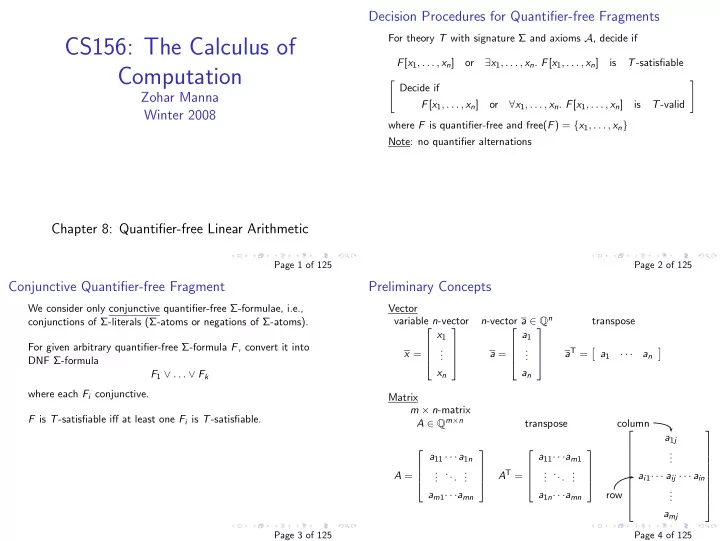
Decision Procedures for Quantifier-free Fragments

For theory T with signature Σ and axioms A, decide if F[x1, . . . , xn]

  • r

∃x1, . . . , xn. F[x1, . . . , xn] is T-satisfiable

  • Decide if

F[x1, . . . , xn]

  • r

∀x1, . . . , xn. F[x1, . . . , xn] is T-valid

  • where F is quantifier-free and free(F) = {x1, . . . , xn}

Note: no quantifier alternations Page 2 of 125

Conjunctive Quantifier-free Fragment

We consider only conjunctive quantifier-free Σ-formulae, i.e., conjunctions of Σ-literals (Σ-atoms or negations of Σ-atoms). For given arbitrary quantifier-free Σ-formula F, convert it into DNF Σ-formula F1 ∨ . . . ∨ Fk where each Fi conjunctive. F is T-satisfiable iff at least one Fi is T-satisfiable. Page 3 of 125

Preliminary Concepts

Vector variable n-vector n-vector a ∈ Qn transpose x =     x1 . . . xn     a =     a1 . . . an     aT =

  • a1

· · · an

  • Matrix

m × n-matrix A ∈ Qm×n transpose column A =     a11 · · ·a1n . . . ... . . . am1· · ·amn     AT =     a11· · ·am1 . . . ... . . . a1n· · ·amn     row           a1j . . . ai1· · · aij · · · ain . . . amj           Page 4 of 125

slide-2
SLIDE 2

Multiplication I

vector-vector aTb = [a1 · · · an]     b1 . . . bn     =

n

  • i=1

aibi matrix-vector Ax =     a11 · · · a1n . . . ... . . . am1 · · · amn         x1 . . . xn     =     n

i=1 a1ixi

. . . n

i=1 amixi

    Page 5 of 125

Multiplication II

matrix-matrix      . . . · · · aik · · · . . .           . . . · · · bkj · · · . . .     =      . . . · · · pij · · · . . .      A B P where pij = aibj =

  • ai1

· · · ain

   b1j . . . bnj     =

n

  • k=1

aikbkj Page 6 of 125

Special Vectors and Matrices

0 - vector (column) of 0s 1 - vector of 1s Thus 1Tx =

n

  • i=1

xi I =     1 ... 1     identity matrix (n × n) Thus IA = AI = A, for n × n matrix A. unit vector ei =           . . . 1 . . .           ith (Note: matrix indices start at 1) Page 7 of 125 Vector Space - set S of vectors closed under addition and scaling

  • f vectors. That is,

if v1, . . . , vk ∈ S then λ1v1 + · · · + λkvk ∈ S for λ1, . . . , λn ∈ Q Linear Equation F : Ax = b m × n-matrix variable n-vector m-vector represents the ΣQ-formula F : (a11x1 + · · · + a1nxn = b1) ∧ · · · ∧ (am1x1 + · · · + amnxn = bm) Gaussian Elimination Find x s.t. Ax = b by elementary row operations

◮ Swap two rows ◮ Multiply a row by a nonzero scalar ◮ Add one row to another

Page 8 of 125

slide-3
SLIDE 3

Example 4 I

Solve    3 1 2 1 1 2 2 1       x1 x2 x3    =    6 1 2    Construct the augmented matrix    3 1 2 6 1 1 1 2 2 1 2    Apply the row operations as follows: Page 9 of 125

Example 4 II

  • 1. Add −2a1 + 4a2 to a3

   3 1 2 6 1 1 1 1 −6   

  • 2. Add −a1 + 2a2 to a2

   3 1 2 6 −1 1 −3 1 −6    This augmented matrix is in triangular form. Page 10 of 125

Example 4 III

Solving x3 = −6 −x2 + x3 = −3 ⇒ x2 = −3 3x1 + x2 + 2x3 = 6 ⇒ x1 = 7 The solution is x =

  • 7

−3 −6 T Page 11 of 125

Inverse Matrix

A−1 is the inverse matrix of square matrix A if AA−1 = A−1A = I Square matrix A is nonsingular (invertible) if its inverse A−1 exists. How to compute A−1 of A? [A | I] [I | A−1] elementary row operations How to compute kth column of A−1? Solve Ay = ek, i.e.        . . . A 1 . . .        solve triangular matrix y = . . . (kth column of A−1) solve using elementary row operations Page 12 of 125

slide-4
SLIDE 4

Linear Inequalities I

Polyhedral Space For m × n-matrix A, variable n-vector x, and m-vector ¯ b, the ΣQ-formula G : Ax ≤ ¯ b, i.e., G :

m

  • i=1

ai1x1 + · · · + ainxn ≤ bi describes a subset (space) of Qn, called a polyhedron. Page 13 of 125

Linear Inequalities II

Convex Space An n-dimensional space S ⊆ Rn is convex if for all pairs of points ¯ v1, ¯ v2 ∈ S, λ¯ v1 + (1 − λ)¯ v2 ∈ S for λ ∈ [0, 1] . Ax ≤ ¯ b defines a convex space. For suppose A¯ v1 ≤ ¯ b and A¯ v2 ≤ ¯ b; then also A(λ¯ v1 + (1 − λ)¯ v2) ≤ ¯ b . Page 14 of 125

Linear Inequalities III

Vertex Consider m × n-matrix A where m ≥ n. An n-vector ¯ v is a vertex of Ax ≤ ¯ b if there is

◮ a nonsingular n × n-submatrix A0 of A and ◮ corresponding n-subvector ¯

b0 of ¯ b such that A0¯ v = ¯ b0 . The rows a0i in A0 and corresponding values b0i of ¯ b0 are the set

  • f defining constraints of the vertex ¯

v. Two vertices are adjacent if they have defining constraint sets that differ in only one constraint. Page 15 of 125

Example I

Consider the linear inequality              −1 −1 −1 −1 1 1 1 −1 1 −1             

  • A

     x y z1 z2     

x

≤              3 2 2             

b

A is a 7 × 4-matrix, b is a 7-vector, and x is a variable 4-vector representing the four variables {x, y, z1, z2}. Page 16 of 125

slide-5
SLIDE 5

Example II

v = [2 1 0 0]T is a vertex of the constraints. For the nonsingular submatrix A0 (rows 3, 4, 5, 6 of A: defining constraints of v),      −1 −1 1 1 1 −1     

  • A0

     2 1     

v

=      3 2     

b0

Page 17 of 125

Example III

Another vertex: v0 =

  • T, since

     −1 −1 −1 −1     

  • A0

         

v0

=          

b0

(rows 1,2,3,4 of A: defining constraints of v0) Note: v and v0 are not adjacent; they are different in 2 defining constraints. Page 18 of 125

Linear Programming I

Optimization Problem max cTx . . . objective function subject to Ax ≤ b . . . constraints Maximize

n

  • i=1

cixi subject to     a11 · · · a1n . . . ... . . . am1 · · · amn         x1 . . . xn     ≤     b1 . . . bm     Page 19 of 125

Linear Programming II

Solution: Find vertex v∗ satisfying Ax ≤ b and maximizing cTx. That is, Av∗ ≤ b and cTv∗ is maximal: cTv∗ ≥ cTu for all u satisfying Au ≤ b

◮ If Ax ≤ b is unsatisfiable,

then maximum is −∞

◮ It’s possible that the maximum is unbounded,

then maximum is ∞ Page 20 of 125

slide-6
SLIDE 6

Example: Consider optimization problem: max

  • 1

1 −1 −1

  • cT

     x y z1 z2     

x

subject to              −1 −1 −1 −1 1 1 1 −1 1 −1             

  • A

     x y z1 z2     

x

≤              3 2 2             

b

Page 21 of 125 Example (cont): The objective function is (x − z1) + (y − z2) . The constraints are equivalent to the ΣQ-formula x ≥ 0 ∧ y ≥ 0 ∧ z1 ≥ 0 ∧ z2 ≥ 0 ∧ x + y ≤ 3 ∧ x − z1 ≤ 2 ∧ y − z2 ≤ 2 Page 22 of 125

Example: Linear Programming I

A company is producing two different products using three machines A, B, and C.

◮ Product 1 needs A for one, and B for one hour. ◮ Product 2 needs A for two, B for one, and C for three hours. ◮ Product 1 can be sold for $300; Product 2 for $500. ◮ Monthly availability of machines:

A: 170 hours, B: 150 hours, C 180 hours. Page 23 of 125

Example: Linear Programming II

Let x1 and x2 denote the amount of product 1 and product 2, resp. We want to optimize 300x1 + 500x2 subject to: 1x1 + 2x2 ≤ 170 Machine (A) 1x1 + 1x2 ≤ 150 Machine (B) 0x1 + 3x2 ≤ 180 Machine (C) x1 ≥ 0 ∧ x2 ≥ 0 Page 24 of 125

slide-7
SLIDE 7

Example: Linear Programming III

x1 x2 x1 + x2 ≤ 150 x1 + 2x2 ≤ 170 3x2 ≤ 180 Page 25 of 125

Example: Linear Programming IV

Optimize 300x1 + 500x2: x1 x2 $49000 $45000 $30000 v∗ Page 26 of 125

Duality Theorem

For m × n-matrix A, m-vector b and n-vector c: max{cTx | Ax ≤ b ∧ x ≥ 0} = min{b

Ty | ATy ≥ c ∧ y ≥ 0}

if the constraints are satisfiable. That is, maximizing the function cTx over Ax ≤ b, x ≥ 0 (the primal form of the optimization problem) is equivalent to minimizing the function b

Ty over ATy ≥ c, y ≥ 0

(the dual form of the optimization problem) By convention: when Ax ≤ b ∧ x ≥ 0 unsatisfiable, the max is −∞ and the min is ∞. Page 27 of 125

  • Ax ≤ b

cTx ≤ δ δ− δ+ Figure: Visualization of the duality theorem The region labeled Ax ≤ b satisfies the inequality. The objective function cTx is represented by the dashed line. Its value increases in the direction of the arrow labeled δ+ and decreases in the direction of the arrow labeled δ−. Page 28 of 125

slide-8
SLIDE 8

Example: A Dual Problem

What is the value of a machine hour? Let yA, yB, yC be the values of machine A, B, and C. The value of the machine hours to produce something ≥ the value

  • f the product (> if that product should not be produced).

yA ≥ 0 ∧ yB ≥ 0 ∧ yC ≥ 0 1yA + 1yB + 0yC ≥ 300 2yA + 1yB + 3yC ≥ 500 We minimize the value 170yA + 150yB + 180yC to get the value of a machine hour: yA = 200 ∧ yB = 100 ∧ yC = 0 170yA + 150yB + 180yC = 49000 This is the dual problem. It has the same optimal value. Page 29 of 125

The Simplex Method

Consider linear program M : max ¯ cT¯ x subject to G : A¯ x ≤ ¯ b The simplex method solves the linear program in two main steps:

  • 1. Obtain an initial vertex ¯

v1 of A¯ x ≤ ¯ b.

  • 2. Iteratively traverse the vertices of A¯

x ≤ ¯ b, beginning at ¯ v1, in search of the vertex that maximizes ¯ cT¯

  • x. On each iteration

determine if ¯ cT¯ vi > ¯ cT¯ v′

i for the vertices ¯

v′

i adjacent to ¯

vi:

◮ If not, move to one of the adjacent vertices ¯

v ′

i with a greater

  • bjective value.

◮ If so, halt and report ¯

vi as the optimum point with value ¯ cT¯ vi. The final vertex ¯ vi is a local optimum since its adjacent vertices have lesser objective values. But because the space defined by A¯ x ≤ ¯ b is convex, ¯ vi is also the global optimum: it is the highest value attained by any point that satisfies the constraints. Page 30 of 125

Example

x1 x2 Page 31 of 125

Example

x1 x2 30000 Page 32 of 125

slide-9
SLIDE 9

Example

x1 x2 30000 45000 Page 33 of 125

Example

x1 x2 45000 49000 Page 34 of 125

Example

x1 x2 49000 Page 35 of 125

How do we use optimization to determine satisfiability?

We are not interested in an optimal solution x such that F : Ax ≤ b ; we want some solution. However, this hard to find. Idea: Transform F into an optimization problem with an initial (not-optimal) vertex v1 and a desired optimum vF. Apply the Simplex Method until an optimal vertex v∗ is obtained. The optimum value for v∗ is vF iff F : Ax ≤ b is satisfiable. The solution can be computed from the optimal solution x of the

  • ptimization problem.

Page 36 of 125

slide-10
SLIDE 10

Outline of the Algorithm I

Determine if ΣQ-formula F :

m

  • i=1

ai1x1 + . . . + ainxn ≤ bi ∧

  • i=1

αi1x1 + . . . + αinxn < βi is satisfiable. Note: Equations ai1x1 + . . . + ainxn = bi are allowed; break them into two inequalities: ai1x1 + . . . + ainxn ≤ bi −ai1x1 + . . . + −ainxn ≤ −bi Page 37 of 125

Outline of the Algorithm II

F is TQ-equivalent to the ΣQ-formula F ′ :

m

  • i=1

ai1x1 + . . . + ainxn ≤ bi ∧

  • i=1

αi1x1 + . . . + αinxn + z ≤ βi ∧ z > 0 Page 38 of 125

Outline of the Algorithm III

To decide the TQ-satisfiability of F ′, solve the linear program max z subject to

m

  • i=1

ai1x1 + . . . + ainxn ≤ bi

  • i=1

αi1x1 + . . . + αinxn + z ≤ βi F ′ is TQ-satisfiable iff the optimum is positive. Page 39 of 125

Outline of the Algorithm IV

When F does not contain any strict inequality literals, the corresponding linear program max 1 subject to

m

  • i=1

ai1x1 + . . . + ainxn ≤ bi has optimum −∞ iff the constraints are TQ-unsatisfiable, 1 iff the constraints are TQ-satisfiable. Page 40 of 125

slide-11
SLIDE 11

Outline of the Algorithm V

To determine the satisfiability of F : Ax ≤ b, M → M0 reformulate the satisfiability of F as an optimization problem: M0 : max{¯ cT¯ x′ | A′¯ x′ ≤ ¯ b′} such that F is TQ-satisfiable iff the optimal value of M0 is a particular value vF (derived from the structure of F). Simplex Method vertex traversal until termination Page 41 of 125

Outline of the Algorithm VI

The simplex method traverses the vertices of A′x′ ≤ b

′ searching

for the maximum of the objective function cTx′. If v1, v2, . . . are the traversed vertices in the iteration, then cTv1 < cTv2 < · · · . The simplex method terminates at some vertex vi∗ where cTvi∗ is the global optimum Final step: Compare the discovered optimal value cTvi∗ to the desired value vF.

◮ if equal, then F is TQ-satisfiable ◮ otherwise, F is TQ-unsatisfiable

Page 42 of 125

Step 0: From Satisfiability to Optimization

Given ΣQ-formula F : Ax ≤ b (8.1) reformulate to new constraint system (new A, x, b) F ′ : x ≥ 0, Ax ≤ b such that F ′ is TQ-equisatisfiable to F The trick: replace each variable x in F by x1 − x2 and add ¯ x ≥ 0 Page 43 of 125

Step 0: From Satisfiability to Optimization

Making the bi positive Collect the lines where bi is negative: Ax =

  • D1

−D2

  • x

  • g1

−g2

  • = b

where g1 ≥ g2 > Multiply the bottom rows with −1: D1x ≤ g1 D2x ≥ g2 Page 44 of 125

slide-12
SLIDE 12

Example 1: x + y ≥ 1 ∧ x − y ≥ −1

ΣQ-formula F : x + y ≥ 1 ∧ x − y ≥ −1 . To convert it to the form x ≥ 0 ∧ Ax ≤ b, introduce nonnegative x1, x2 for x and y1, y2 for y: F ′ : (x1 − x2) + (y1 − y2) ≥ 1 ∧ (x1 − x2) − (y1 − y2) ≥ −1 ∧ x1, x2, y1, y2 ≥ 0 F is TQ-equisatisfiable to F ′. In matrix form (with x ≥ 0), F ′ :

  • −1

1 −1 1 −1 1 1 −1

  • A

     x1 x2 y1 y2      ≤

  • −1

1

  • b

Page 45 of 125

Example 1: x + y ≥ 1 ∧ x − y ≥ −1

F ′ : (x1 − x2) + (y1 − y2) ≥ 1 ∧ (x1 − x2) − (y1 − y2) ≥ −1 ∧ x1, x2, y1, y2 ≥ 0 Since b1 < 0 and b2 > 0, separating constraints yields

  • −1 1 1 −1
  • D1

     x1 x2 y1 y2      ≤ [1]

  • g1
  • 1 −1 1 −1
  • D2

     x1 x2 y1 y2      ≥ [1]

  • g2

Page 46 of 125

Step 0: From Satisfiability to Optimization

D1x ≤ g1 g1 ≥ 0 D2x ≥ g2 g2 > 0 Generate the optimization problem: M0 : max 1T(D2x − z) subject to x, z ≥ (1) D1x ≤ g1 (2) D2x − z ≤ g2 (3) (8.2) length of variable vector z = # of rows of D2

◮ The point x = 0, z = 0 satisfies constraints (1) – (3). It’s a

vertex.

◮ The optimum vF equals 1Tg2 (the equality in (3) holds) iff F

is TQ-satisfiable. (proof on p. 220) The x part of the optimal solution v∗ satisfies F. Page 47 of 125

Step 0: From Satisfiability to Optimization

MF can be written in standard form as MF : max 1T D2 −I

  • cT
  • x

z

  • y

subject to      −I −I D1 D2 −I     

  • A
  • x

z

  • y

≤      g1 g2     

b

(8.3) Page 48 of 125

slide-13
SLIDE 13

Example 1: x + y ≥ 1 ∧ x − y ≥ −1

[ −1 1 1 −1 ]

  • D1

   x1 x2 y1 y2    ≤ [1]

  • g1

and [ 1 −1 1 −1 ]

  • D2

   x1 x2 y1 y2    ≥ [1]

  • g2

D2 has only one row, so z = [z]. Pose the following optimization problem: max [ 1 −1 1 −1 ]    x1 x2 y1 y2    − [z] subject to . . . Page 49 of 125

Example 1: x + y ≥ 1 ∧ x − y ≥ −1

x1, x2, y1, y2, z ≥

  • −1

1 1 −1

    x1 x2 y1 y2      ≤ [1]

  • 1

−1 1 −1

    x1 x2 y1 y2      − [z] ≤ [1] F is TQ-satisfiable iff the optimum is 1Tg2 = 1. [x1 x2 y1 y2 z] = [0 0 0 0 0] is a vertex. Page 50 of 125

Example 1: x + y ≥ 1 ∧ x − y ≥ −1

Rewriting the optimization problem max

  • 1

−1 1 −1 −1

  • cT

        x1 x2 y1 y2 z         subject to

A

            −1 −1 −1 −1 −1 −1 1 1 −1 1 −1 1 −1 −1                      x1 x2 y1 y2 z         ≤

b

             1 1              Page 51 of 125

From < to ≤ (reminder)

If we have some strict inequalities: x ≥ 0 A0x ≤ b0 A1x < b1 introduce a new variable z ≥ 0 and maximize z, such that x ≥ 0 ∧ z ≥ 0 A0x ≤ b0 A1x + z · 1 ≤ b1 The maximum is greater than 0 iff the original constraint is satisfiable. Note: In this case, one can stop the simplex algorithm after the first time z increases. Why? Page 52 of 125

slide-14
SLIDE 14

Example 1A: x + y > 1 ∧ x − y > −1

Normal form: x1, x2, y1, y2 ≥ 0 −x1 + x2 + y1 − y2 < 1 −x1 + x2 − y1 + y2 < −1 Introduce z1 for the strictness: Maximize z1 subject to x1, x2, y1, y2, z1 ≥ 0 −x1 + x2 + y1 − y2 + z1 ≤ 1 −x1 + x2 − y1 + y2 + z1 ≤ −1 Introduce z2 to get rid of negative bound: Page 53 of 125

Example 1A: x + y > 1 ∧ x − y > −1

Maximize x1 − x2 + y1 − y2 − z1 − z2 subject to x1, x2, y1, y2, z1 ≥ 0 −x1 + x2 + y1 − y2 + z1 ≤ 1 x1 − x2 + y1 − y2 − z1 − z2 ≤ 1 Page 54 of 125

Example 1A: x + y > 1 ∧ x − y > −1

In matrix form: max [1 −1 1 −1 −1 −1]x subject to                −1 −1 −1 −1 −1 −1 −1 1 1 −1 1 1 −1 1 −1 −1 −1                x ≤                1 1                Page 55 of 125

From Satisfiability to Optimization: Summary

  • 1. Adding the constraints x ≥ 0

Replace each variable x by x1 − x2, then add x ≥ 0.

  • 2. Getting rid of strict inequality <

Add variable z ≥ 0, replace Ax < b with Ax + z ≤ b,

  • ptimize z.

Strict inequality satisfiable iff optimum > 0.

  • 3. Making the bi positive

Page 56 of 125

slide-15
SLIDE 15

Vertex Traversal: Find a Better Vertex

Optimization problem of form max cTx (8.3) subject to Ax ≤ b we are given satisfying vertex vi.

◮ The simplex method traverses vertices of the space defined by

Ax ≤ b to find the vertex v∗ that maximizes cTx.

◮ One iteration seeks vertex vi+1 “adjacent” (n − 1 shared

defining constraints) to vi s.t. cTvi+1 > cTvi

◮ For i = 1, the initial vertex v1 of M0 is x = 0, z = 0

Example (cont): v1 = [x1 x2 y1 y2 z]T = [0 0 0 0 0]T Page 57 of 125

Vertex Traversal

Find u Construct vector u s.t. uTA = cT (8.4) If u ≥ ¯ 0 then by the Duality Theorem vi is optimal.

◮ Given vi ◮ Construct n × n nonsingular submatrix Ai with corresponding

rows bi s.t. Aivi = bi

◮ Let R = rows of A in Ai ◮ Solve

Ai Tui = c (8.5)

◮ Let u be ui for indices in R and

0’s for indices not in R (ui suffices!) Page 58 of 125

Example 1: x + y ≥ 1 ∧ x − y ≥ −1

Choose the first five rows of A and b (R = [1; 2; 3; 4; 5]) since        −1 −1 −1 −1 −1       

  • A1

           

v1

=            

b1

i.e. −Iv1 = b1. Solving (by Gaussian elimination):        −1 −1 −1 −1 −1       

  • A1T

u1 =       1 −1 1 −1 −1      

  • c

Page 59 of 125

Example 1: x + y ≥ 1 ∧ x − y ≥ −1

(i.e. −Iu1 = c, and thus u1 = −c) yields u1T =

  • −1

1 −1 1 1

  • .

Then u =

  • −1

1 −1 1 1 T Page 60 of 125

slide-16
SLIDE 16

Vertex Traversal

Case 1: u ≥ 0 In this case, vi is actually the optimal point with optimal value cTvi. (proof on p. 226) Case 2: u ≥ 0, i.e. there exists some uk < 0 In this case, vi is not the optimal point. We need to move along an edge to an adjacent vertex to increase the value of the objective function.

◮ Let k be the lowest index of u s.t. uk < 0 (must be k ∈ R) ◮ Let k′ be the index of the corresponding row of ui and Ai

and the corresponding column of −A−1

i

Page 61 of 125

Vertex Traversal

Find y

◮ Let y be the k′th column of −A−1 i

. Solve Aiy = −ek′ (8.8) That is, aℓy = 0 for every row aℓ of Ai, ℓ = k′ ak′y = −1 for the k′th row ak′ of Ai The vector y provides the direction along which to move to the next vertex. Page 62 of 125

Example 1: x + y ≥ 1 ∧ x − y ≥ −1

We found so far u1 =

  • −1

1 −1 1 1 T and u =

  • −1

1 −1 1 1 T k = 1 since the first row of u is −1. k′ = 1 since it is also the first row of ui. Thus, solve         −1 −1 −1 −1 −1        

  • A1

y =         −1        

  • −e1

i.e. −Iy = −e1, yielding y =

  • 1

T. Page 63 of 125

Vertex Traversal

Find λ and vi+1 We move along edge y to better vertex vi+1.

◮ Let S = indices ℓ s.t. aℓy > 0 ◮ Find greatest λi ≥ 0 such that

A(vi + λiy) ≤ b Choose λi > 0 such that aℓ(vi + λiy) = bℓ for some ℓ ∈ S am(vi + λiy) ≤ bm for m ∈ S − {ℓ} Page 64 of 125

slide-17
SLIDE 17

Vertex Traversal

◮ Set

vi+1 = vi + λiy (8.12) Vertex vi+1 is discovered by moving along ray y as far as possible without violating the constraints. Moreover, cTvi+1 > cTvi .

◮ Construct Ai+1 from Ai for next iteration by substituting row

aℓ of A for row ak′ of Ai Since there are only finite number of vertices to examine, Case 1 eventually occurs. Page 65 of 125

Vertex Traversal

y

  • vi
  • vi+1

Ax ≤ b cTx y

  • vi

Ax ≤ b cTx (a) bounded (b) unbounded (a) depicts the discovery of vertex vi+1 by moving along ray y as far as possible without violating the constraints. (b) illustrates what happens when all points along the ray laybeled y satisfy the constraints: moving along the ray increases cTx without bound. Page 66 of 125

Example 1: x + y ≥ 1 ∧ x − y ≥ −1

We found in Step 1 y =

  • 1

T where         −1 −1 −1 −1 −1        

  • A1

        1        

y

=         −1        

  • −e1

Page 67 of 125

Example 1: x + y ≥ 1 ∧ x − y ≥ −1

Compute Ay            −1 −1 −1 −1 −1 −1 1 1 −1 1 −1 1 −1 −1           

  • A

      1      

y

=            −1 −1 1            Page 68 of 125

slide-18
SLIDE 18

Example 1: x + y ≥ 1 ∧ x − y ≥ −1

S = [7] since a7y = 1 > 0. Examining the 7th row of the constraints, choose the greatest λ1 such that (8.7b)

  • 1 −1 1 −1 −1
  • a7

(v1 + λ1y) =

  • 1 −1 1 −1 −1

                       + λ1         1                 = 1

  • b7

that is, choose λ1 = 1. Therefore, (8.7c) v2 = v1 + λ1y =

  • 1

T Page 69 of 125

Example 1: x + y ≥ 1 ∧ x − y ≥ −1

Form A2 from A1 replacing the 1st row (k′ = 1) of A1 by the 7th row (ℓ = 7) of A. A2 =         1 −1 1 −1 −1 −1 −1 −1 −1         b2 =         1         Thus, A2v2 = b2. This move to vertex v2 makes progress:

  • 1 −1 1 −1 −1
  • cT

               

v 1

= 0 <

  • 1 −1 1 −1 −1
  • cT

        1        

v 2

= 1 . Page 70 of 125

Example 1: x + y ≥ 1 ∧ x − y ≥ −1

Now R = [7; 2; 3; 4; 5] (rows of A in A2). Solve       1 −1 −1 1 −1 −1 −1 −1 −1      

  • A2T

u2 =      1 −1 1 −1 −1     

  • c

for u2 yielding u2 = [1 0 0 0 0]T. Since u2 ≥ 0, we are in Case 1: we have found an optimum point, v2, with optimal value 1. Since we have that vF = 1Tg2 = 1, the equality of the optimial point and vF implies that Page 71 of 125

Example 1: x + y ≥ 1 ∧ x − y ≥ −1

F : x + y ≥ 1 ∧ x − y ≥ −1 is TQ-satisfiable. In particular, extract from      x1 x2 y1 y2 z      = v2 =      1      the assignment x = x1 − x2 = 1 − 0 = 1 and y = y1 − y2 = 0 − 0 = 0 , which indeed satisfies F. Page 72 of 125

slide-19
SLIDE 19

Example 2

Consider optimization problem of the form (8.3) max

  • −1

1

  • cT

x subject to    −1 −1 2 1   

  • A

x ≤    2   

  • b

v1 =

  • T is a vertex.

The first two constraints are the defining constraints of v1, so choose R = [1; 2]: A1 =

  • −1

−1

  • b1 =
  • .

Thus A1v1 = b1. Page 73 of 125 cTx

  • v1

x1 x2 The solid lines represent the constraints. The dashed line indicates cTx; the arrow points in the direction of increasing value. Page 74 of 125

Example 2

First Iteration From (8.5), solving

  • −1

−1

  • AT

1

u1 =

  • −1

1

  • c

i.e., − Iu1 = c for u1 yields u1 = −c =

  • 1

−1 T . Adding 0s for rows not in R produces u =

  • 1

−1 T . This u satisfies uTA = cT of (8.6). Page 75 of 125

Example 2

Since the 2nd row of u is -1, we are in Case 2 (u 0) with k = 2 of u, corresponding to row k′ = 2 of u1. Let y be the 2nd column of −A−1

1 , and solve (8.8)

  • −1

−1

  • A1

y =

  • −1
  • −e2

for y, yielding y =

  • 1

T . Page 76 of 125

slide-20
SLIDE 20

cTx y

  • v1
  • v2

x1 x2 The y is visualized by the dark solid arrow that points up from v1. The vertical and horizontal lines are the defining constraints of v1; in moving in the direction y, we keep the vertical constraint for the next vertex v2 but drop the horizontal constraint. The diagonal constraint will become the second of v2’s defining constraints. Page 77 of 125

Example 2

Choose λ1 such that    −1 −1 2 1   

  • A

     

  • v1

+λ1

  • 1
  • y

      ≤    2   

  • b

. Page 78 of 125

Example 2

We have

  • −1
  • (A)1
  • 1
  • y

= 0

  • −1
  • (A)2
  • 1
  • y

< 0

  • 2

1

  • (A)3
  • 1
  • y

> 0 ⇒

  • 2

1

  • + λ1
  • 1
  • = 2

⇒ λ1 = 2 Thus λ1 = 2, ℓ = 3. Page 79 of 125

Example 2

From (8.12), v2 = v1 + λ1y =

  • + 2
  • 1
  • =
  • 2
  • .

Choosing R = [1; 3] and replacing the 2nd row of A1 and b1 (k′ = 2) with the 3rd row (ℓ3 = 3) of Ax ≤ b yields A2 =

  • −1

2 1

  • and

b2 =

  • 2
  • ;

i.e., A2v2 = b2 The vertical and diagonal constraints are the defining constraints

  • f v2.

Page 80 of 125

slide-21
SLIDE 21

Example 2

Next Iteration In the next iteration, solving

  • −1

2 1

  • AT

2

u2 =

  • −1

1

  • c

yields u2 =

  • 3

1

  • T. Adding 0s for rows not in R produces

u =

  • 3

1 T . Since u ≥ ¯ 0, we are in Case 1. The max is cTv2 =

  • −1

1

  • 2
  • = 2

at vertex vT

2 =

  • 2
  • .

Page 81 of 125

Example 3: x ≥ 0 ∧ y ≥ 0 ∧ x ≥ 2 ∧ y ≥ 2 ∧ x + y ≤ 3

ΣQ-formula (8.1) F : x ≥ 0 ∧ y ≥ 0 ∧ x ≥ 2 ∧ y ≥ 2 ∧ x + y ≤ 3 ,

  • r, in matrix form,

F :       −1 −1 −1 −1 1 1       x y

      −2 −2 3       Is F TQ-satisfiable? Page 82 of 125

Example 3: x ≥ 0 ∧ y ≥ 0 ∧ x ≥ 2 ∧ y ≥ 2 ∧ x + y ≤ 3

Step 0 Because x and y are already constrained to be nonnegative, we do not need to introduce new x1, x2, y1, y2. Rewrite: [1 1]

  • D1
  • x

y

  • ≤ [3]
  • g1

and

  • 1

1

  • D2
  • x

y

  • 2

2

  • g2

so that g1 ≥ 0 and g2 > 0. Then (8.2): max 1T(D2x − z) subject to x, z ≥ D1x ≤ g1 D2x − z ≤ g2 Page 83 of 125

Example 3: x ≥ 0 ∧ y ≥ 0 ∧ x ≥ 2 ∧ y ≥ 2 ∧ x + y ≤ 3

Expanding, we have cTx = 1T D2 −I

    x y z1 z2      = [1 1]

  • 1

−1 1 −1

    x y z1 z2      =

  • 1

1 −1 −1

  • cT

     x y z1 z2      . Page 84 of 125

slide-22
SLIDE 22

Example 3: x ≥ 0 ∧ y ≥ 0 ∧ x ≥ 2 ∧ y ≥ 2 ∧ x + y ≤ 3

  • btaining the optimization problem (8.3)

max [1 1 − 1 − 1]

  • cT

     x y z1 z2      subject to              −1 −1 −1 −1 1 1 1 −1 1 −1             

  • A

     x y z1 z2      ≤              3 2 2             

b

Page 85 of 125

Example 3: x ≥ 0 ∧ y ≥ 0 ∧ x ≥ 2 ∧ y ≥ 2 ∧ x + y ≤ 3

Use the initial vertex v1 =      x y z1 z2      =           in Step 1. F is satisfiable iff the optimal value vF is equal to 1Tg2 = [1 1]

  • 2

2

  • = 4 .

We use the simplex algorithm to find the optimum. Page 86 of 125

Example 3: x ≥ 0 ∧ y ≥ 0 ∧ x ≥ 2 ∧ y ≥ 2 ∧ x + y ≤ 3

Step 1 Choose rows R = [1; 2; 3; 4] of A and b, giving      −1 −1 −1 −1     

  • A1

         

v1

=          

b1

Solving      −1 −1 −1 −1     

  • A1T

u1 =      1 1 −1 −1     

  • c

Page 87 of 125

Example 3: x ≥ 0 ∧ y ≥ 0 ∧ x ≥ 2 ∧ y ≥ 2 ∧ x + y ≤ 3

yields u1 = [−1 − 1 1 1]T. Adding 0s for the rows not in R produces u: u =

  • −1

−1 1 1 T . Since u1, u2 < 0, we are in Case 2 with k = k′ = 1. Let y be the first column of −A−1

1 : solve

    −1 −1 −1 −1    

  • A1

y =     −1    

  • −¯

e1

to yield y =

  • 1
  • T. Then S = [5; 6]; i.e., the 5th and

6th rows a of A are such that ay > 0. Choose the largest λ1 such that A(v1 + λ1y) ≤ b. Page 88 of 125

slide-23
SLIDE 23

Example 3: x ≥ 0 ∧ y ≥ 0 ∧ x ≥ 2 ∧ y ≥ 2 ∧ x + y ≤ 3

Focusing on the 5th and 6th rows of A (since S′ = [5; 6]), choose the largest λ1 such that 1 1 1 −1

  • rows 5,6 of A

                

v1

+λ1     1    

y

         ≤ 3 2

  • rows 5,6 of b

Namely, choose λ1 = 2 (and ℓ = 6). Then v2 = v1 + λ1y =           + 2      1      =      2      Page 89 of 125

Example 3: x ≥ 0 ∧ y ≥ 0 ∧ x ≥ 2 ∧ y ≥ 2 ∧ x + y ≤ 3

Replace the 1st row of A1 (since k′ = 1) by the 6th row of A (since ℓ = 6) to produce A2 =      1 −1 −1 −1 −1      and b2 =      2      Have we made progress? Yes, for cTv1 = 0 < 2 = cTv2 . The objective function has increased from 0 to 2. Page 90 of 125

Example 3: x ≥ 0 ∧ y ≥ 0 ∧ x ≥ 2 ∧ y ≥ 2 ∧ x + y ≤ 3

Step 2 Now R = [6; 2; 3; 4] (the indices of rows of A in A2). Solve      1 −1 −1 −1 −1     

  • A2T

u2 =      1 1 −1 −1     

  • c

to yield u2 = [ 1 −1 1 ]T 6 2 3 4 . Page 91 of 125

Example 3: x ≥ 0 ∧ y ≥ 0 ∧ x ≥ 2 ∧ y ≥ 2 ∧ x + y ≤ 3

Then filling in 0s for the other rows of A produces: u = [0 −1 1 1 0]T 2 3 4 6 u2 < 0, so k = 2, which corresponds to row k′ = 2 of u2. According to Case 2, let y be the 2nd column of −A−1

2 : solve

A2y = −e2 to yield y = [0 1 0 0]T. Then the 5th and 7th rows a

  • f A are such that ay > 0 so that S = [5; 7].

Focusing on the 5th and 7th rows of A, choose the largest λ2 such that

  • 1

1 1 −1

  • rows 5,7 of A

                2     

v2

+λ2      1     

y

           ≤

  • 3

2

  • rows 5,7 of b

Page 92 of 125

slide-24
SLIDE 24

Example 3: x ≥ 0 ∧ y ≥ 0 ∧ x ≥ 2 ∧ y ≥ 2 ∧ x + y ≤ 3

Choose λ2 = 1 (and ℓ = 5). Then v3 = v2 + λ2y =      2      + 1      1      =      2 1      Replace the 2nd row of A2 (since k′ = 2) by the 5th row of A (since ℓ = 5) to produce A3 =      1 −1 1 1 −1 −1      and b3 =      2 3      Page 93 of 125

Example 3: x ≥ 0 ∧ y ≥ 0 ∧ x ≥ 2 ∧ y ≥ 2 ∧ x + y ≤ 3

Have we made progress? Yes, for cTv1 = 0 < cTv2 = 2 < cTv3 = 3 . The objective function has increased from 2 to 3. Page 94 of 125

Example 3: x ≥ 0 ∧ y ≥ 0 ∧ x ≥ 2 ∧ y ≥ 2 ∧ x + y ≤ 3

Step 3 Now R = [6; 5; 3; 4]. Solve A3Tu3 = c, yielding u3 = [0 1 1 1]T. Now u3 ≥ 0, so we are in Case 1: v3 is the optimum with objective value [1 1 − 1 − 1]

  • cT

     2 1     

v3

= 3 . Final Step: Satisfiability The optimal value of the constructed optimization problem is 3, which is less than the required vF = 4 of Step 0. Hence, F is TQ-unsatisfiable. Page 95 of 125

Linear Programming (Dantzig 1940s)

A linear programming problem involves the optimization of a linear

  • bjective function, subject to linear inequality constraints.

max cTx (objective function) subject to Ax ≤ b (constraints) x denotes a vector: max

n

  • i=1

cixi subject to     a11 · · · a1n . . . . . . am1 · · · amn         x1 . . . xn     ≤     b1 . . . bm     Page 96 of 125

slide-25
SLIDE 25

Example: Linear Programming

A company is producing two different products using three machines A, B, and C.

◮ Product 1 needs A for one, and B for one hour. ◮ Product 2 needs A for two, B for one, and C for three hours. ◮ Product 1 can be sold for $300; Product 2 for $500. ◮ Monthly availability of machines:

A: 170 hours, B: 150 hours, C 180 hours. Let x1 and x2 denote the projected monthly sale of product 1 and product 2, respectively. We want to optimize 300x1 + 500x2 subject to: 1x1 + 2x2 ≤ 170 Machine (A) 1x1 + 1x2 ≤ 150 Machine (B) 0x1 + 3x2 ≤ 180 Machine (C) x1 ≥ 0 ∧ x2 ≥ 0 Page 97 of 125

The Simplex Algorithm

To find the optimal solution proceed as follows:

◮ start at some vertex of the solution space, ◮ proceed along adjacent edge to reach a vertex with better

cost,

◮ continue until local optimum is found.

The solution space forms a convex polyhedron. Therefore local optimum is global optimum. Page 98 of 125

A Problem with a Simple Vertex

If the problem is of the following shape: x1 ≥ 0 . . . xn ≥ 0 Ax ≤ b, where b ≥ 0

  • r (in matrix form)

           −1 ... −1 A            x ≤            . . . b1 . . . bm            , where b1, . . . , bm ≥ 0, then a simple (initial) vertex of solution space is x = 0. Page 99 of 125

Vertex of Ax ≤ b and its dual

An n-vector v is a vertex of Ax ≤ b if there is nonsingular n × n-submatrix A0 and corresponding n-subvector b0 s.t. A0v = b0 and Av ≤ b Move the rows corresponding to A0 in A and b0 in b upwards: A =

  • A0

  • and b =
  • b0

  • Construct solution u of the dual problem ATy ≥ c as follows:

Since A0 is invertible, we can solve A0Tu0 = c to get u0. Set u :=

  • u0
  • , then:

ATu =

  • A0T

  • u0
  • = A0Tu0 + 0 = c .

Page 100 of 125

slide-26
SLIDE 26

Case u ≥ 0

If u ≥ 0, then v is optimal: We have cTv = (ATu)

Tv

= uTAv = uT

  • A0

  • v

=

  • u0T
  • b0

  • =

uTb Let x be an arbitrary vector that satisfies Ax ≤ b, then: cTx = (ATu)Tx = uTAx ≤

u≥0

uTb = cTv . Hence, cTv is maximal. Page 101 of 125

Case u ≥ 0

If u ≥ 0, there is some coordinate k s.t. uk < 0. This corresponds to some row of matrix A0. Find y Solve for y in equation A0y = −¯ ek . This is the direction in which we move. Set v′ = v + λy, where λ ≥ 0 . Then A0v′ = A0(v + λy) = b0 − λ¯ ek ≤ b0 and equality holds for all but the kth row. Page 102 of 125

Case u ≥ 0

Moreover, v′ is better than v: cTy = u0TA0y = u0T(−¯ ek) = −uk > 0 . Hence, cTv′ = cTv + λ cTy

  • >0

≥ cTv Page 103 of 125

How to find λ

Find λ Now choose λ such that still A(v + λy) ≤ b and equality holds for some constraint (A)ℓ(v + λy) = bℓ, ℓ > n. This gives a better vertex. For each row ℓ > n with (A)ℓy > 0, solve λℓ in the equation (A)ℓ(v + λℓy) = bℓ From (A)ℓv ≤ bℓ: ≤ bℓ − (A)ℓv = λℓ(A)ℓy Since (A)ℓy > 0, we have λℓ ≥ 0. Choose as λ the smallest λℓ. Page 104 of 125

slide-27
SLIDE 27

The cases for λ

Since A0y = −¯ ek, A(v + λy) ≤ b + λAy = b + λ            −¯ ek (A)n+1y . . . (A)my            Case 1 There is no ℓ > n with (A)ℓy > 0. Then A(v + λy) ≤ b holds for all λ ≥ 0 and the maximum value of cTx is unbounded: lim

λ→∞ cT(v + λy) = lim λ→∞

 cTv + λ cTy

  • >0

  = ∞ . Page 105 of 125

The cases for λ

Case 2 If λ is the smallest λℓ with (A)ℓy > 0, then (A)ℓ(v + λy) = bℓ and A(v + λy) ≤ b Thus v + λy is a better vertex. Page 106 of 125

Example 4: Linear Programming

max

  • 300

500

  • c

x subject to         −1 −1 1 2 1 1 3        

  • A

x ≤         170 150 180        

b

Page 107 of 125

Example 4: Linear Programming

x1 x2 y Page 108 of 125

slide-28
SLIDE 28

Example 4: Linear Programming

v =

  • T
  • −1

−1

  • A0
  • v

=

  • b0
  • −1

−1

  • AT

u0 =

  • 300

500

  • c

⇒ u =

  • −300

−500 T u2 = −500 < 0 ⇒ choose k = 2

  • −1

−1

  • A0

y =

  • −1
  • −¯

e2

⇒ y =

  • 1

T Page 109 of 125

Example 4: Linear Programming

  • 1

2

  • (A)3
  • 1
  • y

> 0 ⇒

  • 1

2

  • + λ3
  • 1
  • = 170

⇒ λ3 = 85

  • 1

1

  • (A)4
  • 1
  • y

> 0 ⇒

  • 1

1

  • + λ4
  • 1
  • = 150

⇒ λ4 = 150

  • 3
  • (A)5
  • 1
  • y

> 0 ⇒

  • 3
  • + λ5
  • 1
  • = 180

⇒ λ5 = 60 Page 110 of 125

Example 4: Linear Programming

Thus λ = λ5 = 60, ℓ = 5, and v′ =

  • v

+ 60

  • λ
  • 1
  • y

=

  • 60
  • .

Page 111 of 125

Example 4: Linear Programming

max

  • 300

500

  • x

subject to         −1 3 −1 1 2 1 1         x ≤         180 170 150         ℓ = 5 ⇒ k = 2 (not swap, but okay) Page 112 of 125

slide-29
SLIDE 29

Example 4: Linear Programming

x1 x2 30000 y Page 113 of 125

Example 4: Linear Programming

v =

  • 60

T

  • −1

3

  • A0
  • 60
  • v

=

  • 180
  • b0
  • −1

3

  • AT

u0 =

  • 300

500

  • c

⇒ u =

  • −300

166 2

3

T u1 = −300 < 0 ⇒ choose k = 1

  • −1

3

  • A0

y =

  • −1
  • −¯

e1

⇒ y =

  • 1

T Page 114 of 125

Example 4: Linear Programming

  • −1
  • (A)3
  • 1
  • y

= 0

  • 1

2

  • (A)4
  • 1
  • y

> 0 ⇒

  • 1

2

  • 60
  • + λ4
  • 1
  • = 170

⇒ λ4 = 50

  • 1

1

  • (A)5
  • 1
  • y

> 0 ⇒

  • 1

1

  • 60
  • + λ5
  • 1
  • = 150

⇒ λ5 = 90 Page 115 of 125

Example 4: Linear Programming

Since (A)3y = 0, λ4 = 50, and λ5 = 90, we have λ = 50 and ℓ = 4, so v′ =

  • 60
  • v

+ 50

  • λ
  • 1
  • y

=

  • 50

60

  • .

Page 116 of 125

slide-30
SLIDE 30

Example 4: Linear Programming

max

  • 300

500

  • x

subject to         1 2 3 −1 −1 1 1         x ≤         170 180 150         ℓ = 4 ⇔ k = 1 (swap) Page 117 of 125

Example 4: Linear Programming

x1 x2 45000 y Page 118 of 125

Example 4: Linear Programming

v =

  • 50

60 T

  • 1

2 3

  • A0
  • 50

60

  • v

=

  • 170

180

  • b0
  • 1

2 3

  • AT

u0 =

  • 300

500

  • c

⇒ u =

  • 300

−33 1

3

T u2 = −331 3 < 0 ⇒ choose k = 2

  • 1

2 3

  • A0

y =

  • −1
  • −¯

e2

⇒ y = 2

3

− 1

3

T Page 119 of 125

Example 4: Linear Programming

  • −1
  • (A)3

2

3

− 1

3

  • y

< 0

  • −1
  • (A)4

2

3

− 1

3

  • y

> 0 ⇒

  • −1
  • (A)4

     

  • 50

60

  • v

+λ4 2

3

− 1

3

  • y

      =

  • b4

⇒ λ4 = 180

  • 1

1

  • (A)5

2

3

− 1

3

  • y

> 0 ⇒

  • 1

1

  • (A)5

     

  • 50

60

  • v

+λ5 2

3

− 1

3

  • y

      = 150

  • b5

⇒ λ5 = 120 Page 120 of 125

slide-31
SLIDE 31

Example 4: Linear Programming

Since (A)3y < 0, λ4 = 180, and λ5 = 120, we have λ = 120 and ℓ = 5, so v′ =

  • 50

60

  • v

+ 120

  • λ

2

3

− 1

3

  • y

=

  • 130

20

  • .

Page 121 of 125

Example 4: Linear Programming

max

  • 300

500

  • x

subject to         1 2 1 1 −1 −1 3         x ≤         170 150 180         ℓ = 5 ⇔ k = 2 (swap) Page 122 of 125

Example 4: Linear Programming

x1 x2 49000 Page 123 of 125

Example 4: Linear Programming

v =

  • 130

20 T

  • 1

2 1 1

  • A0
  • 130

20

  • v

=

  • 170

150

  • b0
  • 1

1 2 1

  • AT

u0 =

  • 300

500

  • c

⇒ u =

  • 200

100 T Since u ≥ 0, we have reached the maximum, with x =

  • 130

20

  • .

Page 124 of 125

slide-32
SLIDE 32

Example 4: Linear Programming

Finally, therefore, max =

  • 300

500

  • cT
  • 130

20

  • x

= 49000 . Page 125 of 125