Finite Mathematics MAT 141: Chapter 1 Notes Slopes and Equations of - - PowerPoint PPT Presentation

finite mathematics mat 141 chapter 1 notes
SMART_READER_LITE
LIVE PREVIEW

Finite Mathematics MAT 141: Chapter 1 Notes Slopes and Equations of - - PowerPoint PPT Presentation

1/18/2012 Finite Mathematics MAT 141: Chapter 1 Notes Slopes and Equations of Lines. David J. Gisch January 10, 2012 Recall the Cartesian Plane Intercepts The x-intercept is where a line crosses the x-axis. The y-intercept is where


slide-1
SLIDE 1

1/18/2012 1

Finite Mathematics MAT 141: Chapter 1 Notes

David J. Gisch January 10, 2012

Slopes and Equations of Lines.

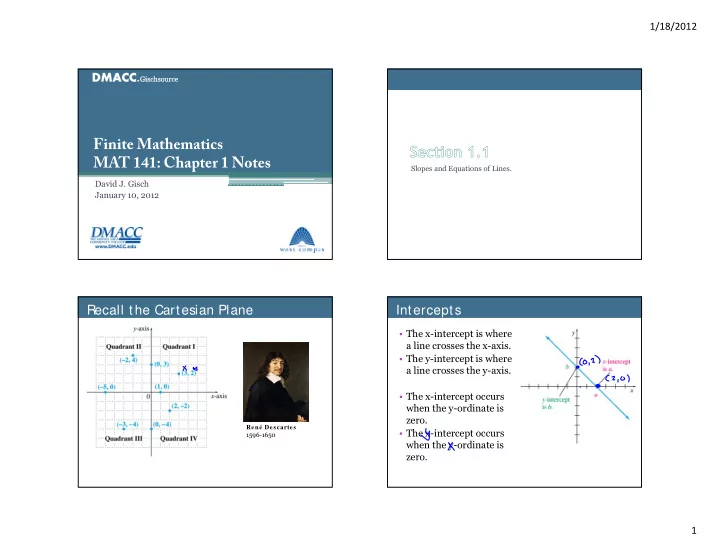
Recall the Cartesian Plane

René Descartes 1596-1650

Intercepts

  • The x-intercept is where

a line crosses the x-axis.

  • The y-intercept is where

a line crosses the y-axis.

  • The x-intercept occurs

when the y-ordinate is zero.

  • The x-intercept occurs

when the y-ordinate is zero.

slide-2
SLIDE 2

1/18/2012 2

S lope

  • The order of the subscripts does not matter as

long as you are consistent.

S lope

Example 1.1.1 Find the slope of the line.

S lope

Example 1.1.2: What is the slope of the line with the following properties?

(a) passes through 2, 3 and 4, 1 (b) passes through 3, 5 and has an x-intercept of 5.

S lope

slide-3
SLIDE 3

1/18/2012 3

Equations of Lines S pecial Cases S ummary of Equations Equation of a Line

Example 1.1.3 Find the slope of the line. (a) 2 10 (b) 4 8 24 (c) Horizontal and through 2.2, 5.875

slide-4
SLIDE 4

1/18/2012 4

Equation of a Line

Example 1.1.4 Find the equation of the line. (a) passing through 2, 8 and 4, 4 (b)has an x-intercept of 5 and a y-intercept of 2 (c) Horizontal and through 2, 5 (d) Vertical and through 2, 10

Parallel and Perpendicular

Or if their slopes are opposite reciprocals (e.g.

  • and
  • )

Equation of a Line

Example 1.1.5 Find the equation of the line. (a) Through 4, 6 and parallel to 3 2 13 (b)Through 3, 4 and perpendicular to 4

Equation of a Line

Example 1.1.6 Find so that the line through 4, 1 and , 2 is (a) parallel to 2 3 6 (b) perpendicular to 5 2 1

slide-5
SLIDE 5

1/18/2012 5

Graphing

Example 1.1.7 Graph the line

  • 5

Graphing

Example 1.1.8 Graph the line 5 6 11

Linear functions and Applications

Linear Functions

Recall that notation just signifies that we have a function with the variable . There is also nothing special about the letter .

  • We could have a function describing height in reference to time.
  • We could have a function describing calories burned in reference

to hours.

  • We could have a function describing your grade in reference to

minutes of studying.

slide-6
SLIDE 6

1/18/2012 6

S upply and Demand

  • Supply – the amount of “objects” a company produces.
  • Dem and – the number of people wanting to buy those

“objects.”

  • Equilibrium – where supply and demand are equal. Best

scenario for the company (not the consumer). Example 1.2.1: Suppose that Greg Tobin, manager of a giant supermarket chain, has studied the supply and demand for

  • watermelons. He has noticed that the demand increases as

the price decreases. He has determined that the quantity (in thousands) demanded weekly, , and the price (in dollars) per watermelon, , are related by the linear function 9 0.74 (a) Find the demand at a price of $5.25 and at $3.75 (b) Greg also noticed that the supply decreased as the price

  • decreased. Price p and supply q are related by

0.75 Find the supply at a price of $5.25. (c) Graph both functions on the same axes.

S upply and Demand Equilibrium Point

  • We saw graphically that the equilibrium point is

when the quantity is 6000 watermelons and the price is $4.50.

  • Solve for this algebraically.

9 0.74 0.75

slide-7
SLIDE 7

1/18/2012 7

Cost Function

  • Give an example of a linear cost function.

Marginal Cost

Marginal cost is the rate of change of cost at a level

  • f production (i.e. slope).

Example 1.2.2: The marginal cost to make batches of a prescription is $10 per batch, while the cost to produce 100 batches is $1500. Find the cost function, given that it is linear.

Cost and Revenue

  • Just like supply and demand we can analyze the

relationship of cost and revenue.

  • Cost – The amount you spend to make/provide a service
  • r item.
  • Revenue - the amount of money you make for selling

that service or item.

Cost and Revenue

Cost > Revenue Revenue > Cost

  • Spent more than we took in.
  • A loss of money
  • Took in more than we spent
  • A profit
slide-8
SLIDE 8

1/18/2012 8

Critical Thinking

Example 1.2.3: For supply and demand you have the equilibrium point. For cost and revenue you have the break-even point. Compare and contrast the two (from the companies point-of-view).

Cost and Revenue

Example 1.2.4: The cost of producing iPhone 4s’s (32 GB) is 300 1500000 And the revenue is 849. What is the break-even quantity?

*Apple sold about 15 million iPhones just in the 4th quarter.

The Least Squares Line

Least S quares Line

  • The table below lists the number of accidental deaths in the

U.S. through the past century.

slide-9
SLIDE 9

1/18/2012 9

Least S quares Line

  • Now it is obvious that the data has a linear trend. We would

like to create a line, as accurately as possible, which would help predict future data. But how?

Least S quares Line Least S quares

  • How do we get the line below or even know

when it is the “best fit”?

Least S quares on TI-84

  • We will not do this by hand
  • We will use the TI calculator to calculate the line of best

fit using least squares.

  • 1. StatEdit
  • 2. Input your list. (check if the columns are L1, L2)
  • 3. StatCALCLineReg(ax+b)
  • 4. Enter, Enter
slide-10
SLIDE 10

1/18/2012 10

Graphing Y

  • ur Results

1. 2ndStat Plot (Top Left), Enter 2. Turn plot on, check xlist, ylist 3. Y=, and type the results of LinReg(ax+b)

▫ In this case type in -.5597x+90.3333 ▫ Clear any other equations

4. Zoom Zoom Stat

Correlation Coefficient

  • This gives us the best possible line but it would be nice to

know how linear the data really is.

  • The correlation coefficient, r, tells us how strong our

conviction can be in saying the data is linear.

  • Again, we will not do this by hand. We will let the

calculator do it.

  • 1. 2nd, Catalog
  • 2. Find DiagnosticOn
  • 3. Enter, Enter
  • 4. Run LinReg(ax+b) again.

Correlation Coefficient

  • The closer is to 1 or 1, the more linear it is.
  • The sign tells you whether it is sloping up or down.

This is close to -1 so the data is very linear and we can feel confident about our equation 0.5597 90.3333

Linear Regression (Least S quares)

Example 1.3.1: An economist wants to estimate a line that relates personal consumption expenditures and disposable income . Both and are in thousands of

  • dollars. She interviews eight heads of households for

families of size 3 and obtains the data show below.

(a)Us linear regression to find a prediction equation. (b)State your level of confidence in your equation. (c)Using your equation, predict the amount of consumption if a family had a disposable income of $42,000.

slide-11
SLIDE 11

1/18/2012 11

Linear Regression (Least S quares)

Example 1.3.2: The marketing manager at Levi-Strauss wishes to find a function that relates the demand for men’s jeans and , the price of the jeans. The following data was obtained.

(a)Us linear regression to find a prediction equation. (b)State your level of confidence in your equation. (c)Using your equation, predict the amount of demand if the price of jeans were $21. (d)Based on the data, what is the optimal price?

Linear Regression (Least S quares)

Example 1.3.3: As a class gather data on your height and the length of your wingspan. Make your height the independent variable.

(a)Us linear regression to find a prediction equation. (b)State your level of confidence in your equation. (c)If I was 73” tall, what would my estimated wingspan be?

FIRS T TES T

  • We will take a test over the Review and Chapter

1 next Wednesday

▫ You should be able to

 Simplify, solve, factor, use the quadratic equation  Anything from Chapter 1

▫ No notes. ▫ Bring your calculator! ▫ We will review for the first 20 minutes, then you get the rest of the period.