FINDINGS Central Oregon Intergovernmental Council December 201 9 - - PDF document

findings
SMART_READER_LITE
LIVE PREVIEW

FINDINGS Central Oregon Intergovernmental Council December 201 9 - - PDF document

12/12/2019 HOUSING FOR ALL INTERVIEW FINDINGS Central Oregon Intergovernmental Council December 201 9 1 INTER VIEW S 9 leaders from different sectors T om Anderson,DeschutesC ountyAdministrator JessicaBiel,PinnacleArchitecture


slide-1
SLIDE 1

12/12/2019 1

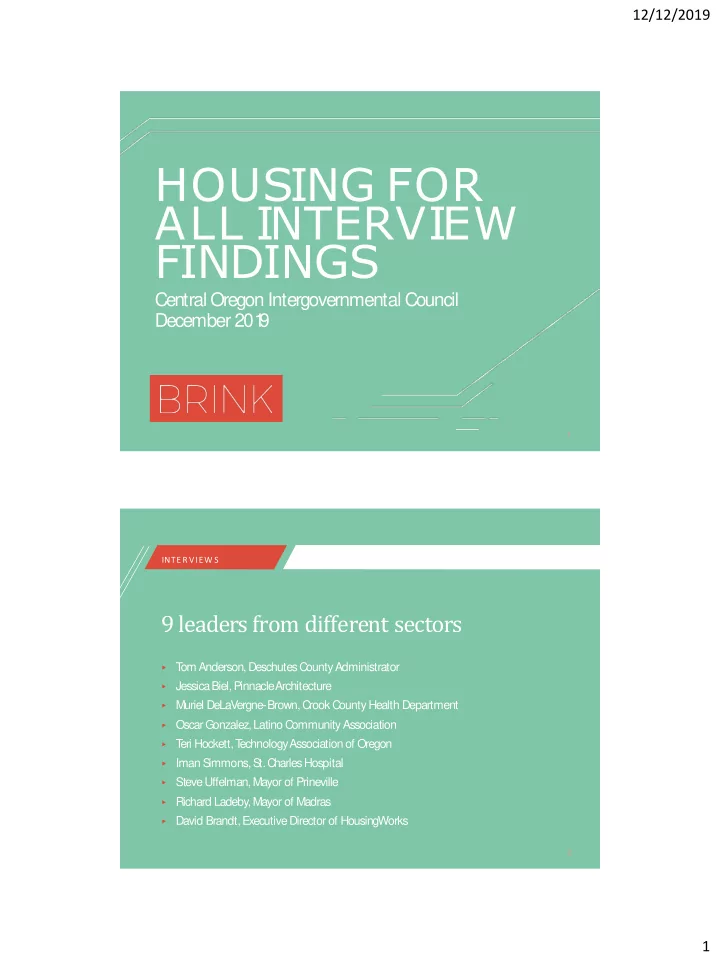
HOUSING FOR ALL INTERVIEW FINDINGS

Central Oregon Intergovernmental Council December 201 9

1

INTER VIEW S

2

9 leaders from different sectors

▸ T

  • m Anderson,DeschutesC
  • untyAdministrator

▸ JessicaBiel,PinnacleArchitecture ▸ Muriel DeLaVergne-Brown,C rook C

  • unty Health Department

▸ Oscar G

  • nzalez,Latino C
  • mmunityAssociation

▸ T eri Hockett,T echnologyAssociationof Oregon ▸ Iman S immons,S t.C harlesHospital ▸ SteveUffelman,Mayor of Prineville ▸ Richard Ladeby,Mayor of Madras ▸ David Brandt,ExecutiveDirector of HousingWorks

slide-2
SLIDE 2

12/12/2019 2

3

Summary Findings

Interview responses to survey

“People make themistake of focusing on housing units within a certain income bracket. That is themost obvious issue, but thereisalso a lack of housing period in theregion— which pushes people from higher income brackets into lower cost housing, forcing lower income people out. It’s thelack of housing generally, asopposed to an affordable housing challenge only.” — TOMANDERSON

4

Interviewees believe that Central Oregon has an urgent crisis of both affordability and supply

A C R IS IS AT A LL INC OME A ND DEMOGR A P HIC LEV ELS

slide-3
SLIDE 3

12/12/2019 3

“Even fiveyears ago therewasn’t thiskind of income inequality.” — IMAN SIMMONS “Alot of people moving here, wealth from south and north. They can drop 1million to buy a house easily. Many of them don’t really want to improve thetransportation because “those” people will come to

  • town. Therearepeople who arevery caring, but a lot of people want it to bean elitist place.”

— MURIEL DELA VERGNE-BROWN

5

Central Oregon’s growth as increasing real or perceived gaps between the “haves” and “have nots”

INC OME INEQUA LITY IS GR OW ING W OR S E “I don’t think a lot of folkswho moved hererecently understand, if they haven’t been part of thediscussion. Folkswho have been here a long time aremore concerned about growth impacts–congestion and traffic.” — JESS ICABIEL “It’sworse now than ever.I seethepushback from locals about outsiders coming in and taking over and pushing people out who havebeen herefor a long time. People areso closed minded and afraid of change in that respect. They don’t seethebenefit of thegreatergood.” — O SC ARGONZALEZ “W edo havesome longtime residents that would liketo keep it theway it was asa small rural

  • community. Y
  • u’re always going to have thenaysayers who talk about how things were in the

1 9

  • 60s. I remember the1

9 60s too, but I also know we’re not in the1 9 60s.” — RIC HARD LADEBY

6

A dynamic that pits "long-time locals" against "newcomers"

B END HA S ITS OWN NIMBY IS M

slide-4
SLIDE 4

12/12/2019 4

Leaders understand that a broad spectrum of impacts are connected to housing

7

▸ Workforce/ economy ▸ T ransportation ▸ Cost of Development ▸ Education / childhood outcomes ▸ Family / community health

A B R OA D UND ERS TA NDING OF IMPA C TS “Wehaveteachers that havebeen recruited in, thebest teachers. They go to look for housing and they can’t afford it. T alent isnot moving to thearea.” — TERI HOC KETT “Why don’t you havehousing that’s affordable for public school teachers?Makeit affordable for them aswell assurgeons. That’s thesocial fabric of America that we’ve lost. W edon’t communicate across income, raceor ethnicity.” — IMAN SIMMONS

8

A B R OA D UND ERS TA NDING OF IMPA C TS

slide-5
SLIDE 5

12/12/2019 5

“Housing affects all of us, not so much theaffluent, but therest of usliving paycheck by paycheck. Folksthat emanate from disadvantaged or marginalized comms of color or impacted worse.” — O SC ARGONZALEZ “There arean incredible amount of haves and havenots, thereisso much wealth.An attitudethat well they just need to pull themselves up. So many peoplehave been affected by trauma and they don’t havetheskills. If we keep that cycle going it’s just going to get worse.” — MURIEL DELA VERGNE-BROWN

9

Stakeholders understand the devastating impacts to people of color and low-income residents

IMPA C TS TO S P EC IFIC C OMMUNITIES “W ehavethemost diverse community in Central Oregon. W e’renot geared towards upper retirement community likeBend. W eneed to gear our focus on lower incomes, migrant workers, thebackbone of our community.” — RIC HARD LADEBY “Folks in thelower paid areasof our economy (tourism, recreation, service) haveto livewith a lot of

  • roommates. W

edo not available housing for folks to beableto livewhere they work.” — JESS ICABIEL

10

IMPA C TS TO S P EC IFIC C OMMUNITIES

slide-6
SLIDE 6

12/12/2019 6

▸ More rental housing, including deeply affordable housing

11

▸ More density ▸ Mixed-income housing and multi-income neighborhoods ▸ UGB expansion ▸ Incentives for developers ▸ More financing for affordable housing

SUP P OR TING A VA R IETY OF HOUSING SO LUTIONS

▸ Transportation infrastructure that supports living where you work

12

▸ Data & technology solutions (Smart Cities, Built for Zero) ▸ Replicate existing successes (NorthWest Crossing, Ochoco SchoolCrossing)

S UPP OR TING A VA R IETY OF R ELATED S OLUTIONS

slide-7
SLIDE 7

12/12/2019 7

“Developers aremaking money hand over fist. People want single family homes that they can sell for $800,000. Why would they build anything different than that?” — IMAN S IMMONS “People don’t want affordable housing— want lower income people to liveelsewhere.” — JESS ICABIEL “Wehavesmall pocketsof people who areresistant to development. W epassed a UGB ordinance last council. Even after wetalked about it for 2 years, they were upset that we were passing this UGB district that includes theirarea.” — RIC HARD LADEBY

13

Policy, funding & politics are standing in the way

BA R R IER S

Influencing people with the power to make change

14

▸ State and local government officials ▸ County commissioners ▸ Developers ▸ Community leaders,faith community ▸ Rotary, Kiwanis,C hambers ▸ Largerbusinesses

“It’s going to takea collective effort on not just government, community members. Faith based

  • groups. It affects us all. It’s likeglobal warming.”

— O SC ARGONZALEZ P R IOR ITY A UDIENC ES

slide-8
SLIDE 8

12/12/2019 8

“W ehaveto work together. W ecan, everybody knows everybody. T

  • makethings work you haveto

bring thecommunity together. W edon’t havetheegos that theBay has. W earethewild west.” — TERI HOC KETT “It’s a matter of through COICthere’s a visibility of what’s available, coordination of services

  • regionally. How to better improve awareness of opportunities for government entities/ agencies

and thepublic asa whole. What kindsof things that we can mutually work on?” — STEVEUFFELMAN

15

There is strong desire to set a collective vision for housing in the region and meet needs across sectors

CO LLA B OR ATIV E A C TION

Review of National Literature

16

slide-9
SLIDE 9

12/12/2019 9

INTER VIEW S

17

Review of National Literature

▸ Audiences need root causesand how problem impactsthem ▸ Demonstratehow housingis morethan just aplaceto live ▸ Help people seethelong-term vision and what it takesto get there ▸ T ell thestory of "us" not thestory of "them"

“People make themistake of focusing on housing units within a certain income bracket. That is themost obvious issue, but thereisalso a lack of housing period in theregion— which pushes people from higher income brackets into lower cost housing, forcing lower income people out. It’s thelack of housing generally, asopposed to an affordable housing challenge only.” — TOMANDERSON

18

Interviewees believe that Central Oregon has an urgent crisis of both affordability and supply

LITER ATURE R EVIEW

slide-10
SLIDE 10

12/12/2019 10

19

Strategic Implications for Our Campaign

20

Create and explain a positive vision

S T R ATEGIC S T R ATEGIC IMP LIC ATIONS IMP LICATIONS

slide-11
SLIDE 11

12/12/2019 11

21

S T R ATEGIC S T R ATEGIC IMP LIC ATIONS IMP LICATIONS

Humanize the housing crisis through storytelling, photography and visuals

▸ People ▸ Projects ▸ What’sworked

22

Connect housing solutions to a future that impacts every resident

▸ Children’s health &achievement ▸ Jobs &the economy ▸ Transportation ▸ Quality of life S T R ATEGIC S T R ATEGIC IMP LIC ATIONS IMP LICATIONS

slide-12
SLIDE 12

12/12/2019 12

23

Use a narrative frame for greater understanding

S T R ATEGIC IMP LIC ATIONS

PROBLEM SOLUTION IMPACTS BENEFITS

24

Emphasize the strength

  • f diverse neighborhoods

▸ Income ▸ Racial/ cultural ▸ Age ▸ Outlook S T R ATEGIC S T R ATEGIC IMP LIC ATIONS IMP LICATIONS

slide-13
SLIDE 13

12/12/2019 13

25

Create a campaign

  • f partners

S T R ATEGIC S T R ATEGIC IMP LIC ATIONS IMP LICATIONS

26

Discussion