FINAL REPORT STATE EMPLOYEE GROUP INSURANCE AND BENEFITS - - PDF document

final report state employee group insurance and benefits
SMART_READER_LITE
LIVE PREVIEW

FINAL REPORT STATE EMPLOYEE GROUP INSURANCE AND BENEFITS - - PDF document

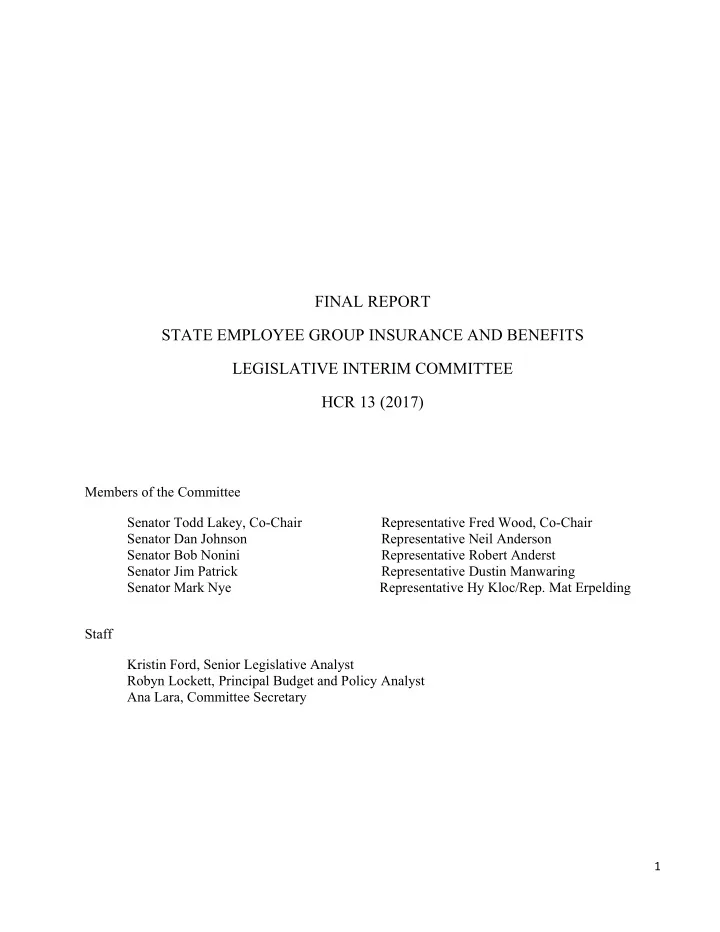
FINAL REPORT STATE EMPLOYEE GROUP INSURANCE AND BENEFITS LEGISLATIVE INTERIM COMMITTEE HCR 13 (2017) Members of the Committee Senator Todd Lakey, Co-Chair Representative Fred Wood, Co-Chair Senator Dan Johnson Representative Neil Anderson


slide-1
SLIDE 1

1

FINAL REPORT STATE EMPLOYEE GROUP INSURANCE AND BENEFITS LEGISLATIVE INTERIM COMMITTEE HCR 13 (2017)

Members of the Committee Senator Todd Lakey, Co-Chair Representative Fred Wood, Co-Chair Senator Dan Johnson Representative Neil Anderson Senator Bob Nonini Representative Robert Anderst Senator Jim Patrick Representative Dustin Manwaring Senator Mark Nye Representative Hy Kloc/Rep. Mat Erpelding Staff Kristin Ford, Senior Legislative Analyst Robyn Lockett, Principal Budget and Policy Analyst Ana Lara, Committee Secretary

slide-2
SLIDE 2

2

Committee Charge The State Employee Group Insurance and Benefits Committee was authorized by 2017 HCR

  • 13. The charge of the committee was to continue the work of the 2016 State Employee Group

Insurance and Benefits Legislative Interim Committee in studying the state employee group insurance plan to include, but not be limited to, consideration of the costs and benefits of allowing the grandfathered status of the current plan to lapse, as well as the structural plan changes that will be required as a result; consideration of other cost-effective benefit plan changes while maintaining a total compensation and benefits package; consideration of a self-insured plan or a fully insured plan structure; and development of a list of changes to the employee group insurance benefit package, as well as potential statutory changes outlining the minimum employee group insurance benefit plan design that will comply with the Patient Protection and Affordable Care Act should the Legislature adopt structural plan changes. The Committee was authorized to retain the services of a consultant familiar with health insurance and health care plans to provide advice and assistance to the Committee in selecting the most appropriate form of employee health care benefit plan for recommendation to the Idaho Legislature. Meetings The Committee met seven times in the State Capitol in Boise: May 4, 2017 May 18, 2017 June 2, 2017 July 31, 2017 September 21, 2017 November 8, 2017 December 1, 2017 An RFP for a health care plan consultant was published in April, and the Committee held its first meeting on May 4th, in order to review the RFP responses from potential consultants. The Committee discussed guiding principles and asked questions of Deputy Attorney General Julie

  • Weaver. The Committee then went into executive session in order to consider the hiring of a

consultant and then emerged with the request that invitations be issued to three applicants to provide additional information on their proposals. On May 18, 2017, the Committee again went into executive session in order to hear the three different proposals from consultants. After executive session, the Committee voted to pursue contract negotiations with the health care consultant Mercer. On June 2, 2017, the Committee met and were given a contract negotiation status update with Mercer and the Committee authorized the co-chairs to finalize the negotiated contract. Co- chairs Wood and Lakey provided remarks on guiding principles for the Committee and listed the aspects of health care plans they felt should be addressed and analyzed. Mercer representatives then made a presentation on health care trends at the local and national level. Committee members asked

slide-3
SLIDE 3

3

questions and Mercer asked the members to take their survey on what they would like to see in a health care plan. On July 31, 2017, the Committee met and heard a presentation on the Office of Group Insurance’s cost projections for the state’s health plan. Next, Mercer consultants reviewed the results

  • f the Committee members’ response to their survey, provided information regarding the Affordable

Care Act future excise tax and then went into great detail regarding accountable care organization

  • models. Committee members asked questions regarding value-based care arrangements, subscription

primary care models, and strategies to reduce costs. On September 21, 2017, the Committee again met with Mercer consultants, who presented their draft strategic roadmap for changes to the state health care plan model, and then presented a self-funding financial analysis for the state. Committee members had many questions and further information was requested from Mercer. The Committee was scheduled to meet again on October 19, 2017, but the meeting was postponed in order to allow for additional time to obtain information from Mercer, Blue Cross of Idaho, and the Department of Insurance. On November 8, 2017, the Committee met and heard a presentation from Cynthia York, Administrator of the Idaho Department of Health and Welfare’s SHIP (Statewide Healthcare Innovation Plan) program and their use of the primary care medical home model and the successful establishment of seven regional health collaboratives. The program is also moving toward payment reform in the form of value-based services instead of the fee-for-service model. The Committee heard from Blue Cross of Idaho regarding the current hybrid platform of self-insurance versus full

  • insurance. Blue Cross also supported the cost savings potential of moving to a value-based care

model, and then reviewed its current program offerings and potential additional opportunities. The Director of the Department of Insurance, Dean Cameron, also offered some comments regarding the utility of the best practices set forth in chapter 40, title 41, Idaho Code. On December 1, 2017, the Committee met a final time to review and approve the final report and recommendations. The Committee took testimony from Susan Buxton, Administrator, Idaho Division of Human Resources, and also consulted with Jennifer Pike, Administrator, Office of Group Insurance, and Sean White, Mercer consultants, as it discussed the Committee’s recommendations. The Committee concluded that the issuance of an RFP in 2018 that allows vendors to submit health benefit proposals addressing Mercer’s recommendations, under both a fully-insured hybrid model or a self-funded model, or both, would be beneficial to the Committee’s ability to assess the best path forward for state employee health benefits. Mercer’s recommendations to the Committee are as follows:

  • 1. The State of Idaho should self-fund state employee health benefits.
  • 2. The State of Idaho should exempt itself from Chapter 40 of Title 41, Idaho Code,

just as the state exempted all counties of the state in 2001.

slide-4
SLIDE 4

4

  • 3. Cost savings Programs: Mercer has recommended 23 programs that have been

shown nationally, if implemented using first-in-class vendors and properly

  • perated, to provide long-term reductions in annual increases of health care costs.

These programs are listed in the work products delivered to the Committee.

  • 4. The state should replace its current three health benefit plans for employees as

follows: Current State Employee Health Benefit Plans Mercer Recommendations Non-Health Savings Account (HSA) qualified high-deductible health plan (HDHP) with no state contribution for the deductible to the HDHP. HSA-qualified HDHP with the option of the state funding an HSA contribution of a predetermined dollar amount per employee

  • r employee plus family.

Preferred Provider Organization (PPO) plan Continue same or similar PPO plan but review operation of the plan for the most cost-effective PPO network and plan management available. Traditional plan Evaluate Value-Based Care (VBC)

  • pportunities, including an Accountable

Care Organization model. The VBC plan may be an option or inclusion on each health plan. Committee Recommendations It is the unanimous recommendation of the members of the State Employee Group Insurance and Benefits Committee that:

  • 1. The Department of Administration, with the assistance of the Committee’s contractor

Mercer, shall develop a Request for Proposals (RFP) to be issued by the state, for the selection of one or more administrators, including carriers, third party administrators (TPAs) and vendors to administer an array of health benefit plans adopted for employee health care benefits. The Committee recommends that the RFP request bids on the three health care benefit plans recommended by Mercer in the foregoing chart. All plans should use as many elements of value-based care as possible. All administrators should incorporate, to the extent possible, the 23 Mercer recommended programs to reduce long-term costs and rates of cost increases to health care. Administrators shall be allowed to bid on any one or any combination of the recommended plans. Bids need not

slide-5
SLIDE 5

5

be statewide bids. The RFP shall provide for administrators to bid using the current hybrid fully-insured model or a self-funded model, or both. Bids using the self-funded model should have as part of the bid, an analysis of Chapter 40 of Title 41, Idaho Code, with a recommendation as to whether the state should exempt itself from the chapter, as the state exempted all counties in 2001. The analysis should be based on costs, flexibility, potential liability, and other relevant considerations.

  • 2. The Legislature reauthorize the State Employee Group Insurance and Benefits Legislative

Interim Committee to meet in 2018 in order to work with the consultant in acting upon the Committee’s recommendations.

  • 3. The Legislature authorize the extension of the contract with Mercer consultants in 2018,

contingent upon the successful negotiation of a new statement of work and contract price for the contract between the consultant and the Co-Chairs of the State Employee Group Insurance and Benefits Legislative Interim Committee, as approved by the Committee.

  • 4. The Committee review the results and award of the RFP outlined in Recommendation No.

1, above for compliance, fairness and thoroughness. Based upon that review, the Committee shall make a funding recommendation to the Joint Finance-Appropriations Committee and the Idaho Legislature.

slide-6
SLIDE 6

57

PRIORITIZATION OF ADDITIONAL OPPOR TU N ITIES

Feature Considerations for Optimization Potential Results Value Based Care (VBC) strategy

  • Exploration to include Accountable

Care Organization (ACO), Patient Centered Medical Home (PCMH), Regional Care Model, Direct Primary Care (DPC) options

  • Explore possibility of leveraging PCMH

network being developed under the Idaho SHIP program

  • Include plan design steerage to incent

utilization of high value providers $$-$$$ Telemedicine

  • Target 10%-15% Utilization
  • Reduce costs at PCP, Urgent Care

and Emergency room

  • Improved productivity

$ Care management

  • Explore care and disease

management options through carriers and through third party vendors

  • Implement best in class program

$ $ = 0% - 2% savings $$ = 3% - 5% savings $$$ = 5% - 10% savings

Care delivery

SOURCE: Mercer's State of Idaho Benefit Strategy Development, September 2017

slide-7
SLIDE 7

58

PRIORITIZATION OF ADDITIONAL OPPOR TU N ITIES

Feature Considerations for Optimization Potential Results Expert Medical Option (EMO)

  • Implement EMO program to improve

diagnosis, treatment decisions, and

  • utcomes for those with complex

diagnosis and high cost claims $ On-site/near-site clinics

  • Explore on-site/near-site clinic options

to supplement VBC providers $-$$ Centers of Excellence (COE)

  • Implement COE solution and/or

bundled payments through a vendor or via direct contracting to achieve better surgical costs and outcomes (ortho, cardiac, etc.) $ Potential to integrate State Employee population into Medicaid, with Medicaid Fee Schedule or reimbursement

  • Join Medicaid population, fund

reimbursements at Medicaid rates.

  • CMS Approval for addition of

population and increased fee reimbursement to offset commercial reimbursement. $$ $ = 0% - 2% savings $$ = 3% - 5% savings $$$ = 5% - 10% savings

Care delivery

SOURCE: Mercer's State of Idaho Benefit Strategy Development, September 2017

slide-8
SLIDE 8

59

PRIORITIZATION OF ADDITIONAL OPPOR TU N ITIES

Feature Considerations for Optimization Potential Results Well-being

  • Implement evidence based well-being

programs with outcomes-based incentives $-$$ Targeted point solutions

  • Implement best-in-class point solutions

to address weight management/diabetes prevention, cancer, maternity, and musculoskeletal $-$$ Tobacco surcharge

  • Implement tobacco surcharge of $50-

$100 per month (via affidavit) $ $ = 0% - 2% savings $$ = 3% - 5% savings $$$ = 5% - 10% savings

Workforce health

SOURCE: Mercer's State of Idaho Benefit Strategy Development, September 2017

slide-9
SLIDE 9

60

PRIORITIZATION OF ADDITIONAL OPPOR TU N ITIES

Feature Considerations for Optimization Potential Results Transparency

  • Implement transparency solution to

allow employees and their families to shop for high quality, lower cost care $-$$ Advocacy

  • Explore advocacy solutions to provide

a resource for employees and their families to better navigate the health care system $-$$ Salary-based strategies

  • Explore salary based contributions

and/or account contributions as a means to address affordability for employees $ Spousal surcharge

  • Implement spousal surcharge for

those with access to other coverage of $50-$100 per month (via affidavit) $ Retiree Options

  • Retiree options, outside of the State of

Idaho Programs

  • Retiree Exchange Opportunities

$-$$ $ = 0% - 2% savings $$ = 3% - 5% savings $$$ = 5% - 10% savings

Program design

SOURCE: Mercer's State of Idaho Benefit Strategy Development, September 2017

slide-10
SLIDE 10

61

Feature Considerations for Optimization Potential Results Life Insurance Plan Management

  • Conduct RFP for Life Insurance, both

employer paid and voluntary benefits

  • Best Practices Approach
  • Enhance benefit offerings
  • Reduce overall costs

$-$$ Disability Insurance Plan Management

  • Conduct RFP for Short-term and Long-

term Disability

  • Potential for Base and Buy-Up options
  • Best Practices Approach
  • Enhance benefit offerings
  • Reduce overall costs

$-$$ Review opportunity to introduce Voluntary Benefit Offerings

  • Enhance benefits offering with VB

Options

  • Enhance Employee Choice

$ Review all other Current or Future Benefit Offerings

  • TBD

$ $ = 0% - 2% savings $$ = 3% - 5% savings $$$ = 5% - 10% savings

Program design

PRIORITIZATION OF ADDITIONAL OPPOR TU N ITIES

SOURCE: Mercer's State of Idaho Benefit Strategy Development, September 2017

slide-11
SLIDE 11

62

Feature Considerations for Optimization Potential Results Medical plan management

  • Conduct RFP for medical plan

administration including conversion to self-funding $-$$ Pharmacy plan management

  • Explore savings opportunities through

Mercer Rx collective savings

  • Improved contract terms
  • Implement care management features
  • Explore Specialty Pharmacy

management options, including the potential for a Specialty Rx tier $-$$ Introduction of a catastrophic plan

  • Not designed to drive meaningful cost

savings, but to offer true expanded choice and a very low cost or no cost

  • ption

$ Dental and vision plan management

  • Conduct RFP for dental and vision

plan administration including conversion to self-funding $ $ = 0% - 2% savings $$ = 3% - 5% savings $$$ = 5% - 10% savings

Delivery infrastructure

PRIORITIZATION OF ADDITIONAL OPPOR TU N ITIES

SOURCE: Mercer's State of Idaho Benefit Strategy Development, September 2017