Final exam Patrick Loiseau, Michela Chessa Game Theory, Fall 2013 - - PDF document

final exam
SMART_READER_LITE
LIVE PREVIEW

Final exam Patrick Loiseau, Michela Chessa Game Theory, Fall 2013 - - PDF document

Final exam Patrick Loiseau, Michela Chessa Game Theory, Fall 2013 2 hours, no document allowed except an A4 sheet of paper (both sides) with handwritten notes only. Questions ( 1 point each) Say whether the following assertions are true or false


slide-1
SLIDE 1

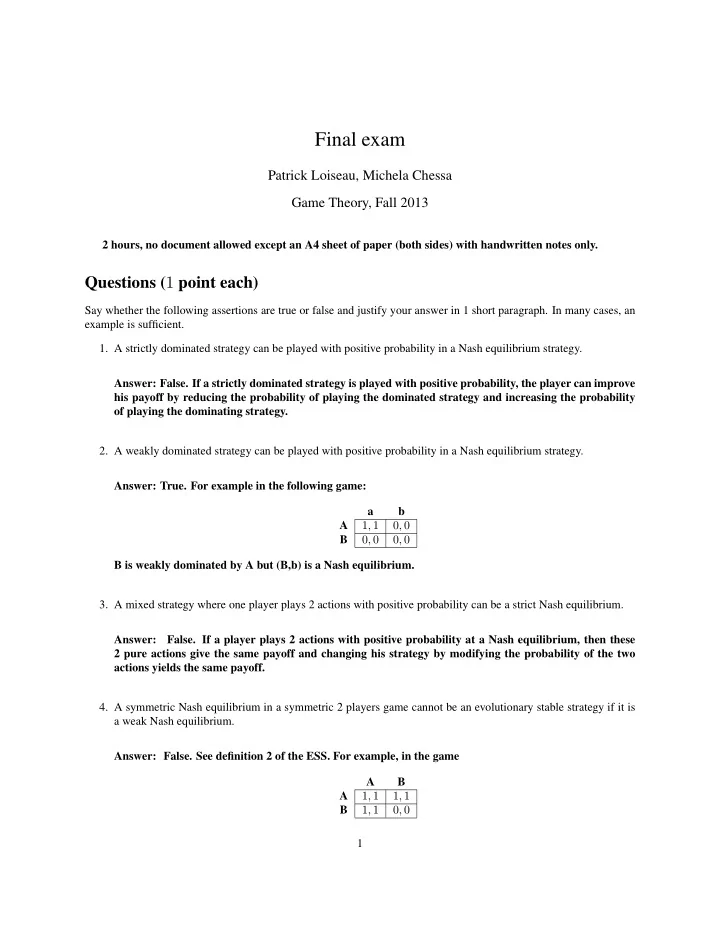
Final exam

Patrick Loiseau, Michela Chessa Game Theory, Fall 2013

2 hours, no document allowed except an A4 sheet of paper (both sides) with handwritten notes only.

Questions (1 point each)

Say whether the following assertions are true or false and justify your answer in 1 short paragraph. In many cases, an example is sufficient.

  • 1. A strictly dominated strategy can be played with positive probability in a Nash equilibrium strategy.

Answer: False. If a strictly dominated strategy is played with positive probability, the player can improve his payoff by reducing the probability of playing the dominated strategy and increasing the probability

  • f playing the dominating strategy.
  • 2. A weakly dominated strategy can be played with positive probability in a Nash equilibrium strategy.

Answer: True. For example in the following game: a b A 1, 1 0, 0 B 0, 0 0, 0 B is weakly dominated by A but (B,b) is a Nash equilibrium.

  • 3. A mixed strategy where one player plays 2 actions with positive probability can be a strict Nash equilibrium.

Answer:

  • False. If a player plays 2 actions with positive probability at a Nash equilibrium, then these

2 pure actions give the same payoff and changing his strategy by modifying the probability of the two actions yields the same payoff.

  • 4. A symmetric Nash equilibrium in a symmetric 2 players game cannot be an evolutionary stable strategy if it is

a weak Nash equilibrium. Answer: False. See definition 2 of the ESS. For example, in the game A B A 1, 1 1, 1 B 1, 1 0, 0 1

slide-2
SLIDE 2

(A, A) is a weak NE and A is an ESS, in fact u(A, A) = u(B, A) and u(B, A) > u(B, B).

Exercise A (∼ 8 points)

We consider the following public good provision game. There are 2 players, each choosing the amount of money xi (i ∈ {1, 2}) they will give to build a public good. We assume that each player has a maximum of 1 unit of money that he can give, so that xi ∈ [0, 1] for both players. Once the good is built, they receive a utility h(G) from using it, where G = x1 + x2 is the total amount that was invested in the public good. We assume that h(G) = K √ G, where K ≥ 0 is a non-negative constant. Each players utility is therefore ui(x1, x2) = K√x1 + x2 − xi (i ∈ {1, 2}). (1)

  • 1. For a given value of x1 ∈ [0, 1], compute the best response of player 2 (hint: be careful that it must be in [0, 1]).

Give also the best response of player 1 to x2 ∈ [0, 1]. Answer: We observe at first that the game is symmetric. Let x1 ∈ [0, 1]. The utility u2(x1, x2) as a function of x2 is strictly concave. The FOC (first order condi- tion) is given by ∂u2 ∂x2 = K 2√x1 + x2 − 1 = 0, i.e., x2 = k2

4 − x1. Remembering that also x2 must be in [0, 1], we include the border conditions and we

  • btain that the best response of player 2 to x1 is

BR2(x1) =    if x1 > K2/4 1 if x1 < K2/4 − 1 K2/4 − x1

  • therwise.

Symmetrically, the best response of player 1 to x2 is BR1(x2) =    if x2 > K2/4 1 if x2 < K2/4 − 1 K2/4 − x2

  • therwise.
  • 2. Draw the best response diagram in the three cases K ∈ [0, 2], K ∈ [2, 2

√ 2] and K ≥ 2 √ 2. Answer: See Figure 1.

  • 3. Give all Nash equilibria in pure strategy (hint: separate the cases K ∈ [0, 2], K ∈ [2, 2

√ 2] and K ≥ 2 √ 2). Answer: The NE are the points where the best responses intersect. From the graphs of the previous question we get: Case 1 If K ∈ [0, 2], the NE are all the profiles of the form (x1, K2/4 − x1) with x1 ∈ [0, K2/4]. Case 2 If K ∈ [2, 2 √ 2], the NE are all the profiles of the form (x1, K2/4 − x1) with x1 ∈ [K2/4 − 1, 1]. Case 3 If K > 2 √ 2, the only NE is (1, 1). 2

slide-3
SLIDE 3

Figure 1: Best-response diagrams. 3

slide-4
SLIDE 4
  • 4. Suppose that there is a social planner that can choose both x1 and x2 in order to maximize u1(x1, x2) +

u2(x1, x2). What values could he choose? (give all possible solutions) Answer: We may write the aggregate utility as u1(x1, x2) + u2(x1, x2) = 2K√x1 + x2 − x1 − x2 = U(x1, x2). This is a concave function. The FOC are given by ∂U ∂x1 = K √x1 + x2 − 1 = 0 ∂U ∂x2 = K √x1 + x2 − 1 = 0, then they have as solution any profile which satisfies x1 + x2 = k2. Imposing the border conditions, we

  • btain that the social planner can maximize the aggregate utility by choosing:

Case 1 If K ∈ [0, 1], any profile (x1, K2 − x1) with x1 ∈ [0, K2]; Case 2 If K ∈ [1, √ 2], any profile (x1, K2 − x1) with x1 ∈ [K2 − 1, K2]; Case 3 If K > √ 2, only the profile (1, 1).

  • 5. Compare the answer of question 4. to the Nash equilibria and comment.

Answer: The amount of public good achieved at Nash equilibrium is never larger, and sometimes strictly smaller (when K < 2 √ 2) than at social optimum. This is due to externalities that are not taken into account for individual decision at Nash equilibrium.

Exercise B (∼ 8 points)

Consider the following two-player game: l r T α, α 0, γ B γ, 0 β, β where α > β > 0 are fixed parameters and γ > 0 is a parameter which can take on different (positive) values. In this exercise we study the equilibria for different values of γ.

  • 1. First assume that γ > α.

(a) Is there a strictly dominated strategy? Answer: l is strictly dominated by r and T is strictly dominated by B. (b) Find all Nash equilibria (pure and mixed). Answer: The only NE is (B, r) (pure). Remark: we have seen that a NE in strictly dominating strategy is necessarily unique; there is no point in looking for a mixed-strategy NE (which you will

  • f course not find).

4

slide-5
SLIDE 5

(c) What type of game is it? Answer: It is a prisoner’s dilemma.

  • 2. Assume now that γ ≤ α.

(a) Is there a strictly dominated strategy? Is there a weakly dominated strategy? Answer: There is no strictly dominated strategy. If γ = α, l is weakly dominated by r and T is weakly dominated by B. If γ < α, there is no weakly dominated strategy. (b) Find all Nash equilibria (pure and mixed). Answer: There are two pure strategy equilibria (T, l) and (B, r). Looking for the mixed NE, we assume that player one plays a strategy (p, 1 − p) and 2 a strategy (q, 1 − q), with p, q ∈ [0, 1]. Then the utility of 1 can be written as u1(p, q) = αpq + γ(1 − p)q + β(1 − p)(1 − q) = [(α − γ + β)q − β]p + . . . and she has best response function BR1(q) =      1 if q >

β α−γ+β

if q <

β α−γ+β

[0, 1] if q =

β α−γ+β

The utility of 2 can be written as u2(p, q) = αpq + γp(1 − q) + β(1 − p)(1 − q) = [(α − γ + β)p − β]q + . . . and then the best response function is the same than the one for player 1. The mixed strategy NE is (β/(α − γ + β), (α − γ)/(α − γ + β)) for each player. We observe that if γ = α, the mixed NE is the same as (T, l) (then in this case there are only the two pure strategies NE). (c) For each Nash equilibrium (pure and mixed), say if it is strict or weak and under which condition on γ. Answer: A mixed-strategy NE is always weak. The NE (B, r) is always strict, in fact each player gets β and by deviating she would get 0 < β. The NE (T, l) is strict if γ < α and weak if γ = α. (d) Among the pure strategy equilbria, say if one Pareto dominates the other. Answer: (T, l) Pareto dominates (B, r) as α > β. 5

slide-6
SLIDE 6

(e) Say which strategies (pure only) are evolutionary stable and under which condition on γ. Answer: Remark that the game is symmetric. To discuss ESS, we interpret the actions as B = r and T = l. (B, r) is always a strict NE so B is always an ESS. Similarly, T is an ESS if γ < α since (T, l) is a strict NE. If γ = α, (T, l) is a weak NE. We have u1(T, r) = 0 < u1(B, r) = β, so T is not an ESS. (f) Suppose that γ < α. Is the mixed strategy played at Nash equilibrium an evolutionary stable strategy? Answer: Let ˆ s = (

β α−γ+β , α−γ α−γ+β ) be the mixed strategy NE. It is a weak NE. For ˆ

s to be an ESS, we must have u1(ˆ s, s′) > u1(s′, s′) for all s′ = ˆ

  • s. But for s′ = r (pure strategy), u1(ˆ

s, s′) =

α−γ α−γ+β · β <

u1(s′, s′) = β. Therefore ˆ s is not an ESS. 6