Filipino skilled migration to ASEAN: Searching for what neighbors - - PowerPoint PPT Presentation

filipino skilled migration to asean
SMART_READER_LITE
LIVE PREVIEW

Filipino skilled migration to ASEAN: Searching for what neighbors - - PowerPoint PPT Presentation

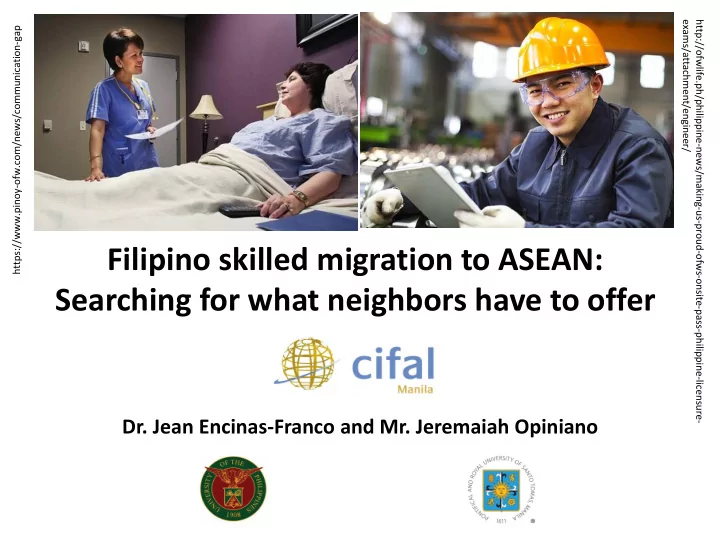
exams/attachment/engineer/ http://ofwlife.ph/philippine-news/making-us-proud-ofws-onsite-pass-philippine-licensure- https://www.pinoy-ofw.com/news/communication-gap Filipino skilled migration to ASEAN: Searching for what neighbors have to offer


slide-1
SLIDE 1

Filipino skilled migration to ASEAN: Searching for what neighbors have to offer

  • Dr. Jean Encinas-Franco and Mr. Jeremaiah Opiniano

http://ofwlife.ph/philippine-news/making-us-proud-ofws-onsite-pass-philippine-licensure- exams/attachment/engineer/ https://www.pinoy-ofw.com/news/communication-gap

slide-2
SLIDE 2

Contexts

  • ASEAN integration
  • Labor mobility and skills recognition
  • The Philippines as a major source country of international migrants

worldwide, across skills

slide-3
SLIDE 3

The paper

  • Benefits and potentials of Filipino skilled migration to Asean.
  • Who are the Filipino workers in Asean?
  • Asean countries’ economic competitiveness vis-à-vis labor mobility.
  • Receptiveness to skilled foreign labor.
slide-4
SLIDE 4
  • 1. Skilled Filipino labor in Asean
  • Not many Filipino workers go to Asean countries
slide-5
SLIDE 5
  • 2. Filipino migrants to Asean
  • Because

there are

  • ther

destina- tions Filipino workers can go to

slide-6
SLIDE 6
  • 3. Intra-Asean migration
  • Within Asean, ‘internal’ Southeast Asian migration flows are

topped by those moving within landlocked states

slide-7
SLIDE 7
  • 4. ASEAN skilled labor mobility

http://aseanup.com/overview-of-the-asean-skilled-labor-market/

slide-8
SLIDE 8
  • 4. ASEAN skilled labor mobility

http://aseanup.com/overview-of-the-asean-skilled-labor-market/

2009 2007 2008 2008 2006 2005 2005 2012

slide-9
SLIDE 9
  • ONLY 1.5 percent of the

total ASEAN workforce

http://aseanup.com/overview-of-the-asean-skilled-labor-market/

slide-10
SLIDE 10
  • 4. ASEAN skilled labor mobility

Three challenges for intra-Asean skilled migration to prosper (Asian Development Bank, 2015)

  • The complexity of countries’

qualifications recognition processes;

  • National-level barriers within Asean

countries for foreign workers in relation to skilled worker quotas and visas; and

  • Limited interest due to perceived

cultural, language and socio-economic differences.

slide-11
SLIDE 11

BusinessWorld infographics

slide-12
SLIDE 12
  • 5. Asean economic competitiveness
slide-13
SLIDE 13
  • 6. Asean countries’ receptiveness?
  • 2,469,173 international migrants
  • Categories of foreigners; expatriates [pegawai

dagang], foreign skilled workers [pekerja asing], unskilled and semi-skilled workers, foreign students, foreigners under the Malaysia My Second Home program (Kanapathy, 2008)

  • 3.4 million skilled workers overall (a fourth of

country’s workforce). But Malaysia has a skills shortage! (lifted ban on hiring foreign workers in manufacturing, construction, furniture making and plantation sectors [The Daily Samakal, 2016])

  • Targets (Eleventh Malaysia Plan, 2015): 5.3 million

skilled workers, or 35 percent of total employed workforce

slide-14
SLIDE 14
  • 6. Asean countries’ receptiveness?
  • International labor migration to be handled by

a single authority under the Ministry of Human Resources

  • Malaysia’s qualifications framework, suiting it

to Asean’s: TechVoc has eight levels to jive with levels of university-schooled workers.

  • MAS’ critical occupations list (COL): electrical

and electronics, oil and gas, information and communication technology and global business services, telecommunications and multimedia, and financial services and accounting

slide-15
SLIDE 15

TalentCorp’s Malaysia My Second Home program

  • Targets

Malaysian citizens abroad and expatriate talents

slide-16
SLIDE 16

2011-15: 3,900 RP-T applications

  • OKd. BUT

ONLY 6.71 percent come from Asean countries

slide-17
SLIDE 17
  • 7. Asean countries’ receptiveness?
  • 3.44 million employed workers, of which 2.103 million

are locals and some 1.404 million foreigners By

  • ccupational group, covering all workers by nationality,

Singapore has 290.7 thousand professionals and 483.4 thousand associate professionals as of 2014 (Department of Statistics Singapore, 2015)

slide-18
SLIDE 18
  • 9. Asean countries’ receptiveness?
  • Permanent

residents: about 527,000 (June 2015)

  • 8,868 only are

non-citizen spouses married to Singaporeans

slide-19
SLIDE 19
  • 9. Asean countries’ receptiveness?
  • Previously, Singapore liberalized its

immigration policies so that skilled immigrants gain permanent residency. Singapore even implemented previously programs to ease the costs of hiring skilled workers, and to employ foreigners who graduated from Singaporean skills.

  • But “liberalization” had received resistance

from the Singaporean public giving rising number of foreigners and the impact of the 2008 global financial crisis on Singapore. So some new rules were made.

slide-20
SLIDE 20
  • 10. Conclusions
  • Asean countries as stepping stones for Filipino skilled workers

to go outside of Asean

  • How host countries treat and welcome foreigners and foreign

workers matters (not just through immigration policies but through workplace arrangements)

slide-21
SLIDE 21
  • 10. Conclusions
  • ADB’s four components (2015) of a prosperous intra-Asean

skilled labor mobility--portable qualifications, increased access to the skilled labor market, adequate supply of skilled professionals and strong demand for skilled professionals— can have a fifth component: international migration policies and their implementation. These migration policies impact on the four earlier components.

  • Intra-ASEAN skilled migration becomes a government

commitment in the spirit of regional solidarity. But workers’ movements outside of ASEAN, or from ASEAN to outside of ASEAN, are their individual decisions.

  • Take-away question: How is Thailand open to foreign skilled

labor, in particular, and foreign labor, in general?

slide-22
SLIDE 22

THANK YOU VERY MUCH!

  • Dr. Jean Encinas-Franco (Assistant Professor,

Department of Political Science)  jeanfranco825@yahoo.com

  • Mr. Jeremaiah Opiniano (Assistant Professor

and Coordinator [Journalism], Department of Communication and Media Studies; Executive Director, Institute for Migration and Development Issues)  ofw_philanthropy@yahoo.com