
SLIDE 1
1
CSC 4103 - Operating Systems Spring 2008
Tevfik Koar
Louisiana State University
April 8th, 2008
Lecture - XVIII
File Systems
File-System Structure
- Provides organized and efficient access to data on
secondary storage, E.g.:
– Organizing data into files and directories – Improve I/O efficiency between disk and memory (perform I/O in units of blocks rather than bytes) – Contains file structure via a File Control Block (FCB)
– Ownership, permissions, location..
Allocation Methods
- An allocation method refers to how disk blocks are
allocated for files:
- Contiguous allocation
- Linked allocation
- Indexed allocation
Contiguous Allocation
- Each file occupies a set of contiguous blocks on
the disk
- Simple – only starting location (block #) and
length (number of blocks) are required
- Wasteful of space (dynamic storage-allocation
problem)
- Files cannot grow
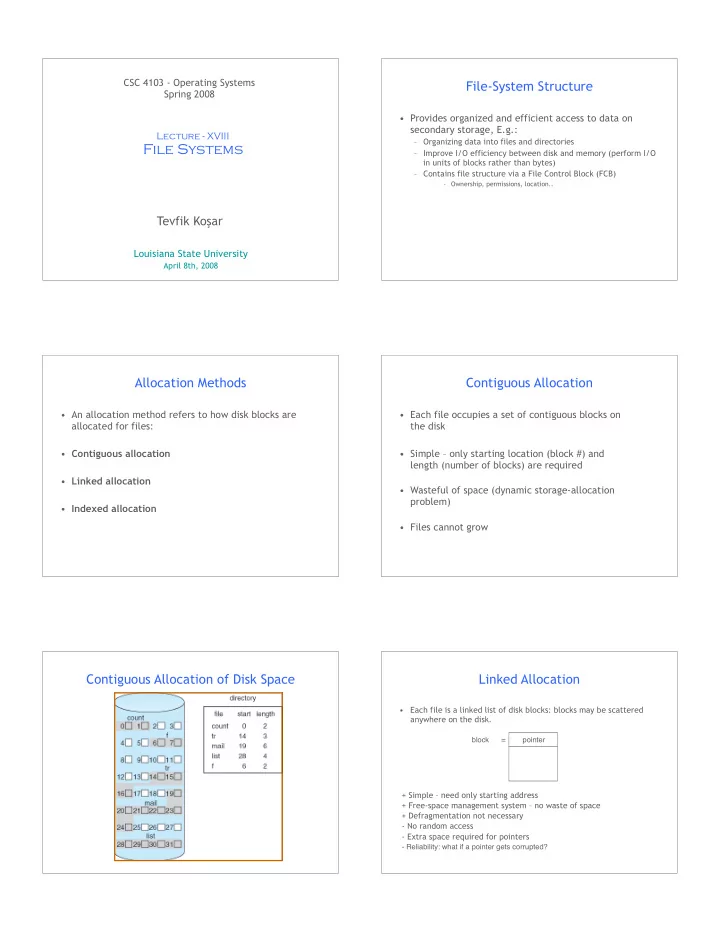
Contiguous Allocation of Disk Space Linked Allocation
- Each file is a linked list of disk blocks: blocks may be scattered
anywhere on the disk.
pointer block =
+ Simple – need only starting address + Free-space management system – no waste of space + Defragmentation not necessary
- No random access
- Extra space required for pointers
- Reliability: what if a pointer gets corrupted?