File class in Java n Programmers refer to input/output as - - PDF document

file class in java
SMART_READER_LITE
LIVE PREVIEW

File class in Java n Programmers refer to input/output as - - PDF document

10/23/18 File class in Java n Programmers refer to input/output as "I/O". n The File class represents files as objects. n The class is defined in the java.io package. File Input and Output n Creating a File object allows you to get


slide-1
SLIDE 1

10/23/18 1

File Input and Output

TOPICS

  • File Input
  • Exception Handling
  • File Output

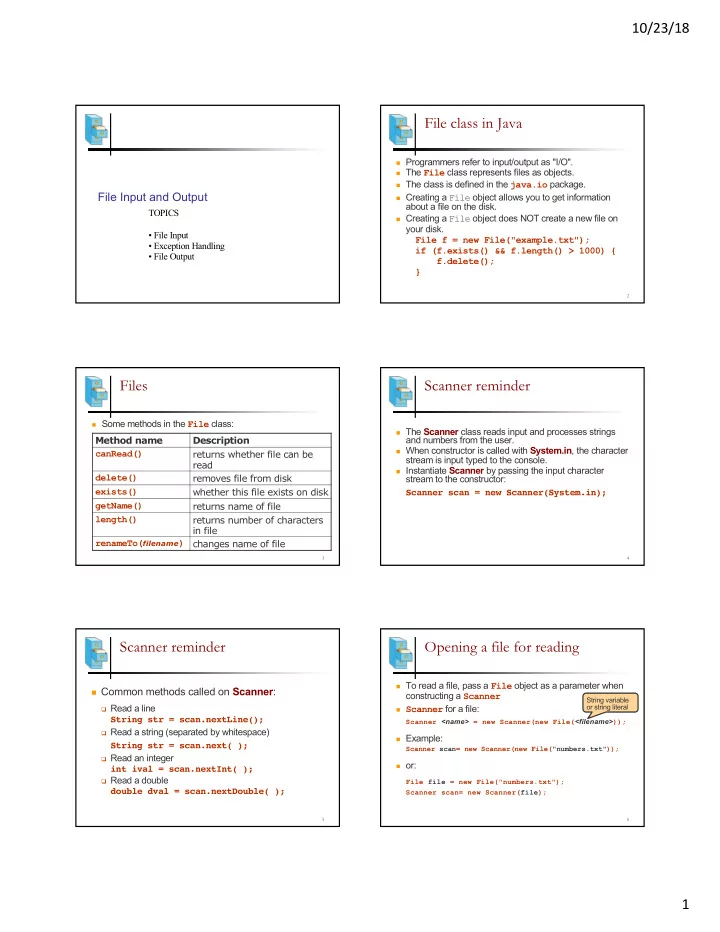
File class in Java

n Programmers refer to input/output as "I/O". n The File class represents files as objects. n The class is defined in the java.io package. n Creating a File object allows you to get information

about a file on the disk.

n Creating a File object does NOT create a new file on

your disk. File f = new File("example.txt"); if (f.exists() && f.length() > 1000) { f.delete(); }

2

Files

n Some methods in the File class:

Method name Description canRead() returns whether file can be read delete() removes file from disk exists() whether this file exists on disk getName() returns name of file length() returns number of characters in file renameTo(filename) changes name of file

3

Scanner reminder

n The Scanner class reads input and processes strings

and numbers from the user.

n When constructor is called with System.in, the character

stream is input typed to the console.

n Instantiate Scanner by passing the input character

stream to the constructor: Scanner scan = new Scanner(System.in);

4

Scanner reminder

n Common methods called on Scanner:

q Read a line

String str = scan.nextLine();

q Read a string (separated by whitespace)

String str = scan.next( );

q Read an integer

int ival = scan.nextInt( );

q Read a double

double dval = scan.nextDouble( );

5

Opening a file for reading

n To read a file, pass a File object as a parameter when

constructing a Scanner

n Scanner for a file:

Scanner <name> = new Scanner(new File(<filename>));

n Example:

Scanner scan= new Scanner(new File("numbers.txt"));

n or:

File file = new File("numbers.txt"); Scanner scan= new Scanner(file); String variable

  • r string literal

6

slide-2
SLIDE 2

10/23/18 2 File names and paths

n relative path: does not specify any top-level folder, so

the path is relative to the current directory:

q "names.dat" q "code/Example.java"

n absolute path: The complete pathname to a file starting

at the root directory /:

q In Linux: ”/users/cs160/programs/Example.java” q In Windows: ”C:/Documents/cs160/programs/data.csv” 7

File names and paths

n When you construct a File object with a relative path, Java

assumes it is relative to the current directory.

Scanner scan = new Scanner(new File(”data/input.txt”));

q If our program is in

~/workspace/P4

q Scanner will look for

~/workspace/P4/data/input.txt

8

Compiler error with files

n Question: Why will the following program NOT compile?

import java.io.*; // for File import java.util.*; // for Scanner public class ReadFile { public static void main(String[] args) { File file = new File(“input.txt”); Scanner scan = new Scanner(file); String text = scan.next(); System.out.println(text); } }

n Answer: Because of Java exception handling!

9

Compiler error with files

n Here is the compilation error that is produced:

ReadFile.java:6: unreported exception java.io.FileNotFoundException; must be caught or declared to be thrown Scanner scan = new Scanner(new File("data.txt"));

n The problem has to do with error reporting. n What to do when a file cannot be opened? n File may not exist, or may be protected. n Options: exit program, return error, or throw exception n Exceptions are the normal error mechanism in Java.

10

Exceptions

n exception: An object that represents a program

error.

q Programs with invalid logic will cause exceptions. q Examples:

n

dividing by zero

n

calling charAt on a String with an out of range index

n

trying to read a file that does not exist

q We say that a logical error results in an exception

being thrown.

q It is also possible to catch (handle) an exception.

11

Checked exceptions

n checked exception: An error that must be

handled by our program (otherwise it will not compile).

q We must specify what our program will do to handle

any potential file I/O failures.

q We must either:

n

declare that our program will handle ("catch") the exception, or

n

state that we choose not to handle the exception (and we accept that the program will crash if an exception

  • ccurs)

12

slide-3
SLIDE 3

10/23/18 3 Throwing Exceptions

n throws clause: Keywords placed on a method's header

to state that it may generate an exception.

n It's like a waiver of liability:

q "I hereby agree that this method might throw an exception, and I

accept the consequences (crashing) if this happens.”

q General syntax:

public static <type> <name>(<params>) throws <type> { … }

q When doing file open, we throw IOException.

public static void main(String[] args) throws IOException {

13

Handling Exceptions

n When doing file I/O, we use IOException.

public static void main(String[] args) { try { File file = new File(“input.txt); Scanner scan = new Scanner(file); String firstLine = scan.nextLine(); ... } catch (IOException e) { System.out.println(“Unable to open input.txt”); System.exit(-1); } }

14

Fixing the compiler error

n Throwing an exception or handling the exception both

resolve the compiler error.

n Throwing Exceptions: User will see program terminate

with exception, that’s not very friendly.

n Handling Exceptions: User gets a clear indication of

problem with error message, that’s much better.

n We will handle exceptions when reading and writing files

in programming assignments.

15

Using Scanner to read file data

n Consider a file numbers.txt that contains

this text:

308.2 14.9 7.4 2.8 3.9 4.7 -15.4 2.8 n A Scanner views all input as a stream of

characters:

q 308.2\n 14.9 7.4 2.8\n\n\n3.9 4.7 -15.4\n2.8\n 16

Consuming tokens

n Each call to next, nextInt, nextDouble, etc.

advances the position of the scanner to the end of the current token, skipping over any whitespace:

308.2\n 14.9 7.4 2.8\n\n\n3.9 4.7 -15.4\n2.8\n ^ scan.nextDouble(); 308.2\n 14.9 7.4 2.8\n\n\n3.9 4.7 -15.4\n2.8\n ^ scan.nextDouble(); 308.2\n 14.9 7.4 2.8\n\n\n3.9 4.7 -15.4\n2.8\n ^

17

First problem

n Write code that reads the first 5 double

values from a file and prints.

18

slide-4
SLIDE 4

10/23/18 4 First solution

public static void main(String[] args) try { File file = new File(“input.txt”); Scanner scan = new Scanner(file); for (int i = 0; i <= 4; i++) { double next = scan.nextDouble(); System.out.println("number = " + next); } } catch (IOException e) { System.out.println(“Unable to open input.txt”); System.exit(-1); } }

19

Second problem

n How would we modify the program to read all

the file?

20

Second solution

public static void main(String[] args) try { File file = new File(“input.txt”); Scanner scan = new Scanner(file); while (scan.hasNextDouble() { double next = scan.nextDouble(); System.out.println("number = " + next); } } catch (IOException e) { System.out.println(“Unable to open input.txt”); System.exit(-1); } }

21

Refining the problem

n Modify the program again to handle files that

also contain non-numeric tokens.

q The program should skip any such tokens.

n For example, it should produce the same

  • utput as before when given this input file:

308.2 hello 14.9 7.4 bad stuff 2.8 3.9 4.7 oops

  • 15.4

:-) 2.8 @#*($&

22

Refining the program

while (scan.hasNext()) { if (scan.hasNextDouble()) { double next = scan.nextDouble(); System.out.println("number = " + next); } else { // consume the bad token scan.next(); } }

23

Reading input line-by-line

n Given the following input data:

23 3.14 John Smith "Hello world" 45.2 19

n The Scanner can read it line-by-line:

23\t3.14 John Smith\t"Hello world"\n\t\t45.2 19\n ^ scan.nextLine() 23\t3.14 John Smith\t"Hello world"\n\t\t45.2 19\n ^ scan.nextLine() 23\t3.14 John Smith\t"Hello world"\n\t\t45.2 19\n ^

n The \n character is consumed but not returned.

24

slide-5
SLIDE 5

10/23/18 5 File processing question

n Write a program that reads a text file and

adds line numbers at the beginning of each line

25

Solution

int count = 0; while (scan.hasNextLine()) { String line = scan.nextLine(); System.out.println(count + “ “ + line); count++; }

26

Problem

n Given a file with the following contents:

123 Susan 12.5 8.1 7.6 3.2 456 Brad 4.0 11.6 6.5 2.7 12 789 Jennifer 8.0 8.0 8.0 8.0 7.5

q Consider the task of computing hours worked by each

person

q Approach:

n

Break the input into lines.

n

Break each line into tokens.

27

Scanner on strings

n A Scanner can tokenize a String, such as a line of a file.

Scanner <name> = new Scanner(<String>);

q Example:

String text = "1.4 3.2 hello 9 27.5"; Scanner scan = new Scanner(text); System.out.println(scan.next()); // 1.4 System.out.println(scan.next()); // 3.2 System.out.println(scan.next()); // hello

28

Tokenize an entire file

n We can use string Scanner(s) to tokenize each line of

a file:

Scanner scan = new Scanner(new File(<file name)); while (scan.hasNextLine()) { String line = scan.nextLine(); Scanner lineScan = new Scanner(line); <process this line...>; }

29

Example

n Example: Count the tokens on each line of a file. Scanner scan = new Scanner(new File("input.txt")); while (scan.hasNextLine()) { String line = scan.nextLine(); Scanner lineScan = new Scanner(line); int count = 0; while (lineScan.hasNext()) { String token = lineScan.next(); count++; } System.out.println("Line has “+count+" tokens"); }

Input file input.txt: 23 3.14 John Smith "Hello world" 45.2 19 Output to console: Line has 6 tokens Line has 2 tokens 30

slide-6
SLIDE 6

10/23/18 6 Opening a file for writing

n Same story as reading, we must handle exceptions:

public static void main(String[] args) { try { File file = new File(“output.txt”); PrintWriter output = new PrintWriter(file);

  • utput.println(“Integer number: ” + 987654);

... } catch (IOException e) { System.out.println(“Unable to write output.txt”); System.exit(-1); }

31

File output

n You can output all the same things as you would with

System.out.println:

n Discussion so far has been limited to text files.

  • utput.println(”Double: " + fmt.format(123.456));
  • utput.println("Integer: " + 987654);
  • utput.println("String: " + "Hello There");

n Binary files store data as numbers, not characters. n Binary files are not human readable, but more efficient.

32