FEMINISTS UNDER COMMUNISM? Everyday Experiences of Polish Women as - - PowerPoint PPT Presentation

feminists under communism
SMART_READER_LITE
LIVE PREVIEW

FEMINISTS UNDER COMMUNISM? Everyday Experiences of Polish Women as - - PowerPoint PPT Presentation

FEMINISTS UNDER COMMUNISM? Everyday Experiences of Polish Women as Filmed by Female Documentarians Anna Misiak, Falmouth University, UK THE PROJECT The Leverhulme Trust Fellowship 2015 The National Film Archive in Warsaw Poland The

slide-1
SLIDE 1

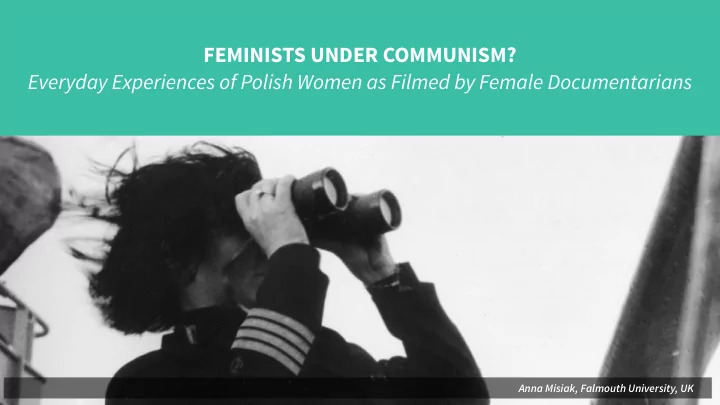
FEMINISTS UNDER COMMUNISM?

Everyday Experiences of Polish Women as Filmed by Female Documentarians

Anna Misiak, Falmouth University, UK

slide-2
SLIDE 2

THE PROJECT

  • The Leverhulme Trust Fellowship 2015
  • The National Film Archive in Warsaw Poland
  • The Documentary Film Studio (Documentary Films vs. Newsreels)
slide-3
SLIDE 3

Krystyna Gryczełowska (1931-2009) Danuta Halladin (1930-1987) Irena Kamieńska (1928-2016) Maria Kwiatkowska (1926-1999) Helena Amiradżibi (1932-2017)

slide-4
SLIDE 4

WOMEN’S DOCUMENTARY FILMS IN POLAND An Overview

  • Female contribution to the Polish School of Documentary (1950s-1970s)
  • Domestic and international festival trophies
  • Non-political authorial visions
  • Variety of documentary styles Diverse experiences of men & women
  • Films focussed on women from the late 1950s
  • Limited visibility in film history at home & abroad
  • Resisting the official version of gender equality
slide-5
SLIDE 5

OFFICIAL FILM RECORDS OF GENDER EQUALITY Newsreels

Men Don’t Know About It (1957) dir. Jerzy Kaden

slide-6
SLIDE 6

THE DIFFERENT HISTORY OF WOMEN UNDER COMMUNISM The Female Perspective

  • Women on tractors (The laughing stock)
  • Communism in the Catholic patriarchal society
  • Legal equality (official)
  • Gender identity fixed on biology (traditional

femininity)

  • Domestic matriarchy/Self-sacrificing women
  • Job market (equal work,not career progression,

up to 40 % pay gap)

  • Double burden of work
  • Feminism dubbed ‘unnecessary’
  • Female complaints as ‘not serious’
  • Women’s heterotopia (Foucault)
  • Women’s survival strategies in the documentary

films (and their views on that)

slide-7
SLIDE 7

DIGGING OUT: THE COMMUNIST PIONEERS OF TODAY’S FEMINISM

  • Female documentary filmmakers as

‘unintentional’ pioneers of contemporary feminist activists

  • Legal guarantees and access to the job market

don’t translate into gender equality in everyday life

  • Women’s resilience under patriarchal

discrimination

  • Distinct & differing definitions of womanhood

empowerment and resistance (from girl power to female sisterhood)

  • Recognition of privilege (city vs countryside,

workers vs educated women)

  • Varied articulations of resistance from heroism

through celebration of femininity to a rare open statement of resistance

  • Diverse versions of feminism as an emergency

exit from women’s heterotopia

slide-8
SLIDE 8

FILMED EVIDENCE OF WOMEN’S HETEROTOPIA Coping with the Double Burden of Work

The 24 Hours of Jadwiga L. (1967)

  • dir. Krystyna Gryczełowska

Our Friends from Łódź (1971)

  • dir. Krystyna Gryczełowska

Guarded Grade Crossing (1976)

  • dir. Maria Kwiatkowska
slide-9
SLIDE 9

FILMED EVIDENCE OF WOMEN’S HETEROTOPIA Coping with the Double Burden of Work

Our Friends from Łódź (1971) dir. Krystyna Gryczełowska

slide-10
SLIDE 10

FILMED EVIDENCE OF WOMEN’S HETEROTOPIA Celebrating the Self-Sacrificing Mother/Caretaker

Good Morning, Children (1966)

  • dir. Irena Kamieńska

The Family (1971)

  • dir. Danuta Halladin

Nurses (1974)

  • dir. Krystyna Gryczełowska
slide-11
SLIDE 11

FILMED EVIDENCE OF WOMEN’S HETEROTOPIA Coping with Social Suppression (Female Migrant Workers)

Zambrów (1962)

  • dir. Helena Amiradżibi

The Women’s Island (1968)

  • dir. Irena Kamieńska

They Were There (1985)

  • dir. Danuta Halladin

Where From Where To (1987)

  • dir. Danuta Halladin
slide-12
SLIDE 12

FILMED EVIDENCE OF WOMEN’S HETEROTOPIA Coping with Social Suppression (Resilient Heroines)

Fathers of A Town (1972)

  • dir. Danuta Halladin

Workwomen (1980)

  • dir. Irena Kamieńska

Day Afuer Day (1988)

  • dir. Irena Kamieńska
slide-13
SLIDE 13

FILMED EVIDENCE OF WOMEN’S HETEROTOPIA Empowerment through Fashion, Leisure & Entertainment

Who Wants a Dress? (1963)

  • dir. Helena Amiradżibi

Career (1964)

  • dir. Helena Amiradżibi

Not Just on Fashion (1965)

  • dir. Maria Kwiatkowska
slide-14
SLIDE 14

FILMED EVIDENCE OF WOMEN’S HETEROTOPIA The Independent Career Woman

The Girls from Nawojka (1963)

  • dir. Maria Kwiatkowska

Scenes with the Captain (1971)

  • dir. Maria Kwiatkowska

Ms Zofia (1978)

  • dir. Maria Kwiatkowska
slide-15
SLIDE 15

DOCUMENTARY EVIDENCE OF WOMEN’S HETEROTOPIA An Open Statement of Female Resistance to Patriarchy

The Weak Woman (1967) dir. Helena Amiradżibi

slide-16
SLIDE 16

THE WEBSITE

http://womenundercommunism.com/