The Vietnam War Cold War Review Containment was successful through - - PowerPoint PPT Presentation

the vietnam war cold war review
SMART_READER_LITE
LIVE PREVIEW

The Vietnam War Cold War Review Containment was successful through - - PowerPoint PPT Presentation

The Vietnam War Cold War Review Containment was successful through the 1950s Truman Doctrine Marshall Plan Korean War BUTin 1945, US govt became concerned with threat of Communism in Asia Vietnam Controlled by France


slide-1
SLIDE 1

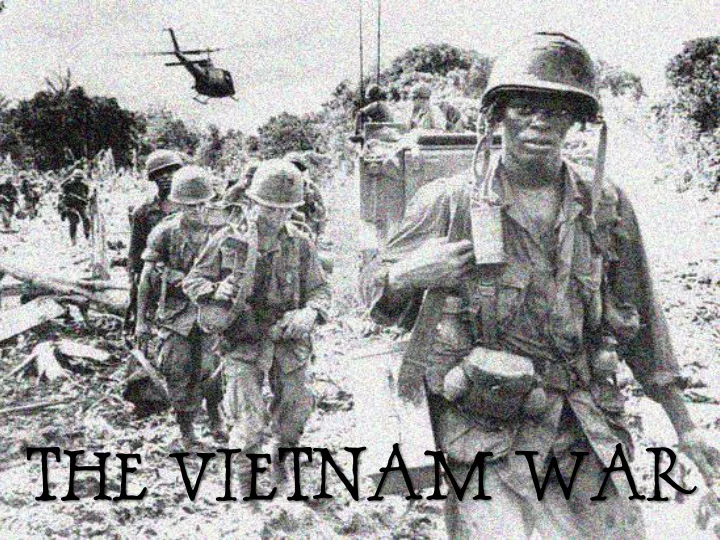
The Vietnam War

slide-2
SLIDE 2

Cold War Review

  • Containment was successful through the 1950s

–Truman Doctrine –Marshall Plan –Korean War

  • BUT…in 1945, US gov’t became concerned with

threat of Communism in Asia

slide-3
SLIDE 3

Vietnam

  • Controlled by France since 1887
  • 1945: Ho Chi Minh leads war for

independence

–USA concerned revolution would result in Communist government

  • Truman and Eisenhower sent

aid to France

slide-4
SLIDE 4

Vietnam

  • 1954: France withdrew troops
  • Vietnam divided at 17th

parallel

  • Ho Chi Minh

h took over the North

  • Ngo
  • Dinh Diem

em became Democratic leader of the South

slide-5
SLIDE 5

Vietnam

  • Eisenhower & Kennedy

supported Diem in South Vietnam

  • Sent military advisors to put

down Communist supporters in S. Vietnam

  • Nov. 1963: Diem assassinated

– Led to chaos in S. Vietnam

  • LBJ inherited Vietnam

“problem”

slide-6
SLIDE 6

Gulf of Tonkin

  • 1964: USS Maddox attacked by North Vietnam in the

Gulf of Tonkin

  • Congress issued the Gulf of Tonkin Resolution which

gave LBJ broad powers to “defend Vietnam at any cost”

  • Led to escalation of US

involvement in Vietnam

slide-7
SLIDE 7

Escalation

  • LBJ began sending U.S.

troops in 1965

–Goal: CONTAIN N COMMUNISM M

  • By 1968, over 500,000 U.S.

soldiers were fighting in Vietnam

slide-8
SLIDE 8

Fighting in Vietnam

  • US troops were battling the Vietcong

–Vietcong: supporters of Communism in South Vietnam

  • Problem:

–difficult to tell who the enemy was –Vietcong used guerilla tactics to combat U.S. military superiority –Jungle made fighting difficult

slide-9
SLIDE 9

The Tet Offensive

  • 1968: the Vietcong launched the

Tet Offensive against U.S. forces in South Vietnam

  • American anti-war movement

grew

–LBJ announced he would not run for re-election

  • = a turning point, as the US

began to withdraw from Vietnam

slide-10
SLIDE 10

Election of 1968

  • Chaos of 1968 led Americans to demand peace

and stability

  • Republican Richard Nixon won election
slide-11
SLIDE 11

Nixon and Vietnam

  • “Peace with Honor”
  • Vietnam

amization: gradually withdraw U.S. troops & replace them with South Vietnamese soldiers

  • secretly sent U.S. troops

Cambodia & ordered bombings of Laos Led to biggest protests in US History

slide-12
SLIDE 12

Ending the War

  • 1973, the U.S. & North

Vietnam agreed to a cease fire

–the U.S. withdrew troops from Vietnam

  • 1975, North Vietnam invaded

South Vietnam

–unified the nation under a communist government

slide-13
SLIDE 13

Impact of Vietnam

  • Vietnam was the longest & most divisive war in

U.S. history

  • Of the 3.3 million U.S. soldiers who served:

–58,000 were killed –303,000 were wounded –15% were diagnosed with post-traumatic stress disorder after the war –Many vets faced hostility from other U.S. citizens when they returned home

slide-14
SLIDE 14

Impact of Vietnam

The war changed foreign policy

  • Containment ended as Americans became

cautious of the U.S. role in the world

  • Congress limited a president's ability to send

troops without a declaration of war by passing the War P r Powers s Ac Act in 1973

slide-15
SLIDE 15

Impact of Vietnam

The war changed America at home

  • People began to lose faith in the honesty of

gov’t leaders during the Johnson & Nixon years

  • The $176 billion cost of the war led to high

inflation in the 1970 & weakened LBJ’s Great Society

  • The 26th Amendment lowered the voting age

to 18 years old