Feed the Future Africa Great Lakes Region Coffee Support Program - - PowerPoint PPT Presentation

feed the future africa great lakes region coffee support
SMART_READER_LITE
LIVE PREVIEW

Feed the Future Africa Great Lakes Region Coffee Support Program - - PowerPoint PPT Presentation

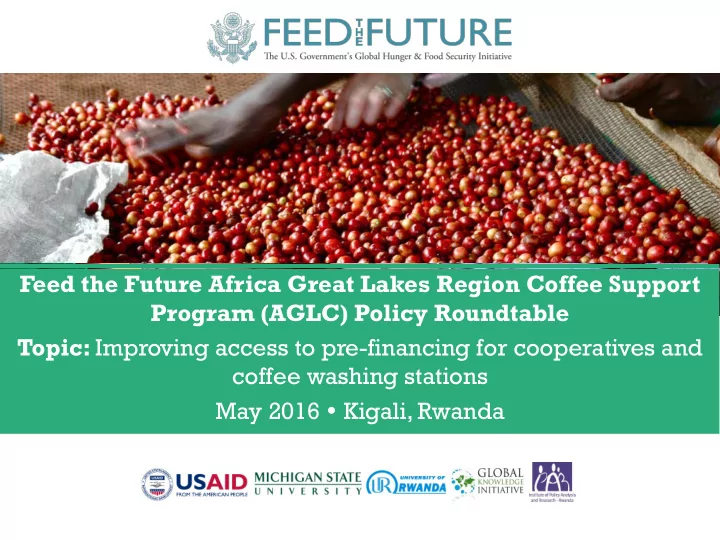
Feed the Future Africa Great Lakes Region Coffee Support Program (AGLC) Policy Roundtable Topic: Improving access to pre-financing for cooperatives and coffee washing stations May 2016 Kigali, Rwanda Introduction to the Challenge 2 AGLC

slide-1
SLIDE 1

Feed the Future Africa Great Lakes Region Coffee Support Program (AGLC) Policy Roundtable Topic: Improving access to pre-financing for cooperatives and coffee washing stations May 2016  Kigali, Rwanda

slide-2
SLIDE 2

2

Introduction to the Challenge

slide-3
SLIDE 3

Global Knowledge Initiative 3

AGLC Background

  • AGLC is a 3-year USAID-funded initiative that

addresses 2 major challenges in the coffee sector in Rwanda (and the Africa Great Lakes region)

  • Reduce antestia bug/potato taste defect (PTD)
  • Raise coffee productivity
  • Partners
  • Rwanda: Inst. of Policy Analysis and Research

(IPAR) and Univ. of Rwanda (UR)

  • USA: Michigan State University (MSU) and Global

Knowledge Initiative (GKI)

  • Numerous public and private sector partners
  • Components: • applied research • policy

engagement • capacity building

slide-4
SLIDE 4

Global Knowledge Initiative 4

Applied research component

  • AGLC draws upon a broad mix of quantitative

and qualitative methodologies, including:

  • Coffee farmer/household surveys (and CWS

survey)

  • Experimental field/plot level data collection
  • Key Informant Interviews
  • Focus Group Discussions
  • Comprehensive coffee sector data base
  • Goal to integrate information from these four data

collection activities

  • Provide empirical basis for policy engagement and

farmer capacity building

slide-5
SLIDE 5

Global Knowledge Initiative 5

Guiding question:

How might we improve access to pre-financing for cooperatives and coffee washing stations?

slide-6
SLIDE 6

6

Methodology

slide-7
SLIDE 7

Global Knowledge Initiative 7

Baseline survey of coffee growers

  • Geographically

dispersed sample across four coffee growing districts: Rutsiro, Huye, Kirehe and Gakanke.

  • 4 CWSs in each

District (2 cooperatives, 2 private)

  • 64 HHs randomly

selected from listings of each of the 16 CWSs

  • (64 x 16 = 1,024 HHs)
slide-8
SLIDE 8

Global Knowledge Initiative 8

Baseline survey, cont.

  • Focus on fully-washed coffee. Sample does not

include HHs not on CWS listings

  • Advantage: In depth focus on core of Rwanda’s

coffee sector strategy (FW)

  • Disadvantage: Ordinary coffee (parchment)

producers underrepresented

  • Survey instrument includes diversity of topics:
  • coffee growing practices • antestia control practices •

cost of production • coffee field size • number of trees • slope • location (GPS) • cherry production & cherry sales • landholding • equipment & assets • household income • barriers to investment in coffee

  • basic household demographics
  • Programmed (in CSPro) on 7” tablets for data

collection

  • 10 enumerators (working in 2 teams of 5)
slide-9
SLIDE 9

Global Knowledge Initiative 9

Qualitative Data

  • Key informant interviews
  • Key coffee sector leaders including public sector

representatives, farmer organizations, and private sector stakeholders.

  • Focused on challenges identified by stakeholders

and provided insights into critical areas of convergence and disagreement among various specialty coffee sector stakeholder groups.

  • Focus group discussions
  • Held with major coffee stakeholder groups

including coffee farmers, washing station managers, coffee exporters, others.

  • Groups of 5-7 members of each stakeholder

group

slide-10
SLIDE 10

Global Knowledge Initiative 10

Fieldwork

AGLC Baseline survey

interview with farmer in

Gakenke Focus group discussion with farmers at Buf Café washing station

slide-11
SLIDE 11

Global Knowledge Initiative 11

Overview parameters of sample

  • Gender of Head of HH

– 81.5% Male – 18.5% Female

  • Head of HH completed

primary school: 38.1%

  • Mean age of head of HH:

51 years

  • Median number coffee

trees on farm: 400

  • Head of HH member of

cooperative: 55.4%

  • Median cherry produced

in 2015: 600 Kg

  • Mean cherry price

received in 2015: 198 RWF

  • Median HH cash income:

340,000 RWF

  • Share of total cash income

from coffee: 44%

  • Percent of coffee farmers

reporting antestia: 55%

slide-12
SLIDE 12

12

Primary and Secondary Research Findings

slide-13
SLIDE 13

Sub-questions addressed in findings

  • 1. Why are cooperatives beneficial to farmers and to

the broader coffee sector?

  • 2. What incentivizes farmers to sell to cooperative

CWS versus private CWS?

  • 3. Why do coffee washing stations need access to

pre-financing?

  • 4. Which CWS have access to pre-financing and

which do not? Why?

  • 5. What are the consequences (for the sector, CWS,

and farmers) of a lack of pre-financing?

13

slide-14
SLIDE 14

14

slide-15
SLIDE 15

15

Premises to challenge

  • 1. Cooperatives can provide farmers with benefits

not provided by private companies and are important to the growth of the specialty coffee sector

  • 2. Coffee washing stations (CWS) often require pre-

financing in order to pay farmers appropriately and on time

  • 3. Cooperative-owned CWS often cannot access pre-

financing

  • 4. Because cooperatives often do not have the pre-

financing required to pay farmers upfront, farmers may be incentivized to sell to either middlemen or private CWS

slide-16
SLIDE 16

Trends in coffee production

16

slide-17
SLIDE 17

17

2

slide-18
SLIDE 18

18

slide-19
SLIDE 19

19

slide-20
SLIDE 20

20

Evidence from the Literature: Benefits of Cooperative Membership

“Farmers [selling to cooperatives] are more likely to make the necessary effort in the production of coffee that leads to the required quality of raw coffee because as stockholders, they have an incentive to make their

  • rganization more profitable. By doing so, they

expect their cooperative to generate high profits, which will be repaid in the form of dividends.” (Murekezi et. al., 2009)

slide-21
SLIDE 21

21

Evidence from the Literature: Benefits of Cooperative Membership

“Farmers who have no access to credit show a positive and significant decision to participate in cooperatives. Cooperatives are one of major source of credits for [smallholders]; therefore smallholder farmers are more likely to become members in order to have access to credit loan without collateral requirement and high interest rate …” (Issa et al, 2015)

slide-22
SLIDE 22

22

Evidence from the Literature: Challenges facing cooperatives “Private processors easily get loans at market rates because they have collateral. Coffee farmer cooperatives have less

  • collateral. Banks are reluctant to give loans

to cooperatives for fear of loan default.” (Murekezi et. al., 2009)

slide-23
SLIDE 23

23

Evidence from the Literature: Challenges facing cooperatives

“…there is no indication that farmers who sell to cooperative factories get more benefits than farmers selling to private processing plants. These findings suggest that, although the structure of some specialty coffee channels, such as the fair trade market, put cooperatives at a competitive advantage, private processors are able to compete with cooperatives and sometimes offer strong incentives to farmers.”(Murekezi et. al., 2009)

slide-24
SLIDE 24

24

2.6% 39.0% 58.3% 0% 10% 20% 30% 40% 50% 60% 70% 80% 90% 100%

Independent trader Private CWS Cooperative-owned CWS

Percentage (%)

Farmer's main buyer of cherry in 2015

Evidence from baseline: Farmer behavior

slide-25
SLIDE 25

25

27.6% 38.8% 7.5% 9.7% 16.4% 0% 10% 20% 30% 40% 50% 60% 70% 80% 90% 100% Other Not a member of coop Does not give bonus Delay in payments Paid lower prices

Percentage of farmers

Why farmers do not sell to nearest coffee washing station

Evidence from baseline: Farmer behavior

slide-26
SLIDE 26

26

Evidence from Key Informant Interviews

  • 1. Many cooperatives and cooperative-owned

CWS face management challenges.

  • 2. Banks trust private CWS owners more than

cooperative-run CWS.

  • 3. Even those cooperatives that do receive

financing often receive it late because the bank loan cycle may be misaligned to coffee season.

  • 4. Banks may have difficulty determining how

best to pre-finance cooperatives.

slide-27
SLIDE 27

27

Evidence from Key Informant Interviews Cooperative mismanagement: “There are many problems with pre- financing because there have been many defaulters in the past. It doesn’t mean that coffee doesn’t make profit, but it has been mismanaged at the cooperative level.” – Key Informant

slide-28
SLIDE 28

28

Evidence from Key Informant Interviews

Loan cycle misaligned with coffee season: “What’s still lacking is a good understanding of the coffee business on the part of the finance agencies…Loans are being given due on December 31st and sometimes coffee is unsold until that date. We need banks to reconsider and give contracts that go beyond December 31st.”

  • Key Informant
slide-29
SLIDE 29

29

Evidence from Key Informant Interviews

Bank understanding of sector:

“Banks should be more flexible in giving loans to agricultural projects in general, they should learn from how these international banks work. They should reduce the bureaucracy, like asking for a loan and you are asked to have more many requirements that may take more than a month to get and cause delay to start with the season and later they finally give you the money when it’s too late. ”

  • Key Informant
slide-30
SLIDE 30

30

Summary and discussion points

slide-31
SLIDE 31

Recap of challenge and findings

31

  • 1. CWS use pre-financing to pay for coffee

cherry upfront. Loans are then reimbursed from the proceeds of coffee sales.

  • 2. Private CWS often receive pre-financing from

banks because they have collateral.

  • 3. Cooperative CWS often cannot obtain pre-

financing because banks believe cooperatives are mismanaged, and that cooperatives will default on their loans.

slide-32
SLIDE 32

Recap of challenge and findings

32

  • 4. Bank loan cycles often do not match up with

the coffee season. As a result, even when CWS do receive financing, it may not be at the right time.

  • 5. Since cooperative CWS often cannot receive

the pre-financing necessary to pay farmers upfront, many farmers sell to private CWS, which do not (1) advocate for farmers’ needs; (2) elicit trust from farmers; (3) incentivize farmers to produce high quality coffee; (4) increase traceability in the sector.

slide-33
SLIDE 33

Discussion questions

  • What do we conclude from the data?
  • How can we better articulate the challenge

and what else do we need to know?

  • What are the major policy levers that can

help CWS and cooperatives access pre- financing?

  • How might we encourage stakeholders to

work together to ensure CWS and cooperatives have access to pre-financing?

33

slide-34
SLIDE 34

Thank You!