
SLIDE 1
Guns accounted for I2.I%"of federal convictions in FY ZAn
1n
Violent FightAgoinst Lou"Letel Cun 7ìrrgel.r Ðept.
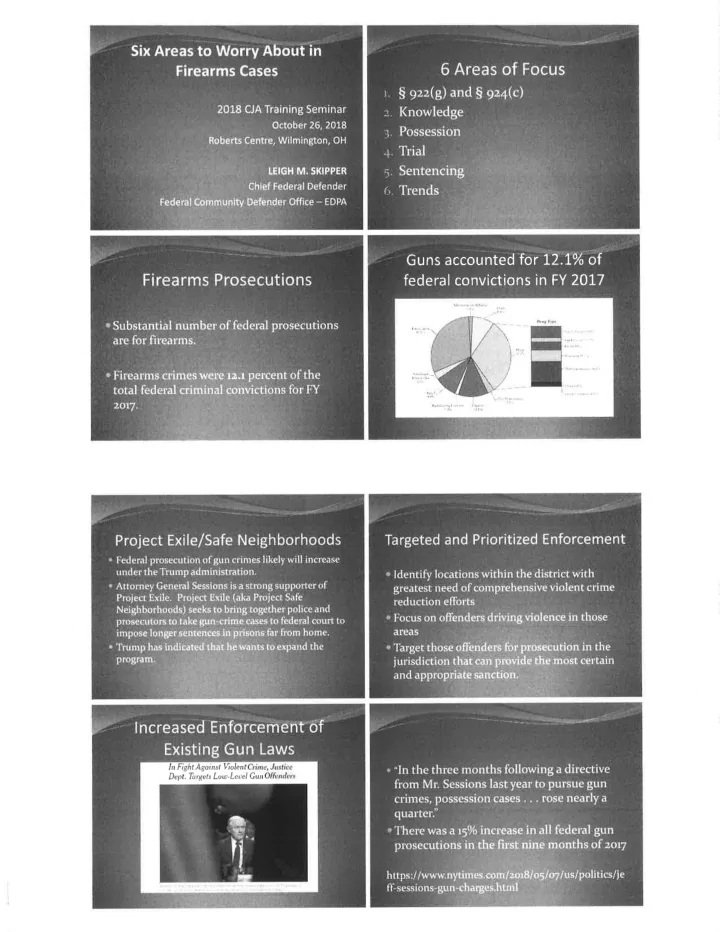
federal convictions in FY ZAn FightAgoinst Violent 1n - - PDF document
Guns accounted for I2.I%"of federal convictions in FY ZAn FightAgoinst Violent 1n Lou"Letel Cun ept. 7rrgel.r Two Firearms Offenses Make Sessions "Nervous" That Are Most Common P<ssession of fire.rrm by.r convicted
1n
Violent FightAgoinst Lou"Letel Cun 7ìrrgel.r Ðept.
P<¡ssession of fire.rrm by.r convicted felon (rB USC $ 9zz(g)(r)); and
Firearm possessed during and in relation to crime of violence or drug trafficking offense (r8 l",SC 6 q¿¿(cxrx.À) )
r8 U.S.C. $ gzz(gxr) makes it a Federal crime or
felony oflense to possess å fìrealm in or affècting
i nterstate coûlrrìerce.
l)r'olr ibitecl persons .rls<¡ inclucle:
"lllegal".-rliens Fugitivcs flom justice Unlawful users of controlled substances; acldicts
Adi ud icatecl "melrtal defèctives"
I ) i s h on o r"rtrly discharged service personnel
L.l.S. citiz.ens who have renounced cítjzerrslrip M isde rneanor dornesric violence nåtters
A defenclant ca¡r be found ¡¡uilty of a $ Szz(g)
provcd beyond a reasonable cloubt:
'I h¿ L Lhe [)cfi,nt1¡nt knoH irtgly ¡rossessed .r f ìrearrr ; .l'h¿ t the [)ele¡lc{¡ rrt knorvingly possessed .r fìre¿ rnr
i n 0r ¿lfi-criDg irìl(fstatr or f' rrciÍln c' ìilr¡ìrerre, ¿\
chargetl; and 'l'hat befo¡e the Defendrnt possessed the fire¿rm the Dcfendant had been convict¿d in a court
term in excesg ofone yea6 that ie, a felony
lJ¡rt se¿ rB IJ.S.C. S q¿l(aXzollB): ifstateclasgifìesoffense.rs.r
nl is<lrnr¿arror and dorsnt errcee<l z year sfat rn ¡r, not a lelony.
'l hird:
Li]:r:
Seco¡rtl:
Fetleml law does not prevent prohibiterl pelsons fronr posst'ssing, a n "a¡ìtique" f ì re¡r'm. Arr .rntique fìrearnr is any fìrearrn nranufàctr¡¡'ecl bcfblc 1898, See r8 U.S.C. S 9¿r(a)(r6)(A). On Jr.rly rz, zor7, Sen. Billl C.rssidy (lì-LA) introduced
bill (S. r54r) to modify tlre definition of antique
firear¡n. Unclcr ploposcd bill, "1898," is stricken and lepl"rced rvitlr "the c.rlenclal year that is roo years bcfble the calend.rr: year in which the detclminatir-rrl âs to whethe r the lìrearrn n'le€ts the le<¡uilement of this subparagraph beirrg nradel'
Defenclant consciously possessed u,hat hc knew to be a firearrn.
defendant wa$ aì/vare that he possessecl a fìrearm. (lovelnlnent need not plove that clefþndant knew
¡rosscssion of fìr'e.rrr-¡r was unla'¡,f ul.
:orz); [J..9. y. Thonra.s, 615 F.3d 89S, 8sg (8tlì Cir.
zoro); {./.5. v. McCrcy, ¡+: }'. App'x 498 (ntl' Cir.
¿t¡t'rg); U.S. v. Wilson, $7 Y.}d 616, 6¿o (7'r' Cir: zoo(r); U.S. v. Dodd, zz5F3d 3,.+<r, 344 i3d Cir., :,crr¡o); U.S. v. Frazier-El,zo4F3d 551,56r (4'l'Cir.
:uro).
'. Gorsuclr concurrence in Game.s-Pe¡ez, (rfi7 [:'.3d rr36, rr4u-43 (roth Cir. zor:,) (Gorsuch, f., conculring)
Precedent dictates that the r,rnly knou'lcdgc rt <¡uirccl is t he linowleclgc lhat instrtunent possr:ssed is a fir'ca¡rl. "Ilt]recedent son'retilrres ¡'equircs r.ls to lìlakc nìistakcs."
Holding that thegovernmerrttloes not necd to provc a defbnd.¡nt,knew be was a felon "sirnply can'l bc squarttl u'ith the text of [$ çr¿¿(C)l 5 92,1(a)(:) autlrolizes irnplisonmerrt for "u,hoever hnorvirrgly violates" 5 9¿z(g). Prececlent "leapfrog[sl" over first element (fblony
corrviction) to focus on the second (possessed
fircalm)
Colsuch argues that knowingly should be applied to o/1 three elenrents.
Bifurcation in a single-count case.
the fäct of a prior felony conviction. Llnite(l States y ?ñompson, 675 Fed. App'x :,2r, zz4 (3d Cir. zotT ) (concltrd,ing bifurcation for single-count c;rses nôl required but perrnissible).
'l\vo tvoes of uerssession; actual and corlstructive Constructive posses$ion: power and intent to exerclse dominioaand control over
" Insufficient eviclence to establish that clefend.rnt
constructively possessed firear'¡n:
th¡t <tefend¡¡t - u'ho sintply walked tk¡rv¡r stleet u'ith
co-de{endant who rvas canying gun in a [.lackp.rck clitl rìot coûstructi!'ely possess gun in backpack)
See olso U.S. v. Anderssn, 6zz F 3ð 1264, 1268-69 ( D.C.
the se.rt" {toes ¡rot arïosrlt to¡dmission of constnrctive possession) LJ.S. v. Hooks, 55r F.jd rzo5, rzr3-r4 (roth
Cir'. zoog) (no constructive possession u'hel'e clefendant was one of several passengers, no fingerprints, no showing of kno.,r4 edge or control)
l.)ixon v. U¡titecl States, ¡+tl U,S. r (zoo6)
I)ixon w.rs charged rvith rS U.S.C. fi .{j 9zr(n)
(receivirrg a fì¡'e¿rnr while under indictrnent) .rnrt
g¿t(a)(6) (making false statements in connectior.r with the acqlisition of a firearnr). Dixon claimed duress and requested a .iury iustructíon placing the burclen on the golernment
to rlisprove her dures clefbnse beyoncl .r reason¿blc doubt.
clicl not run afoul of the DP clausc u'hcn
they placecl the burclen on Dixon to cst.rblish the existence of duress by a preponderance of the evidence', (z) Modelrr
prepond,erance of the evidence.
' 'l'he'l'hird Cilcuit lras yet to recognize the affirrnative defènse of "innoccnt" or "transitoly" possession. , Only one published appellate opinion fì nding crime r¡l innocent possession and affìlmative clefènse to !i gz¿(gXr). U,S. v. Mason, 233 F.jcl 6r<.¡ (D.C. Cir. zooo)
'lir successfuìly invoke innocelrt possession dclbnse, the l¿cts must be that:
(r) tl're fìr'earrn was attained innocently and held
witlr no illicit purpose and (z) possession of the lìreamr was transitory * i.e., in liglrt of the circurn$tä,ûces presented there is a
goocl basis to fìnd that th.e defendant took .ìdequate rìleasur€s to lid l¡i¡nself of posscssion of
thc fìrearnr as pronqrtly as reasonably possible. 'I'he'l'hild Circuit has assumecl for the salce of' argument that if tlre afiìrmative defl'nse applied, it rvould use the standard articulated in U.S. v.
Mason.
See U.S, v, Longfo,rddavis, 454 Fed. App'x 34 (3d
Cir: zorr) (hold,irtg ir¡st¡uclio* <¡n i¡urocent possession not wa¡¡ânted)l sec r¡lso U,S. v.
Hollowoy,4oe Fed. App'x 692 (¡oroXholding
defþndalrt not enti.tled to instruction on f leeting innocent contaet).
U.S. v. Jockson, z8:u Fed. App'x 999 (3d Cir: zootÌ) (no evidence suggesting that clefèndant obtained \\¡capons in an "i¡rnocent" fäshion as required to
support atïìrmative defense fol tlansitory possession).
U.S. v. Duniels, 248 Fet1. App'x 387 (3tl Cir. "reru7)
(holding innocent possession not a{Hrmative
detènse to possessio¡l of fì¡earm try convicted felon)
, Rule 4o4(b) c¿rries rtr> ¡:r'esunr¡:tion of
adnrissibility. Plior act evidence is inadn'rissible unless the evidence is (l) oflerecl fbr.r proper non*plopensity purpose; (z) relevantto rhat identified pulposc; (3) sufficiently probati.ve r¡nder Rule 4o3; (4) accornpanied by a li,rnìting instrt¡ction.
U.S. v. ( uldu,ell, 7(ro [r.jd 267 (i<l Cir. zor4)
(holding evidence of defelrdant's plior convictions for unlawhrl fircar'¡n possession u,as not adrnissiblc
t o slrorv knou,leclge).
Calclrvcll was charged u'ith violating 9zz(g)(r). 'l'lrc gove¡-nnìent's theory rvas "purely one of actual
¡.rossession [. l"
A defe nclant's "knowleclge" is alnrost neve l a
nraterial issue when the govelnment l'elies exclusively on a theory of actual possession."
' l'he goverrr nrent tìr ilecl to .rdec¡uately a rt icu l"rte thc
rron-¡rro¡rensity chain of inferences it lro¡red thc
july n,oulcl nrake flom the introduction of
Cal drvell's priol convictions. t'krw di<l Caltlrycll'.s two prior cor,victions for u¡rl¿rvlul fire'arrn possessit¡n Èom ¿oo5.rnt{ zoo6 sugg*st he krrowingly pr.rssessecl a gun seven years later?
Not enough to nrerely recite.r Rtrle 4c4(b) ¡;ur¡>ose; must articulate how the evit{ence is prob.rtive of that purpose. How dirl Caldwell's pr,io¡ unl¿,wfll firearnr ¡:ossession convictions suggest lre knowir,rgly posse.ssecl this gun rrn this occasiora?
{/..S. v /ìoi/r'y, B4o F. 3d ggnq (jd Cir'. (lct, rlì, :orl>)
dlue tr'.1ffi cking.rncl grrn case challenging adrnissiorr
District court.rdnritted video of murderand non- viclco cvitletce (testimony and recorded convelsations).
l leld: Court did not err in adnritting non-video evidence of mu¡der, Fforvever. court was "extremely
t lou blecl" tl're cou ¡t all¡wed surveillance video of
shooti nglnrulcler into evidence,
Reverse 404(b) evidence inadmissible to show
another person's propens¡ty to possess firearms
. U.S. v. lUilliants,45tl Ir.3d )12,317 (3d Cir. :oo(;) (affir'nring exclusion of revelse 4o4(b) eviclence where only purpose rvas to shor,r, propensity to carry fìr'eanns rvhere defendant plesented no evidence that inclividual's prior conviction involvcd the same gun, the sarne type of gun or that he hacl continued access to the t,?e of gun). Iror more support t¡f the use ol Reverse 4o4(ll) evidence see:
[./.5. v. Srcvens, 935 ['.zd lf8o, r4o4-o5 (:d Cin
r<.¡9r) (defèndan t may introcluce revelse 4o4(b)
evidence so long as its probative value under Rule 4or is not sr"rbs{antially outweighed by Rule 4o3 considerations)
(explaining that a reverse 4c4(b) analysis should
be helcl ttr a less rigorous standard because prejudice to the defenclant is not.r factor)
U.S. v. lucas, 357 F:d 59q, 6os-ç6 (titr' Cir. roo4)
(applying the saare ruleas Sfevens)
I)istritt o.f Ct>lumbio v. Ileller, ¡28 S. Ct. 2783 (zor.r8) (holtling t).C. ban on h.rndgun possessiou irr honre
viol¿tcs tho :"'l Amcrìdrìrcnt)
ct) Ìtslituti(.,tìal.
Sec U.5. v ?b¡rc.s-Rosario,658 F.jd tro. rr3, rr j n.r (r'r
Cir: :,orr); US. rr llogle, 7ry F.jd 2th, 28: (zd Cil zor3); t/.S. v. /Jo¡¡on,63j F.3rl t6B, rTtt-t75 (3<1 Cir: :orr): ti..!. y Mctore,666 F.3d 3r3, jr(rr7 (4'h Cir zorz); [/.S. v.
t\lcuntar.T)tFAd r4l, r45 (5th Cir. zorj); t/.S. v. Khani, 16: Freci. Appx 5or, 5o7-8 (6'h Cir. aoro); tLS. ri lltilliants, ó16 F.3d 685,69r-94 (7tr'Cir. ¿oro); [i..S. v.
/oo.s, (r38 F.3d 58r. 586 iSth Cir. :on)l [15. v. V'ong-ray, 594 F.3d rr1r, rn4-5 (9th Cír. ¿oro); U.S. v. Ì\|cCane, 573 F.3d ro37, ro47 (roth Cirl :oo9) ånd U.S. rr Ãozicr, 59Íì F.3d 7ó8. 77o^t (ttt, Cir. zolo),
Mc'[)onold v- City t¡f-Chicago, t3o S.Ct. 3ozo (:,oro) Second Anrendrnent light to bear alms is fully ap1:licable to the States by virtue of tlre r,1,1' Arnendlnent. McDonold leaves in tact ban on ow:rership of firearnrs by [elons.
Hollis v. I¡tnch, Bz7 F.3d 436 (5rr' Cir'. zor(r) (upholding federal law barring posscssit'rn of machine guns holcling rnachine guns âr'e rìot protected by the Second Amenchnent). Machine guns not pfotected by Secontl Anrendnrent.
ßinclcrup v. Htilder, No. r3-cv-o675o, zor4 WL
.176.+.124, slip. op. (8.D. Pa. Sept. :,5, zor,¡).
l)espite prior conviction, defendant demonstrated th.rt lre poses no gre¿ter risk of future yiole¡rt corrduct than averrge lau-abiding citizen. 'Ihus, applic.rtion of $ 922(gxr) as appliecl to him viol¿te's the Second Amendment Ilindeltr¡r rebutted the pt'esurnptio¡r r.risecl in I lalle r that there is no ploblcrn rvith barring felons fìr¡nr
possessing guns.
'lb raise s¡,tccessful as-applied cha lleng,e, chll lenger
must distinguish lris circt¡mst.lrÌces fronr tbose historically bar¡ed f¡om Second Amendment protectioRs.
'I'hir<l Cilct¡it cn bc¡¡c court.rffìrrned trvo as-a1.lplied Sect¡nd Amendment challerrges to clainlatìts wh<¡ were ¡rlohibite<l persons based on non-r,iole¡rt state rnisdemeanor convictions that were pr.rrrishable by nrore th¿¡l one year in prisotr. T'he claiurants were convicted of corrupting the nrolals
unlicensed gun possession, crírnes tirat are punishable by rnole than one year in prison, but¿re not serious enough to justify stripping away a person's Second Amentünent rights.
, lìoth defendants had ¡¡one crime frec for sutrstanti¿l
amourltri of time. 'l'he governrnent could not show that thc fbl<¡n-in- possession statute suryives intermediate sclutiny as- applied to these ch¿llengers, because their'isolatcd, decades-old non-violent misderneanor crrnvictions tlo not permit an i¡ference that dirarming peoplc like them woulcl pr:omoteresponsible fìrearnr usc l'-r.rctured cn hanc clecision.
Lar,r, of Circuit:
the tu,o.'step US v. Marzzarell.r f'rar¡ework corrtrols all Second Arrrendment challenges, irrcluclíng as-applied challenges to g qzz(gXr);
.r challengel will satisfy the first step o[ that
fianrework ouly if he proves that the law or regulation at issue burdens conduct prctected by the Second Anrendnrerrt;
to satis\'stcp one in the colìtext of ¿ìn .ìs-apl)lied rhalle nge to S g¿z(gXr),a clr.rllenger nÌust prove th..rt
he u'as not previousll, convictcrl of ¡ se¡'ious clinle : eviclence r¡f a challenger's relrabilitatio¡r or his
likelihood of recidivisrn is r¡ot relevant to thc stcp-
às the nârrowest ¡¡round $upporting the Cr¡ur('s
iudgnlerrts fo.r Binclerup ar¡d Suârez, th(' co¡rsideratior¡s r{isclr¡;sed above will deternrinc whet¡er cri¡¡res are se¡'icrus (r.c., tlisqrralifying) at step one; and
if'a challenger rn"rkes the necessary step-one shorvinq, the bulclen shifts io thc Covc¡'nnrent at step two to prove that the regulation at is$ue survives intermediate scruti ny.
Principal is a felon and possessed firearrn Must co-defenclant know of ,principal's convicted fclon status? 9zz(g)(r) violation
U.S. v. li¡rrl, l3:r lr.3cl 63 (r't Cir. zo16) (holdinggov't rìrust ¡:rrovo lleyorrrl .r re¡srrn¡ble doubt th¡t put.ìtive ùi(ler atìd
¿bettol kuew that princip.rl had previously lreen convicted of
.r crirne punishable by nrore rl'ran one year in prison).
{lS. v ,5arnur,/s, 5rr F'.yl 8o4,8u*"2 iTth Cir. zooS)(explairring
tl¡.rt rlelèntlant "nìüst knorv ôr håve rea;on to knorv" that
indivitlu¡l is a fþlon af ti¡ne of aiding and alætting)
LI.S. v. Gurdner, +tl8 F.:,d 7oo, 714-16 (6rl' Cir. 2o()7)
( holdi ng gov't nìust sl¡ow defenrla¡rt "knerv or h,rcl causc
to know that thc principal was a convicted fblr.rn'')
IJ.S. v. Xuvíer, z F.3d rz8r, n86-87 (3d Cir rq93) (hol<ìing
"there c¿n l¡e no c¡irninal liability for aìr1ing arrd;rbetting
a violation r¡f S gzz(gxr) wíthout knowledge or ltaviug cùuse ro believe the possesgort status as a felon'')
(/.S. r (Ì¡non, 993 F.:tl 4j9, t.+42 (9¡r'Cir r9g3) (g6vl tloes not lr.rvc to prr)ve that defendarrt krrcrv prin<:ipal rt'as a fi'lon); åu¡ see U.S. r,. Cr<¡|e"-, 14¡ F.;cl r¡85, u88 n.l (9'r' Cir r998) (aclinowledgjng "serious ¡eservations
at¡out the soul'rclness" of the holding ìr,r Conon)
5 gz+(cxrXA) '' ftirearn¡ possessecl during and in relation to crirne of violence ol drug tr'.rf ficking
if posse'ssecl r mantio consecutive 5 yeals if b¡andished - nrûndo consecut¡\¡e 7 yeårs ifdischargor{ - rnaüdo coüsecutive rô yeårs
Ch a racte ristics {cont'd )
if rnachinc gun - nrando conseclrtive 3.: ye¿rs
(J.5. v. ()'llrien, r3o S. Cr. z169 (zoro) (g gea(c)
nr.rchine gun ¡rrovision reqtriring 3o-year mandatory rnirrir¡rurn is.rn element of rhe crin¡e to be proved to.r
f ury beyonti a reasonable doubt, not a sentencirlg, f.rctor'
to be ¡r't},ed to.r iudge at sentenci*g)
U.S. v. []urwell, 69o lr.3d 5oo, 5r5 (D.C. Cìr. zorz)
(rciecting notion that O?rien cont.rincd intplicit requirernent that the lfovernlnent ¡>r'tlve defèuclarrt
knerv firear¡n was a machine gun )
See olso U.S. v. Haíle ,68: F.fd r:,n, r:,r8 (utl, (lir.
¿or:,) (explaining that O'Brien does not requirc proof defendant knew firearm'*'as machine gun)
LJnited Stcttes v S/aften, 865 l::.jd 7tr7 (D.C. Cir'. .zor7) (lrolclin¡¡ g:4(c)'s lo- yeâr nrarrclatoly
rninirnunr, as-applietl, violates the Eighth ¡\rnencLnent)
I )e fên<lant's were ¡rrovidin g diplcxna ti c secu rity
It.lr l)epartrnent of State in lraq.
Cov't-issued weapons.
Nr.r ¡'lrior convictio,rrs.
U.S. v. Franklin,3zt F.3d rz3r, rz4o (9tl' Cir
zoo3) (instruction requiring knowing possession fìrearm was machine gun rìot plain erlor)
U.S. v. Dixon, qjf ðá6y6,64a-4r (5th Cir, :,oor ) ( knowùgly used sho¡t-barrelecl
slrolgun);
Ll.S. v. WLtlkt'r, 657 lr.jd 16o (jcl Cir: :otr) (rvhcrc
blothels jointly sold coc.rine, blotlrer's knowledge of
reasorr.rbly infþr th¿t he constructively possessed we¿porì ilr lurtherance of clmg traffìcking,); U.S. t. Ki¡t9,63: F.3d 646 (roth Cir. ¿ou) (concluding evidence w"rs suffìcient that King had the ability to exelcise donrinion or cûntrol over rifle U.S. v. Perez, 66r F.3cl 568, 578 (ntl'Cir.
zorr)(mere awareness of the presence of guns is insufficient for constmctive possession. Need intention or ability to exercise do¡rrinion
In llosernond, thc Suprcme Court clarified what the !4overnment must prôve to convict a defenclant of $924(c) under an aiding-and- abetting theory {i.e., when the gun is
used /carried/possessecl /brandished by
someone else). Rosemond v. U.S.,134 S. Ct. *4o (zo4)
The governrnent r'¡lust prove
'I'lris nreans knowledge "beforelra¡rd," suclt that the detènrlant h.1s.-r "realistic opportunity to cluit the crinre." A key lactol in determining "realistic
comnrission of offbnsewould risk danger ttr bystunclers, to ather criminal particþanfs, or to
t he defentla nt hintself.
Pa rticipation Sta nda rd
l(nou'leclge tìrst gained during the comnrission ol- the offense ty¡rically rvill not be erroug,h, e vcn rvhe¡r tlre clefend.rnt cr:ntinues to participate.
ln unusual cbcunrstalrces, such knorvledge coukl
be sufficient * perhaps i* a particulally protr.ìcted
It is the sovernment's burden beyond .r leasonable doubt. It is not the clefendant's burden to prove lack
CRI"I'IC/T L O U N DERS'IAN D THAT WITH MU I,T'I PI-E t¡24(C) COUN'¡'S, S'IACKING IS APPLIEDTO EACH
c()[]N'I Exanrple: Multiple Hobbs Act Robbery counts rvith multiple 924(c) counts, if fìrst 9z+(c) count is branclished the consecutive application u,ould ¡nandate B4 months plus :5 consecutive years for each adclitional cou¡rt in adclition to the underþing guidelines.
See U.S. v. Deql,5o8 U.S. ng (1993) Using or Carrying a Firearrn During ancl ln Rel.rtion To Any Crirne of Violence or f)rug
Tr.rfficking Crime (rB U.S.C. S e¿+(c)(r)(A))
MUS I' BE IMPOSED CONSECUTIVELY TO OTH I]II
COUNTS.
See ez+(cXrXÞXíi)
924(c) penalty:
A|le¡,ne v. L1.5.,31S. Ct. zr5r (zorj), overnrling Harris
increasing statutoty mandatory minimum sentence
is elenrent of offense, not â serltencíng fhctor', that
rnust be sutrmitted to jury and frlund BRD) Holding applíes to clrug types and qr"rantities, an<l any othe r fact niggering a manclatory rnininrurn sentence
vitality of Alm endurez-Torres v. Unitecl Stotes, 523
U.S. zz4 (1998) as an open qr"restion, rnaking these
'['his c.rse lr.rs no irnpact on guidelines fact-fìncling, so long.rs the guiclelines relnain advisory t\lle1,ng not ¡-etroactive to cases on collateral review: LI.S. v. Olvera, n5F.3dZz6 (S't'Cir'. zor5);
t/..S. v. Re1,e.r, 755 F.7& uro $d C;¡. zo4) ; ]ettn ty v.
lUardett, l;(l-Micmi,757 F,3d rz83 (uth Cir'. ¿or4).
t Nnn) sl^1f:5 0l,\u!f,1(i{.
l¡¡nfif
til0r.\tx. sLÀG¡iR,
Itcfrqd¡¡r. C.¡ô¡nrl N.: 2!16-f7A (;L(tù^¡ pr ¡^ -{a,RË¡IMFNT tN TXlr uNtftf,)sT,rTtìs DIsrRtcl couRT
!(rRllrt DIsl Rt(rt oFsowl c^IloLlNÀ
?.
ÀqKmlrß bT lht Stal( 0f Soutb (iqr0lins, ln rËrmtor ühc defend¡nt's ple¿
{a) lo disñisj, ùjlhin tile dars 0l lhe Nrrpn,ìcÈ of ihìs gui lly pk¡, lhc chtrgc
pcndinl in,S/4/{ r:.\T¿f!¡, C¿s! No.20l5.CS.ll!-146.6, sübjæl ro rc-indictrncil if, tir ary re*oncrued b¡'lhcdclìÂdnrt, rhcagr.{rcnl i! not fqlûlledl
(b) r0 rrcl filc ut additioNl clur¡ts agair* tfu delendanr arisin¡ our trfrhe
fels lomjngtlÉ b¡sis foilhe cdnrschuged in tlr lndictment. 'lle dcfcdant agrucsthat úr Sliicitor ruyaddrcss the Court al snlenci){ on t*h¡lf of üc StÀte Df Soùtlr l-'ùolii¡.
concurling opinion which urges defense practitioners
to challenge tlìe "sepårate sovereigns" exceptiolt to double ieopardy when the separate sovereign is a state
serve the purpcse of double jeopardy and is 'ãn affront
to human dignity." The
a case where the
and tlren prosecuted be strongest in i¡¡ state court,
r.
On lt"*l zr.:otS,f!¡!
rßr.d by lh¡ldclpl';¡ Policc Onìc.s ond
rlúBcd iì ihrrtoùr srrh mu[i'û sun{.húdedn¡5.
?. ù Moy ¡ 9, :0 I 5, a ÈeÞl S.¡'ú jury ..runÉd rhk iil¡crhùnt clur8¡n8 thc
*u Fscsionofo tìroonn by ¡(Nv¡drd ß{o¡, in viohrio¡ott8
tj.S.(. i922{rXl), lu*d o¡tk Mm.h 28. ?015 Phikddptilr Ìolic€¡ncn.
L
IhÉ lh¡ld.lphit D¡rrhr
^noh.y
s Onic. hß cl.dcd ro prcccd vnh Ìi fÉ.m
rrsc ¿r¡n¡sr rh &lcúnr i. shr. coun, I h go!.ñh.nt &lì.!.3 thût ¡ is in th irreßr ol
jüile h d.fq ro rhß s{c 0ro*cur¡on.
"l'llhe crime of fèlon in possession is not a crime of
violence rvithin the meaning of g :r:6(aX+)l' U.S. v. Bowers,43zF3d 5r8,5:o (3d Cir. zoo5) "Felon in possession does not involve substantial risk of violence, r8 U.S.C. S:rS6{aX+XÐ), and there
is not a direct lelationshíp between the ofense and a risl< of violencel. j" fd at 43e F.3d at 5zz. See also U.S. v. Hardon, No. 98-r6e5, ryt¡&WL3zog45 16tt' Cir: June 4, 1998); {J.5. v. Lane, z5z F.3d go1, go7-
(9'h cir. eoq); uS. v. lngle, 4s4 Fad ro8z {ro'r' Cir.
U.S. v. Grøy,529
tzg?,r3Ðz (uth Cir. zoo6); U.S. v. /ohnsor.t, zoo5); U.S. v,
16 (Ð;C. Cir. 1999)
(D. Mass
lqt,'tSz (5.D.
zooT); U.S. v.
But see U.S. v. Dillard, zr4 F.3d 88, 93 (zd Cir. zooo) (holding that being felon in possession
Act); U.S. v. Allen,4o9 F.Supp. zd 6zz,63r (D. Md. zoo6); U.S. v. Green, 4r4 F.Supp. zd tozg (N.D. Okla.
2tlcl6) (holding rnagistrate judge erred in finding
that g¿z(gXù is not C0Vwitþia naeaning.of
llRA);U.S. v. Shirley, r89 F.$upp. zd966, g68 (W,D.
U.S. v. Peralte,464 Fed. App'x 55, 57 (3d Cir: zorz)
(appellate waivers are valid "if entered into knowingly and voluntarily, unless they work a miscarriage of iustice") (citing U.S. v. Khattok, z13F3d 557, 558 (3d Cil zoor)). the full and voluntarily, lo66 (nth Cir. made knowingly understood
U.5. v.,Iol:nson, 54r zooS)
A guilty ple.r cloes not inhelently rv.rive a
constitution¿l challer-rgc to the statute of
rb-q24, ¿or8 U.S. LtiXlS 1378 (tìeb.:r, zorS). Note that C/ass will not be of âny help if your client enters into a plea agreemerìt that broadly waives his or her right tn challenge the convict iorr
with larrguage that encrxnpasses constítLlti{,ìn"r I
challenges.
l)t )J irnnourrces in zor4 that "[f]tdtral prosecuto¡s slrortld no Lrnqel seek irr plea agreements to h.ì\,e.1
rlcf c¡rtli¡¡lt w.rive cl.rinrs of inell'ective assistance of
counsel|.j"
t incler ¡rolicy, however, prosecutors ate "f¡ee to request
rv.rir,els of appeal and of post-conviction remedies to
the firll extent pennitted by law."
Only way to get below mandator')¡ r¡ini¡'nunr
sentence is if the Government fìles a substantial assistance motion. l8 USC 1553(e).
Only leal way to evaluate cooperation vari*bles is to have a roäl appreciation <¡f your forunr,
"I lr]edelal district courts have authority to review a prosecut()r1s refiusal to file a substanti¿l-assistance
rnotion and to granta ren'redy if tlrey find that the relus.rl .¡as based on an unconstitutional rnotive," such as delendant's r.1ce or relig.ion."
lUade v. l/nifed Sfûfes, to4 U.S. r8r, 185-86 (rqgz) (no ¡rlea agleement)-
.See oLso U.S, v. Floycl,4zS F.jd 5r3, 5r5-16 (3d Cir. zoo5)
(using contract lar,r. to determine whether the ag,r'eenìent
has been satisfìed); U.5. n Iscac, r4r F.3d 477,481, q84 bÅ Cir. r9q8) (even where prosecut{rr retains'ssle discretion" irì plca
iìgreement, court is required ro evaltate rvhether plosecutor has made decírÍon in good faith).
Su¡rpression- 4tl' Arnendment Frecluently turns on police cledibility involving circumstances leadirrg to reasonable suspicion .rnd/<¡r probable cause. Consider conditional plea under Rule ¡r(aXz). Goal is to obtain "Acceptance of Responsibiliry" while motion issue is preserved. If defendant is successful on âppeal, withdraw plea.
(E.D. P.r. Mar'. :,8, :,r,trz) (granting motion due t{) l.rck of creclibility ol the testifying ofïìcer.) Officer's f.rbricatio,n of fäcts to justify illegal search, warrantecl finc{ing a*l subsequent evidence (even that which under most circu,mstances rvould be consiclered legaTly cbtained) to be lmit of the pr-risonous tree,
.See also L|nitecl Srafes v. Broomfelcl,4rT F3tl
654 (7,1' Cir. zoo5).
Stop upheld, butgood languagebyf. Posner
"tlilding the lily, the officer testifìed th¿¡t he u'.rs
additionally sus¡ricious bec¡use wlren he tllove by Ilroorr¡field in his squad c¡r belilre turning.ri'ountl .rntl gctting out ånd åccosting hirn he noticed th.rt lìrurornfìeld was "staring straight .rhea<i." Broomfield,4r7 F.jd at 655.
"llad llroonrfìclcl inst.e.r<l ¡llanctcl around hinl, t he
sccnlccl rìcrvr)us or, thc preferreil terrn because of its v<ìguencss, 'fìr'tive.' IvVht:lhr:¡ y¡rrr st¡nd st ill or ÌTlr)\;c, rlrirc.rìrt¡r'(:. bckxt.r¡r¿it f hr:s¡tcctl linrit,,vorr uill bc tlt:rr:r'ilrt:r I hr' t he polìt t: as .rct ilrg suspricious lv sllou lcl
Illcv rri:;ìr to st(Ìp or au'csit you. Srtch sul),eclivc,
¡>r ornìsrr.rr)r1\.ìl)lxr(ìls t(),11 íncffablc inluiti¡r¡l shuuìil
r¡ot l¡t' t r'ctliir:c1." /t/. ( ernplrasis.rclded) U.S. v. Gaines, No. RDB*ro-..-o198, 2oro U.S. Dist LEXIS r3oru (D. Md. Dec. 8, zoro ) (suppressing,
firearm and corn¡tìenting that "it simply str.ìins credtrlity to believe that L)fficer. . . could see tlÌis crack f in windshieldl from the rear seåt of tlÌe police vel'ricle. . . êcros$ a'n íntersection")
Lltah v. Strtì.ff, r:6 S. Ct. zo5l> (zo16)
ln this ca.se, a police officel u¡rlarvÂ:lly st<lppecl
and detained Streifland learnecl during the
dcterìtion that he had a valid warrênt out for his arrest fbl a traftìc violation. 'flre offìcer arrested him pursuånt to the w¿rnant and co¡rducted a search incident to arrest,
lìn di ng nrethamphefarni.ne and paraphrrnal ia. Helr/: LJndel the three "attenuation" fàctors
.tnrtounced i¡r Brolyn v. lllinois, 4ze U.S. 5qo (1975): (r) the terrrporal proximity between the unconstitutional conduct and the discovely of' evidence, (z) the presence ûf inter!'ening cilcurnst¿nccs, and (j) thc purposc and flagrancy
acl m issible in St¡'eiffs criruinal prosecu t ion.
. INVF;S]'IGAT'ION
hlvidence:
ATF investig.rtes
Oftcn little fbrensic evidence - no prints, DN¡\, etc.
Freqrrently seeing client hr - prison telepho¡re ¡cer¡mlints Not dealing, with infornrarts orvideota¡:e Alnrost exclusively cop oedibility Reverse 4o4(b) (i.e., ¿np ñles, prior acts, etc.)
C)bvious prejuclicial elenrerrt ol'9rz(g)(r) is ¡rrcvitrus ctlnvictir-¡n pturishable by one year or nl()te.
BF.CTAUSU OF SUBSTANTIAL PREJUDICE ANr)
I{ISI( (]F VERDICT"TAINTçD BY IMPROPËR CONSIDIIRATIONS FROM NAT'URI OF PRIOR,
0NIY ELEMENTWHERE DEFENSE CÂN I)IìM^ND STIPULATION. ûldChíefv. U.5., tt7 S
Ct.64.1, ry4çgg?1.
Pleselve a consti tutional co¡n merce cl'rallen ge in case there is one day a change in the larv. Request a jury instruction requiring gov't to prove that possession had substantial elfèct on l/S comrnerce ()K to obt.rin langu.rge indicating by virtuc of fìr'calnl's preserìce in st"rte, given rl.rn u lact u rer's I ocatiolr, f ì¡'ea lln rnust have tr.l,ellcd irr irrterstate <¡r fìllei¡¡n cornrnerce -- providecl no languag,e as to effect or impact on cornrnerce is in stipulation
L/.5-. v. Cnrfe¡, z7olt.3dZï,77j (8'i'Cir. zoor),
(assunring arquendo that the stanrped info on g.un is hearsa¡,, p{rsuant to F.R.E. 7oJ, ån expert nìay rely upon it trecause it is 'bf'a type leasonably relied upon" try fìrearms experts).
shou, that the gun(s) travelecl i¡r l/S c¡rn-rnrelce.
he/she researchecl the uranufacturer of the gun(s) and tl.re gun was manufacturecl by the XIZ compan)', which is located in, sa1,, Kansas City, Missouri. 'laylor v. United States, 136 S. Ct. :,o74 (:o16) 'ltr obtain a conviction under the Hobbs Act tbr lobbery or atterrrpted robbery of a drug dealer, the govcnrnrent is nct required to prove that the drugs the defèndant stole or attempted to steal either traveled or welr destined for transport across state lines. It is sulfìcient f'or the governmelìt to l:'rove the tiefendant knor,r'ingly stole orattenìpte(l to steùl drugs
nrarket for illegal drugs is commerce ovel which the fèdelal governrnent has jurisdiction.
, The evidence on tlre interstate coûlrterce elenrent r+as
sufficierrt in this case because the governnlent introduced evidence rhat TayJor's gang intentionall¡, targeted drug dealers to obtaiu dnrgs and drug proceeds, and both rob,beries w.e¡e conrmitted with intent to obtÀin thos* ilÏegal drugs and drug proceecls.
Ph'e¡r¡¿r.Flâ&:
^_ Îs 'fHEAE
A
Kêhae€ ) ¿/zt îuaaz
<æêâj) Ð ae/z.=
Re pL à-e
eA
lJelcl: ''illnrposirrg an ilrcreasecl senterrce urrdcr thc rt'sirltr¿l clause of the Arnrt'd C.rreer Crirninal ¡\ct vir¡|.¡tes thc Constittttion's guarantee of due process." lVe ¡re convinced that the indÈtenninacy of the wide- langing inquiry required try the resitlual clause both tlenics f.rir notice to defendants.lnd invites arbitrary enf()rcenrent by judges. Increasing, a defend¿nt's seotence u¡rrler tht
cl.rr.rse clenies clue process of :law."
runcertainty about how to estimate the risk posecl by a crirne. lt ties the juclicial assessment of risk to a iudicially inraginecl 'ordinary case'of a crime, not to real-ryorld facts or statutory elements."
abrout how much risk it takes for: a crimc to qualify as a vialent felonyl'
'I'he gov't .rnd prob.rtion should no longer be lclyi ng on rcsidual-clause predicates. [)r'e-/oAnson caselaw holding valious climes to be ACCA prcdicates under residual clause no longel gutcl la,uv.
Fìvc n i l' gov't/prol¡ation labels pred icate as
fc¡rce/cnuurerated offense, make sure it is not a
rcsidu.T l clause-type offense.
Welch v. United Sfafes, 136 S. Ct. rz57 (:,o16). Johnson a¡rnounced new substantive rulc of
to ACCA cases on collateral review.
'l'hc clelinition <.¡f "crime of violence" utrcler the caleer-rlffbndcr guideline contains a substantially i<lentic.rl residual clause at +Br.z(aXz). Argue that it, too, is void forvaguer¡ess urtder lohnsort.
'|he advisory Cuitlelines ¡re uot subject to v.lguc¡ìess challen¡;es u¡rder tlre l)ue Process Cl.ruse.
' 'l'helcftrre, IJ,S.S.C. S 4Br.z's (career offènrler gtrideline)
residual clause is not void for vagueness.
Cuir{elines only, leaving open tlae possibility that defendants sentenced r¡n¡iar tlr*ple-Booker manclatory Cuitlelínes rray raise vagreness challenges to their setìteIìce.
'l'hc USSC's amendrnent eliminates the residual
clause plovicling tlr.rt a "crime r-¡f violence" includes
.r fèlony offense that "otherwise ìnvolves concluct
that presents a serious risk ofphysical iniury to
¿rrut.lter," See USSG 5 +Br.¿{a){r}
. ln voting to elin-rinate the lesiclual clause in thc c¿r'et'r'
"the ongoingi litigation i¡r this area across the' natiotr and the uncertainty resulting frorn the foånson case."
Press Relcase, United States Sentencing Conrr.nissit>r'r, U.S. Senterìcing Comm'n Adopts Amendmerìt to
Defìnition of "Crirae of Viole¡rce" in Federal Sentettcìtrg Guidelines and Proposes A<lditional Arnentlnrents ( f arr.
fì, zo16).
():+(cXl)(B) tlefines "crirne r¡f violence" .'rs a critne: tlrat, by its nature, involves a substantial risk
that ¡rhysical force against the person or pl'operty of another may bre usecl in ther coulse of committing the offþnse. Argue that clause is void fbr va¡¡ueness. Alsr¡, s.rme language as ró{b). Make sirnilar ar!1ument (See Dimaya)r.
''IA ]ny person who, tluring "rnd in lcl¡tiorr to .r rr r r r irrrr
r\rgunrcnt: Hr"rbbs Act, bank robtrery, c.rrj.rcking, etc.,
no longel qualifu as crinres of violence, firllon,ing loÅnson, because they do not categorically recluile t hr: use ol force. 'I'hus. they rnay not lionn the basis for gz4(c) counts.
t/r?if cd.Sfofes v. Iloåin.son. 844 l'ì.jd r37 (3d Cir.
:or(r) (holding catc¡¡orical ap¡lroach docs not a¡rply
rvlre le rol;Lrcly and $ 924(c) u'ere tried tr.r the same
july)
When the pleclicate COV offense and li qz4(c) are tried togctlrer, categorical approach not required. Thelefore, court mllst exalnine conternporaneous ct'¡¡n'iction to dcter¡nine whether preclicate is COV.
,"The rcsidual clause in rB U.S.C. fi 16(b) uscs language that is virtually ide¡rtical to that
u'hich the high court cleclareel unconstitutionally vague in the ACCA in Johnson. Dirnuya v. Lynch,8o8 F.jd uro (9th Cir'. zor5) (applying/oån.son and ruling that S 16(b) is
tr nconstitutionally vague)
Se,ssions v. Dimaya,l3S S. Ct. rzo4 (zor8)
(holding ¡'esidual clause in the CCIV clefinition of r8 U.S.C. S r6(b) is
u n co nst i tutional ly vague)
Sessions v. Ðimaya rìreans that/ohnson's analysis is not Iirnited to the ACCA, 'l'herefore, any larvs that use language like tìre residual clause (federal/state) shoulcl be declared unconstitutionally vague.
Post-f)irrrcyc thc Supreme Coult has issucd
a numbel of GVR orclers (grant, vacate,
remand) Thc'list of cases includes not only S r6(b)
cascs, but also numcrous cascs challcnging
'l'he 924(c) c.rses that rvere GVIìed rvere: (ìlovcl v. Unitcd States, No. r(r-8777;'Ihylorv. Llnitcrl St¿tes, No. r(r-8996; I)avis v United States, No, rfr-8997; lJnitctl
States v. lenkins, No. 17-97; Lhrited States v. J.rcksorr,
Wintcrs v. Uniterl St¡tes, No. 17-5+95; l,in v. Uniterl St¡tcs, No. q-5767; Ëize¡nberv. United States, No. 17
{rr17; Enix r,. (Jnited States, No. r7-ó34o; Ecoulse-
Westbrook v. United States, No. r7-63fi8l Carleon'"'. United Statcs, No. 17-69ró
LOth Cir Holds 92a{Q Residual
'l'hc'resirlual clause of g 9z+(c)(¡)(f]) defining, Cf)V is tunconstitutionally vague in light of Sessions v.
I)inruy<t. St¡<:tiorr 9:+kXi)(R) possesses the sa¡ne featurt's.rs the ACCA's lesiclu.rl cl.ltse and S 16(b) that conrhined to ¡>rorluce nrore unpredictability and arbitrariness than
thc IIP Clause woulrt allow.
[./n itr<i .S¡cfcs v. Sa&rs, No,z:r¡-CR-o3r8¡- Rll-:, ¿or8 L].S.
r\pp. l.tiXlS n(rti65 (roth Cir. May 4, zorB).
lìeading the 'l-e¿ Leavcs: the 924 (c) r'csidu.rl
clar-rse may be struck dou,n.
l-ile a M'I"D in every S g:+(c) case. And if it
is a plea, try to negotiate a conclitional plea
to preserve the iszue {negotiate a cârve-ollt if you have a plea agreement appeal waiver). Evcry $ gz+(c) cäse raust be appealed.
{lS. u }irung, 7ri6 Ir.3rl 6zr (irtr,Cir. :or1) (tlef'entl.rrit
se¡ttc'rtcc'tl to nr.nrl.rtory r5-,ve.ìr term of irn¡rrisottrttetrt
un<lcr thc ACCA lcll being a fe.lon itr possessiorr of ¿nrnrtrnitir¡n)
It4.r ncla tor¡ Ììi nìrm¡nì sentence did not vioLrte Ei¡;hth
Ânrc¡ldurent because it rlãs not grossly disproportionate to
defc nd;rn t's previous crimes.
T hc ÂC(¡\ as.rpplietl to defend¡nt bet-¿use he l¡¡d f.¡ir not ice
Begay v. U.S. rz8 S. Ct. r58r (zorr8) Nerv Mexico
DUI not a "violent felony" fbr ACCA pul'poses.
drugs for gun * rrot "use" within meaning, of e+(c)(1XA). (låanrlrers v. L).5., ns S. Ct. rr87 (¿oo9) (11.. failule to rcpolt conviction rrot violent felony undcr
ACCA's othenvise clause) Shepard v. U.5.,544 U.S. r3 (zoo5) * Sentencing
Coult can't look at police leports in making
"general bulglary" determination. Need to look at
le liable Court documents, plea agleernent , or
tr.rnscript, etc.
"Except to tììe cxtent tlìat à g,reater nrirrimurn selltcncc is
provision of lau', any person who, during ancl irl relat ion to
.rny crinre oiviolence or drug traffìcking crinte . . ."
¡\ delencl.rnt is subject trl:r mandatory, consecr¡live
serìterÌcrÌ fol a 92,1(c) colrviction. and is not s¡>aled fì'om th.rt sente¡ìce by virtue of rcceivirrg a higher
nì¿ndato¡y mini¡num ôn ¡ differerìt count of convict ir¡ rr. A defèncl¿nt is subject to the highest mandatory mirrimunr specified for his co¡rduct in
$ 92.¡(c) uuless ¡nother provision oflaw directe<l to
corrtluct proscú,bed by $ ç¿¿{c) imposes an even gre.rtel mandarory minímum,
Ahhott v. U.S., r3r S. Ct. r8 (¿oro)
f f other marrdns srrch a* rlrrrgs or gtrns, i.e.. 85r or A('('A
c.rses, exceedthe qze(r) provision
U.S. t'. Roblt's,7r>g F.3<{ 98, roo (zcl Cir. zor3,) (holcling
that the "except" clause clot's not exempt (r dcfþnclant. sentenced on nrultiple $ g24(c) counts, fi'onr receiving
<l collsecutive rnandatory milrimtrm selrtence firI e.rch
If your clicnt is not an Ar¡ncd Career Crirninal then lris/hel guidelines will fäll under USSG $zKz.r. tn light crf ßegay , lohnson, Archer, Harrison, be caref ul
to offenses involving a crinre(s) ofviolence.
(.r) tlasc Ofïènse l,evel (A¡r¡rly thc'Greatest): (r) :6, if (A) the ollþnse involved a (i) semiautonraric fìre¿rm th.rt is capable of acceptinrl
.r l.rrge capacity magazine; or (ii) firearrn that is
desclibecl in ¡6 U.S,C. 5845(a); arrd (B) the tlelenclant committed any palt of the instant
co¡l'ictions of eithe¡ a cri¡ne of violence ol' ¿
c<.rn t rolled sübstðnce of&nse;
I)r)tJ tÌt,t; cr()tJNl't NÇ PÊRMtsslßt,E
S,ìrìre pre(lic.ìte use<l fbr both BL)t. & Cl-l U.S. t. L'iz<:arra,6ó8 Ir.3d 516, 5:o-:r (7rl'Cir. :or"r)
(dorrble courrti¡'rg pernrissible uriless.r speci{ìc gtritleline pr'ovirles othelu'ise)
Lt.S. v. l\tchb, ó65 F.3t1 r38o, r'¡82 (rlr'Cir. ror:,) (double
countiru permiüeel if US.SC interrded th.rr rest¡lt and
cach guideline sectiorì in question concerns scp¡r.ltt: notio¡rs rel.rted to se¡¡1çna¡r*, Ll.S. t'. ¡4nrnnn,687 l"-.]d l>8f3, 695 (fr,r' Cir. zorz)
("Permissible cloutrle countirìg occurs 'where it .lp|)er'ìrs that Congless o¡' tlìe Serìterìcing Cornmission ilrtcrrclecl to ðttach multiple penalties to tlre s.rnre conduct."')
U.S. v. l'lunrpton, 6¿8 fj.¡d 654, 664 (4'h Cir: :oro)
(presunring double cor.lnting proper where tlre guidelines do not expressly prohibit it).
(./.S. v. Fis/¡e.¡', 5o¿ F.j<l >93, log {¡rt Cit zooT) (doublc
counting irnperrnissible onþ wllen guidelines specifìc.rll,v prohibír it)
{/..S. r¿ /ìt¡/¡crl"^on. 3og Fed. App'x 9r8.923 (6th Cil
zoor¡) "An rlgument that ¿ distlict court should award ¡
r,¿ri¿rrÌce b¡sed o¡r the 'fi ¡ssr(a) fäctors because the
guicleline rarrge dolble counted prior offenses is a
no ¡r fì'ivolous argurn€nt.'