FCRBE THEMATIC PRIORITY: RESOURCE AND MATERIALS EFFICIENCY - - PDF document

fcrbe
SMART_READER_LITE
LIVE PREVIEW

FCRBE THEMATIC PRIORITY: RESOURCE AND MATERIALS EFFICIENCY - - PDF document

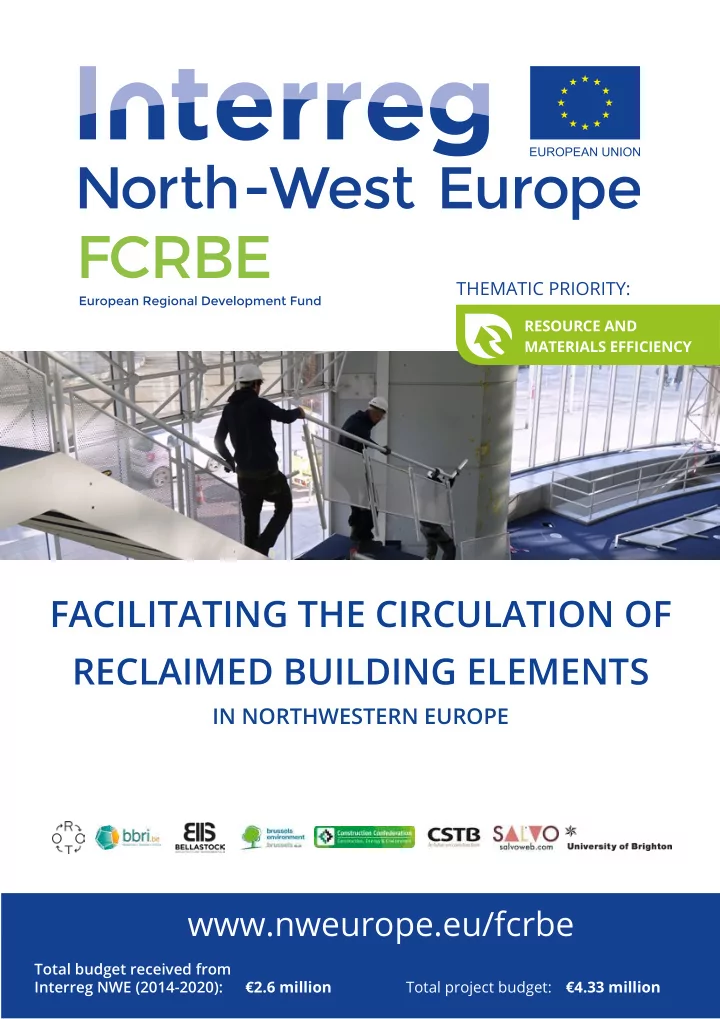
FCRBE THEMATIC PRIORITY: RESOURCE AND MATERIALS EFFICIENCY FACILITATING THE CIRCULATION OF RECLAIMED BUILDING ELEMENTS IN NORTHWESTERN EUROPE www.nweurope.eu/fcrbe Total budget received from Interreg NWE (2014-2020): 2.6 million Total


slide-1
SLIDE 1

FCRBE

FACILITATING THE CIRCULATION OF RECLAIMED BUILDING ELEMENTS

IN NORTHWESTERN EUROPE

THEMATIC PRIORITY:

RESOURCE AND MATERIALS EFFICIENCY

www.nweurope.eu/fcrbe

Total budget received from Interreg NWE (2014-2020): Total project budget: €4.33 million €2.6 million

slide-2
SLIDE 2

PROJECT OBJECTIVES MAIN OUTCOMES

DIRECTORY OF COMPANIES

Currently only 1% of building elements in NW-Europe are reused following their fjrst application. Although a large number of elements are technically reusable, they mostly end up being recycled or

  • disposed. This results in a high environmental impact and a net loss of economic value.

This project aims to increase by 50%, the amount of reclaimed building elements being circulated in NWE by 2032. We want to achieve this by developing forms of reuse that are economically viable and scalable. To respond appropriately to these challenges, the project sets up an international partnership involving specialised organisations, trade associations, research centers, a university and public

  • administrations. It is rooted in earlier programmes that were successfully initiated, on a local level.

A specialist salvage dealer directory within the extended project area will be promoted to the professional construction sector’s procurers, specifjers, designers and builders. This richly documented directory of reclamation dealers will be hosted on existing online platforms, namely Salvo and Opalis. Each directory entry will include a description, photos, a list of regular reclaimed building material stocks, and an architect’s specifjcation table.

SPECIFICATION METHODS

A set of specifjcation methods that support the integration of reclaimed components in construction and renovation projects, including in the context of public tenders and large-scale developments. These methods will help building owners, developers and designers work with reclaimed materials.

RECLAMATION AUDIT METHOD

A user-friendly method that can be utilised by building professionals to assess the reuse potential of the materials and products in buildings slated for demolition, in order to adequately organize their reclamation.

slide-3
SLIDE 3

36 PILOT PROJECTS

Pilot operations carried out in France, Belgium and the UK will test the methods and tools developed. 16 pilot operations will test the reclamation audit method and 20 will test the specifjcation methods and will contribute to the circulation of more than 360 tons of reusable elements, that would have otherwise been discarded as waste. These

  • perations will also provide feedback to fjne-tune the methods. They will

demonstrate the benefjts of reclaiming and reusing building elements, and promote these practices.

TRULY RECLAIMED LABEL

A “Truly Reclaimed” scheme that will allow customers to tell the difgerence between authentic reclaimed building materials and newly produced

  • alternatives. Such a scheme will increase the visibility and representation
  • f these products by promoting ethical dimensions of the reclamation

sector, guaranteeing authenticity and improving customer confjdence in reclaimed building materials and products.

PUBLICATIONS

8 specialised booklets, written as “very short introductions”, will answer recurring questions about reuse, such as health and safety, regulation,

  • r the environmental benefjts of reclaimed components.

1 roadmap, addressed to public authorities, will assist them in supporting the development of the reclamation trade. This roadmap will be complemented by a statistical report on the reclamation trade in NWE. Many articles will also be published to promote the achivements of the projet.

CATALOGUE OF ELEMENTS

An online catalogue of commonly found reclaimed building materials and products will inform construction professionals about a set of reclaimed building elements viable for large-scale projects.

EVENTS

The University of Brighton’s School of Architecture & Design will host a fjve day International Summer School in August 2020. Aimed at students and professionals from the worlds of design, architecture, construction and engineering, ‘The School of Re-Construction’ will demonstrate ways to reuse materials from local construction sites. A symposium and many workshops will gather stakeholders around the

  • bjective of the project, and a mobile exhibition will also promote reuse

during construction fairs and sectoral events. For updated information and details: www.nweurope.eu/fcrbe.
slide-4
SLIDE 4

Rotor (Lead Partner, BE) michaelghyoot@rotordb.org University of Brighton (UK) d.Baker-brown@brighton.ac.uk Salvo (UK) thornton.kay@salvo.co.uk Belgium Building Research Institute (BE) morgane.deweerdt@bbri.be Brussels Environment (BE) cbernair@environnement.brussels Construction Confederation (BE) petra.ronda@vcb.be (Flanders) jonathan.boulvain@ccw.be (Wallonia) lara.perezduenas@cnc.be (Brussels) Bellastock (FR) mathilde.billet@bellastock.com CSTB (FR) sylvain.laurenceau@cstb.fr The FCRBE (Facilitating the circulation of reclaimed building elements in Northwestern Europe) project is co-funded by the Interreg NWE programme and runs between October 2018 and January 2022.

https://www.nweurope.eu/fcrbe CONTACTS