FCPF/PC 6 Guyana 29 June 2010 7/7/2010 1 Vision By 2013 and - - PowerPoint PPT Presentation

fcpf pc 6 guyana 29 june 2010
SMART_READER_LITE
LIVE PREVIEW

FCPF/PC 6 Guyana 29 June 2010 7/7/2010 1 Vision By 2013 and - - PowerPoint PPT Presentation

Figure 2a.1: Physiographic Regions of Nepal FCPF/PC 6 Guyana 29 June 2010 7/7/2010 1 Vision By 2013 and beyond, our greenhouse gas emissions resulting from deforestation and forest degradation, will be significantly reduced by forest


slide-1
SLIDE 1

7/7/2010 1

FCPF/PC 6 Guyana 29 June 2010

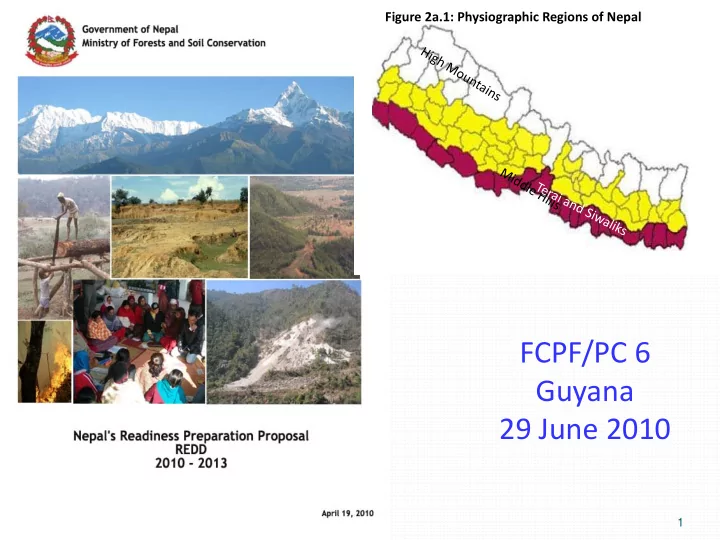
Figure 2a.1: Physiographic Regions of Nepal
slide-2
SLIDE 2

Vision

By 2013 and beyond, our greenhouse gas

emissions resulting from deforestation and forest degradation, will be significantly reduced by forest conservation and enhancement by addressing the livelihoods concerns of poor .

7/7/2010 2

slide-3
SLIDE 3

Principle

 Mainstreaming National REDD Plus Strategy with

Nepal’s overall development strategy.

 Multi-stakeholder involvement  Co-benefits for Nepal’s poverty reduction strategy  Adaptation to climate change  Capture and fully value the wide range of ecosystem

benefits from forests.

 Seeking and coordinating international funding

7/7/2010 3

slide-4
SLIDE 4

National Readiness Management institutional structure

7/7/2010 4

slide-5
SLIDE 5

Consultation and Outreach

7/7/2010 5

slide-6
SLIDE 6

7/7/2010 6

slide-7
SLIDE 7

7/7/2010 7

slide-8
SLIDE 8

7/7/2010 8

Figure 2a.1: Physiographic Regions of Nepal

slide-9
SLIDE 9

Land Use Change

 Nepal has broadly

three ecological region- Terai, Hills and Mountain.

 Data on DD are scanty

and contradicting.

 Community based

resource management approaches are successful

21 7 40 14 18

Fig 1: Land Use Type and Coverage in Percentage (National Forest Inventory 1999)

Agriculture land Public Land Forests and shrub land Grass land Rocks and snow cover 7/7/2010 9

slide-10
SLIDE 10

Prioritized Drivers of DD

  • 1. High dependency on forests and forest products

(timber, firewood, and other NTFPs)

  • 2. Illegal harvest of forest products
  • 3. Unsustainable harvesting practices
  • 4. Forest fire
  • 5. Encroachment
  • 6. Overgrazing
  • 7. Infrastructure development
  • 8. Resettlement

9.Expansion of invasive species

7/7/2010 10

slide-11
SLIDE 11

Further Studies Requirements

 Detailed Assessment of Forest Policy and Law

Enforcement in Nepal

 Marketing Study of Timber and other Forest

Products

 A Detailed Assessment for Land Use, Tenure and

Conflicts

 Assessment of contributions of forestry sector in the

national GDPs of Nepal.

 Development of a Guideline for Invasive Species

Management

7/7/2010 11

slide-12
SLIDE 12

Strategic Options

 Underlying causes of DD and strategic options were

  • developed. Strategic Options revised on 28 03 010.doc

 Further analysis steps include:

  • Conduct analytical studies
  • Consultation for options prioritizations
  • (Social, Economic, Environmental, Governance and

Technical)

  • Economic and financial assessment
  • Preparation and consolidation of the REDD

Strategy

  • Monitoring and Evaluation

7/7/2010 12

slide-13
SLIDE 13

Implementation Approach

 Establish link between carbon ownership and land tenure  Utilize existing institutions  Build on successful benefit sharing  Utilize multi-stakeholders mechanism  Fund Transaction - Trust Fund Model.  Clearing house  Learning from ongoing pilots  Higher benefits to locals

7/7/2010 13

slide-14
SLIDE 14

Social and Environmental Impacts

ToR with six major activities

 Stakeholder Analysis  Initial social and environmental situation  Analysis of possible impacts of ‘no REDD process’  Analysis of the possible impacts of "REDD Process”  Analysis of recommended alternative impacts  Verification of compliance with WB policies

7/7/2010 14

slide-15
SLIDE 15

Historic data

1 9 6 0 1 9 7 0 1 9 8 0 1 9 9 0 2 0 0 0 2 0 1 0 2 0 2 0 2 0 3 0 biom ass

Which line represents the historic trend? LRMP FRA

slide-16
SLIDE 16

Reference scenario

 Three steps  Creation of biomass surface map  Creation of current biomass surface  Development of multi-year historic reference

scenario

 Country wide spatial regression model imbedded in

a CGE (Computable General Equilibrium) model

7/7/2010 16

slide-17
SLIDE 17

Future projections

1 9 6 0 1 9 7 0 1 9 8 0 1 9 9 0 2 0 0 0 2 0 1 0 2 0 2 0 2 0 3 0 biom ass

slide-18
SLIDE 18

Monitoring system

 Will be build on planned FRA activities  Combination of RS and ground data collection  1,700 permanent sample plots established by FRA  Linked to community monitoring system

7/7/2010 18

slide-19
SLIDE 19

Proposed monitoring, data management and reporting system

Central Forest GeoDatabase (CFGD) FRA 2012

National / Sub-national Administrative, Watershed etc.. Community Forest Private forest Leasehold forest GoN Managed forest Protected area Collaborative forest Religious forest etc..

Benchmark database Boundary Regimes Forest Regime Wall-to-Wall monitoring Validation Imageries RS data Field based data from sample Plots

Reported tabular data

National Forest Information Management System (NAFIMS)

Information Monitor Management/Actor

Option # 1 Option # 2 DFCC

VDC/ VFCC

DDC INGO IPs and local communities Civil Society Donors/ Stakeholders Actors

HDI. Poverty Map National Statistics Food Security, Disaster etc..

Other Data Sources

International

Enablers

Access and share data through web-based Portal

DFO/PAs

Information Governance

7/7/2010 19

slide-20
SLIDE 20
  • 5. Budget and Schedule

Total costs 7,654.5 Government 335.0 FCPF 3,595.4 DFID/ S DC through funds already committed for Nepal National Forest Programme 1,447.5 Government of Finland through funds already committed to FRA proj ect 780.0 JICA (TBC) 360.0 US AID (TBC) 1,136.6

slide-21
SLIDE 21
  • 5. Budget and Schedule

Budget categories % Consultation, outreach 23.3 Capacity building 16.3 S tudies 6.4 Developing reference scenario 17.2 Design monitoring system 24.0 M&E framework 3.1

slide-22
SLIDE 22

Addressing TAP Comments

Received on 11 June, 2010

  • Clarifications- minimum work requirement
  • R-PP_Nepal revised June 25, 2010(1).doc
  • Require additional work/discussions
  • Difficulties in addressing
slide-23
SLIDE 23

1.1 Clarification/Suggestions

 Relation between REDD Forum and REDD-Cell,  Role of National Planning Commission,  Indigenous population,  Consultations across the different regions ( in 1b),

slide-24
SLIDE 24

1.1 Clarification/suggestions

 Methodologies to Set up 1,700 sample plots,  Distance users,  Necessity of five proposals under 2a,  Closer ties to other proposed and ongoing project

(e.g. NORAD), Models used by ICIMOD and WWF,

slide-25
SLIDE 25

Addressed/incorporated

 In the Absence of Democratically Elected Bodies …

consider for Pilot Implementation Mechanisms,

 How message could be extended to 16,000 CFUGs,  DD Study in Churia and High Mountain  ToR has been Developed to Commission Study on

Coordination among various stakeholder

 M&E framework developed (component 6)

slide-26
SLIDE 26

Addressed/incorporated

 Seek More Historical data…….ToR has been

Developed,

 What could be Done in the Terai Arc in Curbing

Cross-border Illegal Activities,

 Use of web-based decision support tools for Strategy

Options,

 Incorporated Text under 2d.  GIS boundary for Different Legal Forest Categories

slide-27
SLIDE 27

Require Further Work- few weeks

Cross sectoral policy review- Agri., Energy etc Proposal for monitoring the drivers of DD Monitoring proposal for private trees/farm

trees

Cost of setting up Central Clearing House Costs of the country-wide spatial regression

model…

Boundary separation between different legal

management regimes

slide-28
SLIDE 28

Sufficient basis to move forward

7/7/2010 28

Final statement

slide-29
SLIDE 29

7/7/2010 29

Thank You