Fast structure determination for proteins and small molecules a - - PowerPoint PPT Presentation

fast structure determination for proteins and small
SMART_READER_LITE
LIVE PREVIEW

Fast structure determination for proteins and small molecules a - - PowerPoint PPT Presentation

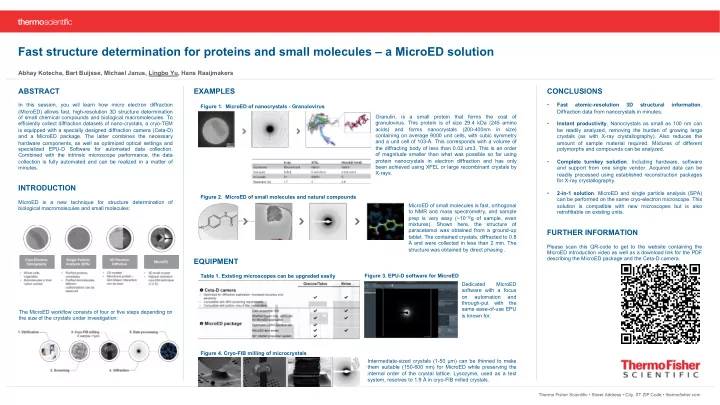
Fast structure determination for proteins and small molecules a MicroED solution Abhay Kotecha, Bart Buijsse, Michael Janus, Lingbo Yu, Hans Raaijmakers ABSTRACT EXAMPLES CONCLUSIONS In this session, you will learn how micro electron


slide-1
SLIDE 1

Thermo Fisher Scientific • Street Address • City, ST ZIP Code • thermofisher.com

Abhay Kotecha, Bart Buijsse, Michael Janus, Lingbo Yu, Hans Raaijmakers

Fast structure determination for proteins and small molecules – a MicroED solution

ABSTRACT

In this session, you will learn how micro electron diffraction (MicroED) allows fast, high-resolution 3D structure determination

  • f small chemical compounds and biological macromolecules. To

efficiently collect diffraction datasets of nano-crystals, a cryo-TEM is equipped with a specially designed diffraction camera (Ceta-D) and a MicroED package. The latter combines the necessary hardware components, as well as optimized optical settings and specialized EPU-D Software for automated data collection. Combined with the intrinsic microscope performance, the data collection is fully automated and can be realized in a matter of minutes.

INTRODUCTION

MicroED is a new technique for structure determination of biological macromolecules and small molecules:

CONCLUSIONS

  • Fast

atomic-resolution 3D structural information. Diffraction data from nanocrystals in minutes.

  • Instant productivity. Nanocrystals as small as 100 nm can

be readily analyzed, removing the burden of growing large crystals (as with X-ray crystallography). Also reduces the amount of sample material required. Mixtures of different polymorphs and compounds can be analyzed.

  • Complete turnkey solution. Including hardware, software

and support from one single vendor. Acquired data can be readily processed using established reconstruction packages for X-ray crystallography.

  • 2-in-1 solution. MicroED and single particle analysis (SPA)

can be performed on the same cryo-electron microscope. This solution is compatible with new microscopes but is also retrofittable on existing units.

FURTHER INFORMATION

Please scan this QR-code to get to the website containing the MicroED introduction video as well as a download link for the PDF describing the MicroED package and the Ceta-D camera.

EXAMPLES

Granulin, is a small protein that forms the coat

  • f
  • granulovirus. This protein is of size 29.4 kDa (245 amino

acids) and forms nanocrystals (200-400nm in size) containing on average 9000 unit cells, with cubic symmetry and a unit cell of 103-Å. This corresponds with a volume of the diffracting body of less than 0.02 um3. This is an order

  • f magnitude smaller than what was possible so far using

protein nanocrystals in electron diffraction and has only been achieved using XFEL or large recombinant crystals by X-rays. The MicroED workflow consists of four or five steps depending on the size of the crystals under investigation: Figure 1. MicroED of nanocrystals - Granulovirus Figure 2. MicroED of small molecules and natural compounds MicroED of small molecules is fast, orthogonal to NMR and mass spectrometry, and sample prep is very easy (~10-12g of sample, even mixtures). Shown here, the structure

  • f

paracetamol was obtained from a ground-up

  • tablet. The contained crystals, diffracted to 0.8

Å and were collected in less than 2 min. The structure was obtained by direct phasing .

EQUIPMENT

Table 1. Existing microscopes can be upgraded easily Figure 3. EPU-D software for MicroED Dedicated MicroED software with a focus

  • n

automation and through-put with the same ease-of-use EPU is known for. Figure 4. Cryo-FIB milling of microcrystals Intermediate-sized crystals (1-50 µm) can be thinned to make them suitable (150-600 nm) for MicroED while preserving the internal order of the crystal lattice. Lysozyme, used as a test system, resolves to 1.9 Å in cryo-FIB milled crystals.

slide-2
SLIDE 2

2

MicroED is a New Technique for Structure Determination of Biological Macromolecules

  • Whole cells,
  • rganelles
  • Biomolecules in their

native context

Cryo-Electron Tomography

  • Purified proteins,

complexes

  • Purified biomolecules,

different conformations can be

  • bserved

Single Particle Analysis (SPA)

  • 2D crystals
  • Membrane protein –

lipid bilayer interaction can be seen

2D Electron Diffration

  • 3D small crystal
  • Highest resolution

cryo-EM technique (1-2 Å)

MicroED

slide-3
SLIDE 3

3

slide-4
SLIDE 4

4

Vitrification Screening Cryo-FIB milling if sample >1µm Diffraction Data processing

The MicroED Workflow

slide-5
SLIDE 5

5

MicroED offers unique advantages

  • Provides high resolution
  • Fast method
  • Small crystals
  • Needs few crystals
  • Mixtures allowed
slide-6
SLIDE 6

6

Resolving Nano-crystals of Granulovirus

Granulin

Protective virus coat 29 kDa protein 9,000 unit cells/virion 0.5 hr data collection on 5 crystals

X-ray XFEL MicroED CetaD Expression Recombinant Native Native Size (μm) 5x5x5 0.2x0.2x0.4 0.2x0.2x0.4 # Crystals 21 83000 5 Resolution (Å) 1.7 2 2.8

slide-7
SLIDE 7

7

Sample

Lacey carbon grid, cryo temperature Dials → shelxt 70% complete

Prep. Acquisition Analysis

Grinded paracetamol 160 x 1.0° x 1sec 0.88Å

Structure Determination of Drugs and Natural Compounds Using MicroED

slide-8
SLIDE 8

8

Structure Determination of Drugs and Natural Compounds Using MicroED

Sample

Lacey carbon grid, cryo temperature

Prep. Acquisition Analysis

Grinded paracetamol Dials → shelxt 70% complete 160 x 1.0° x 1sec 0.88Å

slide-9
SLIDE 9

9

Small molecule structure determination

  • Orthogonal to NMR, mass spec etc.
  • Easy sample prep
  • ~10-12g of sample
  • Data collection <3 min
  • Direct phasing
slide-10
SLIDE 10

10

MicroED is Enabled by the Ceta-D Camera and the MicroED Package

Existing microscopes can be upgraded easily

Glacios/Talos Krios

Œ Ceta-D camera

  • Optimized for diffraction application: increased accuracy and

sensitivity

  • Compatible with SPA screening requirements
  • Compatible with bottom-mount filter (retractable)

 MicroED package

EPU-D: Data acquisition SW Modified beam stop, optimized for MicroED application Optimized C2/SA aperture set MicroED lens series 90° rotation projection system

slide-11
SLIDE 11

11

Ceta-D Camera

Scintillator-based detection with a CMOS sensor designed for MicroED

  • 4x higher sensitivity compared to Ceta:

Optimized scintillator thickness for enhanced signal-to-noise ratio and improved DQE at low frequency.

  • Movie mode is enabled for continuous-

tilt diffraction.

  • Correlated Double Sampling (CDS) in

movie mode decreases noise 2.5x. The Ceta-D offers improved signal-to- noise and enables continuous tilt diffraction

slide-12
SLIDE 12

12

Dedicated MicroED software with a focus on automation, usability and throughput

EPU-D Acquisition Software

  • Intuitive workflow GUI for

navigation, set-up and acquisition.

  • Fast and easy setup of

MicroED experiments

  • Continuous tilt series

acquisition. EPU-D facilitates MicroED with the same ease-of-use EPU is known for

slide-13
SLIDE 13

13

slide-14
SLIDE 14

14

  • Crystal thickness for MicroED is limited to

~700nm. Intermediate-sized crystals can be thinned to make them suitable for MicroED while preserving the internal

  • rder of the crystal lattice.

Cryo-FIB milling makes micro-crystals usable for MicroED

Aquilos Cryo-FIB

slide-15
SLIDE 15

15

  • Crystal thickness for MicroED is limited to

~700nm.

  • Crystals ranging from 1µm to 50µm

thickness can be thinned 150-600nm using cryo-FIB milling. Intermediate-sized crystals can be thinned to make them suitable for MicroED while preserving the internal

  • rder of the crystal lattice.

Cryo-FIB milling makes micro-crystals usable for MicroED

Aquilos Cryo-FIB

slide-16
SLIDE 16

16

  • Crystal thickness for MicroED is limited to

~700nm.

  • Crystals ranging from 1µm to 50µm

thickness can be thinned 150-600nm using cryo-FIB milling.

  • Lysozyme, used as a test system,

resolves to 1.9 Å in cryo-FIB milled crystals. Intermediate-sized crystals can be thinned to make them suitable for MicroED while preserving the internal

  • rder of the crystal lattice.

Cryo-FIB milling makes micro-crystals usable for MicroED

Aquilos Cryo-FIB

slide-17
SLIDE 17

17

Summary

MicroED can make use of crystals too small for XRD High resolution, high throughput technique Cryo-FIB opens a path for intermediate-sized microcrystals

Images of PDB 5K7N; 5K7O; 5TY4; 5K7P; 5K7Q; 5K7R; 5K7S; 5K7T created with Chimera

TGF-bm:TbRII Lysozyme Tau peptide

Components can be retrofitted (depending on configuration)

slide-18
SLIDE 18

18

Thank you!