(fast) Randomized SVD Ryan Levy, Algorithm Interest Group, Jan. 31 - - PowerPoint PPT Presentation

fast randomized svd
SMART_READER_LITE
LIVE PREVIEW

(fast) Randomized SVD Ryan Levy, Algorithm Interest Group, Jan. 31 - - PowerPoint PPT Presentation

(fast) Randomized SVD Ryan Levy, Algorithm Interest Group, Jan. 31 2019 Image: Wikipedia Roadmap Review SVD Its awesome - why you should love it Singular values are almost math magic Bottleneck Scenarios the need for


slide-1
SLIDE 1

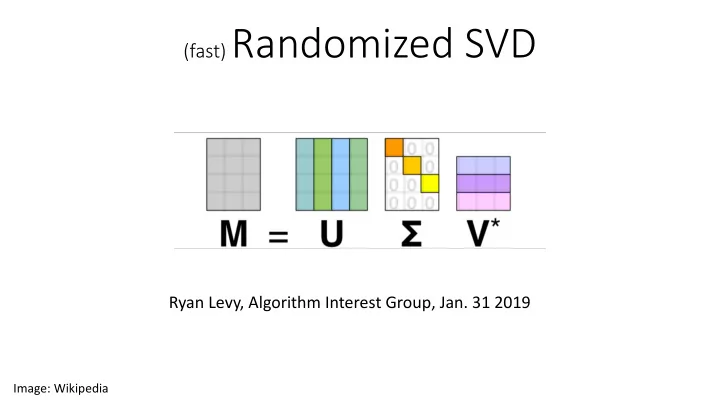
(fast) Randomized SVD

Ryan Levy, Algorithm Interest Group, Jan. 31 2019

Image: Wikipedia
slide-2
SLIDE 2

Roadmap

  • Review SVD
  • It’s awesome - why you should love it
  • Singular values are almost math magic
  • Bottleneck Scenarios – the need for stochastic methods
  • Randomized SVD algorithms
  • Easy
  • Improvements
  • Pictures
slide-3
SLIDE 3

SVD Review

That trick you learned in math class!

Eigendecomposition of a matrix is powerful, but matrix must be square ÞGeneralize to SVD U,V are unitary If M is square the eigenvectors can be U,V SVD can have a geometric interpretation for some M Can approximate M by reducing singular values

Singular Values Any Matrix

slide-4
SLIDE 4

Example 1

M =   1 2 3 4 5 6  

<latexit sha1_base64="(nul)">(nul)</latexit><latexit sha1_base64="(nul)">(nul)</latexit><latexit sha1_base64="(nul)">(nul)</latexit><latexit sha1_base64="(nul)">(nul)</latexit>

= @ 0.32 0.88 0.41 0.52 0.24 −0.82 0.82 −0.4 0.41 1 A @ 9.5 0.51 1 A ✓ 0.62 −0.78 0.78 0.62 ◆

<latexit sha1_base64="(nul)">(nul)</latexit><latexit sha1_base64="(nul)">(nul)</latexit><latexit sha1_base64="(nul)">(nul)</latexit><latexit sha1_base64="(nul)">(nul)</latexit>

U

<latexit sha1_base64="(nul)">(nul)</latexit><latexit sha1_base64="(nul)">(nul)</latexit><latexit sha1_base64="(nul)">(nul)</latexit><latexit sha1_base64="(nul)">(nul)</latexit>

Σ

<latexit sha1_base64="(nul)">(nul)</latexit><latexit sha1_base64="(nul)">(nul)</latexit><latexit sha1_base64="(nul)">(nul)</latexit><latexit sha1_base64="(nul)">(nul)</latexit>

V †

<latexit sha1_base64="(nul)">(nul)</latexit><latexit sha1_base64="(nul)">(nul)</latexit><latexit sha1_base64="(nul)">(nul)</latexit><latexit sha1_base64="(nul)">(nul)</latexit>
slide-5
SLIDE 5

Example 2

slide-6
SLIDE 6

Example 2

50% - 298 75% - 149 90% - 60 95% - 30

Key: [% Σ=0] – [# remaining]

slide-7
SLIDE 7

Where do we see SVDs in physics?

  • Principal Component Analysis (PCA)
  • Look at dominate principal components – large

singular values – to analyze multi dimension problem

  • Easier linear algebra (matrix exponential,

approximating data, etc)

  • Clustering problems (similar to PCA)
  • Calculating Entanglement Entropy
  • Schmidt Decomposition
  • Pseudo-inverse

Image: Wikipedia, doi:10.1038/nature15750

slide-8
SLIDE 8

SVD Bottlenecks – Full SVD Algorithm

Large matrices take huge computational cost Sometimes have hundreds of large matrices to SVD (e.g. facebook)

“…the adjacency matrix of Facebook users to Facebook pages induced by likes, with size O(10⁹) × O(10⁸)”

Source: Facebook research

∼ O(mn2)

<latexit sha1_base64="(nul)">(nul)</latexit><latexit sha1_base64="(nul)">(nul)</latexit><latexit sha1_base64="(nul)">(nul)</latexit><latexit sha1_base64="(nul)">(nul)</latexit>

∼ O(m)

<latexit sha1_base64="(nul)">(nul)</latexit><latexit sha1_base64="(nul)">(nul)</latexit><latexit sha1_base64="(nul)">(nul)</latexit><latexit sha1_base64="(nul)">(nul)</latexit>

Passes through matrix

slide-9
SLIDE 9

SVD Algorithm

~complicated~

slide-10
SLIDE 10

Method 1 – Power Method Lanczos(!)

  • 1. Notice that an SVD is the same as
  • 2. Notice that solving an eigenvalue problem is the same as
  • 3. Start with a random vector then apply the Hamiltonian,

normalizing after each step Pro:

  • Physicists know how to do this!
  • Parallelizes very well

Cons:

  • Hard to find many principal

components

  • Large degeneracies will slow down

convergence

  • Larger storage/GMM cost

M Nx ! Ex, N 1

<latexit sha1_base64="(nul)">(nul)</latexit><latexit sha1_base64="(nul)">(nul)</latexit><latexit sha1_base64="(nul)">(nul)</latexit><latexit sha1_base64="(nul)">(nul)</latexit>

x

<latexit sha1_base64="(nul)">(nul)</latexit><latexit sha1_base64="(nul)">(nul)</latexit><latexit sha1_base64="(nul)">(nul)</latexit><latexit sha1_base64="(nul)">(nul)</latexit>

M = UΣV † ⇔ Av = Ev

<latexit sha1_base64="(nul)">(nul)</latexit><latexit sha1_base64="(nul)">(nul)</latexit><latexit sha1_base64="(nul)">(nul)</latexit><latexit sha1_base64="(nul)">(nul)</latexit>

✓ 0 M M † ◆ ✓U V ◆ = Σii ✓U V ◆

<latexit sha1_base64="(nul)">(nul)</latexit><latexit sha1_base64="(nul)">(nul)</latexit><latexit sha1_base64="(nul)">(nul)</latexit><latexit sha1_base64="(nul)">(nul)</latexit>
slide-11
SLIDE 11

“Easy” Randomized SVD

Goal: obtain SVD for k singular values of a m x n matrix M, assuming m > n

  • 1. Create a n x k matrix of random [normal] samples Ω
  • 2. Do a QR decomposition on the sample matrix ΩM
  • a. Reminder that QR = (orthogonal matrix) (upper triangular)
  • b. QR is slow but accurate

c. Orthogonal matrix Q is m x k

  • 3. Create “smaller” k x n matrix B = Q†M
  • 4. Do SVD on
  • 5. Get original U = Qu

Source: Halko, Martinsson and Tropp (2009)

B = uΣV †

<latexit sha1_base64="(nul)">(nul)</latexit><latexit sha1_base64="(nul)">(nul)</latexit><latexit sha1_base64="(nul)">(nul)</latexit><latexit sha1_base64="(nul)">(nul)</latexit>

Random values are hopefully superposition of correct basis vectors “Randomized Range Finder”

slide-12
SLIDE 12

Visual Example

Actual k=100 rSVD k=100 Thanks to smortezavi’s example code

slide-13
SLIDE 13

Visual Example

Actual k=10 rSVD k=10 Thanks to smortezavi’s example code

slide-14
SLIDE 14

Comments on Randomized SVD

  • By using certain random sample matrices we can speed up the

algorithm and form less intermediate matrices

  • How good can we do?
  • Bounded by error of using a k rank matrix
  • Can sample several times to get another error estimate
  • Con - Assumes singular values decay slowly
  • What if we use the Lanzcos idea and project into the M subspace?
  • Best: Combine both techniques!
slide-15
SLIDE 15

Improve Range Suspace

Power Method

ΩM → (MM †)q ΩM

<latexit sha1_base64="(nul)">(nul)</latexit><latexit sha1_base64="(nul)">(nul)</latexit><latexit sha1_base64="(nul)">(nul)</latexit><latexit sha1_base64="(nul)">(nul)</latexit>

Rounding error problem Instead do QR every step, alternate M, Mt

slide-16
SLIDE 16

Visual Example

Actual k=100 rSVD k=100, q=1

slide-17
SLIDE 17

Visual Example

Actual k=10 rSVD k=10, q=0 rSVD k=10, q=1 rSVD k=10, q=5 Timing (s): SVD: 0.613 rSVD q=0: 0.0096 rSVD q=1: 0.022

slide-18
SLIDE 18

Visual Example

Actual k=10 rSVD k=10, q=0 rSVD k=10, q=20 Unstable rSVD k=10, q=20

slide-19
SLIDE 19

Conclusions

  • SVD is a powerful technique but slow for large matrices
  • Because we don’t always need all the singular values

we can guess how many we need to make a faster algorithm

  • Randomized SVD estimates smaller subspace to perform a full SVD
  • Can be sped up by using smart random sampling
  • Can be improved by using a power method or oversampling

Thanks!