Fair Administrative Action Does it matter especially for service - - PDF document

fair administrative action
SMART_READER_LITE
LIVE PREVIEW

Fair Administrative Action Does it matter especially for service - - PDF document

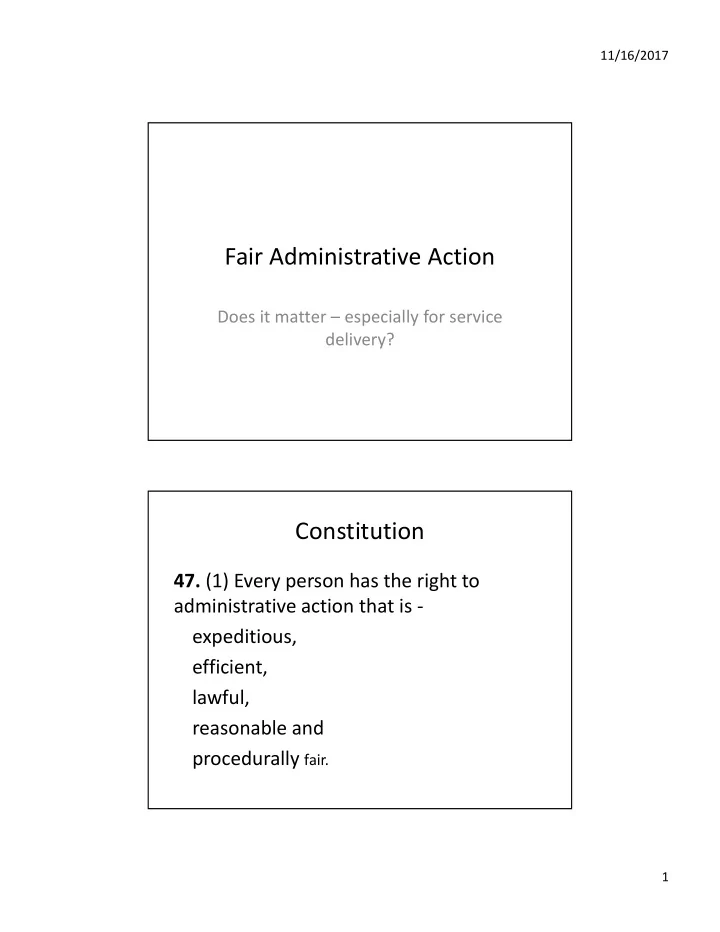
11/16/2017 Fair Administrative Action Does it matter especially for service delivery? Constitution 47. (1) Every person has the right to administrative action that is - expeditious, efficient, lawful, reasonable and procedurally fair.


slide-1
SLIDE 1

11/16/2017 1

Fair Administrative Action

Does it matter – especially for service delivery?

Constitution

  • 47. (1) Every person has the right to

administrative action that is - expeditious, efficient, lawful, reasonable and procedurally fair.

slide-2
SLIDE 2

11/16/2017 2

Main promise

  • Towards a fairer society
  • Deepens democracy
  • Strengthens accountability

“Daily interactions that citizens have with bureaucrats in many African countries are

  • ften fraught with delays broken promises,

extortion and abuse of power.” - Migai Akech

Where does it come from?

  • Has a history in the prevention of government

abuse of power over the centuries

  • But is not limited to “you have no power to do

that under the law”

  • Built on ideas developed for courts and applied

them to many public decision making contexts

– And even to private bodies that affect people’s lives and livelihoods

  • We picked it up from South Africa’s Constitution
  • But have further expanded it
slide-3
SLIDE 3

11/16/2017 3

How does it relate to the delivery of services?

  • Licencing
  • Water
  • Education
  • Health
  • Sanitation
  • Agricultural services
  • Lighting
  • Roads

Highlights

  • Administrative action must be:

– Legal – Procedurally fair – Rational (or reasonable)

  • Now it must also:

– Respect constitutional values – Including human rights

slide-4
SLIDE 4

11/16/2017 4

Legality

  • The right person (or body)
  • With the power
  • Depends on the notion that a conscious

decision is made to give a power to a person because of their expertise etc.

  • If the person is not right or the power is not

there

– A court will send it back to the decision maker – do it right this time!

Procedural

  • Follow the procedure in the law
  • Consider each case
  • Give a fair hearing to anyone affected

– Tell them what is happening and what factors will affect the decision – Give them enough time – Listen to what they say

  • Give them reasons for the final decision
  • Treat them in a way that respects rights

– E.g dignity

  • Consultation and public participation
  • No unreasonable delay
  • Efficient
slide-5
SLIDE 5

11/16/2017 5

Factors affecting the actual decision

  • Bear in mind the purpose of the power
  • Take the right factors into consideration
  • And not the wrong factors

– Including do not discriminate on the basis of personal characteristics

  • Don’t be irrational
  • If affecting rights, ensure that this is proportional to the

aims to be achieved

  • If (lawful) promises have been made, respect the

expectations they give rise to.

  • Public interest does not automatically trump personal

interests

How is it working?

  • Dominance of wealthy and middle class interests

in the cases

– Potential lawyers not admitted to the Kenya School of Law – Professional disciplinary hearings – Challenging revocation of land titles – Demolition of buildings – Destruction of advertising hoardings – Refusal of liquor licences – Citizenship for foreign spouses

slide-6
SLIDE 6

11/16/2017 6

Have been a few more about wananchi

  • Challenging evictions

– Of roadside nursery in Westlands – Of hawkers in Mombasa – From housing

  • Challenging expulsion from school

What is the potential?

  • Speedy decisions
  • Based on public input
  • Based on the needs of those affected
  • Based on evidence and rational thinking
  • Not discriminatory
  • BUT –

– Most useful for situations where there is a service but it is poor and decisions are defective – And for the wealthier

slide-7
SLIDE 7

11/16/2017 7

So

  • To deal with the absence of services, needs to

work in conjunction with Article 43

– Right to health, education, housing, food, sanitation, water and social security

  • Maybe the Ombudsman is a better route for

the ordinary citizen?