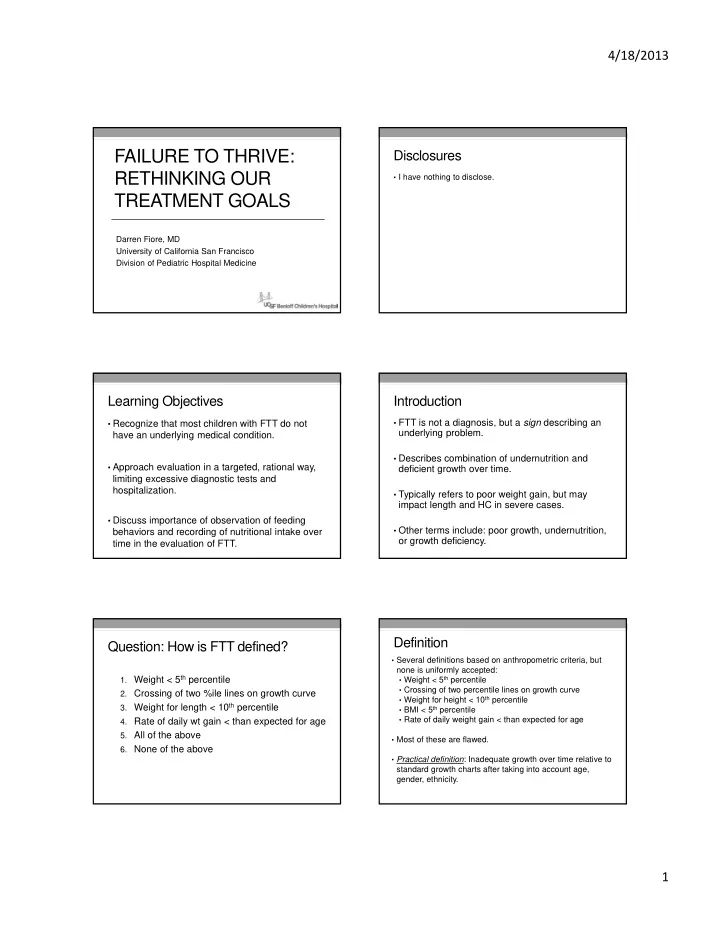

SLIDE 1
4/18/2013 1
FAILURE TO THRIVE: RETHINKING OUR TREATMENT GOALS
Darren Fiore, MD University of California San Francisco Division of Pediatric Hospital Medicine
Disclosures
- I have nothing to disclose.
Learning Objectives
- Recognize that most children with FTT do not
have an underlying medical condition.
- Approach evaluation in a targeted, rational way,
limiting excessive diagnostic tests and hospitalization.
- Discuss importance of observation of feeding
behaviors and recording of nutritional intake over time in the evaluation of FTT.
Introduction
- FTT is not a diagnosis, but a sign describing an
underlying problem.
- Describes combination of undernutrition and
deficient growth over time.
- Typically refers to poor weight gain, but may
impact length and HC in severe cases.
- Other terms include: poor growth, undernutrition,
- r growth deficiency.
Question: How is FTT defined?
- 1. Weight < 5th percentile
- 2. Crossing of two %ile lines on growth curve
- 3. Weight for length < 10th percentile
- 4. Rate of daily wt gain < than expected for age
- 5. All of the above
- 6. None of the above
Definition
- Several definitions based on anthropometric criteria, but
none is uniformly accepted:
- Weight < 5th percentile
- Crossing of two percentile lines on growth curve
- Weight for height < 10th percentile
- BMI < 5th percentile
- Rate of daily weight gain < than expected for age
- Most of these are flawed.
- Practical definition: Inadequate growth over time relative to
standard growth charts after taking into account age, gender, ethnicity.