Failure to Disrupt: Why Technology Alone Cant Transform Education - - PowerPoint PPT Presentation

failure to disrupt why technology alone can t transform
SMART_READER_LITE
LIVE PREVIEW

Failure to Disrupt: Why Technology Alone Cant Transform Education - - PowerPoint PPT Presentation

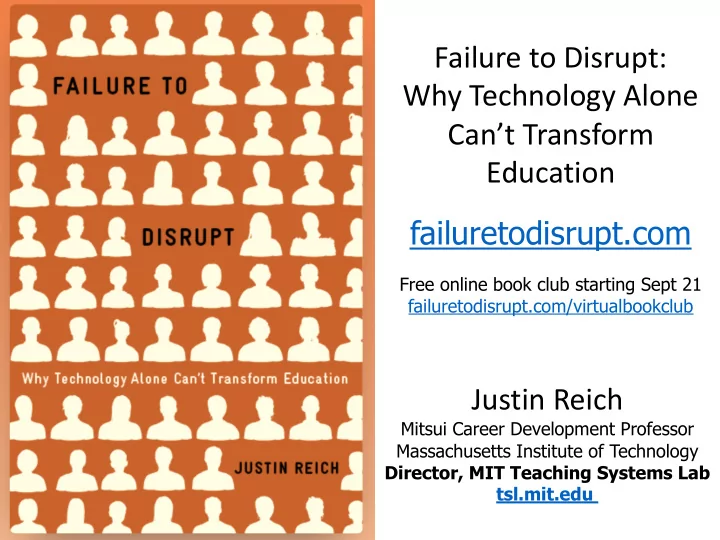
Failure to Disrupt: Why Technology Alone Cant Transform Education failuretodisrupt.com Free online book club starting Sept 21 failuretodisrupt.com/virtualbookclub Justin Reich Mitsui Career Development Professor Massachusetts Institute


slide-1
SLIDE 1

Justin Reich

Mitsui Career Development Professor Massachusetts Institute of Technology Director, MIT Teaching Systems Lab tsl.mit.edu

Failure to Disrupt: Why Technology Alone Can’t Transform Education failuretodisrupt.com

Free online book club starting Sept 21 failuretodisrupt.com/virtualbookclub

slide-2
SLIDE 2

50% of all grade 6- 12 courses online by 2019 At 1/3 cost With better learning outcomes

slide-3
SLIDE 3
slide-4
SLIDE 4

Technologies of Remote Schooling: LMS and Video Telephony

slide-5
SLIDE 5

When teachers get access to new technologies, they use them to extend existing systems. Where there is beneficial and innovative new practice with education technology, it will disproportionately benefit the affluent.

slide-6
SLIDE 6

More recently, we’re seeing that if students put 30 minutes to an hour per week—or one class period per week—toward software-based, self-paced learning, schools will see a 20 to 30 percent greater-than-expected gain on state assessments. That’s exciting because that’s a dosage that’s very doable in mainstream classrooms. We tell schools to give students 30 to 60 minutes of Khan Academy per week, with teachers doing traditional curriculum four days per week. You’re going to see a pretty dramatic improvement. You’ll get the best of both worlds.

Now that I run a school, I see that some of the stuff is not as easy to accomplish compared to how it sounds theoretically.

It’s taken me and the Khan Academy longer to realize this, but not everyone can easily move to a mastery-based, self-paced learning

  • environment. That’s hard to do overnight. We

have a bunch of efficacy studies for that type

  • f model, and they’re really robust, but change

is hard. https://districtadministration.com/sal-khan-envisions-a-future-

  • f-active-mastery-based-learning/

January 31, 2019
slide-7
SLIDE 7
slide-8
SLIDE 8

Charismatic Stance

Technology disrupts and transforms existing systems The future will be brand new and different because of new technology

Tinkering Stance

Existing systems domesticate new technologies The future is an extension of trends from history

Two Stances

slide-9
SLIDE 9

Learning technologies are not all purpose; they are like distinct pegs in a vast landscape of differently- shaped holes Learning technologies are not a switch that you can flip on. They are only as effectives as the learning supports provided to the communities that use them.

slide-10
SLIDE 10

Three Genres

Who guides the sequence of learning activities?

slide-11
SLIDE 11

Pedagogy

Does the technology fill pails? Or kindle flames?

slide-12
SLIDE 12
slide-13
SLIDE 13

What’s New?

slide-14
SLIDE 14
slide-15
SLIDE 15

Complex Uneven Inequitable

slide-16
SLIDE 16

Four “As-Yet Intractable Dilemmas”

Curse of the Familiar Trap of Routine Assessment EdTech Matthew Effect Toxic Power of Data and Experiments

slide-17
SLIDE 17

Curse of the Familiar

slide-18
SLIDE 18

EdTech Matthew Effect

slide-19
SLIDE 19

Trap of Routine Assessment

slide-20
SLIDE 20

Toxic Power of Data and Experiments

slide-21
SLIDE 21

Four “As-Yet Intractable Dilemmas”

Curse of the Familiar Trap of Routine Assessment EdTech Matthew Effect Toxic Power of Data and Experiments

slide-22
SLIDE 22

Justin Reich

Mitsui Career Development Professor Massachusetts Institute of Technology Director, MIT Teaching Systems Lab tsl.mit.edu

Failure to Disrupt: Why Technology Alone Can’t Transform Education failuretodisrupt.com

Free online book club starting Sept 21 failuretodisrupt.com/virtualbookclub