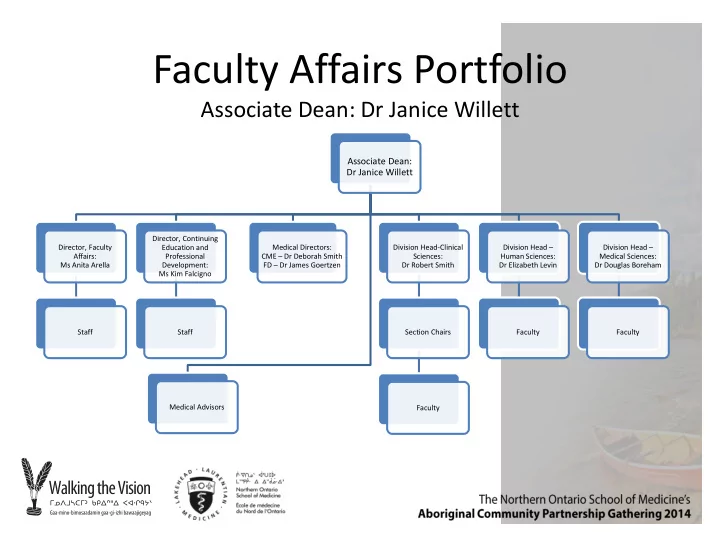
SLIDE 1 Associate Dean: Dr Janice Willett
Director, Faculty Affairs: Ms Anita Arella Staff Director, Continuing Education and Professional Development: Ms Kim Falcigno Staff Medical Directors: CME – Dr Deborah Smith FD – Dr James Goertzen Medical Advisors Division Head-Clinical Sciences: Dr Robert Smith Section Chairs Faculty Division Head – Human Sciences: Dr Elizabeth Levin Faculty Division Head – Medical Sciences: Dr Douglas Boreham Faculty
Faculty Affairs Portfolio
Associate Dean: Dr Janice Willett
SLIDE 2
Faculty Affairs Unit (FA)
Is responsible for the recruitment, appointment, reappointment, evaluation, promotion, remuneration and overall support of Faculty members and works with other Portfolios to establish, implement, coordinate and streamline faculty centred business practices.
SLIDE 3
Faculty Affairs Unit
Comprised of the three sciences - Clinical, Medical, and Human - that form the basis of the curriculum delivered at NOSM.
SLIDE 4 Faculty Affairs Unit
Clinical Sciences Over 1200 health-care professionals with section-specific clinical expertise
- Anesthesia
- Child and Adolescent Health
- Emergency Medicine
- Family Medicine
- Health Sciences
- Internal Medicine
- Orthopaedic Surgery
- Psychiatry
- Surgery
- Women’s Health
SLIDE 5 Faculty Affairs Unit
Medical Sciences
47 Faculty discipline experts for teaching and research in the basic medical sciences, grouped into three sections of disciplines :
- Anatomy, Physiology, and Pharmacology
- Biochemistry, Cell Biology, and Molecular Biology
- Microbiology, Immunology, Genetics, and
Haematology
SLIDE 6
Faculty Affairs Unit
Human Sciences
64 Faculty are experts in their disciplines, participate in lecturing, act as facilitators of small group sessions in the undergraduate medical curriculum, are available to supervise graduate students, and provide opportunities for applied community research placements in various locations and communities.
SLIDE 7
Continuing Education & Professional Development Unit (CEPD)
Dedicated to the provision of innovative, learning centered continuing medical education (CME), faculty development (FD), and continuing professional development opportunities. CEPD educational programming promotes lifelong learning and enhances clinical and teaching competencies and overall performance of health care professionals and faculty, while advancing their ability to meet the needs of the people of Northern Ontario.
SLIDE 8
Accrediting Body
The Committee on Accreditation of Continuing Medical Education (CACME) accredits the Continuing Medical Education/Continuing Professional Development (CME/CPD) offices of all Canadian faculties of medicine.
SLIDE 9 Continuing Medical Education (CME)
CEPD Office works closely with internal and external groups to develop needs based and learner centered CME
- pportunities relevant to the clinical area
- f practice. These opportunities are
extended to other health professionals working in the respective specialty area.
SLIDE 10
Faculty Development (FD)
CEPD works collaboratively with all Undergraduate, Post-Graduate and Community Engagement programs to develop the NOSM Faculty Development Program Annual program evaluation drives change and improvement to Program
SLIDE 11 Faculty Self-Identification
- Annual faculty questionnaire
- ffers an opportunity for faculty
with Aboriginal ancestry to self- identify
- 26 have chosen to self-identify so
far, though we believe there are more not yet identified
SLIDE 12 CME & FD Events
- High quality learning opportunities that are needs-based,
evidence-based, and free of bias
- Multiple ways of attending events (ie., Face to Face,
Videoconference, Ontario Telemedicine Network, Webcast, Teleconference)
- Opportunities to learning in a variety of ways (ie., Lecture,
Simulation, One-on-One, Small group, Self-Directed via
- nline learning options such as Moodle)
- Certificates of Attendance for each event attended AND a
cumulative transcript of all CEPD activities have participated in, available 24 hours/day from website.
SLIDE 13 Aboriginal Peoples’ Health Program Planning Committee
Responsible for developing, implementing and evaluating continuing education programs that address Community Engagement needs, promoting Rural and Remote practice, Francophone Health and Culture, and Aboriginal Peoples’ Health into all programs. Educational
- pportunities are aimed at increasing social
accountability relating to these areas.
SLIDE 14
2011 Events
Jan 2011 – Indigenous Aspects of Cultural Safety Education Nov 2011 – Addressing Colonialism: Understanding the Foundation of Cultural Safety
SLIDE 15
2012 Events
Feb 2012 – Understanding Cultural Contexts in Providing Culturally Safe Care in Health Settings June 2012 –Film Series: The Life You Want: A Young Woman’s Struggle with Addiction
SLIDE 16
2012 Events
Sept 2012 – Improving Health Outcomes for Aboriginal Peoples: How Can Health Care Professionals Contribute? Sept 2012 – Plant Medicine, Traditional Healing and Role of the Modern Health Care Practitioner Workshop
SLIDE 17 2012 Events
Rendezvous Conference:
- Conference on The Move
- Plenary (incl. Aboriginal NOSM
graduate)
- Local Community Visits (i.e.,
Aboriginal Teaching Lodge, Legal Clinic, Health Clinic)
SLIDE 18 2013 – Needs Assessments
- Health Sciences Program Planning
Committee needs assessment revealed requests for programming on Aboriginal health and healing, First Nations medicine topics
- Northern Constellations faculty
development conference evaluations identified cultural competency/safety future topics
SLIDE 19
2013 Events
Mar 2013 – Cultural and Linguistic Competence in Health Care Workshop Mar 2013 – Sioux Lookout Physicians Conference Oct 2013 – Integrating Aboriginal Health and Culture as a Practitioner and Preceptor Workshop
SLIDE 20
2014 Events
Jan 2014 – Sioux Lookout Region Physician Service Retreat Mar 2014 – My Patient/Client Speaks French, and I Don’t Jun 2014 – Northern Health Research Conference (held in Sioux Lookout) Forthcoming: Sioux Lookout Rounds, Academic Days
SLIDE 21 Medical Partnerships
- Thunder Bay Regional Health
Sciences Centre’s Medical Education Committee
- Health Sciences North Sudbury
Continuing Education Committee
SLIDE 22 Aboriginal Reference Group (ARG)
- Reports directly to the Dean
- Seat on Academic Council
- Seat on Joint VP and Dean’s Group
- Serve as interviewers for undergraduate
student admissions interviews
SLIDE 23 Focus Group Questions
- 1. In your opinion, what strategies or
supports could NOSM use to encourage all faculty members of Aboriginal ancestry to self-identify or disclose this information to the Faculty Affairs Unit for reporting purposes?
SLIDE 24 Focus Group Questions
- 2. In your opinion, how can NOSM succeed at
improving the representation of perspectives and needs of Aboriginal communities in the needs assessment phases of provincially
- rganized educational projects (i.e., the IDEAS
Introductory Quality Improvement Program) and NOSM developed CME/FD events?
SLIDE 25
Thank you!
Faculty Affairs &