SLIDE 1 17/05/2017 1
1896 1920 1987 2006
Conservation and Sustainable Use of Marine Biological Resources: Some Reflections from the Evolving Management Approaches
XUE Guifang (Julia) Chair Professor, KoGuan Law School Director Center for Rule of Ocean Law Studies Center for Polar and Deep Ocean Development Shanghai Jiao Tong University
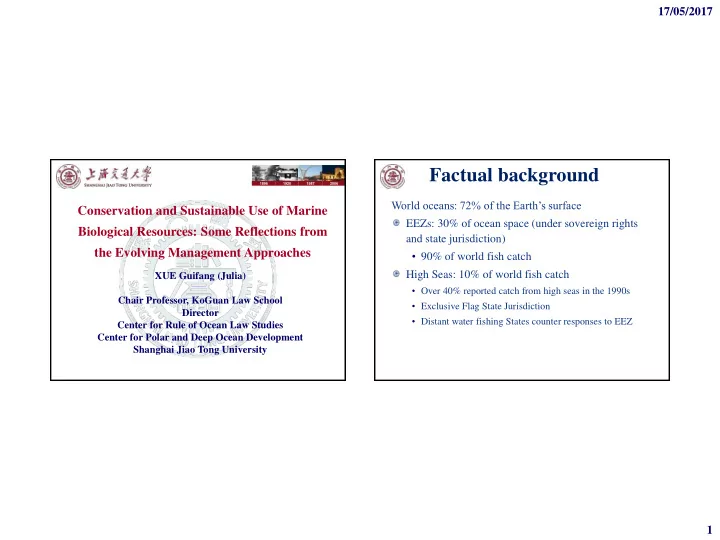
Factual background
World oceans: 72% of the Earth’s surface EEZs: 30% of ocean space (under sovereign rights and state jurisdiction)
High Seas: 10% of world fish catch
- Over 40% reported catch from high seas in the 1990s
- Exclusive Flag State Jurisdiction
- Distant water fishing States counter responses to EEZ
SLIDE 2 17/05/2017 2
Management Phases and Approaches
Prior to 1958 conventions: Free fishing era 1958-1982 UNCLOS: creeping jurisdiction: restricted fishing activities Post UNCLOS responses: legislated control of fishing related matters closing the legal loop holes 21st Ocean Century: fill in the management gaps with a variety of international policy and legal instruments, institutional arrangements and processes relevant to fisheries management and biodiversity conservations
Evolution of Legal Regimes
1958 High Seas Convention
- Freedom of Fishing on high seas
1958 Convention on Conservation of Living Resources
- Flag State Regulation/responsibility
- Failure to ratify Convention
SLIDE 3 17/05/2017 3
Environmental Instruments
The Stockholm Declaration on the Human Environment made at the Stockholm Conference in 1972
- ….the need for a common outlook and for common
principles to inspire and guide the peoples of the world in the preservation and enhancement of the human environment: 7 common outlooks + 26 principles.
Environmental Instruments Relevant to Fishing and Its Impact on Marine Biological Diversity The Dumping Convention and its Protocol (London Convention 1972/1996) Convention on Biological Diversity (CBD 1992) Convention on International Trade in Endangered Species of Wild Fauna and Flora (CITES 1973) Convention on the Conservation of Migratory Species of Wild Animals (CMS 1979) International Plan of Action for Reducing Incidental Catch of Seabirds in Longline Fisheries (IPOA- Seabirds 2000)
SLIDE 4
17/05/2017 4 Global Effort Addressing Environmental Issues “Earth Summit” and the “Rio Declaration” 1992
“Rio+10” 2002 for 10th anniversary of Rio Conference (World Summit on Sustainable Development: WSSD) Rio+20 (WSSD)
Shipping Instruments Relevant to fishing and its Impact on Marine Biological Diversity
IMO regulatory framework and standards to promote safety, security and environmental performance of international shipping The International Convention for the Prevention of Pollution from Ships (MARPOL 1973/1983) and its annexes Revised Guidelines for Identification and Designation of Particular Sensitive Sea Areas (PSSAs) (IMO Assembly Resolution A. 982(24)), 2005 IMO Ship Identification Schemes (fishing vessels)
SLIDE 5 17/05/2017 5
United Nations Convention on the Law of the Sea (UNCLOS 1982)
A Constitution for the Ocean: The Most Comprehensive Single Convention Codification of customary int’l law. Common heritage of mankind. Extension of resource limits
- Exclusive Economic Zone
- Continental shelf.
- Archipelagic waters.
Progressive development by subsequent instruments……
UNCLOS Framework
Comprehensive legal framework for ocean governance Establish basic rights and duties of states in relations to all maritime activities It is the most important instrument for regulating fishing and conservation of marine biodiversity within and beyond national jurisdiction Post UNCLOS instruments make reference to its provisions either explicitly or indirectly via dealing with issues covered by its general provisions.
SLIDE 6 17/05/2017 6
UNCLOS Framework
Zonal Approach resulting in two distinctions: resource under (sovereignty, sovereign rights) and high seas Within areas of national jurisdiction
- Silent for conservation and management of marine living
resources in TS, Archipelagic waters
- Protection and conservation of marine environment and
marine living resource in EEZ
Protection and preservation of the marine environment beyond national jurisdiction
- Jurisdiction and control of fishing vessels on the high seas
- Inclusion of power to prohibit or restrict fishing in certain
areas to protect rare or fragile ecosystems
UNCLOS Provisions
Freedom of Fishing on the high seas (Art. 87(1)(e)), Subject to conditions: i.e.
- Art. 116: Treaty obligations
- Rights duties and interests of coastal States in Arts. 63 (2),
64 and 67
- Duty to adopt measures in respect of nationals (Art. 117)
- Duty to cooperate in taking measures in respect of nationals
to conserve (Art. 117)
- Art. 118: Cooperation to conserve and manage
- Art. 119: Conservation requirements:
- TAC
- MSY-best science available
- Dependent and associated species
SLIDE 7 17/05/2017 7
High Seas Fisheries Challenges
Vessel re-flagging to escape controls Use of “flags of convenience” vessels Unreliable data base Marginal high seas fishing Lack of sufficient cooperation among States
Limitations of the UNCLOS Regime
Resource Pool Not Under Single Ownership Zonal Approach: Artificial jurisdictional boundaries Freedom of Fishing on the high seas Failure to define scope of cooperation
Failure to regulate nationals Failure to determine TAC Compatibility of EEZ/High Seas fishing regimes
SLIDE 8
17/05/2017 8
Post UNCLOS Responses: International Fisheries Agreements
1992: Agenda 21: Chapter 17 (Ocean Chapter) 1993: FAO Compliance Agreement 1995: UNFSA 1995:Code of Conduct for Responsible Fisheries IPOAs: 1999 IPOAs on Seabirds, Shark Management, and Fisheries Overcapacity, 2001 on IUU Fishing New instruments to resolve practical aspects and emerging issues: Flag State Guidelines 2008, Port State Measures 2009, and UN Resolutions
Post UNCLOS Responses Agenda 21 (1992)(Chapter 17): Sustainable development and protection of the oceans States to take effective action to deter re- flagging of fishing vessels States to convene international conference with a view to promoting effective implementation of the Law of the Sea Convention
SLIDE 9
17/05/2017 9
Post UNCLOS Responses
Compliance Agreement 1993: Agreement to promote compliance with international conservation and management measures by fishing vessels on the high seas States to ensure that fishing vessels that fly their flags do not undermine the effectiveness of international conservation and management measures Proper authorization procedures for fishing vessels on the high seas Proper marking and full details of operations
Post UNCLOS Responses
Compliance Agreement 1993 Not to authorize vessels unless sufficient links to exercise flag State responsibilities effectively Link authorization to fish with right to fly the flag Enforcement procedures against vessels with sanctions of “sufficient gravity” Port State enforcement measures
SLIDE 10 17/05/2017 10
19
Post UNCLOS Responses
UN Fish Stocks Agreement 1995 Scope
- Applies to Straddling Fish stocks and highly migratory
fish stocks only
Requires cooperation among coastal States and States whose national fish on the high seas to cooperate by establishing Regional Fisheries Management Organizations
Post UNCLOS Responses
UN Fish Stocks Agreement 1995 Applies essentially to management measures on the high seas Requires compatibility between high seas measures and EEZ measures Requires the application of the precautionary principle both in areas under national jurisdiction and on the high seas
SLIDE 11 17/05/2017 11
Post UNCLOS Responses
UN Fish Stocks Agreement 1995 Framework for International Cooperation (Art. 8)
- agree on specific conservation and management
measures intended to ensure the long-term sustainability of the stocks;
- agree on participatory rights such as allocation of
allowable catch or levels of fishing effort;
- adopt and apply any generally recommended
international minimum standards for the responsible conduct of fishing operations;
Post UNCLOS Responses
UN Fish Stocks Agreement 1995: Framework for Cooperation
- btain and evaluate scientific advice, review the
status of the stocks and assess the impact of fishing
- n non-target and associated or dependent species;
agree on standards for collection, reporting, verification and exchange of data on fisheries for the stocks; compile and disseminate accurate and complete statistical data to ensure that the best scientific evidence is available;
SLIDE 12 17/05/2017 12
Post UNCLOS Responses
UN Fish Stocks Agreement 1995: Framework for Cooperation promote and conduct scientific assessment of the stocks and relevant research and disseminate the results of such research; establish appropriate co-operative mechanisms for effective monitoring, control, surveillance and enforcement; agree on means by which fishing interests of new members of, or participants in, the organisation or arrangement will be accommodated;
Post UNCLOS Responses
UN Fish Stocks Agreement 1995: Regulation of non-
Parties Only States which are members of regional/sub-regional
- rganisations or arrangements or States which agree to
apply the conservation and management measures instituted by the organisation or arrangement can have access to the fisheries resources to which the measures apply (Article 8(4)).
SLIDE 13 17/05/2017 13
Regulation of Non-Parties (cont)
Non-parties to sub-regional or regional fisheries management organisations or arrangements are not to authorise vessels flying their flags to engage in fishing
- perations for relevant stocks subject to the
conservation and management measures imposed by the organisation or arrangement (Article 17(2)). Parties are to take measures consistent with international law and the Agreement to deter activities
- f vessels of third Parties which undermine the
effectiveness of sub-regional or regional conservation and management measures (Article 17(4)).
Flag State Responsibilities (Art. 18)
Control of vessels on the high seas by mean of fishing licences, authorisations or permits Regulations to:
- apply terms and conditions to the licence,
- authorisation or permit; prohibit fishing on the high seas
by vessels not licensed or authorised;
require vessels fishing on the high seas to carry their licence, authorisation or permit on board at all times;
- ensure that such vessels do not conduct unauthorised
fishing within areas under national jurisdiction of other States;
SLIDE 14 17/05/2017 14
Flag State Responsibilities
Creation of a national record of fishing vessels authorized to fish on the high seas Requirements for marking of fishing vessels and fishing gear to facilitate easy identification; Recording and timely reporting of relevant fishing statistics and information such as vessel position, catch
- f target and non-target species, and fishing effort;
Catch verification through measures such as observer programs, inspection schemes; monitoring, control and surveillance of vessels, including the use of satellite vessel monitoring; and Regulation of transshipment on the high seas.
Post UNCLOS Responses
Agreement on Port State Measures to Prevent, Deter and Eliminate Illegal, Unreported and Unregulated Fishing, 2009 Marine biodiversity and biotechnology UN Resolution Development on biodiversity in areas beyond national jurisdiction BBNJ PrepComs: forthcoming 4th session
SLIDE 15 17/05/2017 15
The Problem: Concept Conflicts or Business as Usual?
Oceans Law & policy has been greatly enhanced to control and enclose the open ocean for resources exploitation and conservation purposes Maritime activities have been restricted to the greatest extent; Yet, Enduring problems related to the usage of ocean space and resources have not been resolved to any satisfaction, and More and more environmental problems are transnational in nature and are linked with issues of sustainable development
The Problem: Concept Conflicts or Business as Usual?
Fisheries resource were used to be regarded as “inexhaustible.” We know this is not true, but the demand has to be met…… Big questions need to be asked:
- How far have we gone to exploit the natural resources our
planet has to offer?
- How much have the international laws and policies been
performing and functioning?
- Are we confident in keeping the present biodiversity and
pass them on to the future generations to come?
SLIDE 16 17/05/2017 16
31
Problems and Solutions
Challenges of domestic implementation of international instruments Global warming, sea level rise etc. Precautionary approach: not too late? Need or greed?
- Environmental and biodiversity damage: Individual Users
Have a Disincentive to Conserve
NATO vs. action?
- Global Commitment: Is another mega conference
necessary?
- Do we have enough international legal instruments?
Problems and Solutions
Beneath these issues with such a long process are hidden complex State interests on
- Food security
- Economic development
- International trade
- Intrinsic ecological considerations
For sustainable resource and marine biodiversity:
- Effectiveness of the system
- The constraints affecting effectiveness
- National implementation choices
SLIDE 17 17/05/2017 17
Problems and Solutions
Moratorium on new international instruments?
- More than adequate international legal and policy
framework to address the problem
Need for fresh thinking on implementation strategies
- Holistic approach?
- Collaboration and linkages between and among
- Instruments
- Sectors-National and International
- Capacity building
- especially for developing countries?
Thank you for your attention!