
SLIDE 1
Cloning Medical Ethics 1
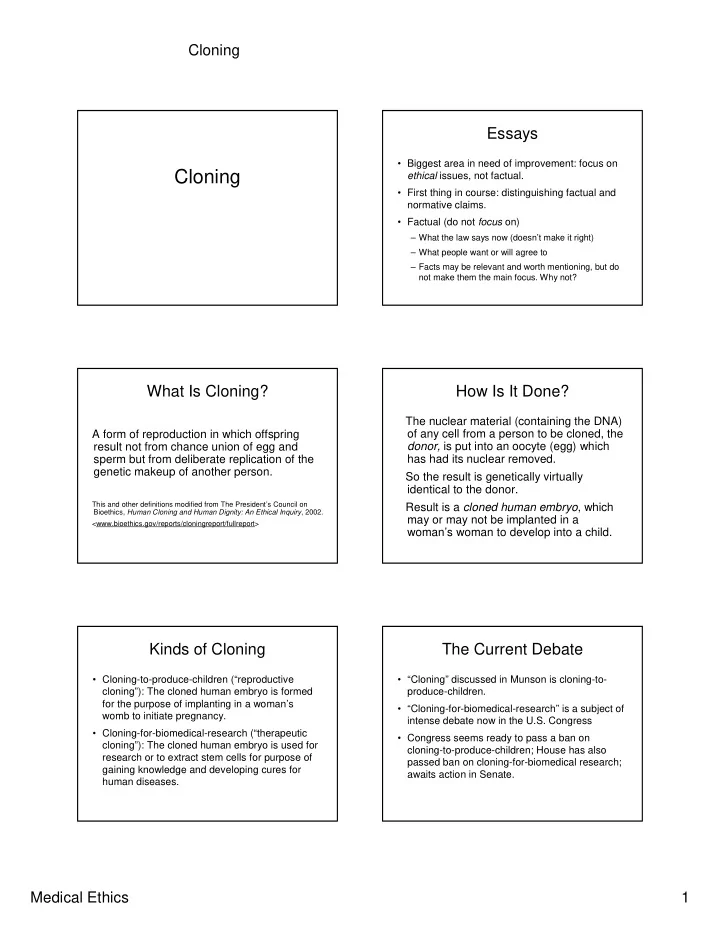
Cloning
Essays
- Biggest area in need of improvement: focus on
ethical issues, not factual.
- First thing in course: distinguishing factual and
normative claims.
- Factual (do not focus on)
– What the law says now (doesn’t make it right) – What people want or will agree to – Facts may be relevant and worth mentioning, but do not make them the main focus. Why not?
What Is Cloning?
A form of reproduction in which offspring result not from chance union of egg and sperm but from deliberate replication of the genetic makeup of another person.
This and other definitions modified from The President’s Council on Bioethics, Human Cloning and Human Dignity: An Ethical Inquiry, 2002. <www.bioethics.gov/reports/cloningreport/fullreport>
How Is It Done?
The nuclear material (containing the DNA)
- f any cell from a person to be cloned, the
donor, is put into an oocyte (egg) which has had its nuclear removed. So the result is genetically virtually identical to the donor. Result is a cloned human embryo, which may or may not be implanted in a woman’s woman to develop into a child.
Kinds of Cloning
- Cloning-to-produce-children (“reproductive
cloning”): The cloned human embryo is formed for the purpose of implanting in a woman’s womb to initiate pregnancy.
- Cloning-for-biomedical-research (“therapeutic
cloning”): The cloned human embryo is used for research or to extract stem cells for purpose of gaining knowledge and developing cures for human diseases.
The Current Debate
- “Cloning” discussed in Munson is cloning-to-
produce-children.
- “Cloning-for-biomedical-research” is a subject of
intense debate now in the U.S. Congress
- Congress seems ready to pass a ban on