Facts ICT Call 5: Intelligent Information Management Acronym: - - PowerPoint PPT Presentation

facts
SMART_READER_LITE
LIVE PREVIEW

Facts ICT Call 5: Intelligent Information Management Acronym: - - PowerPoint PPT Presentation

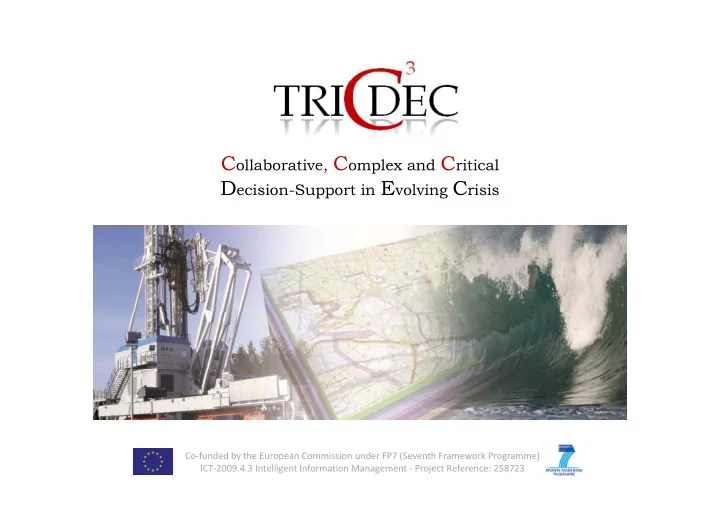
C ollaborative, C omplex and C ritical D ecision-Support in E volving C risis pp g Co funded by the European Commission under FP7 (Seventh Framework Programme) ICT 2009.4.3 Intelligent Information Management Project Reference: 258723


slide-1
SLIDE 1

Collaborative, Complex and Critical Decision-Support in Evolving Crisis

pp g

Co‐funded by the European Commission under FP7 (Seventh Framework Programme) ICT‐2009.4.3 Intelligent Information Management ‐ Project Reference: 258723
slide-2
SLIDE 2

Facts

  • ICT Call 5: Intelligent Information Management
  • Acronym: TRIDEC
  • Reference: 258723
  • Start Date: 01.09.2010
  • End Date: 31.08.2013
  • Duration: 36 months
  • Contract Type: Collaborative Project ‐ IP
  • Costs: 8.9 million €
  • Funding: 6.79 million €
  • 10 Partners
  • Coordinated by GFZ German Research Centre for

Geosciences Potsdam

2

slide-3
SLIDE 3

The Challenge g

  • TRIDEC focuses on new technologies for real‐time

intelligent information management in collaborative, complex critical decision processes in earth management.

Objective ICT-2009.4.3: Intelligent Information Management

Collaboration and decision support: efficient and dependable problem solving and decision support systems for critical information-bound domains in which our ability to share decision support systems for critical, information-bound domains in which our ability to share and exploit information is outstripped by the rate of its growth in size and complexity. Intended beneficiaries include organisations with complex business processes and access control policies; scientific communities collaborating on challenging projects and building very large datasets; teams of professional creators working on complex designs or multimedia materials; and web communities with sophisticated cooperation needs. The effectiveness of such solutions will be tested against the requirements of the respective groups or communities

3

communities.

slide-4
SLIDE 4

TRIDEC Project History

01 09 2010

http://www.tridec-online.eu/

Negotiation Phase

01.09.2010 Start of TRIDEC

Hearing 13.01.2010 Luxembourg Negotiation Phase 19.02.2010: ‐ Negotiation Mandate ‐ Invitation to NEF 19 03 2010

FP7-ICT-2009-5 Challenge 4: Digital Libraries and Content

Proposal deadline 26.10.2009 +1 g 19.03.2010: Negotiation meeting Luxembourg 04.05.2010 NEF session f ll l d

ICT 2009.4.3 Intelligent information management (CP, NoE, CSA)

ICT Call 5 published 30.06.2009 successfully closed 24.08.2010 TRIDEC Grant Agreement signed by the EC 4

slide-5
SLIDE 5

TRIDEC Partners

  • Helmholtz Centre Potsdam GFZ ‐ German

Research Centre for Geosciences (Germany) Centre for GeoInformation Technology

  • University of Southampton, IT Innovation

Centre (United Kingdom)

  • Queen Mary and Westfield College,

University of London ‐ Department of Electronic Engineering (United Kingdom)

  • JOANNEUM RESEARCH

Forschungsgesellschaft mbH ‐ DIGITAL ‐ Institute of Information and Communication Technologies (Austria)

  • IOSB ‐ Fraunhofer‐Institute of

Optronics, System Technologies and Image Exploitation (Germany) g p ( y)

  • TDE Thonhauser Data Engineering

GmbH (Austria)

  • Q‐Sphere Limited (United Kingdom)
  • Instituto de Meteorologia, I.P. ‐

Departamento de Sismologia e Geofísica (Portugal)

  • Alma Mater Studiorum‐ Universita

5

di Bologna ‐ Department of Physics (Italy)

  • Bogazici Universitesi ‐ Kandilli Observatory

and Earthquake Research Institute (Turkey)

slide-6
SLIDE 6

Key Software Development Tasks y p

  • A communication infrastructure of interoperable services for the intelligent

management of dynamically increasing volumes and dimensionality of management of dynamically increasing volumes and dimensionality of information.

  • A robust and scalable service platform supporting the integration and

utilisation of existing and‐ growing resources such as sensor systems, geo‐ information repositories, simulation‐, and data‐fusion‐tools. information repositories, simulation , and data fusion tools.

  • A knowledge‐based service framework for context information and

intelligent information management with flexible orchestration of system resources.

  • An adaptive framework for collaborative decision making with the support of

complex business processes and workflows.

6

slide-7
SLIDE 7

Demonstration in Two Real-World Scenarios

  • Tsunami Early Warning System

(Natural Crisis Management)

  • Drilling Operations (Industrial

Subsurface Development) ( g ) p )

Deepwater Horizon oil spill Damages by tsunami: City of Conception, Chile imaged on January The oil slick as seen from space by NASA's Terra satellite on May 24, 2010. g y y p g y 10th 2010 (left) and on February 27th 2010 (right) by the RapidEye satellite constellation. The right image was taken eight hours after an earthquake of magnitude 8.8 had occured and the resulting tsunami had affected the shoreline.

7

slide-8
SLIDE 8

Challenges in Software Architecture g

  • Collaborative decision making with the support of complex

g pp p business processes and workflows

  • Collaboration in very loosely coupled, distributed systems
  • Synchronisation of complex business processes
  • Complex event processing

D t lit d li bilit  Data quality and reliability  Filtering and aggregation of events Knowledge base with context information e g sensor  Knowledge base with context information e.g. sensor data, geo-information repositories, historic events  What-if calculations supported by simulation What if calculations supported by simulation components

8

slide-9
SLIDE 9

Drilling Scenario Tsunami Scenario

TRIDEC components

Scenario Scenario

Access for Operators on Duty

Command and Control User Interface (CCUI)

p

Data Enrichment Decision Support Filtering and Aggregation Data Mining and Data Fusion “Data to knowledge” Transformation: Data Standardisation Data Mining and Data Fusion Resources/Sensors Transformation: Data Standardisation

Features and SWE connectivity, OGC Services: WNS, SOS, SAS, SPS

9

esou ces/Se so s

Virtual Sensor Network, Unconventional Sensors, Partner Sensor Networks, Observations

slide-10
SLIDE 10

TRIDEC Workpackage Structure p g

10

slide-11
SLIDE 11

WP1 – Management & Coordination g

This work package encompasses the This work package encompasses the management, co-ordination and quality assurance activities of the project. Additionally, it will include the advice and influx of knowledge from external sources, like the needs of the markets and the involved countries as well as the markets and the involved countries, as well as the involved supranational bodies (IOC, UNESCO) through the inclusion and management of scientific and technical advisory boards and technical advisory boards.

11

slide-12
SLIDE 12

WP2 – End-User Requirements and Scenario Definition Scenario Definition

WP2 id th b i f th t t i t d WP2 provides the basis for the target-oriented design and development of core components, knowledge base, and decision support services (WP3 WP4 WP5) as well as application (WP3, WP4, WP5) as well as application systems (WP6, WP7). In a first step the legal administrative and In a first step the legal, administrative, and economic will be identified for the two scenarios and scenarios the relevant stakeholders will be identified identified. Business processes and interactions will be explored as well as the legal framework based explored as well as the legal framework based

  • n public legislation.

12

slide-13
SLIDE 13

WP3 – Architecture and Core Components Components

WP3 is focused on the conception, design, and specification of the scalable robust and resilient specification of the scalable, robust and resilient TRIDEC collaboration platform. This core infrastructure for the TRIDEC system uses This core infrastructure for the TRIDEC system uses hybrid design principles

  • f

Service Oriented Architecture (SOA), elements of an Event-Driven Architecture (EDA) and a Multi-Media-Streaming Architecture (EDA) and a Multi Media Streaming Architecture (MMSA). The development work requires close interaction p q with TRIDEC technology implementation WP’s (WP4: Knowledge-base, and WP5: Service Orchestrations and Decision-Support) as well WP2 pp )

  • n User Requirements.

13

slide-14
SLIDE 14

WP4 – Knowledge Base g

WP4 develops a knowledge-based service framework for TRIDEC. It provides intelligent processing g g capabilities that will add value to multiple distributed information feeds in an efficient, scalable and robust way. TRIDEC knowledge-base services will be able to subscribe to continuous real-time information feeds, subscribe to continuous real time information feeds, adopting flexible processing strategies (incremental, caching, batch processing etc.) according to the requirements of each actor and at each stage of the q g evolving events for decision-making.

14

slide-15
SLIDE 15

WP5 – Services Orchestration and Decision Support Workflows Decision Support Workflows

WP5 orchestrates the knowledge-based service g

  • framework. The tasks address the challenges in

Decision-support:

  • Scenario Decision-support (D-s) Requirements

Analysis

  • Specification of Thematic Models and Services for

D-s Workflows

  • Rapid Prototyping of D-s Services and Workflow

Engine D l t f th D d W kfl

  • Development of the D-s and Workflow

Management Infrastructure

  • Adaptation/Enhancement of D-s Services for the

Thematic Scenarios Thematic Scenarios

  • Use of existing sensor, video and semantic web

standards for maximum services and data inter-

  • perability

15

  • perability.
slide-16
SLIDE 16

WP6 – Natural Crisis Management g

WP6 develops the TRIDEC tsunami warning system WP6 develops the TRIDEC tsunami warning system. A decision support system will enable human experts to formulate and produce warning messages for different target/user groups. The system will also g g p y include the message logistics necessary to guarantee fast and secure delivery of the warnings. The warning system will integrate the available real time sensor data, including seismometer networks, tide gauges, GPS stations, GPS buoys,

  • cean

bottom units including pressure gauges. Additionally, bathymetric and topographic data sets, as well as precalculated or real-time simulations of coastal wave ill b d run-up will be used.

16

slide-17
SLIDE 17

WP7 – Industrial Subsurface Development (Drilling) Development (Drilling)

WP7 provides the TRIDEC planning and drilling

  • peration

scenario. It includes a collaborative decision process by integrating the planning decision process by integrating the planning decision-support of geologic sites and real-time decision-support for drilling operations. The system has to allow for evolutionary changes. It has to be adaptive as new plans of drilling sites are added, drilling rigs are moved to different locations, rigs are added, and the sensor setup is changed.

17

slide-18
SLIDE 18

WP8 – Project Communication - Dissemination Exploitation Dissemination - Exploitation

This work package covers the tasks of This work package covers the tasks of

  • Project Communication,
  • Dissemination and
  • Dissemination, and
  • Exploitation

The following subtasks stand out:

  • Transportation of the project achievements to the scientific and technical

p p j communities, policy makers and the general public

  • Provision of project results for tertiary education to maximize long term impact

for society.

  • soc e y
  • Development of a business strategy for commercial exploitation for both

application fields

18