FACILITIES MASTER PLAN School Site Committee Town Hall Redwood City - - PowerPoint PPT Presentation

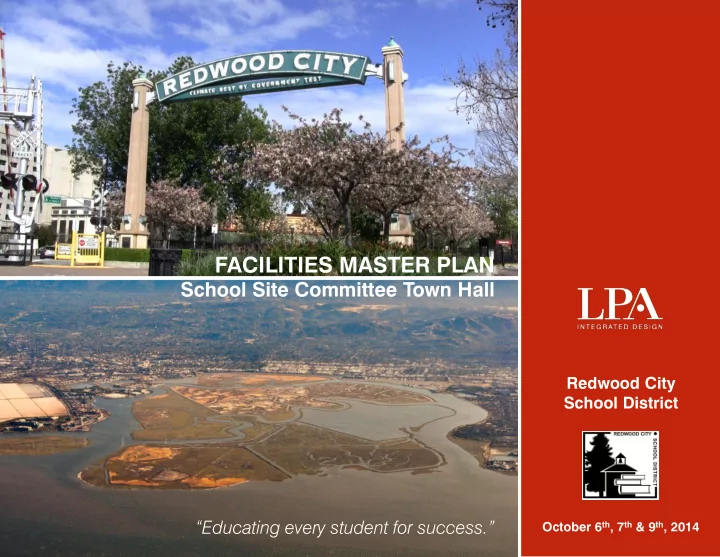
facilities master plan
SMART_READER_LITE
LIVE PREVIEW

FACILITIES MASTER PLAN School Site Committee Town Hall Redwood City - - PowerPoint PPT Presentation

FACILITIES MASTER PLAN School Site Committee Town Hall Redwood City School District Educating every student for success. October 6 th , 7 th & 9 th , 2014 intro & welcome / School Site Committee Town Hall October 6 th , 7 th & 9


slide-1
SLIDE 1

Redwood City School District

October 6th, 7th & 9th, 2014

FACILITIES MASTER PLAN

School Site Committee Town Hall

“Educating every student for success.”
slide-2
SLIDE 2

intro & welcome / School Site Committee Town Hall

October 6th, 7th & 9th, 2014 7:00pm – 9:00pm

slide-3
SLIDE 3

School Site Committee Meetings

Meeting #1 Monday, October 6th Town Hall Meeting Kennedy Middle School 7:00-9:00pm Meeting #2 Tuesday, October 7th Town Hall Meeting Taft Community School 7:00-9:00pm Meeting #3 Thursday, October 9th Town Hall Meeting MIT / North Star Academy 7:00-9:00pm
  • Kennedy,
  • Adelante
  • John Gill
  • Henry Ford
  • Orion
  • Taft
  • Hoover
  • Fair Oaks
  • Garfield
  • Selby Lane
  • MIT
  • Hawes
  • North Star
  • Roosevelt
  • Clifford
  • Cloud
K-5 Adelante Spanish Immersion School Fair Oaks Community School Hawes Community School Henry Ford School John Gill School Orion School K-8 Clifford School Connect Community Charter Garfield Community School Hoover Community School North Star Academy Roosevelt School Roy Cloud School Selby Lane School Taft Community School MS Kennedy Middle School McKinley Institute of Technology

ENGAGEMENT

SCHOOL SITE COMMITTEES

slide-4
SLIDE 4

agenda / Town Hall

Introductions & Committee Welcome 5 minutes FMP Process Overview 10 minutes Facilities Needs Assessment 10 minutes Guiding Principles 10 minutes Elementary K-8 & Middle School 15 minutes Program Opportunities SSC Committee Role 10 minutes SSC Small Groups 1 hour 2 hours total
slide-5
SLIDE 5

create value|

process overview

slide-6
SLIDE 6 Cost Estimating & Scope Prioritization STAKEHOLDER ENGAGEMENT & PRELIMINARY RECOMMENDATIONS Facilities Needs Assessment
  • Field Inspection Survey
  • Maintenance Needs
  • Healthy/Life Safety Issues
  • Code/ADA Compliance
Demographic Analysis
  • Enrollment Projections
  • Site Capacities
  • Student Loading Standards
  • Attendance Boundaries
  • Program Goals
  • Technical Standards
  • Technology Plan
  • Community Needs
Educational Vision Financial Analysis
  • State Eligibility
  • Alternative Funding Sources
  • Local Revenue
  • Cash Flow Analysis

Community Outreach Strategies

  • School Site Master Plan Diagrams
  • Proposed Program Scopes
  • Phasing Plan
  • Cost/Cash Flow Analysis
Finalized Master Plan Recommendations

create value / integrated process

slide-7
SLIDE 7

create value / schedule

slide-8
SLIDE 8 2. Facilities Needs Assessments Campus Overview Code, Health & Life Safety Issue Classroom Counts & Program Functions Measures of Physical Quality Matrix Survey Findings 1. Educational Program Vision Executive Summary Guiding Principles Vision ES, K-8 & MS Program Standards Technology Integration
  • Sq. Ft. & Physical Characteristics
3. Implementation Planning Proposed School Site Master Plan Diagrams Program Cost Estimates Funding Source Analysis Scope Prioritization Communication of Recommendations

create value / deliverable: Facilities Master Plan

slide-9
SLIDE 9

create value / prioritization

Creating a Funding Program
  • Analyze local sources of funding
Current assets Future development Re-development Facility usage fees
  • Calculate State eligibility
Modernization New construction Proposition 39 – Energy Impact of LCFF
  • Present voter approval options
slide-10
SLIDE 10

inter+act| stakeholder engagement

slide-11
SLIDE 11

inter+act / committees & stakeholder input

District Focus Groups Community Outreach Redwood City SD Board of Trustees Facilities Master Plan Committee School Site Input Elementary & K-8 Programs

5

BoT Site Information Technology Town Hall Forums Number of Meetings/Interactions

6

Community Surveys After School, Preschool & Childcare Programs Steering Committee SC

8

FMPC Community Food Services/ Nutrition Special Education ELD & DELAC Middle School Programs Charette Charette 1 1 1 1 1 Principal Surveys School Site Focused Interactions Students

1+1

1x ON- LINE

ASB

1x ON- LINE

2 #

Facilities Assessment & Educational Program Vision

  • verlay to develop school site master plans
Maintenance, Facilities & Operations 1
slide-12
SLIDE 12 Facilities Master Plan Committee (FMPC) (25-40 Committee Members Total) District Participants
  • Board Member(s)
  • Superintendent
  • Asst. Supt. Business Services
  • Asst. Supt. Instructional Services
  • Director Facilities
  • (6-8) Teachers & Administrators Representatives
(Cross Section of Roles/Disciplines)
  • Teacher Union Representative
  • Classified Employee Representative
  • Director of Technology
  • Parent Representatives
Community Members
  • (4-6) Community Leaders Representatives
  • (4-6) Business Community Representatives
(Nucleus of Future Campaign Effort)
  • Community College Representative
  • Senior Community Representative
  • Tax Group Representative
  • Chamber of Commerce Representative
  • Real-estate Organizations Representative
(Purpose is to develop District wide vision and standards with a goal to equally weight the total number of District and local community participants on the FMPC group.)

create value / process participants inter+act / FMP committee members

slide-13
SLIDE 13 Mtg #1 – April 24th, 2014 – “If You Could Dream” Process & Schedule Overview FMP Deliverables Group Perceptions & Priorities for the Plan Mtg #2 – May 13th, 2014 – Educational Program Opportunities Process Update ES & MS Program Opportunities Program Visioning Small Group Activity Mtg #3 – June 9th, 2014 – Draft Educational Standards Facilities Needs Assessment Findings Overview of Proposed Facilities Standards Educational Technology Goals Mtg #4 – Sept. 16th, 2014 – Proposed School Improvements Teacher/Support Staff Survey Results Integrating Culture & Creativity of Silicon Valley Draft ES, K-8 & MS School Diagrams Mtg #5 – October 21st, 2014 – Stakeholders Engagement School Site Committee Priorities District Wide Town Hall Input Community Outreach Processes Mtg #6 – November 18th, 2014 – Implementation Planning Total Program Cost Preliminary Funding Opportunities Prioritization Activity

create value / process participants inter+act / FMPC meeting agendas

S u m m e r B r e a k
slide-14
SLIDE 14

build smart|

site observations

slide-15
SLIDE 15

build smart / site observations

Site Tour Process…
  • Interview with Principal
  • Discussion about current drop-
  • ff/pick-up routines
  • Discussion about recent
modernization and/or new construction projects
  • Discussion about highest
campus priorities/needs
  • Tour of site and spaces
  • Entry/Exit & Parking
  • Administration
  • Classrooms
  • Labs
  • Specialty Spaces
  • Library/Media Centers
  • MUBs/MURs
  • Food Service
  • Locker Rooms
  • Hardcourts & Playfields
  • Family Centers
slide-16
SLIDE 16

build smart / sample site assessment

slide-17
SLIDE 17

build smart / site observations

Drop-off/Pick-up
  • Occurs along the street
  • Occurs through a dedicated loop
  • Safety & security concerns
Campus Front Door
  • Office location is easily identified
  • Secure campus entry
  • Curb appeal
Campus Edge
  • Family Center access
  • Community access
  • Proximity of play areas to
adjacent streets Accessibility
  • Access from parking lots to campus
  • Access to office
  • Access throughout campus
slide-18
SLIDE 18

build smart / site observations

Gathering Spaces
  • Libraries
  • MUBs / MURs
  • Gymnasiums
  • Theaters
How are they currently used? How could they be used? Specialized Spaces
  • Fitness Spaces
  • Locker Rooms
  • Elective Spaces
  • Programs without a home
slide-19
SLIDE 19

build smart / site observations

General Observations
  • Functionality of rooms
  • Day to day use
  • Daylighting
  • Furniture
slide-20
SLIDE 20

build smart / site observations

Outdoor Environment
  • Outdoor Learning Courts
  • Outdoor Eating areas
  • Outdoor Seating
Outdoor Environment
  • Gardens
  • Community Access
  • Running Clubs
Building Components
  • Building materials
  • Systems and components
  • Maintenance
slide-21
SLIDE 21

enrich lives|

guiding principles

slide-22
SLIDE 22

create value / guiding principles

Redwood City School District students deserve the best:

Quality Facilities

  • That support programs infused with the character, culture, creativity and

innovation history, past and future, for which Silicon Valley is known. Stakeholder Driven Process

  • To envision the long range master plan goals and recommendations

for improvement of RCSD’s facilities. Forward Looking

  • Facilities that offer opportunities for well-rounded development of the

whole child’s academic, arts, athletic and social skills.

slide-23
SLIDE 23

create value / guiding principles

Model Good Stewardship

  • Through respect of the natural environment and fiscal resources to

maximize dollars dedicated to the classroom. Flexible & Agile

  • 21st Century technology rich environments able to evolve with growth,

teaching, and learning needs of tomorrow’s students. Community Resource

  • Facilities that are welcoming, healthy, safe and secure neighborhood

centers offering services, family center, joint-use and partnership linkages.

slide-24
SLIDE 24

create value / guiding principles

Equitable

  • Facilities that provide equal access to quality learning opportunities

for all students.

Resulting in schools that mirror the evolution of the Redwood City community…Schools in which students, staff , parents and the local community can take pride.

slide-25
SLIDE 25
  • 6. Enhance Technology (infrastructure)
  • 3. Equitable Mental Health Services
  • 4. Growth of the Community School Model
  • 2. Continue Physical Education
  • 1. Reduction in Class Size
  • 5. Support Professional Development

and Staff Collaboration

CONNECT / LCAP GOALS

  • 7. Library – Evolve into Resource Center

enrich lives|

Facility Standards

slide-26
SLIDE 26

PLANNING CRITERIA

  • Transitional K
  • K – 3rd Grade
  • 4th – 8th Grade

24 – 28 students per classroom 24 students per classroom 28 students per classroom

Loading Standards Impacts

  • Number of classrooms
  • Location on campus
  • Ideal grade level groupings
  • 1. Reduction in Class Size
slide-27
SLIDE 27

CDE SF REQUIREMENTS

  • Located near front of school
  • Near parking lot
  • Appropriate sized rooms
  • Access to restrooms, outdoor play,
shade
  • Associated with small tutoring room
Planning Criteria:
  • 1. Reduction in Class Size
slide-28
SLIDE 28

SUPPORT PE NEEDS

Playfields:

  • All weather track
  • All weather fields
  • Connect to Gym?
BOYS CHANGING 600 SF ACTIVITY ROOM 960 SF GIRLS CHANGING 600 SF STOR. 300SF
  • Indoor PE space
2 classrooms at ES (60 students) 3-4 classrooms at MS 3 classrooms at K-8
  • Near MUB
  • Adjacent to fields
  • Near locker & changing rooms
  • Office for PE Teachers
  • Storage for equipment,
  • Technology ready
  • Divider wall between spaces
  • Sports flooring
Additional Focus Group Input:
  • Locker rooms undersized at MIT
  • Renovation of MS locker rooms
  • Blacktop impacted, needs resurfacing
Planning Criteria:
  • 2. Continue Physical Education
ACTIVITY ROOM 960 SF ACTIVITY ROOM 960 SF ACTIVITY ROOM 960 SF OFF. 120SF
slide-29
SLIDE 29

SUPPORT STUDENT NEEDS

  • CONF. RM.
300 SF 12-15 People PSYCH. 200 SF SPEECH 200 SF COUNSELOR 200 SF
  • Consolidate student services
  • Located near Administration
  • Offices, acoustically separated for
confidential meetings
  • Comfortable seating & environment
  • Needed at all schools
Planning Criteria:
  • 3. Equitable Mental Health Services
Specialized Intervention or Staff Support 600 SF WAITING AREA 200 SF
slide-30
SLIDE 30

GROWTH OF COMMUNITY SCHOOL MODEL

  • Fair Oaks K5
  • Kennedy 6-8
  • Taft K-5 (in 2 yrs will be K-8)
  • Hoover K8
  • Garfield K8
  • Hawes K5 (pending)

Existing Community Schools Potential Future Sites

  • Selby Lane K8
  • Roosevelt K8
  • Gill K5
  • Three classrooms size
  • Access to public street
  • Family Room – with changing area
  • Restrooms & shower
  • Outdoor space – shade and play area
  • Community Room – parent classes,
meetings & storage Family Center Planning Criteria:
  • 4. Growth of the Community School Model
  • CONF. RM.
300 SF 8-10 People OFFICE 120 SF WAITING 300 SF OFFICE 120 SF OFFICE 120 SF T 130SF
  • FAM. RM.
80 SF COMMUNITY ROOM 700-800 SF KITCHENETTE 1000 SF OUTDOOR SPACE W/ SHADE TO STREET ACCESS Storage OFFICE 120 SF
slide-31
SLIDE 31

SUPPORT STAFF

Lounge 600 SF Resource 300SF
  • Dedicated work space
  • On planning days – 3 to 4 teachers
working together
  • Place for teacher resources
  • Technology ready
  • Pin up area
  • Writing surfaces for planning
Additional Focus Group Input:
  • Separate room for copier noise
  • Provide a Parent Resource Room
  • Operable wall between Planning Room
and Lounge
  • Facilitate large & small group meetings
Planning Criteria: ACTIVITY ROOM 960 SF Planning Room 300 SF (2 groups of 3-4 Teachers) Copier 120SF
  • 5. Support Professional Development

and Staff Collaboration

slide-32
SLIDE 32

Tech coordinated with room layout

21st CENTURY CLASSROOM

LARGE FORMAT INTERACTIVE TV SHORT THROW PROJECTION WI FI ACCESS POINTS WRITING SURFACES WRITING SURFACES MOBILE FLEXIBLE FURNITURE
  • 6. Enhance Technology (infrastructure)
slide-33
SLIDE 33

21ST CENTURY CLASSROOM

TODAY

Discussion Traditional Lecture Group Work Project / Problem Based

POSSIBILITIES

  • 6. Enhance Technology (infrastructure)
  • Flexible furniture
  • Technology adaptability
  • Electrical needs (outlets & capacity)
  • Clean & messy work
  • Display student work
Planning Criteria:
  • Wireless access points
  • VOIP cabling
  • More data drops
  • Re-wiring at IDF/MDF rooms
  • Cisco phones
  • Bells, clocks & intercom
  • Core switches at MDF’s
  • Additionally at all schools add:
  • WiFi at exterior areas
  • AC at MDF rooms
  • Security at labs
  • Equipment storage
  • Classroom tech package
  • Computer lab for assessment
Technology FMP Scope:
slide-34
SLIDE 34 Flexible Furniture Reading Garden Flexible Connection Student Zone ‘Huddle Boards’ Media Stations Graphics + Research Stations Teaming Tables Interactive Media Library Innovation Center Doubles as Professional Development Lab Brainstorming Space Mobile Stacks Transition from access content… to a space that

allows students to create content.

LIBRARY AS RESOURCE CENTER

  • 7. Library – Evolve into Resource Center
slide-35
SLIDE 35

Student Input

What I wish my school had or was like…
  • Sports fields
  • Bright classrooms
  • Comfortable place for lunch, hang out
  • More trees and shade
  • Water fountains
  • Modern attractive design
  • Bigger classrooms
  • Variety of food choices
  • Classroom thermal comfort
  • Flexible furniture

Needs or Issues…

  • More sports equipment
  • Library like Starbucks
  • Cafeteria too small, loud & hot
  • Covered outside dining
  • Better restrooms
  • 2nd Floor acoustic issues
  • Locker rooms smelly
  • Hallways crowded
  • Repair fields & blacktop
  • More technology
  • Upgraded computers
  • Food lines long
  • Bike storage not secure (Kennedy)
  • Classroom window curtains old
slide-36
SLIDE 36

Additional Program Opportunities

slide-37
SLIDE 37 MAKER SPACE 1,200SF STOR 200SF MEDIA LAB 1,200SF TECH STOR 200SF
  • Hands-on opportunities
  • Flexible space & furnishings
  • Perimeter casework & sinks
  • Technology ready
  • Separate storage for Art/Science
  • Centrally located
  • Dedicated outdoor lab space
  • Group Media Lab
Planning Criteria: Nueva School Innovation Lab Hillsborough, CA

MAKER SPACE

access to outdoor space water, shade, seating

Learning Environment Qualities - Enhance

slide-38
SLIDE 38 Open Space for Projects Large working Surfaces Interactive Lecture Mobile Storage Systems Resource Space Specialized Equipment Access to Technology Small Group Planning Space Digital Center Recording Studio Filming Access Editing Rooms Digital Storage Creative Learning Systems Computer Pods for Teaming Access to different Programs Flexibility Divider Walls Connection to Technology

STEAM / STEM ELECTIVE Middle School

Learning Environment Qualities - Enhance

slide-39
SLIDE 39

STEAM / STEM ELECTIVE Middle School

Interactive presentation space Opens to outdoors Display student work Cabinet storage Drop down power High and low tables High ceilings, varied lighting fixtures Mobile storage units Some permanent sinks

Learning Environment Qualities - Enhance

slide-40
SLIDE 40 Planning Criteria:
  • Fresh produce refrigeration
  • Outdoor lunch shelter
  • Good acoustic qualities
  • Support staff work flow
  • Better student queing

FOOD SERVICE

slide-41
SLIDE 41

SITE & COMMUNITY USE ELEMENTS

  • Shade
  • Outdoor seating
  • Student social spaces
  • Learning spaces (small & large groups)
  • Improve parking
  • Enhance drop-off safety
  • Repair fields & blacktop
  • Parent PTO space
  • PTO storage
  • Office parent waiting area
  • Fields community use
  • Better signage
  • Lock down vs. ease of access
  • Security solutions
Planning Criteria:
slide-42
SLIDE 42

engagement

SCHOOL SITE COMMITTEES

slide-43
SLIDE 43

School Site Committee Makeup

ENGAGEMENT

SCHOOL SITE COMMITTEES

The following is a list of participants for the SSC. Elementary School SSC: 4-5 members Principal (2) Teachers (Lower & Upper Primary Grades) (1) Classified Staff (1) Parent/PTA K-8 School SSC: 9-10 members Principal (5) Teachers
  • One Lower Primary
  • One Upper Primary
One from each of the following areas:
  • Language Arts/Social Sciences/Math
  • Science
  • Electives
(1) Classified Staff (2) Parents/PTA (1) Student Middle School SSC: 6-7 members Principal (3) Teachers One from each from:
  • Language Arts/Social Sciences/Math
  • Science
  • Electives
(1) Classified Staff (1) Parent/PTA (1) Student Questions If you have any questions, please contact: Name: Jan Christensen Email: jchristensen@rcsdk8.net Phone: 650.482.2200
slide-44
SLIDE 44

Interact with SSC between now and November 3rd Outreach to School Site Counsel & Parents as appropriate Verify Accuracy of Existing Site Plan Diagram Confirm Site Needs in Proposed Master Plan Fill Out Questionnaire & List ‘3’ Highest Priorities Finalize Master Plan Diagram in ‘1 on 1’ Meeting with Architects Sign up for a meeting on November 3rd or 4th

School Site Committee Role

ENGAGEMENT

SCHOOL SITE COMMITTEES

slide-45
SLIDE 45

Q&A

slide-46
SLIDE 46

1. people driven 2. research informed 3. learner centered 4. exploratory 5. transparent 6. implement-able 7. long range

we believe that a sustainable master plan is…

slide-47
SLIDE 47

LPA

creating sustainable places and spaces that enrich the lives of those who use them