F001 Oral Signs of Genetic Disease DISCL ISCLOSURE OF RELATIO - - PDF document

f001
SMART_READER_LITE
LIVE PREVIEW

F001 Oral Signs of Genetic Disease DISCL ISCLOSURE OF RELATIO - - PDF document

2/14/2017 F001 Oral Signs of Genetic Disease DISCL ISCLOSURE OF RELATIO IONSHIPS IPS WITH WITH IN INDUSTRY Jennifer L. Hand, MD Jennifer L. Hand MD F001- Oral Signs of Genetic Disease 10:10 AM 10:30 AM Associate Professor of


slide-1
SLIDE 1

2/14/2017 1

F001

Oral Signs of Genetic Disease

Jennifer L. Hand MD Associate Professor of Dermatology, Clinical Genomics, and Pediatrics Mayo Clinic, Rochester, MN

Jennifer L. Hand, MD F001- Oral Signs of Genetic Disease 10:10 AM – 10:30 AM

DISCLOSURES I do not have any relevant relationships with industry.

DISCL ISCLOSURE OF RELATIO IONSHIPS IPS WITH WITH IN INDUSTRY

Objectives

  • Diagnose oral signs of genetic disease more

accurately

  • Recognize benign skin findings that indicate

an increased risk for systemic disease

  • Obtain a targeted family history for genetic

syndromes with oral features

Syndromes

Connective Tissue Dysplasia

  • Marfan Syndrome
  • Ehlers-Danlos syndrome
  • Osteogenesis Imperfecta
  • Dentinogenesis imperfecta

Ectodermal dysplasia

  • Hypohydrotic Ectodermal

dysplasia

  • Incontinentia Pigmenti

Neoplastic

  • Peutz- Jegher
  • Familial Adenomatous

Polyposis (FAP)

  • MEN2B
  • Cowden syndrome
  • Carney Complex

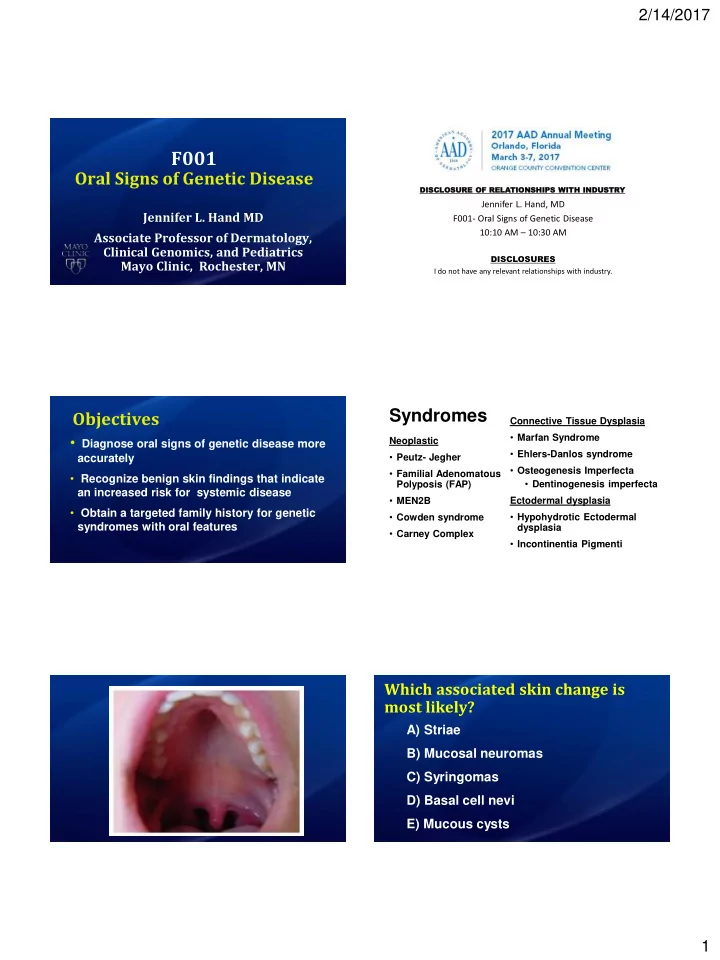
Which associated skin change is most likely?

A) Striae B) Mucosal neuromas C) Syringomas D) Basal cell nevi E) Mucous cysts

slide-2
SLIDE 2

2/14/2017 2 Which associated skin change is most likely?

A) Striae B) Mucosal neuromas C) Syringomas D) Basal cell nevi E) Mucous cysts

Marfan syndrome

  • Autosomal dominant, variable expressivity
  • 1:5,000 persons
  • 25% new (de novo) mutations
  • Affects skeletal, ocular and cardiovascular

systems

  • Potentially fatal; may not be evident until

adolescence

Ghent Systemic Score

Feature Value Feature Value

Wrist and thumb sign 3 Protrusio acetabulae 2 Wrist or thumb sign 1 Reduced elbow extension 1 Pectus carinatum 2 Skin striae 1 Pectus excavatum or chest asymetry 1 Reduced upper-to-lower segment and increased arm span to height ratio 1 Hindfoot deformity 2 Scoliosis 1 Pes Planus 1 Craniofacial features 1 Pneumothorax 2 Myopia 1 Dural ectasia 2 Mitral Valve Prolapse 1

Marfan Syndrome

Score > or = 7 is significant.

Marfan.org

Marfan syndrome

  • Fibrillin-1 (FBN1) mutation
  • Extracellular matrix protein
  • Elastic fibrils of lens, aorta, skin
  • regulator of TGF-b (transforming growth factor beta)

signaling

  • Rarely, mutations in TGFBR1 and TGFBR2
  • type called “Loey’s-Dietz”
  • additional traits: bifid uvula, easy bruising or abnormal

scars

Marfan : Facial Skeletal Features

Down-slanting, deep eyes Malar hypoplasia Micro-, retrognathia High, arched palate Tooth crowding

Marfan Syndrome Skeletal abnormalities

  • Long extremities
  • Reduced arm-span to

height; upper to lower segment ratios

  • Pectus
  • Scoliosis
  • Pes planus
slide-3
SLIDE 3

2/14/2017 3

Marfan: vascular abnormalities

  • Aortic dilatation
  • Z-score >= 2.0
  • Dissection
  • Mitral valve prolapse
  • Arrhythmia

Normal Aorta Marfan

Marfan syndrome

Definitive diagnosis:

  • Aortic root ≥2 z score and ectopia lentis
  • Aortic root ≥2 z score and FBN1 mutation
  • Aortic root ≥2 z score and systemic score ≥7
  • Ectopia lentis and FBN1 mutation
  • Family history and ectopia lentis
  • Family history and systemic score ≥7

Marfan syndrome

  • Prognosis by cardiovascular defects: common

cause of death, aortic abnormalities in adults

  • Advice: Minimize contact sports, Avoid isometric

exercises, Valsalva maneuver.

  • Long-term propranolol decreases myocardial

contractility, risk of aortic dilatation. Losartan (ARBs) superior to beta-blockers

  • Prosthetic replacement of aneurysmal and valve

heart defects, aortic root

Hypermobility Syndromes

Table from Jouni Uitto Eur J Dermatol 2005; 15 (5): 311-2

Ehlers-Danlos syndrome

6 Types

(After 1997) Old Type

Features

Inherita nce

Gene Classical

I, II

Extensible Skin, Joints,Scars, Bruising AD, AR Type V Collagen

Hypermobility

III

Joint Hypermobility, Pain, dislocations

AD

Unknown

Vascular

IV

Thin skin, GI or uterine rupture

AD

Type III Collagen

Kyphoscoliosis

VI

Hypotonia, lax joints, eyes, scoliosis

AR

Lysyl hydroxylase

Arthrochalasia

VIIa, b

Severe joint mobility, birth dislocation

AD

Type I Collagen

Dermatosparaxis

VIIc

Severe skin fragility, extensibility

AR

Procollagen N- peptidase

Major Diagnostic Criteria

  • Skin hyperextensibility
  • Widened, atrophic scars
  • Joint Hypermobility

EDS Classical Type

slide-4
SLIDE 4

2/14/2017 4

EDS  Frenulum is smaller, atrophic in EDS. Normal 

Used with permission. Celletti et al. Am J Med Gene. 2011.

Beighton Scale

GeneReviews/ NIH Drawings from Joint Hypermobility Association UK

“I have had pain in my mouth”

Berglund, Bjorck. J Orofac Pain 2012 Fall;26(4):307-14

“I have had discomfort when eating” “I have been forced to interrupt meals”

Collagen Type I

  • Comprise 30% of human body

weight

  • Found in bones, fascia, tendons,

sclera, dermis and organ capsules

  • Quantitative defects more severe

than qualitative defects

Collagen Type I

  • Osteogenesis Imperfecta:

Inherited disorder associated with bone fragility

  • Why would a dermatologist be

consulted?

Easy bruising Osteogenesis Imperfecta

Type Family FragileB

  • nes

Easy Bruise Short Other

I II III IV

AD

Mild to Mod

Yes Yes

Blue Sclera AD or AR Infant Death

AR

Severe

Yes Very

White Sclera

AD

Mod Mod

slide-5
SLIDE 5

2/14/2017 5 Osteogenesis Imperfecta

  • Thin, atrophic, translucent skin
  • Scars frequently atrophic like EDS
  • Teeth susceptible to caries, break easily,

and are amber yellow to bluish-gray

  • Width of cortex, amount of cancellous bone

decreased

  • Intraoperative brittle bones
  • Prognathism

Osteogenesis Imperfecta

  • Most patients present

with pathologic fractures and

  • steoporosis
  • Mild form

underdiagnosed

The following fact sheets and articles were written with the help

  • f young people who have OI.

College: Career Planning for Students with OI Checklist for College Accommodations College Search Resources College Financial Aid Resources Guidelines for College Selection Process

Learning How to Drive Transition from Pediatric to Adult Care

Which of following diagnoses should be considered ?

A) Multiple mucosal neuromas B) Myxoid neurofibromas C) Syringomas D) Basal cell nevi E) Mucous cysts

Which of following diagnoses should be considered ?

A) Multiple mucosal neuromas B) Myxoid neurofibromas C) Syringomas D) Basal cell nevi E) Mucous cysts

slide-6
SLIDE 6

2/14/2017 6

Multiple Mucosal Neuromas

Multiple Endocrine Neoplasia Type 2B

  • Also called Mucosal Neuroma Syndrome
  • Autosomal Dominant
  • RET is the only gene; testing detects 98%
  • Oral mucosal neuromas may be first to

present

MEN 2B

  • Medullary Thyroid Cancer (MTC) in virtually

all (100 %)

  • Early thyroidectomy (< age1)
  • Pheochromocytoma (50%)
  • Gastrointestinal symptoms from

hamartomas (ganglioneuromas)

  • Hyperparathyroidism (30%)
slide-7
SLIDE 7

2/14/2017 7

MEN2B

Oral Mucosal Neuromas

  • On tongue,

pathognomonic for MTC

  • “Blubbery” lips
  • Oral findings

benign

24-year-old; metastatic Medulllary Thyroid Cancer PET Scan

MEN2B

MEN2B Characteristic appearance

  • “blubbery” lips
  • prominent jaw
  • Elongated face
  • “Lanky” build

Cowden syndrome

slide-8
SLIDE 8

2/14/2017 8

Cowden syndrome

  • Macrocephaly
  • “Overgrowth”

syndrome

Cowden syndrome

PTEN Hamartoma

Cowden syndrome

  • Cancers of the thyroid (35%), breast (up

to 67%),colon (9%), renal (35%), melanoma (5%) and endometrium (30%)

  • Thyroid cancer: follicular or papillary,

not medullary

  • Numerous benign hamartomas

PTEN Hamartoma Cowden Syndrome Criteria

Pat Pathognomo monic

  • Adult Lhermitte-Duclos

disease

  • Mucocutaneous
  • Facial

trichilemmomas

  • Acral keratoses
  • Papillomas

Major

  • Breast cancer
  • Thyroid cancer
  • Macrocephaly
  • Endometrial cancer

From Int J Neuroradiology official blog; Jan 12, 2013

What is Lhermitte–Duclos disease?

PTEN Hamartoma: Cowden Syndrome

  • Adult onset in

Cowden

  • Hamartomatous
  • vergrowth of the

cerebellum

  • Gangliocytoma

PTEN Hamartoma Cowden Syndrome Criteria

  • Diagnostic Criteria updated every year

by the National Comprehensive Cancer Network (NCCN)

  • Operational diagnosis if:
  • 6 or more facial papules-at least 3

trichilemmoma

  • Cutaneous papules and oral papules
  • 6 or more palmo/plantar keratoses
slide-9
SLIDE 9

2/14/2017 9

PTEN Hamartoma:

Cowden syndrome

Acral papules

PTEN Hamartoma:

Cowden syndrome

Palmar “pits”

PTEN Hamartoma

Facial Tricholemmomas

PTEN Hamartoma

Oral Papillomas

PTEN Hamartoma

Banayan-Riley Ruvalcaba

  • Allelic to Cowden (PTEN), autosomal dominant

Penile Hyperpigmented Macules

Surveillance

  • Age < 18: annual thyroid ultrasound, skin

check, physical exam

  • Adults: annual thyroid ultrasound,

dermatology exam, colonoscopy, renal

  • imaging. For family cancer hx, begin

screening 5-10 years prior to youngest diagnosis

  • For women: mammogram, breast MRI,

transvaginal ultrasound or endometrial biopsy

PTEN Hamartoma Syndrome

slide-10
SLIDE 10

2/14/2017 10 With digital pigment and anemia, risk of which cancer is increased ?

A) Gastrointestinal B) Lung C) Esophageal D) Skin E) Breast

With digital pigment and anemia, risk of which cancer is increased ?

A) Gastrointestinal B) Lung C) Esophageal D) Skin E) Breast (54%)

Peutz-Jeghers Syndrome

  • STK11 mutation, autosomal dominant
  • 94% with clinical diagnosis have a

mutation

  • Association of gastrointestinal (P-J)

polyps and mucocutaneous pigmentation

  • Polyps most common in small intestine

(jejunum > ileum > duodenum)

Peutz-Jeghers Syndrome

Peutz-Jeghers Syndrome

  • Epithelial: colorectal, gastric, pancreatic,

breast, ovarian cancer

  • Females: Sex cord tumors with annular

tubules (SCTAT), Adenoma malignum of the cervix

  • Males: Sertoli cell tumors that secrete

estrogen, gynecomastia

  • Overall cancer relative risk up by 10%

Associated Tumors

Genetics Referral Indications

  • Mucocutaneous Pigmentation and
  • ne or more P-J polyps
  • Ovarian sex cord/ Sertoli cell tumor
  • Adenoma malignum of the cervix
  • Pancreatic or breast cancer

Hampel et al. Genetics in Medicine. 17:1 January, 2015

slide-11
SLIDE 11

2/14/2017 11 Risk of which cancer(s) is increased ?

A) Gastrointestinal B) Thyroid C) Testicular D) Pancreatic E) Breast

Risk of which cancer(s) is increased ?

A) Gastrointestinal B) Thyroid C) Testicular D) Pancreatic E) Breast

Carney syndrome:

  • Embolic stroke secondary to cardiac

myxomas

  • Endocrine abnormalities: Cushing’s

syndrome caused by PPNAD (pigmented nodular adrenocortical disease); 25%

  • acromegaly due to growth hormone/

pituitary adenomas

  • prolactinemia

A Multiple Endocrine Neoplasia

  • Pale at birth
  • Brown to black
  • “ink spot” lentigines
  • Increased at puberty
  • Face, lips, mucosa
  • Inner or outer canthi,

vaginal or penile mucosa

Carney Complex

slide-12
SLIDE 12

2/14/2017 12

Carney Complex

  • Also known as
  • NAME (nevi, atrial myxoma, ephelides)
  • LAMB (lentigines, atrial myxoma, blue

nevi)

  • PRKAR1A, Autosomal Dominant, 71%

detection rate

  • Locus heterogeneity: other unknown genes

Carney Complex

  • Psammomatous Melanotic

Schwannomas (10%)

  • Myxomas: skin, breast,
  • ropharynx, female genital

tract

  • Large-cell calcifying Sertoli

cell tumors (LCCSCT) in almost all by adult 

  • Multiple thyroid nodules

(75%)

Carney Complex

  • causes Cushing

syndrome

  • 75% of females,

100% have PPNAD at autopsy

Primary Pigmented Nodular Adrenocortical Disease (PPNAD)

  • Weight gain
  • Growth Cessation
  • “moon facies”
  • Hirsutism
  • Striae
  • Hypertension
  • Buffalo hump
  • Weakness
  • Easy bruising
  • Psychological

disturbance

Basal Cell Nevus syndrome

Jaw Keratocysts

Appear age 8 to 30’s; Benign, cause tooth loss, appear clinically after damage

slide-13
SLIDE 13

2/14/2017 13

I. II. III.

Autosomal Dominant Inheritance

Basal Cell Nevus Syndrome

  • Also Gorlin syndrome or Nevoid Basal Cell

Carcinoma syndrome (NBCCS)

  • Autosomal dominant; 1:30,000
  • Patched (PTCH1) mutation on 9q22.3; also

in sporadic BCC

  • 20-30% de novo mutation
  • Tumor suppressor

PTCH1

Cell Membrane

Sonic Hedgehog

Smoothened Transcription Cascade

Patched1, when not bound with Sonic hedgehog, joins Smoothened to suppress transcription.

Acts as Tumor Suppressor

PTCH1

Nevoid Basal Cell Carcinoma Syndrome (NBCCS) Major Criteria

  • Falx calcification
  • Jaw keratocysts
  • Palm/ plantar pits
  • > 5 BCC’s in a

lifetime

Minor Criteria

  • Medulloblastoma
  • Pleural cysts
  • Macrocephaly
  • Vertebral or rib abnormalities
  • Polydactyly
  • Ovarian or Cardiac fibromas
  • Eye anomalies

In Summary….

  • Multiple similar benign growths suggest a single

gene cancer predisposition might be present

  • A pedigree is a visual tool to recognize a genetic

disorder

  • Certain benign pathology diagnoses warrant

further consideration

  • e.g. Fibrofolliculoma, jaw keratocyst, multiple

mucosal neuroma

slide-14
SLIDE 14

2/14/2017 14

Thank You!