F lexible-wing MAVs F lexible-wing MAVs Dr. Peter Ifju, Bret - - PowerPoint PPT Presentation

f lexible wing mavs f lexible wing mavs
SMART_READER_LITE
LIVE PREVIEW

F lexible-wing MAVs F lexible-wing MAVs Dr. Peter Ifju, Bret - - PowerPoint PPT Presentation

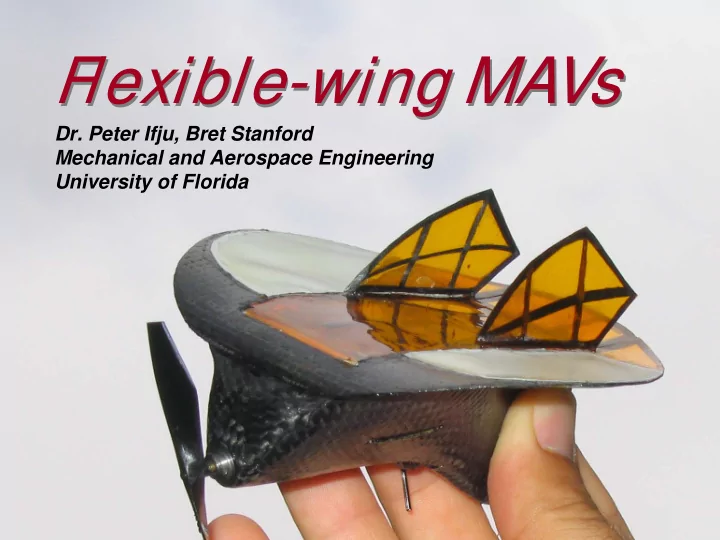
F lexible-wing MAVs F lexible-wing MAVs Dr. Peter Ifju, Bret Stanford Mechanical and Aerospace Engineering University of Florida Special Thanks Special Thanks Students: James Davis Yongsheng Lian Bret Stanford Thomas Rambo Roberto

slide-1
SLIDE 1

F lexible-wing MAVs F lexible-wing MAVs

  • Dr. Peter Ifju, Bret Stanford

Mechanical and Aerospace Engineering University of Florida

slide-2
SLIDE 2

Special Thanks Special Thanks

Students:

Bret Stanford Roberto Albertani Kyu-Ho Lee Sewoong Jung Scott Ettinger Mujahid Abdulrahim Don McArthur Dan Claxton Frank Boria Mike Sytsma Jos Coquyt Dragos Viieru Baron Johnson Mike Morton James Clifton Scott Bowman

UF Faculty:

Rick Lind Warren Dixon Paul Hubner Wei Shyy Rafi Haftka David Jenkins Andy Kurdila Carl Crane Warren Dixon Franklin Percival Mike Nechyba

Sponsors:

Air Force Office of Scientific Research AFRL at Eglin Air Force Base US Special Operations Command NASA Langley Research Center US Geological Survey US Dept of Fisheries and Wildlife James Davis Yongsheng Lian Thomas Rambo Albert Lin Brandon Evers

slide-3
SLIDE 3

Design Concept: Flexible, Thin, Design Concept: Flexible, Thin, Undercambered Undercambered Wing Wing

Undercambered wing provides better aerodynamic characteristics at Reynolds No. below 100,000. Flexibility can be tuned for smoother flight in gusty wind conditions “adaptive washout”. We have built wings with improved longitudinal stability. Delayed/gentle stall has been documented Flexible wing can be morphed efficiently. Flexible wings can be folded for storage and deployed without assembly. Wing configuration can be engineered to be lightweight as well as durable

slide-4
SLIDE 4

Benefits of the UF Designs Benefits of the UF Designs

Morphing Morphing Gust Alleviation Gust Alleviation Storage Storage Durability Durability Stability, high lift Stability, high lift

slide-5
SLIDE 5

Outline: Outline:

  • Introduction
  • Fabrication methodologies
  • Flight testing
  • Experimental program
  • In-situ deformation measurements
  • Structural model
  • Fluid structure interaction models
  • Model validation via deformation measurements
  • Optimization
  • Conclusions and future work
slide-6
SLIDE 6

Custom MAV Design Software Custom MAV Design Software

  • Span
  • Chord
  • Twist
  • Sweep
  • Airfoil

geometry

  • Virtually any

planform shape

MAVLab: rapid wing generation

slide-7
SLIDE 7

CAD Model, Tool Path and Milling CAD Model, Tool Path and Milling

slide-8
SLIDE 8

Finished Tooling and Finished Tooling and Composite Construction Composite Construction

Finished tool with layout pattern Prepreg unidirectional, woven carbon fiber and Kevlar composite construction

slide-9
SLIDE 9

Composite Construction Continued Composite Construction Continued

Vacuum bagging Fuselage layup Component installation Assembly

slide-10
SLIDE 10

Finished MAV in Less Than One Day Finished MAV in Less Than One Day

  • Latex rubber membrane

material is applied

  • Fins are attached
  • Off to be flight tested
slide-11
SLIDE 11

International Micro Air Vehicle International Micro Air Vehicle Surveillance Competition History Surveillance Competition History

1997 1998 1999 2000 2001 2002 2003 2004 2005 2006 10 25 50 MLB MLB UF UF UF UF UF UF BYU KKU UF 4.5 in. (11.4 cm) record

Maximum Dimension, cm

15

Smallest MAV to identify target at 600m

Year

slide-12
SLIDE 12

30 cm US European MAV Competition 30 cm US European MAV Competition

slide-13
SLIDE 13

Three Wings were then Studied Three Wings were then Studied

[±453] [±452] Latex Skin [02]

Rigid Batten-Reinforced BR Perimeter-Reinforced PR

  • Composite wings constructed from carbon fiber

composites, and latex rubber skin

  • All three wings have the same nominal shape:

– AR = 1.25, root chord = 130 mm, wing span = 150 mm

  • Rigid wing: nominal aerodynamics
  • Batten-reinforced wing: adaptive washout
  • Perimeter-reinforced: adaptive inflation
slide-14
SLIDE 14

Coefficient of Lift vs. Angle of Attack Coefficient of Lift vs. Angle of Attack

  • The low aspect ratio accounts for high stall angles
  • After stall, the lift of the perimeter reinforced wing is greater than

The other wings before stall

  • The perimeter reinforced wing has higher CLmax
slide-15
SLIDE 15

Moment Coefficient Moment Coefficient vs vs Coefficient of Lift Coefficient of Lift

  • The perimeter reinforced wing has a higher negative slope
  • The rigid wing has the lowest
  • Static longitudinal stability of the perimeter reinforced wing is

substantially higher than the rigid case with the batten reinforced wing intermediate

slide-16
SLIDE 16

Wing Deformation Measurements Using Wing Deformation Measurements Using Visual Image Correlation Visual Image Correlation

  • The stereo-triangulation is achieved through twin synchronized

cameras (35 mm lens, 1.3 mega pixels, 5-10 ms exposure times) each looking at a different angle

  • After a random speckling pattern is applied to the surface of the 3-D

geometry in question, the VIC system digitally acquires the pattern, and tracks the deformation of each speckle

Synchronized cameras Wind tunnel Model 250 Watt lamp

slide-17
SLIDE 17

Wind Tunnel VIC Tests Procedure Wind Tunnel VIC Tests Procedure

slide-18
SLIDE 18

VIC Results: BR Wing Out VIC Results: BR Wing Out-

  • Of

Of-

  • Plane

Plane Displacements Displacements

12° AOA, Wind Speed = 13 m/s

Wing fixed here: Non-zero displacement implies a small rigid body rotation of entire model Primary region of deformation: battens are forced to bend upwards due to wind loading Deformation patterns here imply that the wind load subjects the leading edge to torsion

slide-19
SLIDE 19

VIC Results: PR Wing Out VIC Results: PR Wing Out-

  • Of

Of-

  • Plane

Plane Displacements Displacements

12° AOA, Wind Speed = 13 m/s

Wing fixed here: Non-zero displacement implies a small rigid body rotation of entire model The primary region of deformation occurs as the membrane billows upwards due to the aerodynamic forces The carbon fiber perimeter exhibits substantial bending

slide-20
SLIDE 20

MAV Structural Modeling MAV Structural Modeling

  • Accurate finite element wing modeling can provide insight into the

complicated fluid-structure interaction over a flexible MAV

  • In keeping with the composite nature of the wing, three different

elements are used: shells to model the carbon fiber weave (red), beams to model the battens (green), and membranes to model the latex skin (blue)

slide-21
SLIDE 21

Static MAV Model Validation Static MAV Model Validation

  • Visual image correlation is an ideal tool for finite element validation
  • Static model validation was conducted by hanging small weights from

the wing, and comparing numerical and experimental displacement fields Out-of-plane displacements caused by a 7 g load at the tip of the outer left batten (MAV clamped at trailing edge) Experimental (VIC) Numerical (FEA)

slide-22
SLIDE 22

High fidelity finite element analysis (FEA) structural model With nonlinear membrane properties Navier Stokes based computational fluid dynamics (CFD) model with master/slave perturbation techniques for remeshing Define rigid wing geometry Conduct CFD on rigid wing Apply aero loads from CFD to FEA Deformed shape analyzed by CFD Apply new aero loads to FEA

Fluid Structure Interaction Model Fluid Structure Interaction Model

Stop when wing geometry converges

slide-23
SLIDE 23

Fluid Structure Interaction Model Fluid Structure Interaction Model Convergence Convergence

slide-24
SLIDE 24

Comparing BR Model and Experiment Comparing BR Model and Experiment

Out-of-plane displacement Chord-wise strain

slide-25
SLIDE 25

Comparing BR Model and Experiment Comparing BR Model and Experiment

Span-wise strain Shear strain

slide-26
SLIDE 26

Comparing PR Model and Experiment Comparing PR Model and Experiment

Out-of-plane displacement Chord-wise strain

slide-27
SLIDE 27

Comparing PR Model and Experiment Comparing PR Model and Experiment

Span-wise strain Shear strain

slide-28
SLIDE 28

0AOA, top 0AOA, bottom

Pressure, Streamlines and Deformation Pressure, Streamlines and Deformation

Rigid Batten Perimeter Rigid Batten Perimeter

slide-29
SLIDE 29

15AOA, top

Pressure, Streamlines and Deformation Pressure, Streamlines and Deformation

Rigid Batten Perimeter Rigid Batten Perimeter 15AOA, bottom

slide-30
SLIDE 30

Comparing BR Model and Experiment Comparing BR Model and Experiment

slide-31
SLIDE 31

Pressure, Streamlines and Deformation Pressure, Streamlines and Deformation

slide-32
SLIDE 32

PR Membrane Pretension vs. Deformation PR Membrane Pretension vs. Deformation

slide-33
SLIDE 33

BR Membrane Pretension vs. Deformation BR Membrane Pretension vs. Deformation

slide-34
SLIDE 34

PR Pretension vs. Performance PR Pretension vs. Performance

slide-35
SLIDE 35

BR Membrane Pretension vs. Deformation BR Membrane Pretension vs. Deformation

slide-36
SLIDE 36

Conclusions and Future Work Conclusions and Future Work

  • The design space can be greatly increased by employing flexibility
  • Flight tests and wind tunnel tests have shown appreciable gains in

some flight parameters with both the batten reinforced and perimeter reinforced membrane wing

  • Advanced structural deformation measurement techniques provide

high fidelity information that can give insight into the mechanisms that lead to enhanced flight performance

  • Fluid structure interaction models can give insight into how to

improve specific flight characteristics

  • However no flexible wing design is the best at everything
  • Topological optimization is currently being used for determining

better ways to reinforce the wing for specific objective functions

  • Future work to validate the fluid structure interaction model by

experimentally characterizing the flow field is desired.