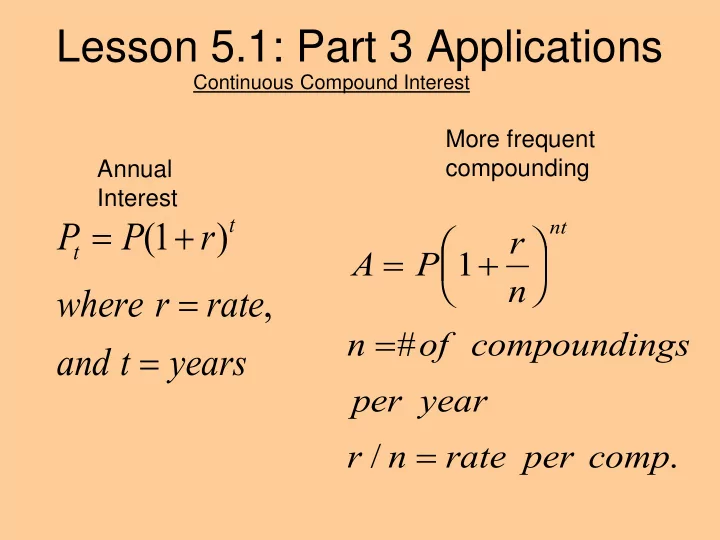
Lesson 5.1: Part 3 Applications
P P r where r rate and t years
t t
( ) , 1
Continuous Compound Interest
Annual Interest More frequent compounding
A P r n n
- f compoundings
per year r n rate per comp
nt
F H G I K J
1 # / .
F I t P P ( 1 r ) nt G J r t H K A P 1 n - - PowerPoint PPT Presentation
Lesson 5.1: Part 3 Applications Continuous Compound Interest More frequent compounding Annual Interest F I t P P ( 1 r ) nt G J r t H K A P 1 n where r rate , n # of compoundings and
Lesson 5.1: Part 3 Applications
P P r where r rate and t years
t t
( ) , 1
Continuous Compound Interest
Annual Interest More frequent compounding
A P r n n
per year r n rate per comp
nt
1 # / .
For Continuous Compounding
Ex 8: A total of $12,000 is invested for 5 years at an annual interest rate of 9%. Find the balance if it is compounded a.Quarterly b.Monthly c.Continuously
P = $12,000 r = 9% t = 5 years Quarterly Monthly
P
5 4 5
12000 1 09 4
.
( )
P
5 20
12000 1 0225 .
P
5 20
12000 10225 .
P
5
11 $18726. P
5 12 5
12000 1 09 12
.
( )
P
5 60
12000 1 0075 .
P
5 60
12000 10075 .
P
5
17 $18788.
A P r n
nt
F H I K
1
A P r n
nt
1
P = $12,000 r = 9% t = 5 years Continuously
A Pert A e 12000
09 5 . ( )
A e 12000
45 .
A $18819.75
Ex 9: The half-life of the radioactive decay rate of the plutonium that spread across Chernobyl, in 1986, in the former Soviet Union, can be modeled using the function
Radioactive Decay
P
t
F
10 1 2
24 360 / ,
where P is the amount of an original 10 lbs of plutonium remaining after t years. If t = 0 represents 1986, how much plutonium is left in 2005? How much plutonium would be left after 24,360 year? 100,000 years?
(extra writing space)
Homework: p373 #51-57 odd
2005 = 19 years
P F
10 1 2
19 24360
P lbs 9 99 .
After 24,360 years
P F
10 1 2
24360 24360
P F
10 1 2
1
5lbs
After 100,000 years
P F
10 1 2
100000 24360 0 58
. lbs