F ARMLAND L EASING AND ISU Extension Farm Management Team L AND V - - PowerPoint PPT Presentation

f armland l easing and
SMART_READER_LITE
LIVE PREVIEW

F ARMLAND L EASING AND ISU Extension Farm Management Team L AND V - - PowerPoint PPT Presentation

F ARMLAND L EASING AND ISU Extension Farm Management Team L AND V ALUES 2014 Melissa ORourke B.S., M.A., J.D. Farm & Agribusiness Management Specialist www.extension.iastate.edu/agdm morourke@iastate.edu 712-737-4230 The Goal?


slide-1
SLIDE 1

1

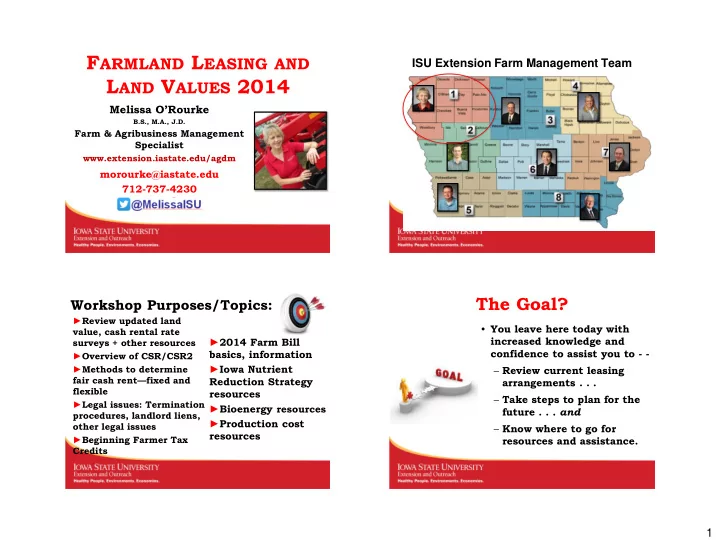
FARMLAND LEASING AND LAND VALUES 2014

Melissa O’Rourke

B.S., M.A., J.D.

Farm & Agribusiness Management Specialist

www.extension.iastate.edu/agdm

morourke@iastate.edu 712-737-4230

ISU Extension Farm Management Team

Workshop Purposes/Topics:

►Review updated land value, cash rental rate surveys + other resources ►Overview of CSR/CSR2 ►Methods to determine fair cash rent—fixed and flexible ►Legal issues: Termination procedures, landlord liens,

  • ther legal issues

►Beginning Farmer Tax Credits

►2014 Farm Bill basics, information ►Iowa Nutrient Reduction Strategy resources ►Bioenergy resources ►Production cost resources

The Goal?

  • You leave here today with

increased knowledge and confidence to assist you to - - – Review current leasing arrangements . . . – Take steps to plan for the future . . . and – Know where to go for resources and assistance.

slide-2
SLIDE 2

2

Let’s get familiar with your Farmland Leasing Arrangements book!

Table of Contents:

inside front cover – Use bold page #s at bottom of the page.

  • 1-25: Resources
  • 26-29: Nutrient

Reduction Strategies

  • 30-61: Surveys
  • 62-69: Worksheets
  • 70-91: Data
  • 92-95: Sample forms
  • 96: Glossary
  • 99: Contact info

www.extension.iastate.edu/agdm

Get familiar with Ag Decision Maker!!

slide-3
SLIDE 3

3

What is the Iowa Nutrient Reduction Strategy?

  • Voluntary, science-based program to reduce

Nitrogen and Phosphorous impact on water

  • Includes cities, industry and agriculture
  • A practice-based approach to show

meaningful and measureable progress

  • A framework for innovation and verification of

new practices and technologies

Why? And why now?

  • Iowa’s productive soils and cropping systems

also contribute to water quality concerns

  • Society and EPA expect more from cities,

industry and agriculture

  • Gulf Hypoxia Task Force requires plan to reduce

N and P load to Gulf of Mexico by 45%

  • EPA requests strategy that emphasizes state

implementation of new and existing N and P practices for point and non-point sources

slide-4
SLIDE 4

4

Iowa Nutrient Management Strategy: Cost Share Program

►$20 M of new state appropriations over 2013-14. ► Administered by Iowa Department Agriculture & Land Stewardship (IDALS) and Iowa Department of Natural Resources (IDNR); research by Iowa State University. ► Contact: Soil & Water Conservation District Office ► $1.4 M in cost-share funds available for Fall 2014 (farmers must match): Cover Crops - $25/A Adopt no-till or strip-till - $10/A Use of Nitrification Inhibitors on fall applied anhydrous ammonia - $3/A.

  • Pg. 26-29, Farm Leasing Arrangements, July 2014

See page 26 in your Farmland Leasing book for a publication on the Iowa Nutrient Reduction Strategy.

Crop Conditions Information

Where to find it?—when you’re not there to look at the crop?!?

In 2012 at this time – things looked different!

slide-5
SLIDE 5

5

In 2013, we had moisture deficits in northwest Iowa: This year in Iowa (2014) . . . things look better.

slide-6
SLIDE 6

6

Where to find that weekly USDA Report?

www.nass.usda.gov/Statistics_by_State/Iowa/Publications/Crop_Progress_&_Condition/index.asp www.nass.usda.gov = the USDA’s National Agricultural Statistics Service

Just Google - - - > USDA NASS

Bioenergy and Crop Residue

Leased Land: Who owns above-ground

residue – Landowner or Tenant?

  • Above-Ground Residue: Iowa Code 562.5A

– Tenant has right to take part of a harvested crop’s above ground plant, such as corn stover and other crop residue – at harvest, after harvest, until termination of tenancy. – Written lease may have language to alter rule.

Questions to ask . . . .

  • Do you want to get into

the corn stover harvesting business?

  • Would you rather

custom contract with someone else to do the harvest?

  • Think about all the

costs, benefits, risks

slide-7
SLIDE 7

7

Ag Decision Maker File A1-70

  • - - - - - -

Contains 8 examples related to pricing stover

This blank interactive spreadsheet is a free tool on Ag Decision Maker.

slide-8
SLIDE 8

8

Read, review, question any written contract presented to you:

  • What are you committing to

provide/deliver?

  • When?—Delivery dates?
  • Price?—set, or determined

by a formula?

  • When will you be paid?—and

is there a penalty for late payment by the buyer?

  • What if you can’t deliver, e.g.,

due to wet fall weather?

  • Other provisions?

Example: Quality requirements in the contracts? http://poet-dsm.com/biomass

Under what circumstances can your delivery be docked or rejected?

Example: Financial penalties in the contracts http://poet-dsm.com/biomass Before you sign a legally binding contract . . . .

  • Have the contract reviewed

by your attorney who is familiar with agricultural

  • perations.
  • Be sure you understand

what you are committing to . . . What are your

  • bligations as seller . . . and

what are the obligations of the buyer?

slide-9
SLIDE 9

9

slide-10
SLIDE 10

10

Example: Calculating Cash Rent Tax Credit

  • 160 acres cash rented
  • $300 per acre
  • $48,000 gross lease

income

  • $48,000 x 7% = $3360

Iowa income tax credit

  • Can be used for flexible

& crop-share leases too.

slide-11
SLIDE 11

11

For More Information and to Apply:

  • See 4-page application at:
  • IowaFinanceAuthority.gov
  • Beginning farmer’s

financial statement

  • Beginning farmer’s

background letter

  • Fees =
  • $200 application fee plus:
  • $50 service fee for each

year of cash lease

  • $100 service fee for each

year of crop share lease

The New 5-Year Farm Program (2014-2018) What do we know?

Marketing Loan National Rates: $1.95/bu Corn $5.00/bu Soybeans Source: The Agricultural Act of 2014, February 2014

Web Sites on the New Farm Program

  • ISU Polk County Ext. Farm Management

(Government Farm Programs: FAQs, Fact Sheets, Regular Updates, Videos and Recorded Webcasts) www.extension.iastate.edu/polk/farm-management

  • Farm Doc – U. of Illinois Ext. Economics

www.farmdoc.illinois.edu

  • Ag Manager – K-State Ext. Economics

www.agmanager.info

  • Ag Decision Maker – ISU Ext. Economics

(Farm Program Decision Tool, Newsletters, Publications, Voiced Media, Monthly e-Newsletter, New Farm Program) www.extension.iastate.edu/agdm/info/farmbill.html

  • USDA Farm Service Agency

www.fsa.usda.gov/FSA/webapp?area=home&subject=arpl&topic=landing

Source: Johnson, ISU Extension, July 2014

slide-12
SLIDE 12

12

ARC PLC Decisions: The 3 Step Process

Once Election has been completed then Enrollment by the “party at risk” occurs

  • annually. Sign-up for both the 2014 and 2015

crops will run concurrently in early 2015. The farmland owner and the farm operator can “reallocate” base acres and/or “update” CC Yields by FSA farm number. Once Base Acres and Yields are determined for that farm, then the Election of the ARC or PLC program is established for the 5-year period 2014-2018.

Source: Johnson, ISU Extension, July 2014

WHEN will these updating, election and enrollment events happen?

slide-13
SLIDE 13

13

  • The first part of August, all owners and
  • perators will receive the following:

1. Letter that provides basic background of base acreage “Reallocation” and “Update” of the CC Yield option. 2. “Summary Acreage History Report” which shows the acreage of covered commodities reported to FSA, 2008 through 2012 per farm. NOTE: This report also includes the “Base Acres” and “CC Yield” as of 9/30/2013.

Summary Acreage History Report

Source: McClure, Iowa FSA Office, July 2014

Reallocating Base Acreage

Farm Historic: 100 Total Base Acres

Corn 50 Acres Soybeans 50 Acres

Source: Johnson, ISU Extension, July 2014

Base Acreage Reallocation

Example #1

Corn Soybeans Total

Corn 65 Acres

Soybeans 35 Acres

Source: Johnson, ISU Extension, July 2014

slide-14
SLIDE 14

14

Corn Soybeans Total

Base Acreage Reallocation

Example #2

Corn 75 Acres

Soybeans 25 Acres

Source: Johnson, ISU Extension, July 2014

  • 1. Retain the Farm’s Current CC Yield
  • r
  • 2. Update Yield (90% of Planted Yield history)

Uses production and total acres planted of covered commodities, 2008 – 2012, using a simple average. A plug yield of 75% of the county yield for any year with low or missing farm’s yield.

Note: This option is available per Crop for landowners and operators regardless of program election: PLC, ARC-CO or ARC-IC.

Source: McClure, Iowa FSA Office, July 2014

Farm’s Yield Update Choices

What’s Corn Suitability Rating?

  • An index that rates a parcel of land –

the soil types in particular– based on productivity for row-crop production.

  • Values range from 100 to 5 pts/acre.
  • Assumes adequate management,

natural weather, artificial drainage where needed, no frequent flooding, no land leveling or terracing.

  • High CSR = theoretically high land

productivity for row crop production.

  • Just one factor for setting rental rate.

Learn more about CSRs:

  • www.extension.iastate.edu/agdm
  • Understanding Iowa CSRs – File C2-86
  • Computing CSR for Your Farm – File C2-87
  • Original CSR explanation:

http://www.extension.iastate.edu/Publications/PM1168.pdf

  • Website for the official NRCS published soil survey (The Web Soil

Survey) is: http://websoilsurvey.nrcs.usda.gov/app/HomePage.htm

  • The Iowa Soil Properties and Interpretations Database (ISPAID):

http://www.extension.iastate.edu/soils/ispaid

  • 40-Slide Presentation on CSR2:

www.ucs.iastate.edu/mnet/_repository/2013/soilmanagement/pdf/burr as.pdf

  • CSR2 Explanation document:

www.extension.iastate.edu/page/sites/www.extension.iastate.edu/file s/page/CSR2%20FAQ%20Final.pdf

slide-15
SLIDE 15

15

Why did CSR need to change?

  • 1. Philosophical goal: To get

values proportional to CSR but with greater transparency, consistency & ease.

  • 2. Technical goal: To have CSR2

consistent with today’s soil mapping, classification, and government programs.

  • 3. Ancillary goal: To extend CSR2

across boundaries.

How might CSR2 change the CSR for my land? It depends on the soil types.

SMU Soil Name CSR CSR2 8B Judson silty clay loam, 2 to 5 percent slopes 82 94 9 Marshall silty clay loam, 0 to 2 percent slopes 90 100 9B Marshall silty clay loam, 2 to 5 percent slopes 85 95 9C2 Marshall silty clay loam, 5 to 9 percent slopes, moderately eroded 68 87 9D2 Marshall silty clay loam, 9 to 14 percent slopes, moderately eroded 58 64 11B Ackmore-Colo-Judson complex, 2 to 5 percent slopes 68 75 99C2 Exira silty clay loam, 5 to 9 percent slopes, moderately eroded 65 87 99D2 Exira silty clay loam, 9 to 14 percent slopes, moderately eroded 55 64 222C2 Clarinda silty clay loam, 5 to 9 percent slopes, moderately eroded 25 43 222D2 Clarinda silty clay loam, 9 to 14 percent slopes, moderately eroded 10 20 822D2 Lamoni clay loam, 9 to 14 percent slopes, moderately eroded 15 13

slide-16
SLIDE 16

16

Where do I find my CSR2 rating? (use these on-line tools):

ISPAID WebSoilSurvey

When & how will CSR2 be used by assessors?

  • Soonest?—2015, required by 2017.
  • CSR2 will be used same way CSR is used now, along with soil maps, to

equalize tax assessments on agricultural land.

  • Iowa Code requires that farmland assessments be based on

productivity and net earning capacity.

  • County assessors use CSR as the measure for determining

productivity of each parcel of land within the county where the tract is located and spreading the valuation across all parcels.

  • Formula starts with average productivity value per acre in each county

as set by the Iowa Department of Revenue. That value is taken times the total taxable acres of farmland in the county.

  • Total taxable farmland value for each county is divided by total CSR

points for that county to determine the value of each CSR point.

  • Value of each CSR point is then multiplied by the average CSR for

individual tracts of farmland to equalize the value per acre based on inherent productivity.

Is CSR2 being used in your county?

  • Ask your County Assessor!
  • According to the Iowa Department of Revenue,

implementation of the official NRCS Soil Survey with CSR2 is required for all Iowa county assessors in 2017.

  • We do not know what each county tax assessor will do

with CSR2 between now and then.

  • They base their assessments on ISPAID data.
  • Each county may work with soil ratings differently until

2017 so please check with your local assessor regarding any updates or changes to their property tax assessments using CSR/CSR2.

Six Key Sources

  • f

Iowa Farmland Value Data

slide-17
SLIDE 17

17

(1) County Assessors’ Offices

  • Some county assessors maintain a public (pdf)

document of ag land sales – for example:

  • www.siouxcounty.org/pdf/assessor/agsales.pdf
slide-18
SLIDE 18

18

www.siouxcounty.org/pdf/assessor/agsales.pdf

www.siouxcounty.org/pdf/assessor/agsales.pdf www.siouxcounty.org/pdf/assessor/agsales.pdf

(2) Realty & Auction Sites

slide-19
SLIDE 19

19

(3) Federal Reserve Bank—Chicago

  • www.chicagofed.org

– Quarterly survey of ag lenders by state – Annual Land Values Conference – AgLetter: Quarterly Newsletter re: ag land values & credit – Go to chicagofed.org and click on publications

Federal Reserve Bank: May 2012

slide-20
SLIDE 20

20

Federal Reserve Bank: May 2013 Federal Reserve Bank: May 2014

(4) Realtors Land Institute

–See your book – at page 35 –Semi-annual survey (March and September) –Compares land classification by corn production –Most recent survey always available on Ag Decision Maker –www.extension.iastate.edu/agdm

Realtors Land Institute – April 2014

slide-21
SLIDE 21

21

(5) Farm Credit Services

Benchmark Farm Appraisals

  • FCSA monitors real estate value

trends through semi-annual appraisals of 66 farms in 4 states

  • 21 benchmark farms in Iowa
  • Approximately 65 appraisers update

the values on Jan 1st & July 1st.

  • As of January 2011, they had

analyzed 13,700 sales in Iowa over the past 5 years.

Farm Credit Services

Benchmark Farm Values

as of January 1, 2012 # of Benchmark Farms shown in parenthesis

  • State 6-Month 1-Year 5-Year 10-Year
  • Iowa (21): 14.8% 34.0% 113.2% 257.7%
  • Neb (20): 28.2% 43.4% 128.0% 225.7%
  • SoDak (23): 10.0% 19.4% 84.8% 262.6%
  • Wyom (2): 0.0%
  • 1.1% 19.6% 105.6%

Farm Credit Services

Benchmark Farm Values

as of January 1, 2013 # of Benchmark Farms shown in parenthesis

  • State 6-Month 1-Year 5-Year 10-Year
  • Iowa (21): 13.8% 20.8% 109.5% 303.1%
  • Neb (20): 12.3% 30.7% 150.3% 313.3%
  • SoDak (23): 17.6% 32.7% 99.1% 328.5%
  • Wyom (2): 0.0% 1.1% -5.9% 95.7%

Farm Credit Services

Benchmark Farm Values

as of January 1, 2014 # of Benchmark Farms shown in parenthesis

  • State 6-Month 1-Year 5-Year 10-Year
  • Iowa (21): -0.9%
  • 3.7% 103.0% 245.5%
  • Neb (18): 1.5%

2.2% 143.6% 314.7%

  • SoDak (23): 5.8% 13.6% 117.2% 332.7%
  • Wyom (2): 5.8% 9.5% 7.8% 68.6%
slide-22
SLIDE 22

22

(6) Iowa State University Farmland Value Survey

– Directed by Dr. Michael Duffy (since ‘82) – Conducted annually since 1941 – Mailed to 1100 licensed real estate brokers; 500-600 responses – Released annually in mid-December – November 1 to November 1 – Latest and historical surveys found on Ag Decision Maker website – www.extension.iastate.edu/agdm

SEE YOUR BOOK – page 30

SUMMARY—Highlights (of results released December 2013):

  • 5.1% increase is 9th out of last 10 years
  • Except for 2009 (economic “crash” year) – first

single-digit increase since 2003

  • Rate of increase slowed throughout the year,

mimicking drop in crop prices

  • Northwest Iowa showed actual declines in value
  • Gross farm income will be the factor to

watch for future directions

2013 AVERAGE VALUES

slide-23
SLIDE 23

23

slide-24
SLIDE 24

24

Statewide Average

$8,716

up 5.1% up $420

High Grade Land

$10,828

up 6.3% up $646

Medium Grade Land

$8,047

up 3.5% up $274

slide-25
SLIDE 25

25

Low Grade Land

$5,298

up 3.5% up $179

AVERAGE VALUES

all grades 1950−2013

$0 $1,000 $2,000 $3,000 $4,000 $5,000 $6,000 $7,000 $8,000 $9,000 1950 1960 1970 1980 1990 2000 2010

AVERAGE VALUES

adjusted for inflation

$- $1,000 $2,000 $3,000 $4,000 $5,000 $6,000 $7,000 $8,000 $9,000 $10,000 1950 1960 1970 1980 1990 2000 2010

Inflation adj values

WHO PURCHASED

farmland

Investors 18% Existing Farmers 78% New Farmers 3% Others 1%

slide-26
SLIDE 26

26

Farm Leases: A Few Basics Farm Lease Goals

  • Determine goals for each

party

– Production – Highest potential return – Fair return to each party – Continuity of income – Risk minimization – Conservation – Stewardship – Farm transition – Other possible goals, considerations?

Why should a farm lease be written?

  • A lease of more than one

year must be in writing to be enforceable.

  • A lease of 5 years or more

must be in writing and recorded at the county recorder’s office.

  • A written lease provides

assurance that the parties understand one another.

Shouldn’t a handshake be good enough?

  • Don’t rely on selective memory.
  • Be sure that you cover all the

provisions that you intend to cover.

  • Define meaning of terms.
  • Put things in writing because you

value the relationship . . . and because you don’t want there to be any misunderstandings later!

slide-27
SLIDE 27

27

An Example . . . .

  • “You’ll take care
  • f the fencing,

right?”

  • “Sure, you bet.”
  • What did they

just agree to???

A Few Farmland Legal Issues

  • Iowa One-Call – applies to farm land
  • Above-Ground Residue: Iowa Code

562.5A

– Tenant has right to take part of a harvested crop’s above ground plant, such as corn stover and other crop residue – at harvest, after harvest, until termination of tenancy. But a written lease may have language to alter this rule.

  • Mowing: Iowa Code 314.17

– blogs.extension.iastate.edu/agdm/ -- June 24

Assuring the Rent is Paid

  • How can

parties assure

  • ne another

that the rent will be paid? First Step? -- Use a written lease.

And, be sure that: (1)The legal description and parcel number in the lease is accurate. (2) The parties to the lease are properly identified. (3) The lease terms are clear.

slide-28
SLIDE 28

28

Additional tools to assure rent payment may include:

  • Require all rent paid on March 1.

(Reduction for interest paid by the borrower may be a consideration.)

  • Require irrevocable letter of credit

from the Producer/Tenant’s lender.

  • Require the Landlord’s name be

included as Payee on checks for crops.

  • File and perfect a Landlord Lien—

this includes recording the lease.

A Landlord’s Lien can be created by including language in a written lease.

  • See Ag Decision

Maker File C2-12 and in your Farmland Leasing Book.

  • Let’s look at the

language 

OWNER’S LIEN AND SECURITY INTEREST. The Operator acknowledges that a statutory Landlord’s Lien exists in favor of the Owner. The Operator grants to the Owner a security interest on, but not limited to, all growing or mature crops on the Real Estate as provided in the Iowa Uniform Commercial Code. The Operator shall sign security agreements and financing statements as requested by the Owner to perfect the Owner’s security interests. At Owner’s request, the Operator shall provide the Owner a list of potential buyers for the crops grown on the farm. The Operator agrees to deliver and sell such crops only to those buyers listed. The Owner shall deliver a Notice of Security Interest to those buyers and only those buyers listed. The Operator shall not sell such crops to any buyer not listed without first obtaining written consent of the Owner.

Should you “do it yourself”?

  • Just having the language in the lease is not enough.
  • Creation, filing and perfection of a Landlord Lien is a

complicated legal procedure involving intricacies of Iowa law (Iowa Code ch 570 and related sections) and Uniform Commercial Code (UCC) (Iowa Code ch 554).

  • Owner-Landlords who wish to do this may find it

advisable to hire an attorney to be certain that all legal documents and procedures are correctly followed.

slide-29
SLIDE 29

29

See also: “Iowa Farm Leases—Legal, Economic and Tax Considerations”

  • Pages 3-4 of this

article included in your Farmland Leasing Book include discussion of the Landlord’s Lien and security interests.

Lease Components - Terminology

  • Term = length of lease

– Tenancy for years – Periodic tenancy (set period – year to year) – Tenancy at will

  • Rental rate/lease
  • Land use
  • Repair and improvements
  • Records and accounts
  • Right to entry
  • Signature

Terminology continued . . . .

  • Land Use – desired use of land by landlord

– Soil fertility – Number of livestock per acre – Types of crops planted – Where specific crops are planted – Weed prevention, treatment – Conservation methods – Fertilizer application rates – Removal of minerals, gravel, etc.. – Environment protection – soil erosion, care of permanent crops, and structures

Terminology continued . . . .

  • Repair and Improvements

– Who will make necessary improvements – How they will be made – Who will pay for improvements

  • Records or Accounts

– Production (yield and price) – Inputs

  • Right to Entry

– Tenant may treat any person who sets foot on the property as a trespasser; statement to provide landlord with right of entry

slide-30
SLIDE 30

30

Reports: Annual or Periodic ?

►More farmland owners are requiring a written annual report as a condition of the lease. ► The owner agrees that any information provided by the tenant-producer (such as yields, management practices) are kept confidential. ► This is propriety business information, and the parties need to share it to negotiate lease terms – but it is not to be shared in the “coffee shop.”

Farm Lease Termination

Does termination mean the end

  • f the Owner–Tenant

relationship?

  • Does termination

mean the Owner wants a new Tenant?

  • No, not necessarily

– but it means the Owner wants to make some changes for the next year.

slide-31
SLIDE 31

31

Lease Termination: The Right Way

  • Lease can be terminated by

mutual agreement

  • Written lease may contain

provisions for termination procedure

  • Serve written notice on or

before September 1st

  • See page 95: Current lease

terminates on following March 1st

  • Serve in person, or by US Mail,

Certified with Return Receipt

2013 Legislative Updates

► Past: Iowa statute did not require written termination notice on parcels of less than 40 acres. ► Now: Iowa Code 562.5 requires a written termination notice on all parcels regardless of size. ► If proper written notice is not provided by September 1, the lease automatically continues on the same terms and conditions as the original agreement.

Exception: Animal Feeding Operations

  • If primary use of a rented

acreage of less than 40 acres is for an animal feeding

  • peration, written notice

requirement does not apply.

  • “Mere cropper” exception

remains – essentially refers to someone hired (as an employee or custom operator) to plant/harvest the crop.

Land Holder Liability

  • 2013 Legislature added phrase

“Educational activities” to Iowa Code 416C -- included in list of recreational purposes for which Iowa landholders have protection from liability.

  • So, if land holder desires to

hold a school farm tour, the code provides some protection from liability.

slide-32
SLIDE 32

32

Determining Farmland Cash Rents – Fixed, Flexible and

  • ther Arrangements

2014 Iowa Cash Rental Rate Survey

William Edwards, Extension Economist

2014 Survey Methods & Responses

  • Sent out over 6,000 surveys
  • 1,674 county observations received

Farmers, 50% Landowners, 25% Prof. Managers, 7% Ag Lenders, 15% Other, 3%

Timing and Purpose

  • Questionnaires sent out in March
  • Summary ready in May

Purpose: provide information to tenants and landlords to use as a starting point for estimating a fair cash rent.

slide-33
SLIDE 33

33

Questions Asked:

  • “What do you think typical cash rental rates

are in your county?”

  • Half paid in advance, half after harvest?

Other?

  • For corn and soybean land

– High 1/3, medium 1/3, low 1/3 productivity – Based on farm yields reported to NASS

  • Oats, hay, pasture, cornstalks, hunting

Iowa Land Value & Cash Rental Rate Trends

Source: Duffy & Edwards, ISU Extension Econ, December 2013, May 2014

Most Recent Averages 2014 Cash Rent: $260/A 2013 Land Value: $8716/A $270 $270 $277 $288 $284 $273 $249 $202 $229

Average Cash Rental Rates for Cropland

  • Pg. 38, Farm Leasing Arrangements, July 2014

Rent per Bushel, CSR2 Index Point

Crop Reporting District Rent per bushel of corn yield* Rent per bushel

  • f soybean

yield* Rent per CSR index point** NW $1.51 $5.38 $3.10 NC $1.60 $5.69 $3.22 NE $1.62 $5.49 $3.44 WC $1.74 $6.00 $3.65 C $1.73 $5.72 $3.30 EC $1.65 $5.26 $3.34 SW $1.64 $5.37 $3.12 SC $1.74 $4.93 $2.58 SE $1.70 $4.96 $2.85 *Based on 5-year average county yields, NASS **new CSR2 values

  • Pg. 39-48, Farm Leasing Arrangements, July 2014
slide-34
SLIDE 34

34

Oats, Hay, Hunting Rights Average Rents

Crop Reporting District Alfalfa Grass Hay Oats Hunting Rights NW $219 $163 $223 $27 NC $208 $138 $197 NA NE $265 $202 $235 $8 WC $222 $172 $214 $12 C $186 $138 $167 $11 EC $213 $167 $170 $13 SW $134 $111 $108 $18 SC $111 $ 83 $118 $13 SE $161 $112 $141 $13

  • Pg. 39-48, Farm Leasing Arrangements, July 2014

Pasture, Corn Stalk Grazing Average Rents

Crop Reporting District Improved Pasture Unimproved Pasture Pasture per AUM Corn stalk Grazing NW $82 $57 NA $11 NC $71 $50 NA NA NE $75 $47 $16 $9 WC $84 $57 NA $7 C $71 $53 NA $20 EC $83 $56 $24 $9 SW $86 $61 $20 $18 SC $71 $47 $25 $10 SE $74 $42 NA $18

  • Pg. 39-48, Farm Leasing Arrangements, July 2014

Farm Leasing Arrangements have changed

  • ver the

years

(US Census of Agriculture)

Distribution of Leased Farmland by Type of Lease

  • Pg. 54-61, Farm Leasing Arrangements, July 2014
slide-35
SLIDE 35

35 Leased Farmland: Importance of Various Tenant Characteristics

  • Pg. 39-48, Farm Leasing Arrangements, July 2014

90 110 130 150 170 190 210 230 250 270 $ per acre Crop Share Cash Flex Rent

Comparing Crop Share, Cash and Flex Rents

Source: Edwards, ISU Extension Econ, May 2013

Cash Rent as % of Gross Crop Revenue

Iowa Average Yield x Oct.-Dec. Cash Price

Mean = 38% Mean = 25%

Blended Avg. = 33%

  • Pg. 66-68, Farm Leasing Arrangements, July 2014

Other Factors

  • Fertility and drainage
  • Size and shape of fields, % tillable
  • USDA program bases and yields
  • Local grain prices and basis
  • Seed production contracts
  • Manure application contracts
  • Longevity of lease
  • “Extras” done by tenant
slide-36
SLIDE 36

36

Iowa Farm Land Rented

20%

Decatur

22%

Davis

24%

Appanoose

26%

Clarke

26%

Lucas

27%

Ringgold

27%

Wayne

28%

Allamakee

28%

Monroe

30%

Dubuque

31%

Clayton

32%

Van Buren

33%

Jefferson

34%

Mahaska

35%

Jackson

36%

Taylor

36%

Wapello

36%

Adams

37%

Marion

37%

Keokuk

37%

Lee

37%

Warren

37%

Union

38%

Winneshiek

39%

Henry

40%

Iowa

40%

Washington

42%

Delaware

45%

Madison

45%

Jones

46%

Louisa

46%

Page

46%

Adair

46%

Poweshiek

47%

Johnson

48%

Guthrie

48%

Fayette

48%

Howard

50%

Des Moines

50%

Cass

50%

Chickasaw

51%

Bremer

51%

Muscatine

51%

Montgomery

53%

Tama

53%

Linn

53%

Mills

54%

Buchanan

55%

Jasper

55%

Audubon

56%

Marshall

56%

Black Hawk

57%

Plymouth

57%

Carroll

57%

Mitchell

57%

Benton

57%

Worth

57%

Harrison

57%

Butler

58%

Kossuth

58%

Clinton

58%

Woodbury

58%

Floyd

59%

Cedar

59%

Scott

60%

Fremont

60%

Pottawattamie

61%

Winnebago

61%

Cherokee

61%

Lyon

61%

Hardin

62%

Story

62%

Dallas

63%

Shelby

63%

Ida

63%

Sioux

63%

Cerro Gordo

63%

Crawford

64%

O'Brien

64%

Webster

64%

Franklin

64%

Calhoun

64%

Emmet

65%

Greene

65%

Boone

65%

Polk

65%

Buena Vista

65%

Sac

65%

Monona

65%

Dickinson

66%

Osceola

67%

Grundy

67%

Hamilton

67%

Wright

67%

Humboldt

68%

Pocahontas

69%

Clay

70%

Hancock

70%

Palo Alto

0% to 40% 40% to 50% 50% to 60% 60% to 75%

Source: Iowa Land Tenure Survey, Duffy, ISU - 2007

Common Types of Farmland Leases

  • Descriptions of

these basic types

  • Advantages,

Disadvantages

  • How-to’s,

Examples

  • Resources

Risk Reward

Custom Farm Crop Share Net Revenue Share Cash Rent (Fixed or Flexed) Cash Rent (Fixed or Flexed) Net Revenue Share Crop Share Custom Farm

What is the Best Type of Farm Lease?

FIXED CASH LEASE

  • Tenant pays a fixed

amount of cash rent per acre per year

  • Terms may include

restrictions on crops, tillage, conservation, pest control practices

  • Otherwise, Tenant

makes decisions, receives all revenue

slide-37
SLIDE 37

37

Advantages/Disadvantages

  • Simple, fewer

misunderstandings

  • Little financial risk for

Owner, Tenant bears all risk

  • Owner relieved of day-to-

day decisions, Tenant has maximum freedom

  • Fewer records necessary
  • Frequent rate negotiation
  • Tenant needs more
  • perating capital

Fixed Cash Lease – Determining a “Fair” Rental Rate

Computing Cropland Cash Rental Rate

  • Book – page 62
  • Bases may include:

– What others are charging – Average rent for production (yields) – Average rent for CSR – Return on Value – Other flexible methods

Do Your Farmland Fact Finding

  • 1. Land value estimate for tillable acres

($/acre)

  • 2. Number of Tillable Acres (If you don’t know,

check county USDA FSA Office: Form 578 completed annually)

  • 3. Corn Suitability Rating? (CSR/CSR2) (See

County Assessor's Office or NRCS Soil Survey)

  • 4. Special features? Drainage issues,

irregular field shapes (See tile, terrace maps,

aerial photos)

  • 5. Most recent 5-Year Actual/Average Yields
  • n that farm (Corn & Soybeans).

Source: Johnson, ISU Extension, May 2011

slide-38
SLIDE 38

38

Method #1: What’s the “going” rate?

  • Rumors often inaccurate.
  • Compare to many others,

not just one

  • Remember, seemingly

small differences in land quality can make a big difference in appropriate rents. Location: Sioux County Tillable Acres in parcel: 75 Acres Corn Yield: 175 bu/Acre Soybean Yield: 50 bu/Acre These are the yields on that farm/parcel. Corn Suitability Rating: 91 CSR2

Let’s take an Example . . . .

►Start at page 37, then go to appropriate District page (1, 2, etc) ►Example parcel is in Sioux – page 39 ►Determine Overall as well as High, Middle, Low averages for county ►Determine where your parcel fits ►Select an appropriate figure from the survey information ►Note on “Example” parcel – CSR is high, but yields a little below average.

Method #1: Typical Cash Rent

p 39

slide-39
SLIDE 39

39

Method #1: Typical Cash Rent . . . continued . . . .

  • “Example” parcel – CSR2 (91) is higher

than county average (89); but yields (175 & 50) are a little lower than county average (183-corn; 55-beans).

  • Sioux County “high quality” rent is $352,

medium quality rent is $292.

  • Average ($352 + $292) / 2 = $322
  • We’ll use $322 as a “typical” rent for this

parcel, based on the ISU survey.

p 39

Method #2: Average Rents per Yield (corn & beans)

  • Corn Yield calculation
  • Parcel’s average corn yield = 175 bu/A
  • Times rent per bushel of Corn yield

$ 1.58

  • Average Rent for Corn Acres:

$ 276.50

– 175 X $1.58 = $276.50

  • Soybean Yield calculation
  • Parcel’s average bean yield = 50 bu/A
  • Times rent per bushel of bean yield $ 5.25
  • Average Rent for Bean Acres:

$ 262.50

– 50 X $5.25 = $262.50

Method #2: Average the corn & bean calculations 

  • Average Rent for Corn Acres:

$ 276.50

  • Average Rent for Bean Acres:

$ 262.50

  • ($276.50 + $262.50) / 2 = $269.50 ($270)
  • Average Rent, Corn & Soybean Acres: $270
slide-40
SLIDE 40

40

Method #3: Corn Suitability Rating calculation

  • Corn Suitability Rating calculation
  • Parcel’s CSR = 91
  • Times rent per CSR index point $ 3.25
  • Average Rent for Corn Acres:

$ 388.68

– 91 CSR X $3.25/CSR point = $295.75 ($296)

– Rent based on CSR only = $296

p 39

Method #4: Rent based on Return on Value/Investment

  • Market value of

cropland/parcel = $/acre

  • Sioux County average:

$12,296 (ISU Survey-Dec 2013)

  • “My” Parcel value = $13,000
  • “My” Desired return on

value = 4.1%

  • $13,000 X 4.1% =

$533/acre

Source: ISU Extension Publication FM-1851

Average first three (3) Methods:

Method 1: Typical Cash Rent $ 322 Method 2: Average Rents per yield $ 270 Method 3: Average Rents per CSR Point $ 296 Average $296 /acre $296 per acre X 75 Tillable Acres = $22,200

Overall Average Method

slide-41
SLIDE 41

41

Source: ISU Extension Publication FM-1851

Average of all 4 Methods

Method 1: Typical Cash Rent $ 322 Method 2: Average Rent per yield $ 270 Method 3: Average Rent per CSR Point $ 296 Method 4: Return on Investment/Value $ 533 Average $355.25 /acre

$355.25 /A X 75 Tillable Acres = $26,643.75

Overall Average Method

See p37 in Leasing book:

Consider Costs of Production—let’s look at page 76 in your Farmland Leasing Book.

FLEXIBLE CASH LEASE

  • Actual rent paid depends
  • n actual yields attained

and selling prices during lease period.

  • Owner shares some risk
  • f low yields, declining

prices

  • Owner shares in “extra”

profits

  • May take into account

crop input costs

Why a Flexible Cash Lease?

  • Rent reflects the farm’s actual yields and

cash prices available at harvest (Gross Crop Revenue)

  • Risk of revenue changes can be shared

between the owner and tenant-producer.

  • Landowner can be guaranteed a base rent,

plus a bonus based on a % of the farm’s net revenue per acre (by crop rotation, tillage, yield)

  • Tenant gets to reflect higher crop input costs
  • Most flex leases are multi-year.
  • Pg. 66-68, Farm Leasing Arrangements, July 2014
slide-42
SLIDE 42

42

Risk Reward

Custom Farm Crop Share Net Revenue Share Cash Rent (Fixed or Flexed) Cash Rent (Fixed or Flexed) Net Revenue Share Crop Share Custom Farm

Risk-Reward Trade-off in Farmland Leasing

Source: ISU Extension Farm Management, July 2012

Determining Input Costs?

  • See cost estimates in your Farmland

Leasing book for different cropping plans/rotations – start at page 76.

  • Owner & tenant can agree to use these
  • averages. Released annually in January.
  • More information available on Ag Decision

Maker: www.extension.iastate.edu/adgm

  • Owner & tenant can also figure actual

costs based on decisions, local information (from coop, suppliers)

Total Cost Expected Yield bu/A Cost Per Bushel Soybeans after Corn Corn after Soybeans Corn after Corn

2015 Crop Cost Forecasts (Preliminary)

$546 $770 $823 50 180 165 $10.92 $4.28 $4.99

Source: Plastina, ISU Extension Economics, July 2014

Flexible Cash Lease Advantages/Disadvantages

  • Rent paid increases or

decreases each year with changes in prices, yields.

  • With a good formula, Owner

and Tenant don’t need to renegotiate each year.

  • Parties must agree on formula.
  • Must agree on how to

determine prices, yields.

  • Uncertainly about Tenant’s

cost and Owner’s income.

slide-43
SLIDE 43

43

On Ag Decision Maker, you can find a list

  • f examples
  • f flexible

lease arrangements.

For the entire list of examples:

  • “Flexible Cash Rent Lease

Examples”

  • File C2-22
  • www.extension.iastate.edu/agdm
  • Whole Farm - Leasing

Flexible Lease: Percentage Share of Gross Revenue

  • Owner gets cash rent = to %

share of gross value of crop

  • Crop Value = Actual Harvest

Yield X Market Price*

  • *Must agree on “market price”
  • Historically – Iowa lease

percentages range 30 to 45%

  • Highly productive land tends

to have higher percentage

  • See book, page 66, Table 1
slide-44
SLIDE 44

44 Average Iowa Cash Rent as Percent of Gross Crop Value and Gross Crop Revenue – see p66 in Farmland Leasing book

Methods to Determine the Actual Yield Price

  • Scale tickets
  • Combine monitors
  • Storage capacity
  • Crop insurance
  • Cash
  • Average of dates

near harvest OR rent payment date

  • FSA posted prices
  • Crop insurance

Corn Example

  • Owner & Tenant agree: Rent = 26%
  • f gross revenue
  • Actual Yield = 180 bushels per acre
  • Actual price = $4.55 per bushel
  • Gross income = 180 X $4.55 = $819
  • Cash Rent = $819 X 26% = $212.94
  • See Form, page 69 – this example is

Option A.

Soybean Example

  • Owner & Tenant agree: Rent = 36%
  • f gross revenue
  • Actual Yield = 50 bushels per acre
  • Actual price = $13.78 per bushel
  • Gross income = 50 X $13.78 = $689
  • Cash Rent = $689 X 36% = $248.04
  • See Form, page 69 – this example is

Option A.

slide-45
SLIDE 45

45

Flexible Lease: Base Rent Plus Bonus option (Option B—p69)

See Example 2, page 67

  • Owner gets a base or minimum

rent plus a share of gross revenue in excess of base value

  • Base rent? Use an amount paid

several years ago. See Table 1, page 70

  • Base value for gross revenue?

A typical gross yield value OR Tenant’s costs of production including the base rent.

Base Rent – How much?

  • Owner’s base rent should be

less than a typical fixed cash rent for the same land –

  • therwise, there’s no

downside risk for Owner!

  • See Table 1, page 66
  • OR look at ISU Extension

cash rental surveys for past years -- available on Ag Decision Maker.

Soybean Example

  • Owner & Tenant agree: Base Rent =

$150/acre Bonus Share = 35%

  • Tenant’s Production Cost = $260/acre
  • Total Gross Cost (for Tenant) = $410

($150 rent + $260 input costs)

  • Actual soybean yield = 52 bu/acre
  • Gross revenue = 52 X $13 = $676
  • Bonus to Owner: $676 minus $410 = $266

X 35% = $93.10

  • $150 base + 93.10 bonus = $243.10 rent
slide-46
SLIDE 46

46

Go to Ag DecisionMaker to find the Excel spreadsheet that allows you to plug in different %s, yields, prices

Custom Farming Contract

  • Not a “true” a lease.
  • Operator supplies all labor

and equipment.

  • Owner pays operator fixed

payment per acre, or a fixed payment for each operation

  • May provide operator a

bonus for meeting planting dates, yield goals

  • “Net share lease” = provides
  • perator percentage of crop

instead of a cash payments.

Advantages/Disadvantages

  • Little financial risk for operator.
  • Owner bears all risk, benefits from

unexpected high prices, yields, USDA payments

  • Owner responsible for grain

marketing

  • Crop inputs – seeds, fertilizer,

pesticides must be arranged for by

  • wner
  • Tax consequences to Owner (self-

employment tax) ?

  • May need annual modification

ISU Extension Custom Farming Contract Resources

  • AgDecisionMaker – Custom Farming: an

Alternative to Leasing AgDM File A3-15

  • Building Rental Rate survey – pages 49, 50
  • 2013 Iowa Farm Custom Rate Survey – AgDM

File A3-10 – your book page 52

  • Pages 76-91 – cost information
slide-47
SLIDE 47

47

Hiring farm employees ?

Crop Share Lease

  • Owner receives share of the

crop + USDA payments, no cash payment from Tenant.

  • In Iowa, typical for Owner to

receive ½ of grain.

  • Owner furnishes land, pays

½ cost of inputs: Fertilizer, seed, pesticide

  • Tenant furnishes labor, fuel,

equipment + ½ input costs

  • Owner responsible for

drying, storage, crop marketing

Advantages/Disadvantages

  • Price & Yield risks are shared
  • Owner more involved in

decisions, grain marketing

  • Both share benefits of yield-

increasing technologies, high yields or prices

  • More points to agree on
  • If storage is shared, marketing

decisions may be shared

  • USDA participation, payment

limits are factors

  • Tax consequences to owner

ISU Extension Crop Share Leasing Resources

  • AgDecisionMaker – LEASE FORMS –

there’s a link to an on-line fillable lease form that you can fill-in and print:

www.mwps.org/stores/mwps/files/Free/ncr_77.pdf

  • Adapting Crop Share Agreements for

Sustainable & Organic Agriculture – AgDM File C2-31

slide-48
SLIDE 48

48

Other Resources

  • Articles and spreadsheets

– http://www.extension.iastate.edu/agdm/

  • Online Courses – Ag Management e-School

– http://www.extension.iastate.edu/ames

  • Workshops, meetings, conferences

– http://www.extension.iastate.edu/calendar/

  • Publications – rental survey, land value survey, etc.

– http://store.extension.iastate.edu/

  • Private Consultation

– http://www.extension.iastate.edu/ag/farm-management-0

Questions?

Thank-you!

Please contact ISU Extension with your Farm Management questions!

Melissa O’Rourke

B.S., M.A., J.D.

Farm & Agribusiness Management Specialist

morourke@iastate.edu 712-737-4230 www.extension.iastate.edu